Changed since our last check
- Reviews code: now Partly. It was Yes when we checked on .
- MCP server: now Partly. It was Yes when we checked on .
The facts, with their sources
What it does
- Writes code
- PartlyThe bridge itself writes no code; it relays messages so the connected Claude Code and Codex agents author the work, as in its own task-split example.
ask either agent to propose a division of labor with the other, and they negotiate who does what before writing code. You steer; they coordinate.
github.com/raysonmeng/agent-bridge - Debugs and fixes
- PartlyReview feedback drives fixes between the two agents, as in the vendor's cross-review exchange, but the bridge provides no diagnosis of its own.
Codex implements; Claude reviews the diff inside the same session and pushes change requests straight back into Codex's thread.
github.com/raysonmeng/agent-bridge - Writes tests
- NoTest authoring is work the bridged agents do, not the bridge; its own described job is message forwarding between Claude Code and Codex.
A bridge that forwards messages between an MCP channel and the Codex app-server protocol
github.com/raysonmeng/agent-bridge - Reviews code
- PartlyCross-review is the headline workflow, but the reviewing is done by the bridged agents; the product supplies the mid-turn channel that carries a review back into the other agent's thread.Was Yes before our last check.
Codex implements; Claude reviews the diff inside the same session and pushes change requests straight back into Codex's thread. Two providers check…
github.com/raysonmeng/agent-bridge - Whole-codebase work
- NoThe bridge carries messages, not edits. Repository-wide work is executed by the two connected agents, and scope is one pair per project directory.
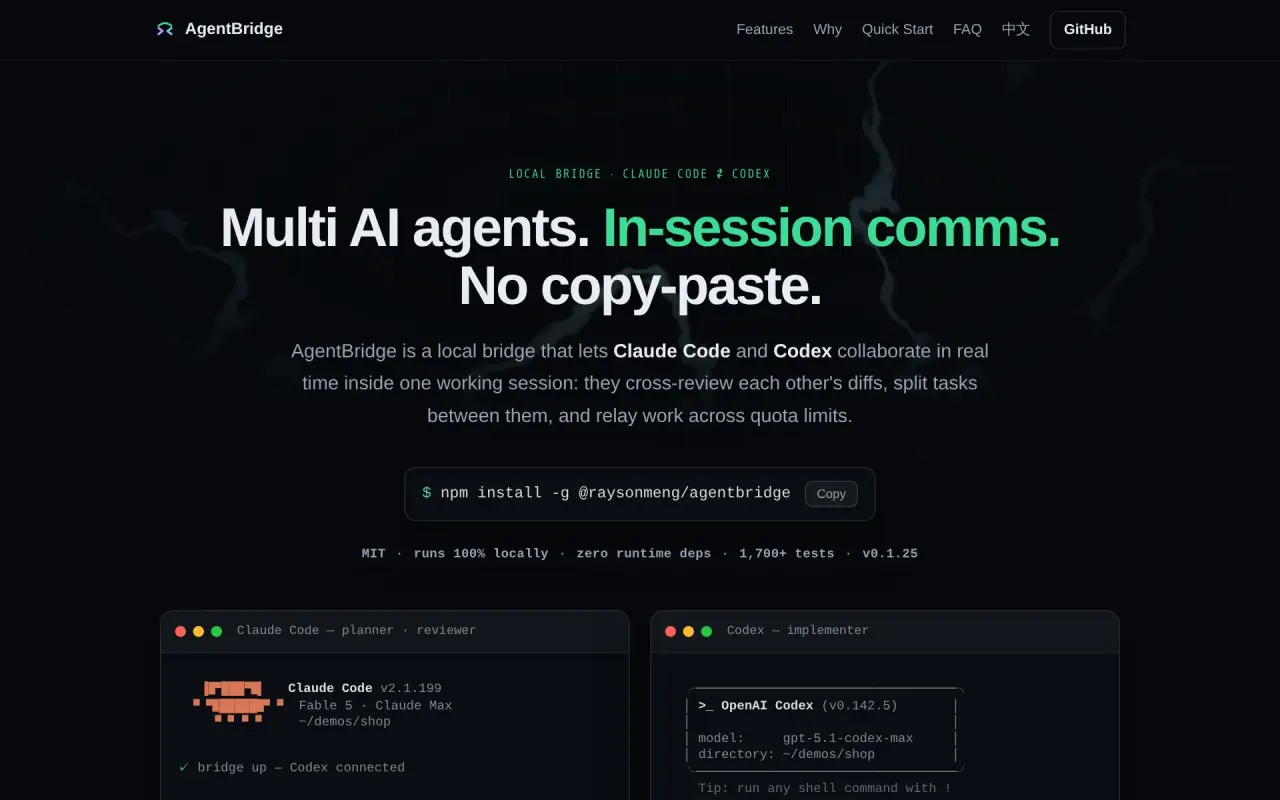
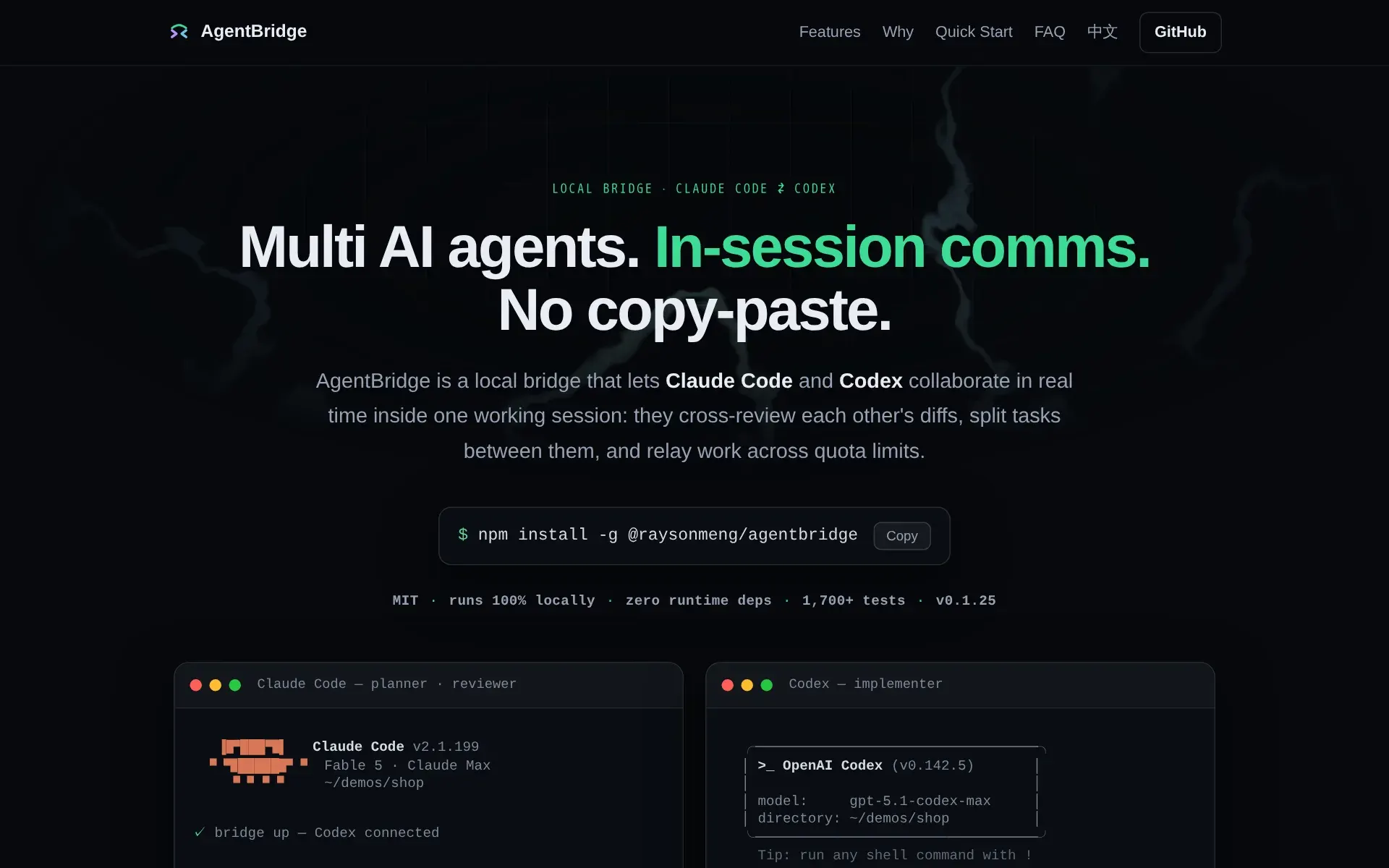
AgentBridge only relays messages between them on your machine; raw work never leaves the box.
raysonmeng.github.io/agent-bridge - Ships it
- NoIt is a local message relay between two coding CLIs and explicitly not an orchestration or deployment layer; shipping stays with the agents and the human.github.com/raysonmeng/agent-bridge
- Done-for-you service
- NoYou install and run the software yourself from npm; there is no hosted service and no team doing the work for you.
No. AgentBridge is a local tool with zero runtime dependencies and no hosted service. You use your existing Claude Code and Codex logins; AgentBridge…
raysonmeng.github.io/agent-bridge
How much it does unattended
- Runs autonomously
- PartlyBoth launchers default to maximum permissions so an unattended pair keeps going, and quota relay resumes work automatically, yet the vendor describes a human steering and assigning the tasks.
By default abg claude launches with --dangerously-skip-permissions and abg codex with --yolo, so an unattended agent pair does not stop for each…
raysonmeng.github.io/agent-bridge - Multi-agent
- YesCoordinating two agents on one task is the entire purpose: they stay live as peers and either side can push a message mid-turn.
AgentBridge keeps both agents live as persistent peers, and either side can push a message mid-turn (a review comment lands while the other is still…
raysonmeng.github.io/agent-bridge - Agent permissions
- YesBy default the pair runs with permission prompts switched off on both sides, so it can run commands and edit files without asking; a --safe flag restores normal prompts.
Both can then run commands and edit files without prompting, so only do this in a workspace you trust. Add --safe (or set AGENTBRIDGE_SAFE=1) to…
raysonmeng.github.io/agent-bridge
Which models it runs on
- Claude
- YesClaude Code is one of the two agents the shipping integration connects, loaded as a Claude Code plugin with an MCP channel.
Today the shipping in-session integration connects Claude Code and Codex.
raysonmeng.github.io/agent-bridge - GPT
- YesOpenAI's Codex CLI is the other half of the shipping pair, reached through the Codex app-server protocol, so GPT models arrive via your own Codex login.github.com/raysonmeng/agent-bridge
- Open models
- NoThe vendor names its shipping integration as exactly two agents and puts every other runtime on a roadmap vote, so no open-weight path exists today.
Today the shipping in-session integration connects Claude Code and Codex. A public adapter vote (issue #212) decides which agent is wired in next;…
raysonmeng.github.io/agent-bridge - Model choice
- PartlyYou choose which of the two supported CLIs plans and which executes, and each brings its own models, but the vendor rules out arbitrary agent backends.
A generic orchestration framework for arbitrary agent backends
github.com/raysonmeng/agent-bridge
Where you use it
- In your editor
- NoBoth surfaces are terminal programs: Claude Code with a channel plugin and the Codex TUI; no editor or IDE extension is offered.
abg codex [args...] | Start Codex TUI connected to AgentBridge daemon.
github.com/raysonmeng/agent-bridge - On the command line
- YesThe whole product is a command-line tool: a global npm install gives an abg binary with init, launch, resume, doctor, budget and log commands.
All commands work with both agentbridge and the short alias abg.
github.com/raysonmeng/agent-bridge - In your pipeline
- NoIt is a local two-process bridge tied to interactive TUIs on a developer machine; no pull-request or CI surface is described anywhere on its pages.
AgentBridge is a two-process local bridge
github.com/raysonmeng/agent-bridge - In a browser
- NoThere is no hosted or browser surface at all; the vendor explicitly rules out a hosted service and states the tool runs on your own machine.
A hosted service or multi-tenant system
github.com/raysonmeng/agent-bridge
Whose machine it runs on
- Self-hosted
- YesLocal operation is the design: a foreground client and a background daemon both run on your own machine with no vendor cloud involved.
AgentBridge is a local tool with zero runtime dependencies and no hosted service. You use your existing Claude Code and Codex logins; AgentBridge…
raysonmeng.github.io/agent-bridge - Open source
- YesSource is public on GitHub under the MIT licence, with a documented clone-and-link development setup for modifying it.
If you want to modify AgentBridge source code, use the local development setup instead
github.com/raysonmeng/agent-bridge
What it costs to run
- How it meters
- NoAgentBridge meters nothing and charges nothing; your cost is whatever your existing Claude Code and Codex subscriptions cost, which the bridge only observes for quota relay.
You use your existing Claude Code and Codex logins; AgentBridge only relays messages between them on your machine.
raysonmeng.github.io/agent-bridge - Free tier
- YesNo sales call, no account and no keys for the bridge itself; one npm install and the local CLI is usable.
No. AgentBridge is a local tool with zero runtime dependencies and no hosted service.
raysonmeng.github.io/agent-bridge - API access
- PartlyYou can drive it programmatically only through local interfaces, an MCP channel, local WebSocket ports and JSON output on doctor and budget; no public remote API is published.github.com/raysonmeng/agent-bridge
- MCP server
- PartlyAnother agent can act through it only as the bridged Claude Code session does, by calling the reply tool over the local MCP channel; there is no remote MCP server for third parties.Was Yes before our last check.
Claude replies via the reply MCP tool, and the bridge injects the reply into the Codex thread as a turn/start.
github.com/raysonmeng/agent-bridge - Bring your own key
- YesInference is always yours: the bridge holds no credentials and runs on the Claude Code and Codex logins already installed on your machine.raysonmeng.github.io/agent-bridge
Buying it for a team
- A company can buy it
- NoThere is nothing to purchase and no vendor relationship to sign: it is an MIT npm package each developer installs on their own machine, with no hosted or multi-tenant offering.
This project is not: - A hosted service or multi-tenant system
github.com/raysonmeng/agent-bridge - Pooled budget
- PartlyThere is no billing balance to pool, but the daemon does treat the two agents' subscription quotas as one coordinated budget, polling both windows and reporting drift between them in a single snapshot.
The daemon polls both agents' account-level 5h and weekly quota. abg budget --json prints the live snapshot: both windows, drift between the two…
raysonmeng.github.io/agent-bridge - Admin controls
- PartlyConstraints exist per launch and per project rather than centrally: a safe flag or environment variable restores permission prompts, and config plus environment variables set ports and watchdogs, but there is no admin console.
Add --safe (or set AGENTBRIDGE_SAFE=1) to launch with normal permission prompts. AgentBridge runs entirely on your machine and is not a hardened…
raysonmeng.github.io/agent-bridge - Audit log
- PartlyLocal daemon and Codex wrapper logs are kept per pair and can be tailed from the CLI, but these are diagnostics rather than an administrative audit trail.
Tail this pair's daemon log (or the Codex wrapper log with --codex); -f follows, -n N sets the line count (default 100)
github.com/raysonmeng/agent-bridge - Single sign-on
- NoThere is no identity layer to federate: the tool has no accounts or hosted service, and the cross-machine preview is gated by a passphrase instead.
Agents on different machines joining one room over your LAN or tailnet: passphrase-gated, with presence and a shared whiteboard.
raysonmeng.github.io/agent-bridge
What happens to your code
- Opt out of training
- PartlyThe bridge itself sends nothing anywhere and states raw work stays on the machine, but the code still reaches Anthropic and OpenAI through the two agent CLIs, whose own policies govern training.raysonmeng.github.io/agent-bridge
- Data residency
- YesYour machine holds everything the bridge touches, since there is no hosted component and state is written to local platform directories.
The daemon stores runtime state in a platform-aware directory
github.com/raysonmeng/agent-bridge - Getting out
- YesNothing is locked in a vendor system: project config, checkpoints and daemon state are plain local files you already own, and no credits exist to expire.
Contents: daemon.pid, status.json, agentbridge.log, killed (sentinel), startup.lock
github.com/raysonmeng/agent-bridge
Plans and pricing
Price and terms
- Free plan
- YesYesThe whole tool is free and MIT-licensed with no account or keys of its own
The terms in full
you still need your own Claude Code and Codex subscriptions, plus the Bun runtime, and Windows is not supported.
Checked .
The Agents Index digest
Price changes and new agents like AgentBridge, at most once a week.
Last issue: Devin vs Claude Code: Which Should You Pick? · 13 October 2026
Works with
 Claude
 GPT
For AI agents
- MCP server
- Partly
- API
- Partly
Filed under
Sources and updates
Last changed
Sources4
The Agents Index in AI answers0 of 1
- PerplexityDoes not cite The Agents IndexAsked
AgentBridge alternatives
on Other sources: libhunt.com, aiindigo.com, glama.ai, github.com, eliteai.tools, hostinger.com
Updates6
- Capabilities · Free tier · Price · Terms
- Capabilities · Free tier · Price · Terms
- Capabilities · Free tier · Price · Terms
- Capabilities · Free tier · Price · Terms
- Capabilities · Free tier · Price · Terms
- Capabilities · Free tier · Price · Terms
Is this yours? Claim it free and edit it in your dashboard, or feature it in Agent tools & infrastructure.