
Summary
Cartesia is a voice AI platform whose Sonic text-to-speech and Ink speech-to-text models power a managed runtime for realtime phone and web voice agents. Agents are configured with instructions, a chosen LLM, tools and telephony, then deployed on Cartesia's infrastructure.
- Best for
- Engineering teams that want an open-source voice-agent SDK with real LLM choice, built on speech models several rival platforms in this category already license as a component.
- Not for
- Regulated enterprises that specifically need the voice-agent runtime itself (not just the speech models) fully self-hosted. Deepgram Voice Agent API offers that; Cartesia's Line layer does not.
- From
- Freethen $5/month
- Free tier
- Yes$0/mo: 20K credits/month (~27 TTS minutes, ~1h51m of Ink-2 STT), $1 prepaid agent dollars (~17 agent minutes at $0.06/min), 2 TTS and 8 STT concurrent requests, 1 Cartesia phone number, no commercial-use licence, no voice cloning, organization limited to one member.
What it does
- Writes code
- NoThe vendor positions itself as a voice model and voice agent lab; no surface authors application code.
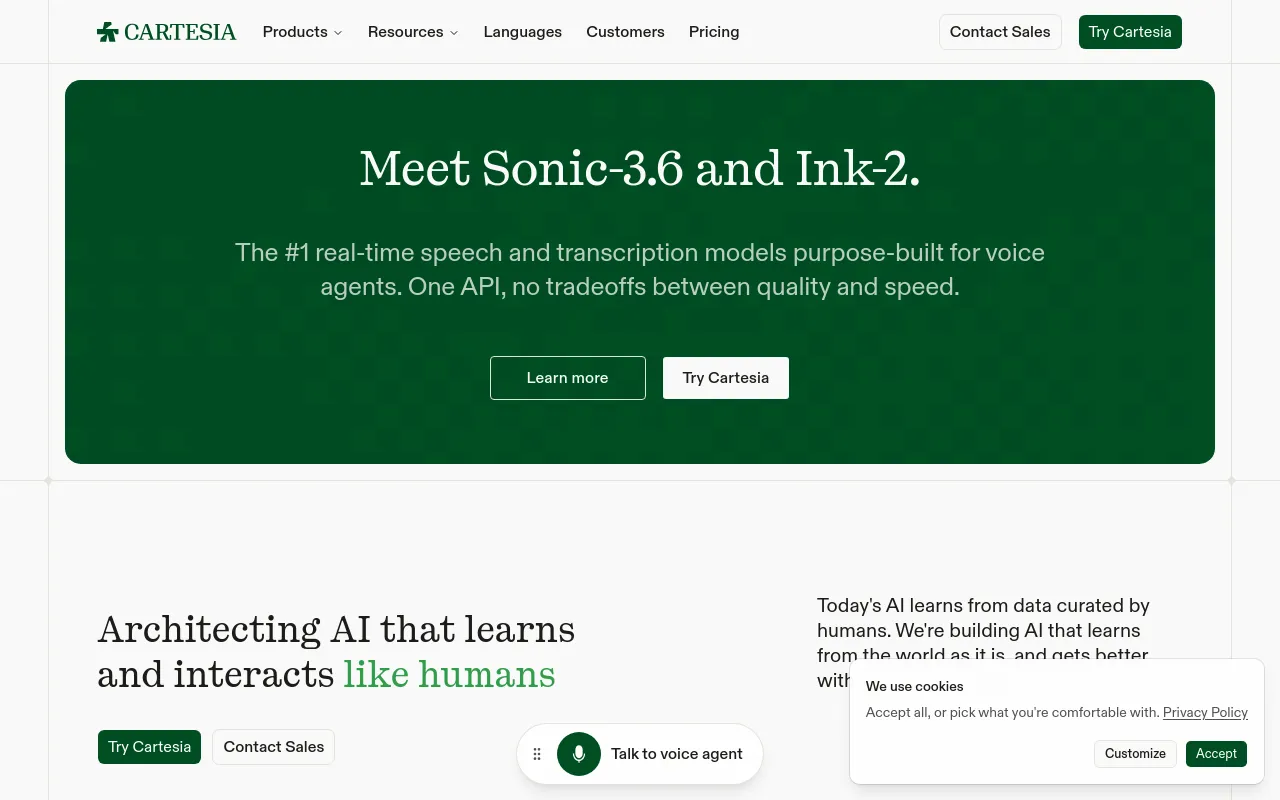
Cartesia is an AI lab building real-time voice models and agents.
docs.cartesia.ai/get-started/overview - Debugs and fixes
- NoIts debugging surface is call logs for conversations, not diagnosis or repair of source code.
Call logs – Debug conversations and monitor performance
docs.cartesia.ai/line/introduction - Writes tests
- NoThe evaluations framework scores live calls against metrics you define; it produces no test code.
How do you know your voice agent is any good? We added a framework for live testing, system metrics, and custom call analytics.
cartesia.ai/agents - Reviews code
- NoNothing in the product or docs reviews a diff; the reviewed artefact is a call, not a change set.
Cartesia is an AI lab building real-time voice models and agents.
docs.cartesia.ai/get-started/overview - Whole-codebase work
- NoRetrieval is over document folders you upload, not over a source repository, so no migration can be carried across one.
Knowledge bases let you augment your agent with domain-specific information it can retrieve on the fly.
docs.cartesia.ai/line/knowledge-base - Ships it
- PartlyThe CLI deploys the agent code you wrote to Cartesia's cloud; the product itself produces no diffs to ship.
Deploy your agent to Cartesia cloud.
docs.cartesia.ai/line/cli - Done-for-you service
- NoSelf-serve software: you build and deploy the agent yourself; sales contact exists for Enterprise terms, not for building it for you.
Start building. Access our models via API and bring a voice agent into production in minutes.
cartesia.ai/agents
How much it does unattended
- Runs autonomously
- YesA deployed agent runs a whole call unattended, handling turn-taking, interruptions and tool calls; it transfers to a human only when a configured condition matches.
Your agent handles turn-taking and interruptions, streams audio, and can use tools during a conversation.
docs.cartesia.ai/agents/introduction - Multi-agent
- NoSystem tools enumerate three slots: end call, DTMF, and transfer to an E.164 phone number. An agent therefore hands off to a number, not to another Cartesia agent.
`config.system_tools` currently supports three slots: `end_call`, `send_dtmf`, and `transfer_to_number`.
docs.cartesia.ai/agents/system-tools - Agent permissions
- PartlyLimits are prompt-level guardrails plus per-tool execution settings (timeout, immediate vs async, speak-before-acting); there is no separate policy engine.
# Guardrails Never invent order details. Ask for an order number before using the lookup tool.
docs.cartesia.ai/agents/configuration
Which models it runs on
- Claude
- YesAnthropic Claude models are named in the SDK's supported-models table and used in its examples.
Anthropic | anthropic/claude-haiku-4-5-20251001, anthropic/claude-sonnet-4-5
docs.cartesia.ai/line/sdk/agents - GPT
- YesOpenAI GPT models appear in the same supported-models table.
OpenAI | gpt-5.4, gpt-5.2
docs.cartesia.ai/line/sdk/agents - Open models
- PartlyThe LLM layer routes through LiteLLM to 100+ providers, but the vendor names only Anthropic, OpenAI and Google, and its own speech models are API-only.
And 100+ more via LiteLLM
docs.cartesia.ai/line/sdk/agents - Model choice
- YesYou pick the agent's LLM and can swap it in the Playground or API; Cartesia owns the speech models and manages the LLM integration.
Cartesia manages the model integration, so you do not need a provider account or API key.
docs.cartesia.ai/agents/models
Where you use it
- In your editor
- PartlyNo native IDE extension; the documented editor surface is the Cartesia MCP server used from Cursor or Claude Code.
Use **Cartesia MCP** in **Cursor**, **Claude Code**, or other MCP clients to list voices, run TTS and STT, manage pronunciation dictionaries,…
docs.cartesia.ai/tools/ai/mcp - On the command line
- YesA `cartesia` CLI creates, deploys and manages agents, and can chat with agent logic locally.
Create, deploy, and manage voice agents from the command line.
docs.cartesia.ai/line/cli - In your pipeline
- PartlyDeployments can be triggered by pushing to a linked GitHub repository, but there is no pull-request or CI review surface.
Use `cartesia deploy` or push to a linked GitHub repository to create a deployment.
docs.cartesia.ai/line/infrastructure/de… - In a browser
- YesThe Playground is the hosted surface for creating, configuring and testing agents and models.
Create and test an agent in the [Playground](https://play.cartesia.ai/agents), or manage the same agents through the…
docs.cartesia.ai/agents/introduction
Whose machine it runs on
- Self-hosted
- PartlyOn-premise or VPC model deployment is sales-gated; separately, agent reasoning code can run on your own servers with Cartesia connecting to your URL.
Yes, reach out to our sales team so we can best understand your needs.
cartesia.ai/pricing - Open source
- PartlyThe official JS/TS and Python client SDKs are public repositories on Cartesia's GitHub; the Sonic and Ink models and the agent runtime are not.
Use the official Cartesia SDKs to call TTS, STT, and voice APIs from JavaScript/TypeScript or Python.
docs.cartesia.ai/tools/client-libraries
What it costs to run
- How it meters
- YesTwo meters: credits for the models (about 1 credit per TTS character, 3 credits per second of Ink-2 audio) and per-minute US dollars for agent calls.
Cartesia meters model usage in **credits** and agent usage in **agent dollars**.
docs.cartesia.ai/pricing - Free tier
- YesA $0/month plan with 20K credits and $1 of prepaid agent usage, signed up for without a call.
Free $0 /mo Start free 20K credits / month $1 prepaid agents / month
cartesia.ai/pricing - API access
- YesREST and WebSocket APIs cover TTS, STT and agent management, with official Python and JS SDKs.
API conventions, errors, and the reference for every REST and WebSocket endpoint.
docs.cartesia.ai/get-started/overview - MCP server
- YesA hosted MCP server (mcp.cartesia.ai) exposes tools for TTS, STT, voices, cloning and credit usage to another agent.
Pick your client, install, and sign in when prompted. A **Cartesia MCP** API key is created for your organization if one does not exist yet.
docs.cartesia.ai/tools/ai/mcp - Bring your own key
- PartlyNo bring-your-own LLM key: Cartesia bills the LLM itself. You can bring your own carrier via SIP trunking and host the agent's reasoning code yourself.
Cartesia manages the model integration, so you do not need a provider account or API key.
docs.cartesia.ai/agents/models
Buying it for a team
- A company can buy it
- YesOrganization workspaces with their own billing, plus an Enterprise plan carrying DPAs and BAAs.
Organization workspaces enable seamless collaboration between multiple team members. All users in an organization share the same view of resources,…
docs.cartesia.ai/enterprise/set-up-an-o… - Seat model
- PartlySeats are not priced, but inviting anyone requires Startup ($49/mo) or above; a Free organization is capped at one member. The pricing page's 'unlimited workspace seats on every plan' contradicts this.
To invite team members, you must first upgrade your organization to the Startup tier or higher. After upgrading, you can invite unlimited users at no…
docs.cartesia.ai/enterprise/set-up-an-o… - Pooled budget
- YesCredits and prepaid agent dollars belong to the workspace, and every member shares the same resources and balance.
Each workspace has its own billing and credit limits, so make sure you are on the intended organization before proceeding to upgrade your…
docs.cartesia.ai/enterprise/set-up-an-o… - Admin controls
- PartlyRoles are Admin and Member only: an admin controls the org, invitations and members, not what an agent is permitted to do at runtime.
1. Admin: has the ability to manage the organization profile, invitations, and members. 2. Member: can use all functionality included in the…
docs.cartesia.ai/enterprise/set-up-an-o… - Audit log
- PartlyDeployment logs, call logs and transcripts are recorded per agent; no administrative audit trail of account actions is documented.
You can click into a call and view any logging statements generated by your reasoning code.
docs.cartesia.ai/line/infrastructure/ob… - Single sign-on
- PartlySAML and OIDC, self-serve from the Playground, but only on the Enterprise plan and only for an organization admin.
SSO is available on the **Enterprise** plan, and only an **organization admin** can configure it.
docs.cartesia.ai/enterprise/set-up-sso
What happens to your code
- Opt out of training
- PartlyOpt-out is by request form for selected categories of content; Enterprise plans can additionally enable Zero Data Retention for TTS and STT inference.
You may request that we not use certain categories of your Content to train our models by completing this online form.
cartesia.ai/legal/privacy - Data residency
- PartlyBy default api.cartesia.ai routes to the nearest endpoint; pinned regional deployments (US, EU, UK, India, Australia) are Enterprise-only.
Dedicated regional deployments are available to Cartesia Enterprise customers to support data sovereignty requirements.
docs.cartesia.ai/enterprise/regional-en… - Getting out
- PartlyPurchased credits survive tier changes and cancellation, but rollover is capped at 2x the monthly plan rate; call transcripts export via API or CLI.
You will keep the credits in your account until you use them. Your account will remain in the same tier until the end of that period, at which time…
cartesia.ai/pricing - Certifications
- YesGDPR, SOC 2 Type II, HIPAA and PCI-DSS service provider, with a public Trust Center; DPAs and BAAs come with Enterprise.
Cartesia is GDPR, SOC 2 Type II, PCI-DSS service provider, and HIPAA compliant.
docs.cartesia.ai/enterprise/zero-data-r…
35 sourced claims on this page. Checked 2026-09-02. How we check.
Alternatives
Where we would send a reader instead, in that listing's own words.
One WebSocket API that runs speech-to-text, LLM orchestration and text-to-speech for real-time voice agents.
Hosted platform for building voice and chat agents, with telephony, SDKs and a choice of LLM.
Pay-as-you-go platform for building, testing and running AI phone, chat and SMS agents.
Filed under
Sources and updates
The pages we read29
Every fact below comes from the vendor. Nothing here is independently corroborated yet.
- cartesia.ai/pricing6 fields
- cartesia.ai/agents4 fields
- docs.cartesia.ai/enterprise/set-up-an-organization4 fields
- docs.cartesia.ai/line/introduction4 fields
- docs.cartesia.ai/line/sdk/agents4 fields
- docs.cartesia.ai/get-started/overview3 fields
- docs.cartesia.ai/line/cli3 fields
- docs.cartesia.ai/line/sdk/overview3 fields
- docs.cartesia.ai/agents/introduction2 fields
- docs.cartesia.ai/agents/models2 fields
- docs.cartesia.ai/line/start-building/agent-builder2 fields
- docs.cartesia.ai/tools/ai/mcp2 fields
- docs.cartesia.ai/tools/client-libraries2 fields
- docs.cartesia.ai/agents/configuration1 field
- docs.cartesia.ai/agents/system-tools1 field
- docs.cartesia.ai/enterprise/regional-endpoints1 field
- docs.cartesia.ai/enterprise/set-up-sso1 field
- docs.cartesia.ai/enterprise/zero-data-retention1 field
- cartesia.ai/legal/privacy1 field
- cartesia.ai/legal/terms1 field
- docs.cartesia.ai/line/infrastructure/deployments1 field
- docs.cartesia.ai/line/infrastructure/observability1 field
- docs.cartesia.ai/line/integrations/telephony/batch-calling1 field
- docs.cartesia.ai/line/knowledge-base1 field
- docs.cartesia.ai/line/sdk/patterns1 field
- docs.cartesia.ai/line/sdk/tools1 field
- docs.cartesia.ai/line/start-building/quickstart1 field
- docs.cartesia.ai/pricing1 field
- docs.cartesia.ai/tools/ai/agent-guide1 field
Coverage elsewhere1
Updates3
- Capabilities · Commercial terms · Free tier
- Capabilities · Commercial terms · Free tier · Price
- Alternatives