
Summary
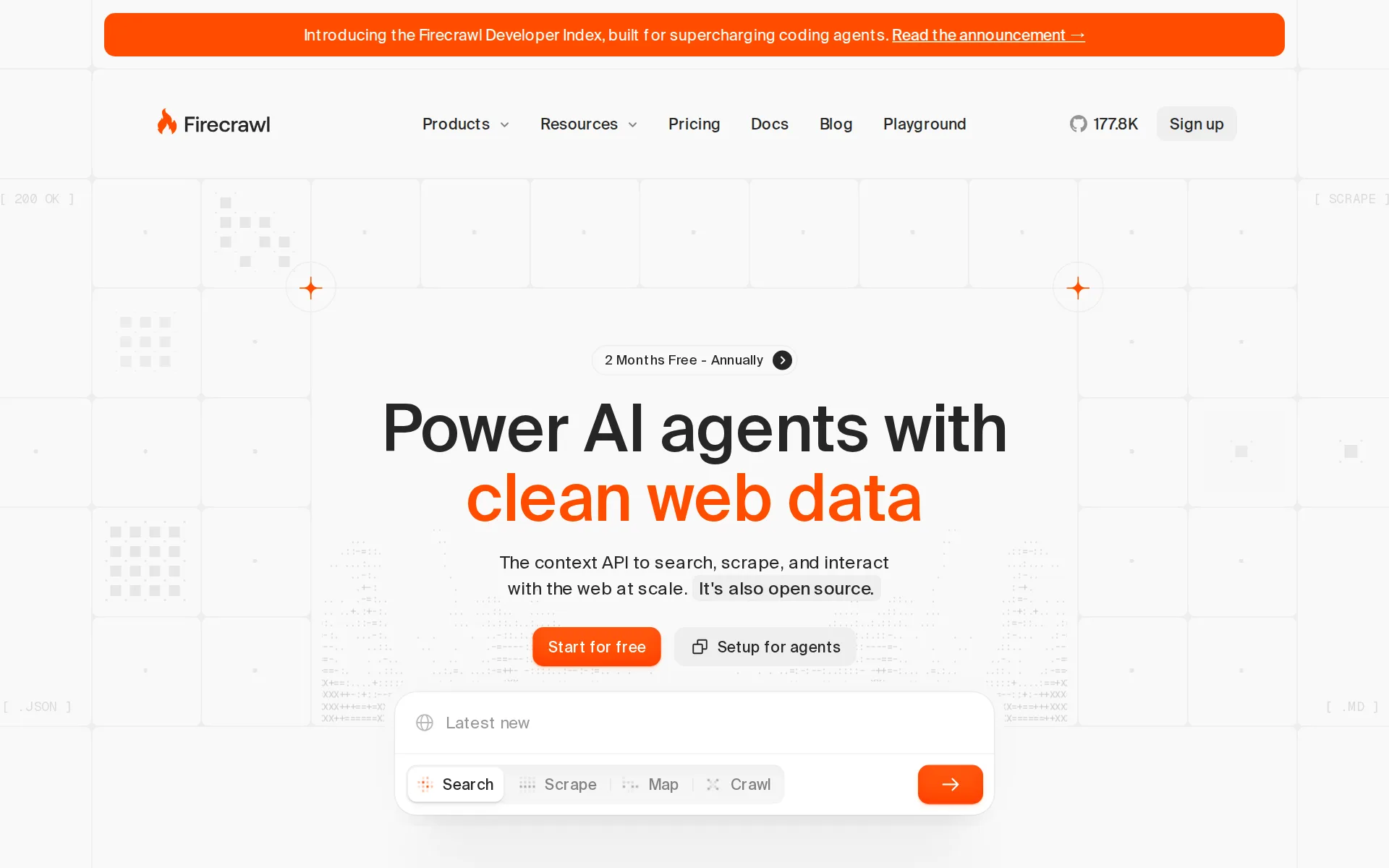
Firecrawl is a web data API that searches the live web, scrapes pages into clean Markdown or structured JSON, and drives a browser to click through dynamic pages. It is sold as a credit-metered hosted service with an AGPL-licensed open-source core.
- From
- Freethen $19 monthly · $16 billed annually
- Free tier
- Yes1,000 credits per month (about 1,000 pages scraped or 500 searches), 2 concurrent browsers, 10 requests/min on scrape, map and search, no card required; no pay-as-you-go, so requests return HTTP 402 once the allotment is spent.
What it does
- Done-for-you service
- NoFirecrawl sells self-serve software you run against its API, not a team that builds and operates the integration for you; Enterprise adds support and provisioning, not delivery work.
Choose Firecrawl Cloud when you want to start scraping without operating the stack.
docs.firecrawl.dev/contributing/open-so…
How much it does unattended
- Runs autonomously
- YesThe /agent endpoint takes a prompt with no URLs and searches and navigates on its own until it returns data, though it is an early-access preview.
Deep Web Search: Autonomously searches and navigates deep into sites to find your data
docs.firecrawl.dev/features/agent - Multi-agent
- PartlyOne agent run spans an orchestrator plus its own subagents, each emitting trace events under a separate agent id. But that topology is internal and undocumented as a feature: there is no parameter to compose, name or budget the subagents.
producerSequence is monotonic per emitting agent, so a single global sort interleaves an orchestrator's events with its subagents' incorrectly.
docs.firecrawl.dev/features/agent.md - Agent permissions
- PartlyPer-key spend limits and team roles bound usage on every plan, but locking a key to specific endpoints, formats or networks is an Enterprise-gated control.
Key restrictions: Lock individual API keys to specific output formats and endpoints, enforced server-side with no request-level override.
docs.firecrawl.dev/enterprise
Which models it runs on
- Claude
- NoFirecrawl names exactly one model for its own agent, its proprietary Spark 2, and states every run executes on it. Claude appears on vendor pages only as a client that calls Firecrawl over MCP, which is the opposite claim.
Firecrawl Agent runs on Spark 2 — cheaper and faster than the earlier Spark 1 models, at comparable accuracy.
docs.firecrawl.dev/features/agent.md - GPT
- PartlySelf-hosted deployments can point LLM-backed extraction at an OpenAI-compatible provider; on Cloud the extraction model is managed by Firecrawl and not named.
LLM-backed extraction and formats | Connect an OpenAI-compatible provider or Ollama | Managed provider path
docs.firecrawl.dev/contributing/open-so… - Open models
- PartlyOpen-weight models are supported only when you self-host, where Ollama can back the extraction formats; Cloud gives you the vendor's managed provider instead.
LLM-backed extraction and formats | Connect an OpenAI-compatible provider or Ollama | Managed provider path
docs.firecrawl.dev/contributing/open-so… - Model choice
- PartlyYou choose the inference provider only on the self-hosted stack; the agent endpoint exposes a model parameter, but Cloud scraping otherwise uses Firecrawl's managed provider path.
You can inspect the code, choose where the stack runs, and connect your own providers.
docs.firecrawl.dev/contributing/open-so…
Where you use it
- In your editor
- YesThere is no Firecrawl editor plugin, but its official MCP server puts the tools inside IDE-resident agents such as Cursor and Windsurf.
Firecrawl has an official MCP server so agents in Cursor, Claude, Windsurf, and other MCP-compatible tools can search, scrape, and interact with the…
firecrawl.dev - On the command line
- YesA published CLI logs in with an API key and runs scrape, search and interact commands from the terminal, alongside agent skills.
There is also a CLI for terminal workflows and agent skills for Claude Code and Codex that handle setup automatically.
firecrawl.dev - In your pipeline
- NoThe integrations page enumerates coding agents, app builders, agent frameworks, visual builders, workflow automation and data platforms, and names no CI system. Nothing in the product acts on a pull request; CI use means calling the REST API yourself.
Don't see your platform? Firecrawl works anywhere you can make an HTTP request.
docs.firecrawl.dev/integrations.md - In a browser
- YesA hosted dashboard carries a playground for scrape, search, crawl and map, plus a live browser session and the agent research tool.
The playground lets you try Firecrawl endpoints directly in the browser before integrating them into your code.
docs.firecrawl.dev/dashboard
Whose machine it runs on
- Self-hosted
- PartlyDocker Compose self-hosting runs the core scrape, crawl, map and search routes, but agent, browser, interact and enterprise controls stay Cloud-only.
Agent, Browser, Interact, dashboard, and enterprise controls | Not included in the default stack | Included by product and plan availability
docs.firecrawl.dev/contributing/open-so… - Open source
- YesThe engine is published on GitHub under the GNU Affero General Public License v3, and the vendor markets the open-source core alongside its Cloud.
It is also open source
firecrawl.dev
What it costs to run
- How it meters
- YesBilling is credits consumed per request, not seats: one credit per scraped page, two per ten search results, with documented add-ons.
Firecrawl billing is credit-based. Every API call that you make consumes credits. The number of credits depends on the endpoint and the options that…
docs.firecrawl.dev/billing - Free tier
- YesA standing free plan gives 1,000 credits a month with no card, and scrape, search and interact also work keyless per IP.
Yes. Firecrawl gives you 1,000 free credits every month, which covers about 1,000 pages, and no card is required.
firecrawl.dev/pricing - API access
- YesThe API is the product: documented v2 REST endpoints with SDKs in Python, Node, Go, Java, Ruby, Rust, .NET, PHP and Elixir.
The API to search, scrape, and interact with the web at scale.
firecrawl.dev - MCP server
- YesAn official hosted MCP server accepts OAuth sign-in, API keys or keyless daily-limited access, so another agent can query Firecrawl directly.
Choose how the connection will authenticate. Signing in and adding an API key are two paths to the same access: both reach the full tool surface on…
docs.firecrawl.dev/mcp-server - Bring your own key
- PartlyBringing your own inference is a self-hosting property, not a Cloud setting: you connect your own provider only when you run the stack yourself.
You can inspect the code, choose where the stack runs, and connect your own providers.
docs.firecrawl.dev/contributing/open-so…
Buying it for a team
- A company can buy it
- YesTeams buy by card on self-serve plans, and Scale and Enterprise add invoiced billing against a signed order form plus DPAs.
Invoiced billing: We bill you by invoice against a signed order form, instead of charging a card.
firecrawl.dev/pricing - Seat model
- NoPlans are priced on monthly credits and concurrency, not per seat; teammates are invited into one shared account with no published per-user charge or floor.
Firecrawl lets you invite teammates to collaborate under a shared account.
docs.firecrawl.dev/dashboard - Pooled budget
- YesOne team balance funds every member and key, with per-key spend limits to stop a single key draining it; Enterprise pools across teams.
A spend limit caps the credits that one API key can use. The cap applies to that key alone, whatever your team balance is. Use it to stop one key…
docs.firecrawl.dev/billing - Admin controls
- YesAdmin and Member roles separate billing and team control from use, and admins set per-key credit limits; stricter endpoint and IP locks are Enterprise.
Every team member is assigned one of two roles: Admin or Member. You choose the role when sending an invitation.
docs.firecrawl.dev/dashboard - Audit log
- PartlyEvery account gets 24-hour activity logs of API requests, but a durable per-fetch audit trail streamed to your SIEM is Enterprise-gated per organization.
SIEM Audit Logging is an enterprise feature and is gated per organization. Contact your Firecrawl account team to have it enabled for your account.
docs.firecrawl.dev/features/siem - Single sign-on
- PartlySAML and OIDC single sign-on with SCIM provisioning exists, but the plan table marks it unavailable on every self-serve tier up to Scale.
Single Sign-On (SSO): SAML and OIDC single sign-on so your team authenticates through your existing identity provider (Okta, Entra ID, Google…
docs.firecrawl.dev/enterprise
What happens to your code
- Data residency
- PartlyThe vendor states storage is in the United States and offers no published region choice, warning European users their data leaves their home country.
Our servers are located in the United States and this is where your data and information will be stored.
firecrawl.dev/privacy-policy - Getting out
- PartlyUsage and results are retrievable through the dashboard and credit-usage endpoints, but purchased credits are forfeited when you cancel the subscription.
Credits you buy stay on your account until you use them. They expire if you cancel your subscription, so use them before you leave.
docs.firecrawl.dev/billing - Certifications
- PartlySOC 2 Type II and regular penetration testing are listed as included on every tier, and paid plans get a DPA; no ISO 27001 claim appears on the pages read.
SOC 2 Type II: Independently audited security controls covering data protection and operational security.
docs.firecrawl.dev/enterprise
Not established: Opt out of training
28 sourced claims on this page. Checked 2026-09-24. How we check.
Sources and updates
The pages we read25
Every fact below comes from the vendor. Nothing here is independently corroborated yet.
- docs.firecrawl.dev/contributing/open-source-or-cloud6 fields
- firecrawl.dev/pricing.md6 fields
- docs.firecrawl.dev/features/agent.md5 fields
- firecrawl.dev/4 fields
- firecrawl.dev/pricing4 fields
- docs.firecrawl.dev/billing3 fields
- docs.firecrawl.dev/dashboard3 fields
- docs.firecrawl.dev/enterprise3 fields
- docs.firecrawl.dev/contributing/open-source-or-cloud.md2 fields
- docs.firecrawl.dev/contributing/self-host.md2 fields
- firecrawl.dev/index.md2 fields
- docs.firecrawl.dev/api-reference/endpoint/threat-protection-update.md1 field
- firecrawl.dev/auth.md1 field
- docs.firecrawl.dev/developer-guides/usage-guides/choosing-the-data-extractor.md1 field
- firecrawl.dev/enterprise.md1 field
- docs.firecrawl.dev/features/agent1 field
- docs.firecrawl.dev/features/siem1 field
- docs.firecrawl.dev/features/siem.md1 field
- github.com/firecrawl/firecrawl1 field
- docs.firecrawl.dev/integrations.md1 field
- docs.firecrawl.dev/mcp-server1 field
- docs.firecrawl.dev/mcp-server/keyless.md1 field
- firecrawl.dev/privacy-policy1 field
- docs.firecrawl.dev/sdks/cli.md1 field
- firecrawl.dev/terms-of-service1 field
Updates3
- Capabilities · Commercial terms · Free tier · Price
- Capabilities · Commercial terms · Free tier · Price
- Created