
Changed since our last check
- Admin controls: now Partly. It was Yes when we checked on .
- Data residency: now Partly. It was Yes when we checked on .
The facts, with their sources
What it does
- Writes code
- YesLangflow Assistant turns a natural-language prompt into whole flows or into Python for a single custom component, scoped to Langflow artifacts rather than an application codebase.
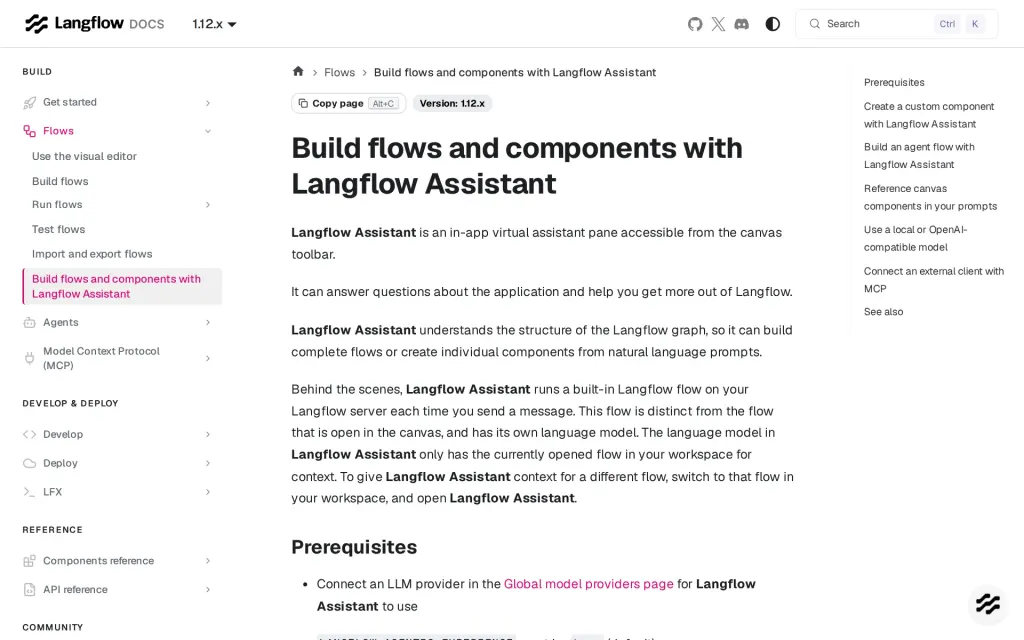
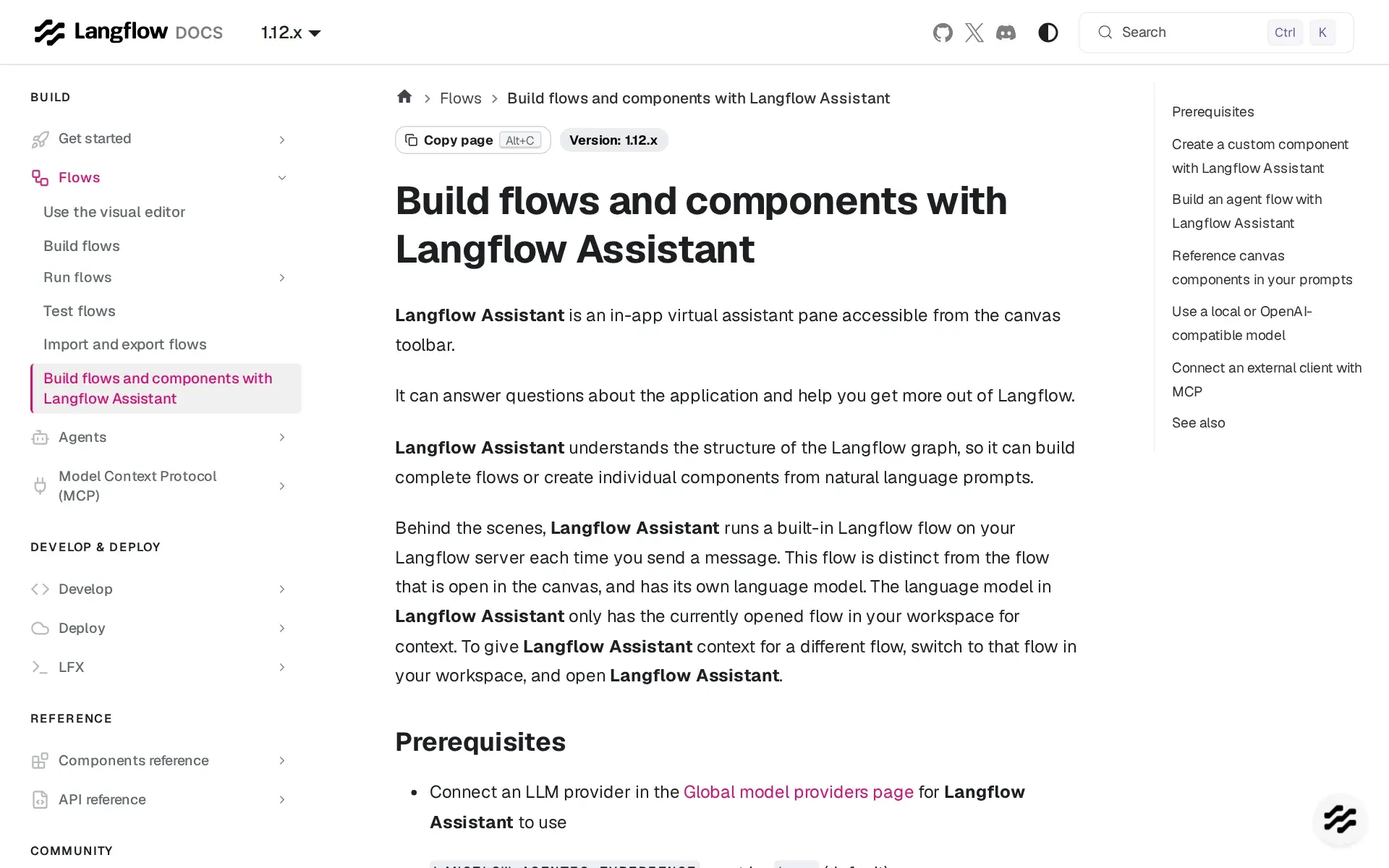
Langflow Assistant understands the structure of the Langflow graph, so it can build complete flows or create individual components from natural…
docs.langflow.org/langflow-assistant - Whole-codebase work
- NoThe vendor bounds the assistant's context to the single flow open on the canvas, so it cannot carry a change across a repository or even across flows.
The language model in Langflow Assistant only has the currently opened flow in your workspace for context.
docs.langflow.org/langflow-assistant - Done-for-you service
- NoYou install and operate the software yourself; Langflow offers professional services and premier support only as enquiries through a contact form, not as a managed build-and-run engagement with published scope.
Have a question, need premier support, or want to learn more about our professional services? We're here to help.
langflow.org/contact-us
How much it does unattended
- Runs autonomously
- YesAgents built in Langflow use the LLM as a reasoning engine to choose and run tools without a human choosing each step, and the docs describe this as autonomous task execution.
Agents extend Large Language Models (LLMs) by integrating tools, which are functions that provide additional context and enable autonomous task…
docs.langflow.org/agents - Multi-agent
- YesOne agent can call another agent as a tool, so several agents coordinate inside a single flow; the project advertises multi-agent orchestration as a headline feature.
An Agent component can use any Langflow component as a tool, including other agents and MCP servers.
docs.langflow.org/agents - Agent permissions
- PartlyWhat an agent may do is fixed at design time by which components you put in Tool Mode and wire to its Tools port; no runtime approval prompt or per-action policy gate is documented inside Langflow itself.
When in Tool Mode, a component has a Toolset port that you must connect to an Agent component's Tools port if you want to allow the agent to use that…
docs.langflow.org/agents
Which models it runs on
- Claude
- YesAnthropic Claude models work out of the box through the core Language Model component, with a dedicated Anthropic bundle adding provider-specific parameters such as prefill and a custom API URL.
Basic Anthropic support is available in all Langflow installations through the core Language Model component. This bundle adds an enhanced Anthropic…
docs.langflow.org/bundles-anthropic - GPT
- YesOpenAI GPT models are supported in every installation via the core Language Model component, and the OpenAI bundle adds extra request parameters plus OpenAI embeddings.
Basic OpenAI support is available in all Langflow installations through the core Language Model component. This bundle adds an enhanced OpenAI…
docs.langflow.org/bundles-openai - Open models
- YesOpen-weight models are reachable two ways: host them with Ollama and register that service in Langflow, or point the OpenAI Compatible provider at any compatible inference endpoint you run.
Configure the OpenAI Compatible provider to point at any OpenAI-compatible endpoint.
docs.langflow.org/components-models - Model choice
- YesYou choose the provider and model per component, and the documentation states plainly that the framework does not tie you to particular LLMs or vector stores.
it doesn't require you to use specific large language models (LLMs) or vector stores
docs.langflow.org
Where you use it
- In your editor
- NoThe install page enumerates every way to run Langflow — desktop app, Docker, Python package, from source — and none of them is an editor or IDE extension; the authoring surface is Langflow's own visual editor.
Langflow can be installed in multiple ways. Choose an option below to jump to the steps.
docs.langflow.org/get-started-installat… - On the command line
- YesA first-class CLI ships with the Python package and manages the server, API keys, migrations and superusers, though it is unavailable in the desktop build.
The Langflow command line interface is the main interface for managing and running the Langflow server.
docs.langflow.org/configuration-cli - In your pipeline
- PartlyFlows are callable from any pipeline through the documented HTTP API and API-key header, but no pull-request integration, GitHub action or CI-specific surface is documented by the vendor.
Validates API keys against the LANGFLOW_API_KEY environment variable. Useful for Kubernetes deployments, CI/CD pipelines, or any environment where…
docs.langflow.org/api-keys-and-authenti… - In a browser
- YesThe visual editor and Playground are a browser application served by the Langflow server you start, reached on port 7860 by default rather than on a vendor-hosted domain.
To access Langflow, navigate to http://localhost:7860/.
docs.langflow.org/get-started-installat…
Whose machine it runs on
- Self-hosted
- YesSelf-hosting is the primary delivery model: a Docker image, a pip-installable package and deployment guides for major clouds, all running on infrastructure you control.
Langflow is completely open source and you can deploy it to all major deployment clouds.
github.com/langflow-ai/langflow - Open source
- YesThe full application is published under the MIT licence in the vendor's own public repository, and components can be customised in Python because the source is available.
Source code access lets you customize any component using Python.
github.com/langflow-ai/langflow
What it costs to run
- How it meters
- NoLangflow itself meters nothing — no seats, tokens, credits or tasks are billed by the vendor; your real spend is the infrastructure you run it on plus the model provider keys you supply.github.com/langflow-ai/langflow
- Free tier
- YesNo call, contract or card is involved: install the MIT-licensed package with one pip command, or download the desktop app after a contact form, and run it indefinitely.
uv pip install langflow
docs.langflow.org/get-started-installat… - API access
- YesA documented REST API with /v1 and /v2 endpoints creates, edits and runs flows, and an OpenAPI spec is served from the running instance at /docs.
You can use the Langflow API for programmatic interactions with Langflow, such as the following: Create and edit flows, including file management for…
docs.langflow.org/api-reference-api-exa… - MCP server
- YesEach Langflow project is exposed as an MCP server whose flows appear to clients as tools, over streamable HTTP with SSE fallback and optional API-key authentication.
This page describes how to use Langflow as an MCP server that exposes your flows as tools that MCP clients can use when generating responses.
docs.langflow.org/mcp-server - Bring your own key
- YesBringing your own keys is mandatory rather than optional: you enter each provider's API key in the Model Providers pane or as a global variable, and inference is billed to your own provider account.
In the API Key field, add your provider's API key. Some providers require additional configuration fields.
docs.langflow.org/components-models
Buying it for a team
- A company can buy it
- PartlyNo software licence is sold, so there is nothing to procure for the engine itself; an organisation can only buy an IBM support subscription around its own deployment.
IBM Elite Support for Langflow is a subscription to the Langflow expertise at IBM.
docs.langflow.org/luna-for-langflow - Seat model
- NoMulti-user accounts and roles exist, but no seat price, seat floor or seat ceiling is published anywhere: the software is free to run for as many users as you provision.
Langflow seeds three built-in system roles that an enforcement plugin uses as a starting point for policy sync. These roles cannot be deleted.
docs.langflow.org/authorization - Admin controls
- PartlyAn admin can cap external users at viewer, editor or admin from a JWT claim and block their API keys, but the docs state this deny-only ceiling is explicitly not full role-based access control.Was Yes before our last check.
The access ceiling is a coarse, deny-only mechanism that maps a JWT claim value to one of three access levels: viewer, editor, or admin. It is not a…
docs.langflow.org/external-authenticati… - Audit log
- PartlyLangflow records API-key usage counts and last-used timestamps in its database and can export traces to an OTLP backend, but no administrative audit trail of who changed what is documented.
By default, Langflow tracks API key usage through total_uses and last_used_at records in your Langflow database.
docs.langflow.org/api-keys-and-authenti… - Single sign-on
- PartlyOIDC-style single sign-on works by trusting a gateway or identity provider token, validated against a JWKS endpoint with just-in-time user provisioning; no native SAML support is documented.
External authentication lets an upstream identity provider, OIDC proxy, or corporate SSO gateway handle login. Langflow accepts the token the proxy…
docs.langflow.org/external-authenticati…
What happens to your code
- Opt out of training
- PartlyAnonymous usage telemetry is on by default and switched off with one variable, but the vendor makes no statement about training models on your data either way.
To opt out of telemetry, set DO_NOT_TRACK=True in your Langflow environment variables before starting Langflow. This disables telemetry data…
docs.langflow.org/contributing-telemetry - Data residency
- PartlyResidency follows your deployment choice rather than a vendor commitment: flows and chat history live in the database of the server you run, and the vendor publishes no jurisdiction guarantee.Was Yes before our last check.github.com/langflow-ai/langflow
- Getting out
- YesFlows export to JSON, optionally stripped of API keys, and the underlying database is a file you control, so there is no lock-in and no credit balance that could expire.
Additionally, when exporting flows, you can choose to omit API keys from the exported flow JSON.
docs.langflow.org/api-keys-and-authenti… - Certifications
- NoNo SOC 2, ISO 27001 or GDPR attestation is claimed; the single GDPR mention assigns the obligation to whoever operates the server.
Follow industry best practices and legal requirements for data privacy and encryption of data in transit and at rest, including GDPR requirements,…
docs.langflow.org/deployment-prod-best-…
Plans and pricing
Price and terms
- Free plan
- YesYes
The terms in full
The whole application is MIT-licensed and free to install and run without limit (`uv pip install langflow`, Docker image, or desktop app). Costs you bear are your own hosting and the model provider API keys you configure; the vendor publishes no paid plan.
Checked .
The Agents Index digest
Price changes and new agents like Langflow, at most once a week.
Last issue: Devin vs Claude Code: Which Should You Pick? · 13 October 2026
Works with
 Claude
 GPT
GPT- YesOpen models
For AI agents
- MCP server
- Yes
- API
- Yes
Screenshots
Docs, langflow.org, captured
Filed under
Sources and updates
Last changed
Sources28
- github.com/langflow-ai/langflow
- docs.langflow.org/get-started-installation
- docs.langflow.org/agents
- docs.langflow.org/api-keys-and-authentication
- docs.langflow.org/agents-tools
- docs.langflow.org/authorization
- docs.langflow.org/components-models
- docs.langflow.org/external-authentication
- docs.langflow.org/langflow-assistant
- docs.langflow.org/
- docs.langflow.org/api-governance-policy
- docs.langflow.org/api-reference-api-examples
- docs.langflow.org/bundles-anthropic
- docs.langflow.org/bundles-ollama
- docs.langflow.org/bundles-openai
- docs.langflow.org/concepts-flows-import
- docs.langflow.org/concepts-publish
- docs.langflow.org/configuration-cli
- docs.langflow.org/configuration-custom-database
- langflow.org/contact-us
- docs.langflow.org/contributing-how-to-contribute
- docs.langflow.org/contributing-telemetry
- docs.langflow.org/deployment-prod-best-practices
- docs.langflow.org/flow-devops-sdk
- docs.langflow.org/get-started-quickstart
- docs.langflow.org/luna-for-langflow
- docs.langflow.org/mcp-client
- docs.langflow.org/mcp-server
The Agents Index in AI answers0 of 1
- PerplexityDoes not cite The Agents IndexAsked
Langflow alternatives
on Other sources: openalternative.co, g2.com, softwaresuggest.com, lindy.ai, enterprisedna.co, startuphub.ai
Updates2
- Capabilities · Free tier · Price · Terms
- Capabilities · Free tier · Terms
Is this yours? Claim it free and edit it in your dashboard, or feature it in Agent frameworks.