
Agentix Labs
VerifiedSummary
Agentix Labs is an AI engineering and automation company that designs, builds and deploys custom retrieval, task, autonomous and multi-agent systems for client workflows. Engagements cover voice agents, OpenClaw and Claude implementations, integrations, evaluation and production rollout.
- Best for
- Ops leaders wanting a partner to build and govern production AI agents
- Not for
- Teams wanting self-serve software with transparent pricing or a public API; Agentix Labs is a sales-led engagement with no published price list and no product to sign up for.
- Price
- Fixed public price claims are often misleading without these boundaries. Ask vendors to separate discovery, build, third-party usage, infrastructure, support, and future change costs.no public pricing
- Free tier
- PartlyA free AI workflow teardown / consultation on one workflow, returning a one-page recommendation. No free build or standing free plan; no card mentioned.
What it does
- Writes code
- YesTheir engineers build the agent itself as a bespoke engagement, so you are buying custom software delivery rather than a coding agent that authors code from a prompt.
Agentix Labs designs the agent architecture, connects it to the existing stack, and hardens it for repeated use.
agentixlabs.com/services/custom-ai-agen… - Debugs and fixes
- PartlyIt diagnoses and hardens an existing agent deployment during a teardown; no page offers debugging of a client's general application code.
Yes. We can audit and improve agent structure, integrations, performance, workflow reliability, and operational visibility.
agentixlabs.com/services/openclaw-imple… - Writes tests
- PartlyTests here mean workflow acceptance and evaluation cases for the agent, not unit tests written into a client's repository.
Start with one owned workflow, a narrow permission set, explicit acceptance tests, logs for every tool call, a human approval point for risky…
agentixlabs.com/services/custom-ai-agen… - Reviews code
- PartlyIt reviews an existing deployment's configuration, secrets and connector boundaries; nothing on the site offers pull-request or diff review.
Audit the current OpenClaw use case, users, tools, deployment target, and integration requirements.
agentixlabs.com/services/openclaw-imple… - Whole-codebase work
- NoEngagements are deliberately scoped to one workflow with a narrow permission set; nothing describes carrying a change across a repository.
Start with one owned workflow, a narrow permission set, explicit acceptance tests, logs for every tool call, a human approval point for risky…
agentixlabs.com/services/custom-ai-agen… - Ships it
- PartlyThey deploy the agent systems they build into client production with rollout controls, but no agent product that ships code changes by itself.
Pilot the agent with real users before expanding autonomy.
agentixlabs.com/services/custom-ai-agen… - Done-for-you service
- YesThis is a delivery firm, not software you buy: their team maps the workflow, builds the agent and takes it through pilot into operated production.
Agentix Labs designs, builds, and deploys production-ready AI agents, agentic workflows, voice agents, and intelligent automation systems for…
agentixlabs.com
How much it does unattended
- Runs autonomously
- PartlyAutonomy is deliberately bounded: agents run inside stop conditions and action budgets, and consequential steps stop for a human approval.
A production autonomous agent does not receive unlimited access and a vague objective. It operates inside a defined workflow with budgets, tool…
agentixlabs.com/services/autonomous-ai-… - Multi-agent
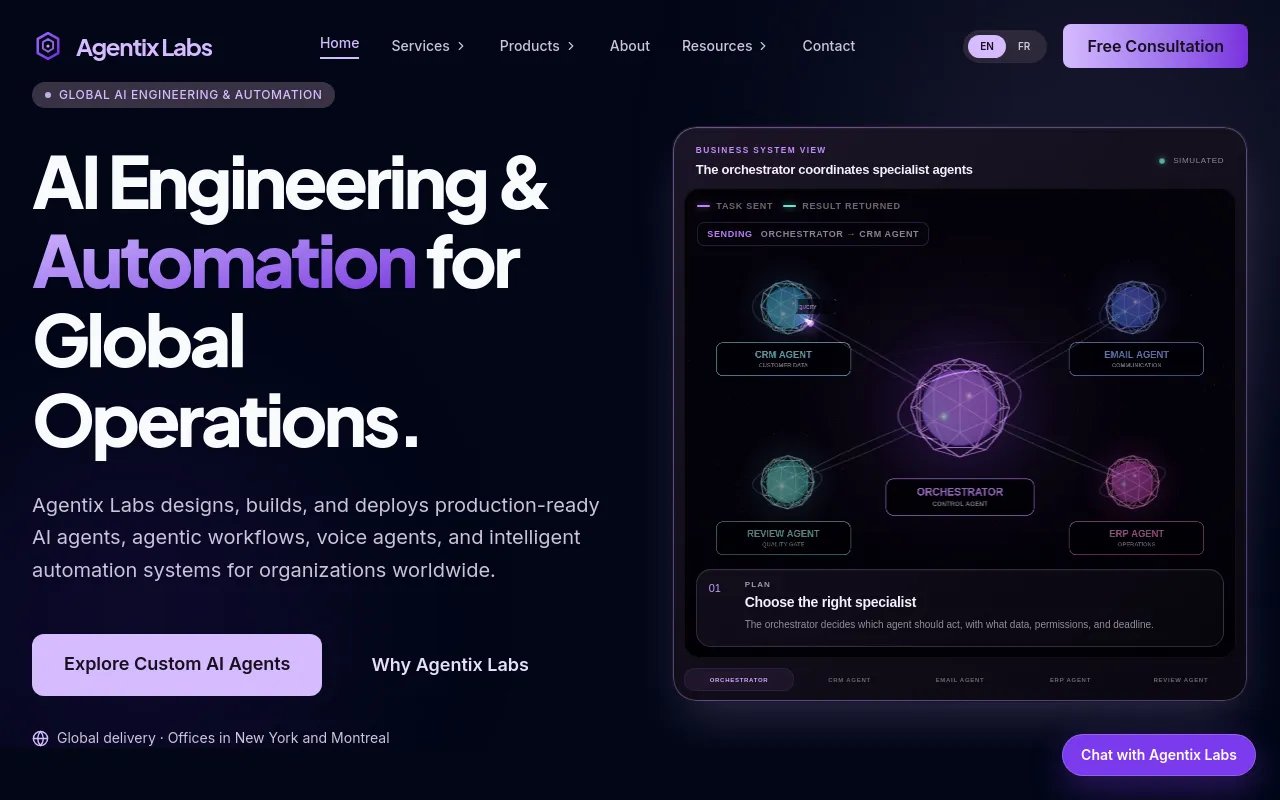
- YesMulti-agent systems with a supervising orchestrator and human escalation are one of the four agent shapes they advertise building.
Multi-agent systems with orchestration and human escalation
agentixlabs.com - Agent permissions
- YesLeast-privilege scoping is the firm's stated design default, with typed tool contracts and approval required before sensitive or external writes.
Consequential or external actions should stop for human approval unless the risk is demonstrably low and reversible.
agentixlabs.com/services/task-ai-agents
Which models it runs on
- Claude
- YesClaude is their headline model platform; they state membership of Anthropic's partner network and sell Claude implementation as a named service.
Agentix Labs participates in the Claude Partner Network and provides Claude implementation services for production AI agents, tool-using workflows,…
agentixlabs.com/partners/anthropic-clau… - GPT
- YesOpenAI is listed among the platforms it integrates, though no service page or case study names a delivered GPT build.
OpenAI revolutionizes AI with advanced research and groundbreaking large language models like GPT-4.
agentixlabs.com/neural-architectures - Open models
- NoEvery model platform named anywhere on the site is a hosted proprietary service; no open-weight model appears, including in the eight-card ecosystem set.
Claude, OpenClaw, Vapi, Botpress, Salesforce, and Microsoft-centered workflows
agentixlabs.com - Model choice
- PartlyModel and platform selection is part of their design work across several named stacks, but Claude is clearly the centre of gravity and no model menu is published.
Agentix Labs starts with the workflow and operating risk, then designs the model, tools, memory, integrations, approvals, evaluation cases, logging,…
agentixlabs.com/why-agentix-labs
Where you use it
- In a browser
- PartlyThe firm builds customer-facing web and messaging agents for clients, so a web surface exists in the delivered systems rather than as an Agentix-hosted application a buyer logs into.
Botpress customer-facing agents
agentixlabs.com/why-agentix-labs
Whose machine it runs on
- Self-hosted
- PartlyClient-owned deployment is offered conditionally rather than guaranteed, and the hedging wording means the architecture decides it case by case.
Client-owned deployment options where the architecture permits
agentixlabs.com/why-agentix-labs - Open source
- NoAgentix Labs publishes no source of its own; the open-source element belongs to OpenClaw, which they merely implement and harden for clients.
OpenClaw setup, configuration, production hardening, and operations
agentixlabs.com/about
What it costs to run
- How it meters
- PartlyBilling is per engagement in phases - teardown, pilot, production deployment, enterprise programme - with third-party usage, infrastructure and support called out as separate lines, but no rate, day rate or unit price is published.
Ask vendors to separate discovery, build, third-party usage, infrastructure, support, and future change costs.
agentixlabs.com/resources/ai-agent-deve… - Free tier
- PartlyYou can get a free scoped workflow teardown and consultation without paying, but any actual build is a paid engagement with no published price.
Bring one workflow, agent idea, or OpenClaw deployment question. Agentix Labs will return a practical one-page recommendation covering the business…
agentixlabs.com/contact - API access
- PartlyAPIs live inside what it builds for you, as typed tool contracts on delivered task agents; Agentix publishes no product API of its own.
Agentix Labs builds task agents with typed tool contracts, least-privilege access, validation, idempotency, human approvals, and complete action logs.
agentixlabs.com/services/task-ai-agents - MCP server
- PartlyMCP appears as something they implement inside client architectures, not as a server a buyer can query Agentix Labs through; no endpoint of their own is documented.
Agentix Labs implements Claude in architectures that may include Model Context Protocol servers, OpenClaw workspaces, messaging surfaces, browser…
agentixlabs.com/partners/anthropic-clau… - Bring your own key
- PartlyArchitectures can run on client-owned infrastructure with credentials held outside prompts, but no explicit bring-your-own-key policy is stated.
The design keeps connectors and credentials outside prompts, applies least privilege, and records tool activity for review.
agentixlabs.com/partners/anthropic-clau…
Buying it for a team
- A company can buy it
- YesEngagements are sold to organisations and enterprises outright; there is no individual self-serve purchase path anywhere on the site.
Serving businesses across Canada and North America
agentixlabs.com/about - Seat model
- NoNo seat or per-user licence exists; the cost components the firm enumerates are discovery, build, third-party usage, infrastructure, support and change.
Ask vendors to separate discovery, build, third-party usage, infrastructure, support, and future change costs.
agentixlabs.com/resources/ai-agent-deve… - Pooled budget
- PartlyBudgets exist, but as per-agent action and spend limits designed into the workflow, not as a balance shared across seats.
Explicit goals, stop conditions, and action budgets
agentixlabs.com/services/autonomous-ai-… - Admin controls
- YesConstraining what the agent may do is the core of their build method: scoped identity, scoped data and tool access, and human approval gates.
Scoped identity, data, and tool access
agentixlabs.com - Audit log
- YesDelivered systems include auditability, step-level traces and action receipts as standard production controls rather than optional extras.
Observability, auditability, escalation, and rollback
agentixlabs.com - Single sign-on
- PartlyEnterprise identity and tenant boundaries are named as an architecture foundation, but no SAML or OIDC support is stated anywhere on the site.agentixlabs.com/resources/enterprise-ai…
What happens to your code
- Opt out of training
- YesThe privacy policy commits to not training public models on client private data without explicit consent, making no-training the default rather than a setting you must find.
We do not use your private data to train public AI models without your explicit consent.
agentixlabs.com/privacy-policy - Data residency
- PartlyDelivery is from Montreal, Quebec for Canadian and North American clients, and deployments can be client-owned; no hosting region or residency guarantee is published.
Based in Montreal, Quebec, Canada
agentixlabs.com/about - Getting out
- PartlyPersonal data access, correction and deletion are offered on request by email, and deployments can be client-owned, but no export format or handover terms are published.
Depending on your location, you may have certain rights regarding your personal information, such as the right to access, correct, or delete your…
agentixlabs.com/privacy-policy
Not established: Certifications
30 sourced claims on this page. Checked 2026-10-09. How we check.
Filed under
Sources and updates
Pages we read on agentixlabs.com23
Every fact below comes from the vendor. Nothing here is independently corroborated yet.
- /11 fields
- /why-agentix-labs8 fields
- /about7 fields
- /services/custom-ai-agent-development6 fields
- /resources/ai-agent-development-cost-canada5 fields
- /services/autonomous-ai-agents5 fields
- /partners/anthropic-claude4 fields
- /resources/enterprise-ai-agent-development4 fields
- /resources/openclaw-vs-custom-agent-frameworks3 fields
- /services/openclaw-implementation3 fields
- /services/task-ai-agents3 fields
- /ai-agent-consultation2 fields
- /neural-architectures2 fields
- /privacy-policy2 fields
- /terms-of-service2 fields
- /contact1 field
- /resources/agentic-ai-soc2-security-review-checklist1 field
- /resources/ai-agent-development-company-montreal1 field
- /resources/ai-agent-read-write-access1 field
- /resources/openclaw-enterprise-deployment-guide1 field
- /services1 field
- /services/ai-automation-consulting1 field
- /services/ai-voice-agents1 field
Updates6
- Capabilities · Commercial terms · Free tier
- Capabilities · Commercial terms · Free tier
- Capabilities · Commercial terms · Free tier
- Capabilities · Commercial terms · Free tier
- Capabilities · Commercial terms · Free tier
- Capabilities · Commercial terms · Free tier