AgentsKit
VerifiedSummary
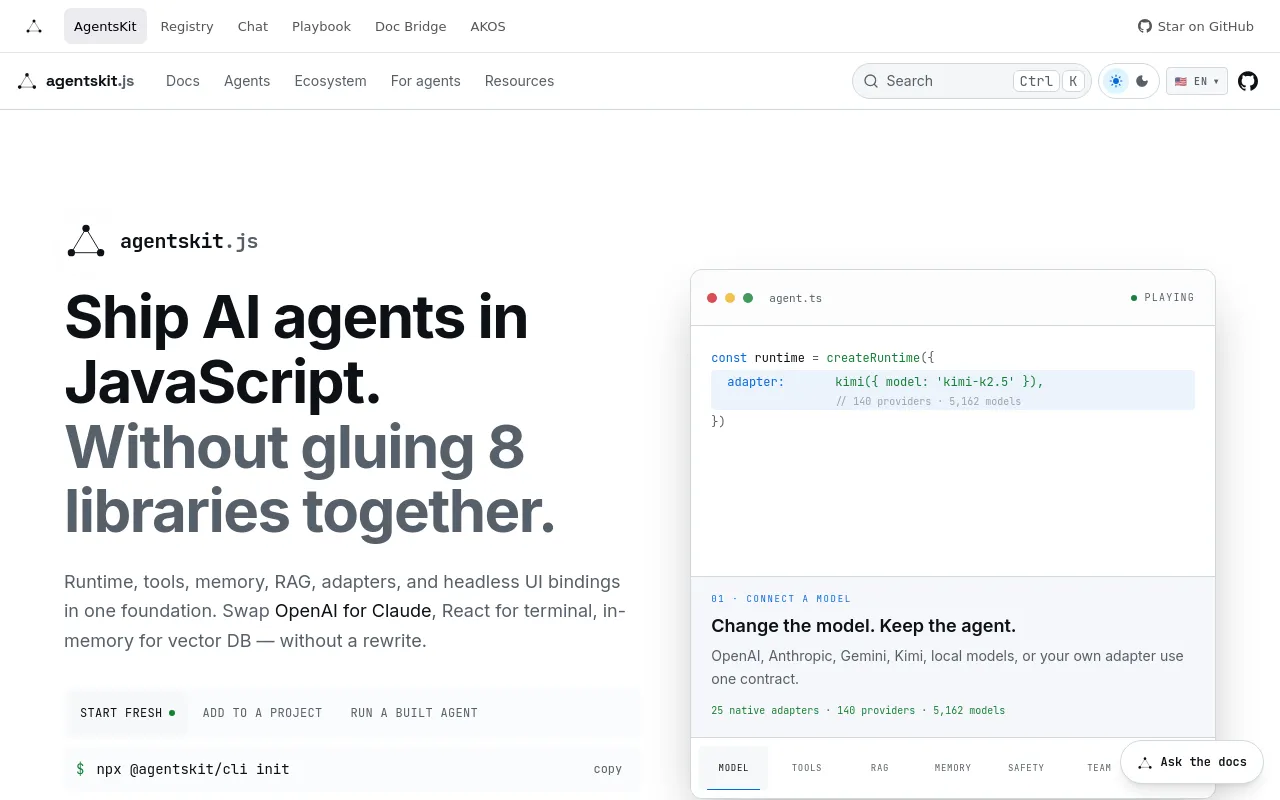
AgentsKit is an open-source TypeScript library for building AI agents from six swappable contracts covering adapters, tools, skills, memory, retrieval and runtime. It ships a ReAct runtime, multi-agent topologies, provider adapters, a CLI and headless chat bindings for seven frontend frameworks.
- Best for
- JS/TS developers who want an ownable, dependency-light agent toolkit
- Not for
- Non-developers or teams wanting a no-code, hosted agent builder: AgentsKit requires Node 22+, TypeScript, and comfort reading generated source code. The open-source core has no built-in managed dashboard or SLA of its own — teams that want one can use AKOS, a separate paid enterprise control plane for governance, audit and cost controls, but it is optional and does not gate the open-source stack.
- From
- Free
- Free tier
- YesNo paid tier and no usage limit set by the vendor; the packages are free and open source, installed from npm. Model inference is billed separately by whichever provider you configure.
What it does
- Writes code
- YesA bundled coder persona implements features from written specs, and the CLI scaffolds typed agent projects from a natural-language description, so code authoring is a first-class use case.
coder: Implements features from specs — TypeScript-first, TDD-leaning, opinionated about code quality.
agentskit.io/llms.txt - Debugs and fixes
- PartlySelf-debug lets an agent read its own traces and retry after a failure, which covers the agent run rather than a documented workflow for diagnosing and landing a fix in someone's repository.
Self-debug: Agents that read their own traces, diagnose failures, retry with corrections.
agentskit.io/llms.txt - Writes tests
- PartlyThe coder persona is described as test-driven in style, and a separate eval package produces agent test suites, but no page states that the agent writes unit tests for your application code.
coder: Implements features from specs — TypeScript-first, TDD-leaning, opinionated about code quality.
agentskit.io/llms.txt - Reviews code
- YesTwo review personas ship with the skills package, one reviewing diffs for bugs and security and one checking a diff against project conventions, and the registry offers an installable code-reviewer agent.
codeReviewer: Reviews diffs for bugs, security, style. Comments in PR-review format.
agentskit.io/llms.txt - Whole-codebase work
- PartlyThe coder skill is documented for multi-file edits, package additions and refactors, but nothing on the site claims a migration carried across a whole repository or repo-wide indexing.
Multi-file edits, package additions, refactors.
agentskit.io/docs/agents/skills/coder - Ships it
- PartlyShell and filesystem tools plus a confirmation-gated deploy example mean you can wire a deployment step yourself, but the library ships no managed pipeline that takes a change to production on its own.
Built-in tools: Ship-ready tools — web, fetch, filesystem, shell.
agentskit.io/llms.txt - Done-for-you service
- NoThis is software you install and operate yourself, published as npm packages with docs and a CLI; the site offers no build service, retainer or managed delivery team.
Foundation library for JavaScript agents. Small packages, one contract, everything composes
agentskit.io/llms.txt
How much it does unattended
- Runs autonomously
- YesThe runtime package drives an observe, think, act loop that keeps calling tools without a person in the loop until the model answers or a step ceiling stops it.
@agentskit/runtime is the execution engine for autonomous agents. It runs a ReAct loop — observe, think, act — until the model produces a final…
agentskit.io/docs/agents/runtime - Multi-agent
- YesFour coordination patterns ship in the runtime package as named helpers, covering a planner routing work to specialists, peer handoffs, nested supervisors and a shared scratchpad.
Four proven multi-agent patterns — supervisor, swarm, hierarchical, blackboard.
agentskit.io/docs/agents/topologies - Agent permissions
- PartlyGating is opt-in per tool: marking a tool as requiring confirmation pauses the run for approval or denial, so anything you do not gate executes unattended by default.
Runtime pauses on invocation and emits `tool.awaiting-approval`. Resume with `chat.approve(toolCallId)` or `chat.deny(toolCallId, reason)`.
agentskit.io/docs/agents/hitl
Which models it runs on
- Claude
- YesA native Anthropic adapter covers the Claude family with streaming, tool calls and vision, and Claude also reaches the runtime through the Bedrock adapter.
anthropic: Anthropic chat adapter — Claude Opus / Sonnet / Haiku. Streaming, tool-calls, vision, long-context.
agentskit.io/llms.txt - GPT
- YesA native OpenAI adapter supports the GPT and o-series models with streaming, parallel tool calls and multimodal input, and an Azure OpenAI adapter covers enterprise tenants.
openai: OpenAI chat adapter — GPT-4o, o-series, GPT-5. Streaming, tool-calls, parallel tools, multimodal.
agentskit.io/llms.txt - Open models
- YesLocal and open-weight inference is a documented path, with adapters for Ollama, LM Studio, vLLM and llama.cpp alongside hosted open-model services such as Together and Fireworks.
Local runtimes: Run fully offline — Ollama, LM Studio, vLLM, llama.cpp.
agentskit.io/llms.txt - Model choice
- YesYou pick the provider, and swapping it is an import change rather than a rewrite, since every adapter implements the same contract behind the runtime.
Hosted chat adapters: 17 managed-LLM adapters. Same contract; swap by changing one import.
agentskit.io/llms.txt
Where you use it
- In your editor
- PartlyEditor use is documented as three patterns you build yourself, through a CLI task, a webview hosting the React chat, or a language server; the vendor states no first-party extension exists yet.
A first-party VS Code extension and a Raycast extension are both on the roadmap (issue #192). The patterns above let you build either one against the…
agentskit.io/docs/production/embedded - On the command line
- YesA nine-command terminal tool covers scaffolding, interactive chat, one-shot runs, a dev server with hot reload and an environment diagnosis command.
CLI: Nine commands wrapping every part of AgentsKit — init, chat, run, dev, doctor, ai, tunnel, rag, config.
agentskit.io/llms.txt - In your pipeline
- PartlyEval results can be written as JUnit, Markdown or GitHub annotations so a failing suite blocks a pull request, which is reporting into CI rather than an agent that acts on the diff itself.
Write eval results as JUnit XML, Markdown, or GitHub annotations so failures block PRs and surface in pull request checks.
agentskit.io/docs/production/evals/ci - In a browser
- PartlyBrowser chat is available as headless bindings for seven frameworks that you host in your own app; the vendor runs no hosted web product for the library itself.
AgentsKit components are headless (`data-ak-*` attributes, no hardcoded styles) and span React, Vue, Svelte, Solid, Angular, React Native, and Ink,…
agentskit.io/docs/compare
Whose machine it runs on
- Self-hosted
- YesEverything runs wherever you can run Node, including your own servers, edge runtimes and desktop hosts, because the runtime is process-agnostic rather than a hosted service.
AgentsKit's headless surface (`@agentskit/runtime`) is process-agnostic. Anywhere you can run Node 20+, you can run an AgentsKit agent
agentskit.io/docs/production/embedded - Open source
- YesThe vendor's own comparison table records the licence as MIT, and the ecosystem page states the listed products are free and open source.
License | MIT
agentskit.io/docs/compare
What it costs to run
- How it meters
- PartlyThe packages themselves carry no price, so your spend is whatever your chosen model provider charges for tokens; the vendor meters nothing and publishes no rate of its own.
The listed products are free and open source.
agentskit.io/llms.txt - Free tier
- YesNo sales call or account is involved: the stated commercial model is free and open source, and installation is one npm command from the public registry.
The listed products are free and open source.
agentskit.io/llms.txt - API access
- YesThe whole product is a programmable library, and every CLI subcommand is additionally exposed as named exports so you can drive scaffolding and runs from your own code.
Programmatic API: Drive every agentskit subcommand from your own code — same internals as the CLI, exposed as named exports.
agentskit.io/llms.txt - MCP server
- YesThe bridge works both ways: your tools can be published as an MCP server over stdio for hosts such as Claude Code and Cursor, and external MCP servers can be consumed as tools.
Expose AgentsKit tools as an MCP server over stdio for Codex, Claude Code/Desktop, Cursor, Cline, Continue, and other MCP hosts.
agentskit.io/llms.txt - Bring your own key
- YesKeys are always yours: adapters take an API key from your own environment, and fully offline inference through Ollama or llama.cpp removes the provider call entirely.
adapter: anthropic({ apiKey: process.env.ANTHROPIC_API_KEY!, model: 'claude-sonnet-4-6' }),
agentskit.io/docs/agents/runtime
Buying it for a team
- A company can buy it
- PartlyThere is nothing to buy for the library itself; the managed product AKOS is the commercial path and is sales-led.
Want a managed product rather than wiring this yourself? AKOS — the operating system for AI agents in production — packages governed flows,…
agentskit.io/docs/production - Pooled budget
- PartlymultiTenantCostGuard pools a dollar budget per tenant with a default for unlisted ones; there is no seat concept to share a balance across.
Same accounting partitioned by tenant for SaaS deployments.
agentskit.io/docs/production/observabil… - Admin controls
- PartlyConstraints are real but expressed in code rather than an admin console: a sandbox wrapper applies allow, deny and validator rules across tools, and per-tool quotas cap how often each may run.
Mandatory sandbox — allow / deny / require / validators across every tool.
agentskit.io/docs/production/security - Audit log
- PartlyA tamper-evident log primitive using a hash chain and HMAC signature is provided for you to wire into a runtime; it records agent activity rather than administrative changes in a vendor console.
Signed audit log — hash-chain + HMAC.
agentskit.io/docs/production/security - Single sign-on
- PartlyOIDC token verification is complete and dependency-free using WebCrypto, while SAML only provides a typed assertion contract and requires you to supply an XML signature validator.
SAML requires an XML / XML-DSig validator — bring your own. The helper provides a typed contract for the parsed assertion shape so the rest of the…
agentskit.io/docs/production/security/s…
What happens to your code
- Data residency
- PartlyJurisdiction is yours to choose because nothing is hosted by the vendor, and the router can pin selection to a region, but no residency guarantee is published.
Require all selected adapters to match this data-residency region.
agentskit.io/docs/api/adapters/interfac… - Getting out
- YesThere is nothing to exit from: MIT packages, no credits and no vendor store, with provider lock-in explicitly answered as none because every layer is a swappable contract.
Provider lock-in | None (contract adapters)
agentskit.io/docs/compare - Certifications
- PartlyNo vendor certification is published, which fits a library with no hosted service; what ships is compliance machinery — a tamper-evident log and erasure helpers.
You want a tamper-evident audit log (SOC 2 / HIPAA friendly).
agentskit.io/docs/reference/packages/ob…
Not established: Opt out of training
33 sourced claims on this page. Checked 2026-10-08. How we check.
Filed under
Sources and updates
Pages we read on agentskit.io39
Every fact below comes from the vendor. Nothing here is independently corroborated yet.
- /llms.txt18 fields
- /10 fields
- /docs/agents/skills/coder4 fields
- /docs/compare4 fields
- /docs/agents/runtime3 fields
- /docs/data/providers3 fields
- /docs/production3 fields
- /docs/agents/hitl2 fields
- /docs/agents/skills/personas2 fields
- /docs/data/providers/local2 fields
- /docs/production/embedded2 fields
- /docs/production/observability/cost-guard2 fields
- /docs/production/security2 fields
- /docs/production/security/mandatory-sandbox2 fields
- /docs/reference/packages/cli2 fields
- /docs/use-cases/code-agent2 fields
- /1 field
- /docs/agents/delegation1 field
- /docs/agents/guarantees1 field
- /docs/agents/self-debug1 field
- /docs/agents/skills/code-reviewer1 field
- /docs/agents/tools/integrations1 field
- /docs/agents/tools/integrations/github-actions1 field
- /docs/agents/tools/mcp1 field
- /docs/agents/topologies1 field
- /docs/api/adapters/interfaces/RouterOptions1 field
- /docs/data/providers/anthropic1 field
- /docs/data/providers/openai1 field
- /docs/for-agents/memory1 field
- /docs/get-started/getting-started/build-your-first-agent1 field
- /docs/production/cli1 field
- /docs/production/cli/programmatic-api1 field
- /docs/production/edge1 field
- /docs/production/evals/ci1 field
- /docs/production/observability/audit-log1 field
- /docs/production/security/sso1 field
- /docs/reference/packages/observability1 field
- /docs/ui1 field
- /ecosystem1 field
Coverage elsewhere1
Updates6
- Capabilities · Commercial terms · Free tier
- Capabilities · Commercial terms · Free tier · Price
- Capabilities · Commercial terms · Free tier · Price
- Capabilities · Commercial terms · Free tier
- Capabilities · Commercial terms · Free tier · Links
- Commercial terms · Links