
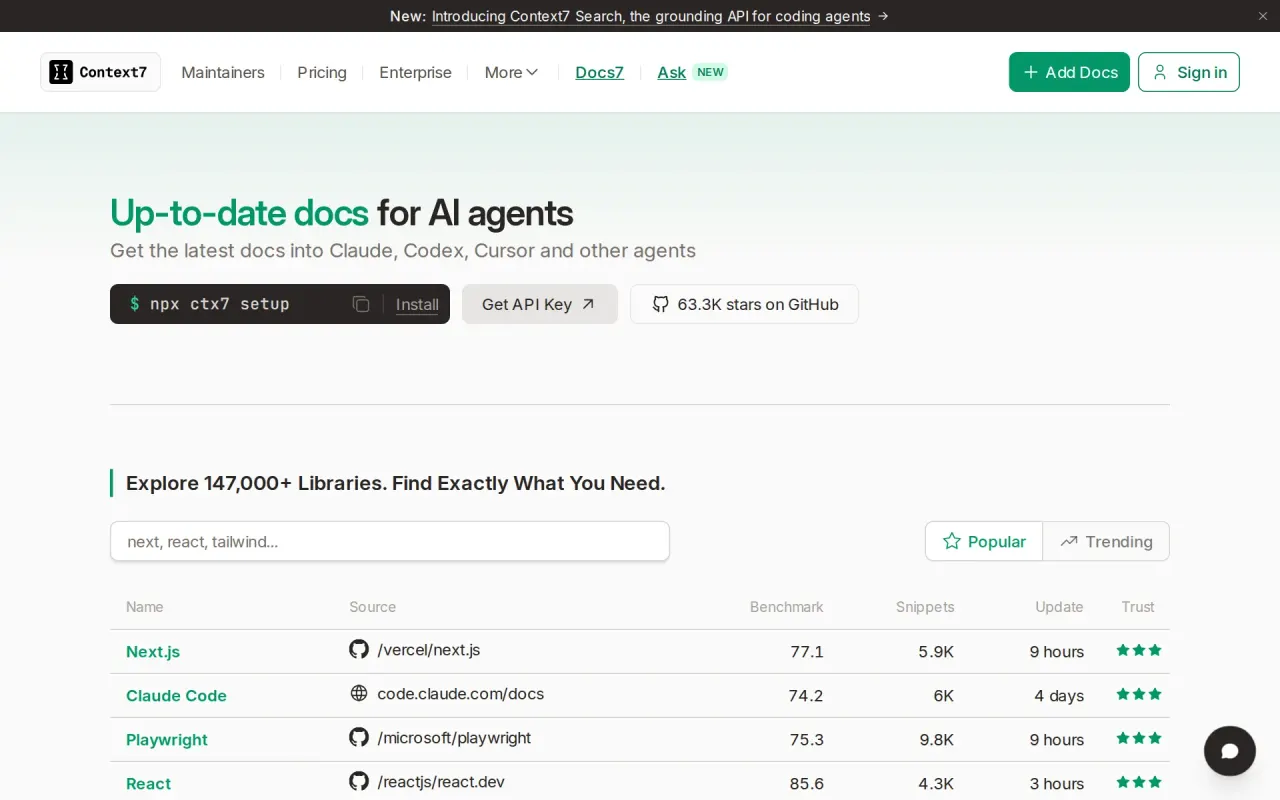
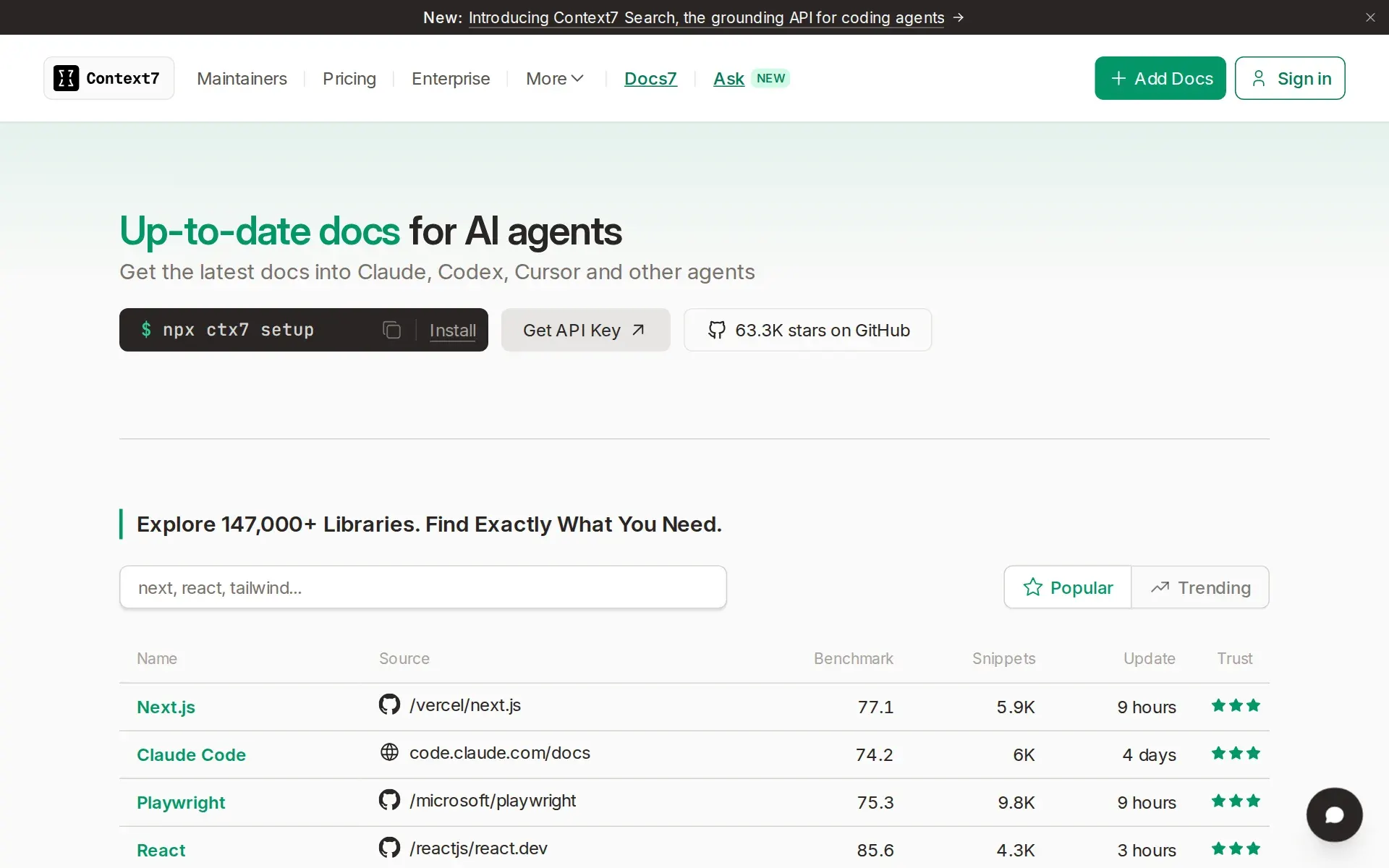
The facts, with their sources
What it does
- Done-for-you service
- NoYou run the software yourself: plans are self-serve per-seat subscriptions, and even the on-premise Enterprise build is deployed and configured by the customer via Docker or Kubernetes, not by Upstash staff.
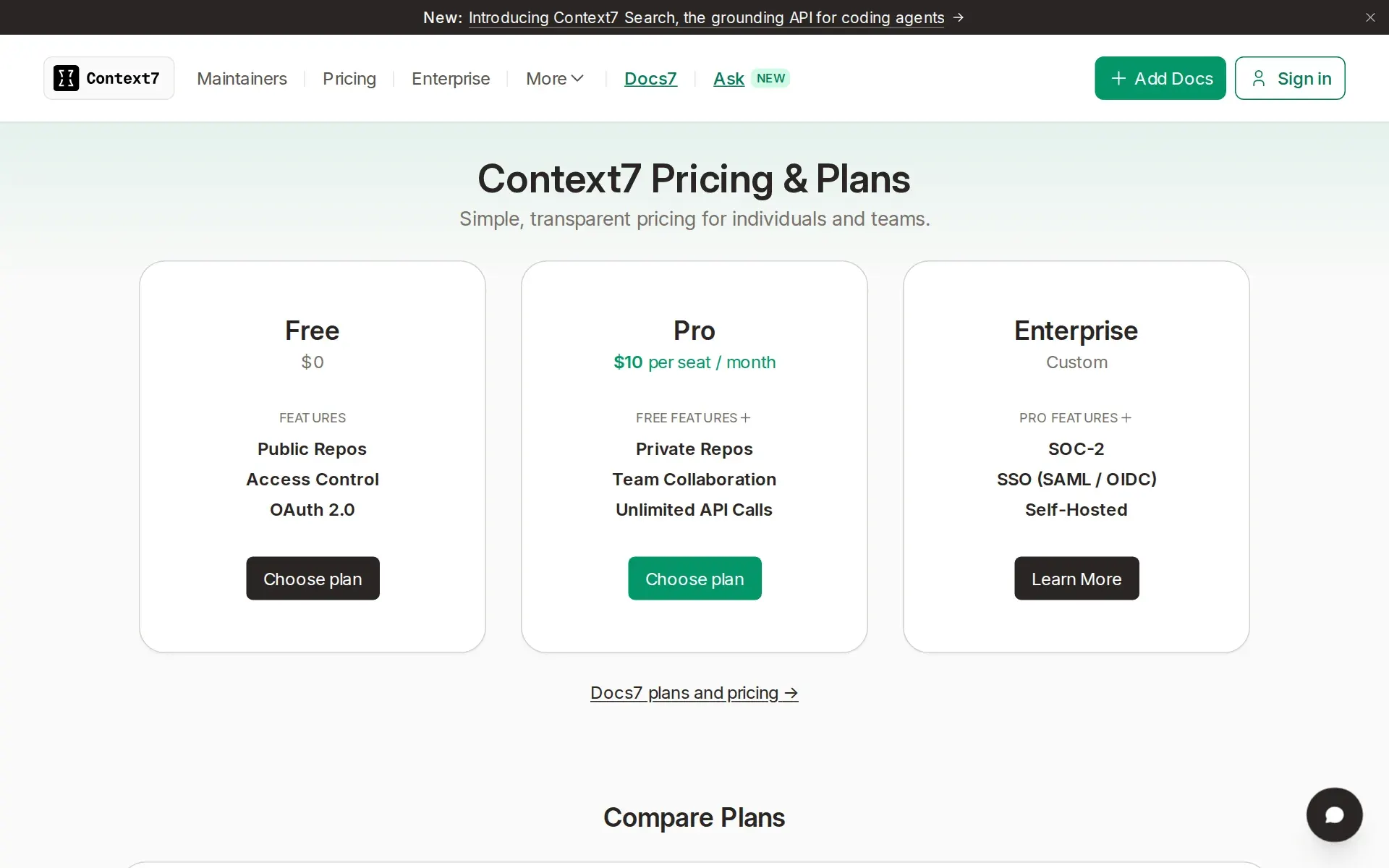
Simple, transparent pricing for individuals and teams.
context7.com/plans
How much it does unattended
- Runs autonomously
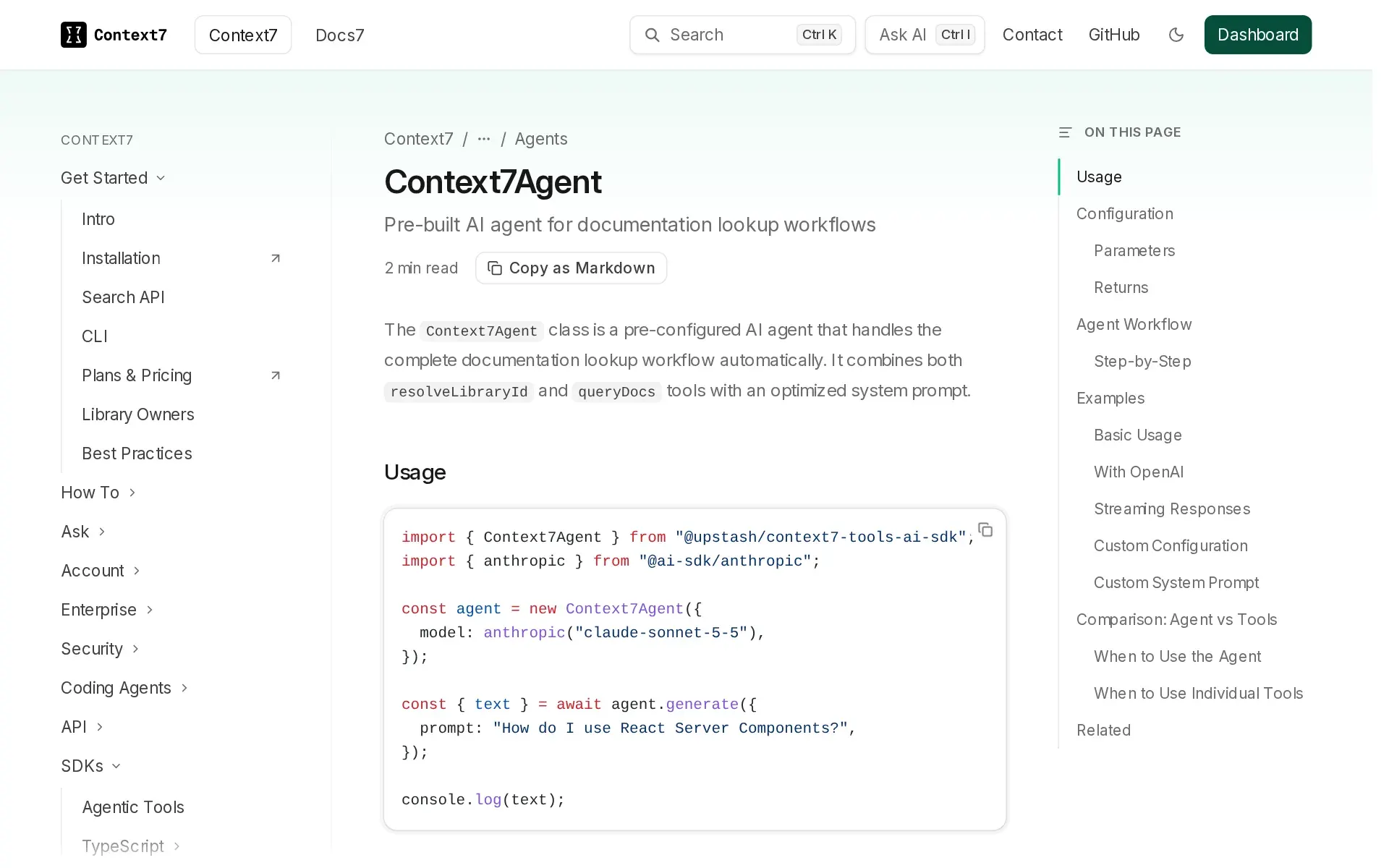
- PartlyThe hosted service itself is a tool an agent calls, but the published AI SDK package ships Context7Agent, a tool-loop agent that resolves a library and fetches docs over multiple steps without a human between them, stopping after five steps by default.
The Context7Agent class is a pre-configured AI agent that handles the complete documentation lookup workflow automatically.
context7.com/docs/agentic-tools/ai-sdk/… - Agent permissions
- PartlyIts MCP tools only read documentation, and an owner or admin can narrow what any agent using the teamspace keys may retrieve through source-type toggles and library filters, but there is no per-action approval step to configure.
Every search and MCP request made with one of the teamspace's API keys is filtered through these policies, so they apply to all members at once.
context7.com/docs/howto/policies
Which models it runs on
- Claude
- YesClaude Code is a first-class client: the ctx7 CLI wires the MCP server into it with one command, and Anthropic is also one of the LLM providers selectable for an on-premise deployment.
set up the Context7 MCP server (or a CLI-based docs skill) for Claude Code, Cursor, OpenCode, and more with a single command
context7.com/docs/clients/cli - GPT
- YesOpenAI models are supported on both sides: the on-premise setup wizard lists OpenAI as an AI provider, and OpenAI's Codex CLI is one of the documented MCP clients configured by ctx7 setup.
AI Provider - Choose OpenAI, Anthropic, Gemini, AWS Bedrock, or a custom OpenAI-compatible endpoint.
context7.com/docs/enterprise/on-premise - Open models
- PartlyOpen-weight models can only be used on the Enterprise on-premise build, where the LLM and embedding providers accept a custom OpenAI-compatible base URL; the hosted service reranks with OpenAI, Gemini and Anthropic and offers no model choice.
Base URL / Bedrock endpoint | Custom OpenAI-compatible endpoint, or an optional Bedrock Runtime endpoint
context7.com/docs/enterprise/on-premise - Model choice
- YesContext7 sits behind the MCP protocol rather than a model, so the buyer's own client and model choice decides everything; the vendor states the connection is independent of the selected model.
The MCP connection is independent of the model selected for the agent. You can use the same Context7 server with any model available in Cursor Cloud…
context7.com/docs/clients/cursor
Where you use it
- In your editor
- YesIt runs inside editors as an MCP server or installed skill, with dedicated setup pages for Cursor and VS Code and a one-command install that writes the client configuration for you.
Context7 brings up-to-date library documentation directly into Cursor. Instead of getting outdated code examples from training data, you get current…
context7.com/docs/clients/cursor - On the command line
- YesThe ctx7 CLI is a real terminal surface, not just an installer: it resolves a library by name and prints its documentation without a browser, and also configures MCP clients.
Fetch library documentation — resolve any library by name and query its up-to-date docs directly in your terminal, without opening a browser
context7.com/docs/clients/cli - In your pipeline
- PartlyCI use is limited to keeping the index fresh and calling the HTTP API: the documented GitHub Actions workflow posts a refresh on push. Nothing in the product acts on a pull request or reviews a diff.
Keep your Context7 documentation in sync by triggering a refresh whenever you push to your main branch.
context7.com/docs/integrations/github-a… - In a browser
- YesThe site itself is a usable surface: a browsable index of libraries plus a hosted chat at /chat that queries the MCP server directly, with sign-in only needed to keep history.
Chat with Context7 MCP Server for up-to-date library documentation
context7.com/chat
Whose machine it runs on
- Self-hosted
- PartlySelf-hosting exists but only as the Enterprise on-premise build, deployed by Docker or Kubernetes with your own vector storage and AI provider; the comparison table marks Self-Hosted absent on Free and Pro.
Context7 On-Premise keeps your repositories, generated documentation, application database, vector store, and MCP server in your infrastructure.
context7.com/docs/enterprise/on-premise - Open source
- PartlyOnly the MCP server client is open source on GitHub and forkable to change what queries it sends; the indexing pipeline, the index itself and the hosted API are not published.
The Context7 MCP server is open source: - Code is publicly available on GitHub
context7.com/docs/security/compliance-a…
What it costs to run
- How it meters
- YesIt bills two ways at once: $10 per seat per month including 2,000 API calls per seat, then $5 per 1,000 extra calls, with private repository parsing metered separately at $5 per 1M tokens.
Pro plan costs $10 per seat per month. Each teamspace member counts as a seat... You get 2,000 free API calls per seat per month, then $5 per 1,000…
context7.com/plans - Free tier
- YesA standing $0 plan gives public-repository access and 1,000 API calls a month with no call to sales; it is capped rather than time-limited, and private repositories need Pro.
The Free plan includes access to public repositories, basic access control, and 1,000 API calls per month.
context7.com/plans - API access
- YesA documented REST API covers search, context retrieval, refresh, usage metrics, policies and library ingestion, authenticated with a bearer API key created in the dashboard; the Search API is on every tier.
All API requests require authentication using an API key. Include your API key in the Authorization header:
context7.com/docs/api-guide - MCP server
- YesThe product is itself an MCP server at mcp.context7.com/mcp exposing two tools, resolve-library-id and query-docs, so any MCP client or agent can query it with a bearer key.
To configure manually, use the Context7 server URL https://mcp.context7.com/mcp with your MCP client and pass your API key via the Authorization:…
context7.com/docs/resources/all-clients - Bring your own key
- PartlyBringing your own inference is an Enterprise capability: on-premise deployments configure their own LLM and embedding provider keys, and Enterprise plans may use their own provider for extraction and ranking. Hosted Free and Pro use Context7's providers.
On-premise Enterprise plans can use their own LLM provider for code extraction and private library ranking
context7.com/docs/security/data-privacy
Buying it for a team
- A company can buy it
- YesOrganisations buy it as teamspaces billed per member on Pro or Enterprise, and teamspaces up to 50 members can activate Enterprise self-serve with a payment method and no sales call.
Teamspaces up to 50 members can self-serve by adding a payment method and activating the Enterprise plan instantly.
context7.com/plans - Seat model
- YesPricing is strictly per seat at $10 a month with each teamspace member counted, and there is a ceiling rather than a floor: Free is one person, Pro caps at 10 members, Enterprise is unlimited.
| Free | 1 (personal only) | | Pro | 10 | | Enterprise | Unlimited |
context7.com/docs/howto/teamspace - Pooled budget
- NoAllowances are explicitly not pooled: each member gets their own 2,000 calls, unused seat allowance does not carry over, and one member's overage is billed even while another seat sits idle.
Limits are per seat, not shared across the teamspace... the unused allocation from other seats does not carry over.
context7.com/plans - Admin controls
- YesOwners and admins set teamspace policies that filter every search and MCP request by source type, trust score, verification and blocked libraries, with developers held to read-only access to those settings.
Policies are scoped to a teamspace. Only owners and admins can change them; developers have read-only access.
context7.com/docs/howto/policies - Audit log
- PartlyAudit trails are named only as an Enterprise entitlement alongside SSO; no admin audit log is described for Free or Pro, where the dashboard shows usage metrics rather than a record of administrative action.
Enterprise customers can enable SSO (SAML, OAuth, OIDC) and receive dedicated audit trails
context7.com/docs/security/overview - Single sign-on
- PartlySAML 2.0 and OIDC are supported but gated to Enterprise, with Entra and Okta setup guides; the comparison table marks SSO absent on both Free and Pro, where sign-in is OAuth 2.0 only.
Single Sign-On (SSO) is available for Enterprise plans.
context7.com/docs/security/auth-and-acc…
What happens to your code
- Opt out of training
- PartlyYour code and prompts never reach Context7, but the queries the client formulates are stored anonymously to benchmark retrieval; switching that storage off is an Enterprise control and the vendor warns it may degrade quality.
Enterprise plans can disable query storage for benchmarking — however, this may affect the quality of context retrieval over time
context7.com/docs/security/data-privacy - Data residency
- YesIndexed documentation and metadata sit in Upstash infrastructure in the United States and the European Union under GDPR and the EU-U.S. Data Privacy Framework, with region-specific residency available to enterprise customers on request.
All indexed documentation and metadata are stored within Upstash's SOC 2 compliant infrastructure in the United States and the European Union.
context7.com/docs/security/data-privacy - Getting out
- PartlyGDPR access, deletion and portability rights are published and deleted data is purged within 30 days, but no documented bulk export of your indexed libraries exists and per-seat call allowances expire monthly without carrying over.
The right to access your data - The right to delete your data - Data portability options
context7.com/docs/security/data-privacy - Certifications
- PartlyGDPR compliance is claimed on every tier and SOC 2 Type II is inherited from Upstash infrastructure, but the plan table reserves SOC-2 compliance for Enterprise and ISO 27001 is still in progress rather than certified.
- SOC 2 Type II - GDPR compliant - ISO 27001 (in progress)
context7.com/docs/security/compliance-a…
Plans and pricing
Price and terms
- Free plan
- YesYesFree plan: $0, public repositories only, 1,000 API calls per month, one person (personal teamspace)
The terms in full
On hitting the cap you are blocked but granted 20 bonus API calls per day until the month resets; private repositories require Pro.
What needs a higher plan
- Enterprise
- Open models, Self-hosted, Bring your own key, Audit log, Single sign-on, Opt out of training
Checked .
Works with
 Claude
 GPT
- PartlyOpen models
Enterprise
For AI agents
- MCP server
- Yes
- API
- Yes
Screenshots
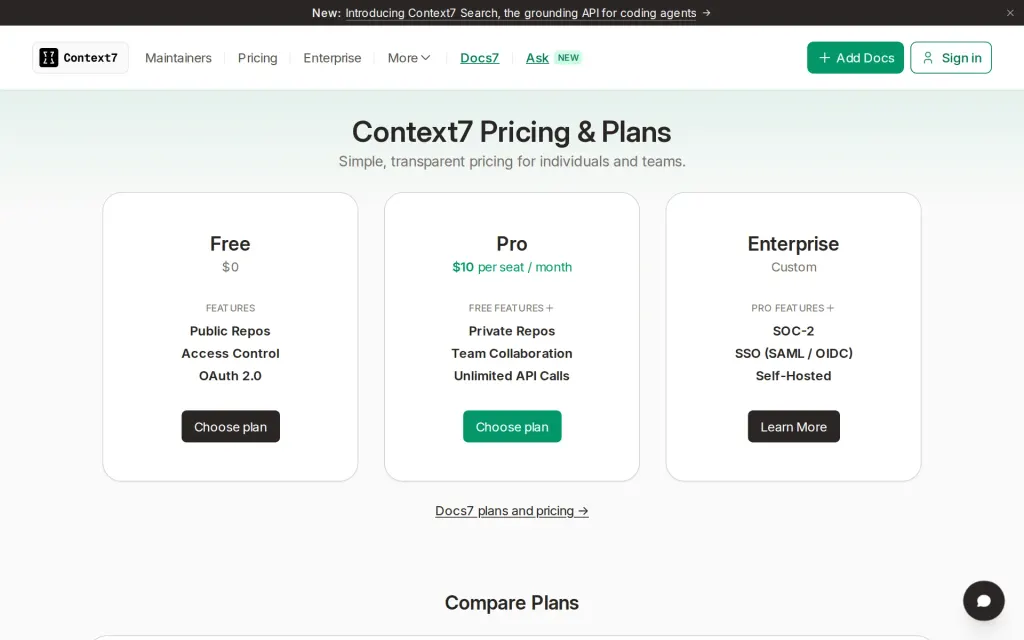
Pricing page, context7.com, captured 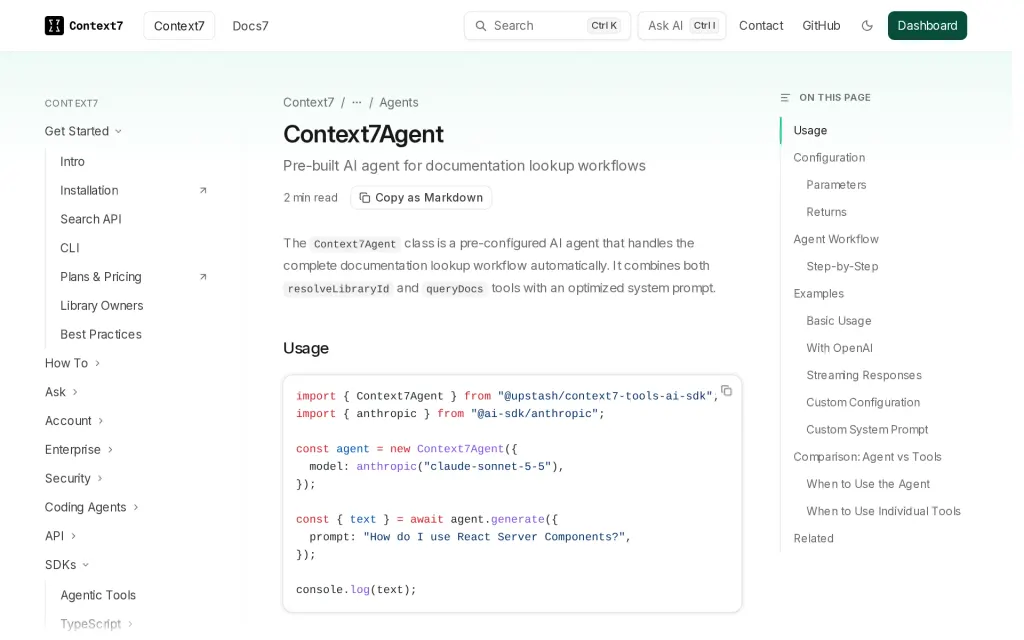
Docs, context7.com, captured
Filed under
Sources and updates
Sources on context7.com15
- /plans
- /docs/security/data-privacy
- /docs/enterprise/on-premise
- /docs/clients/cli
- /docs/clients/cursor
- /docs/howto/policies
- /docs/security/compliance-and-reporting
- /chat
- /docs/agentic-tools/ai-sdk/agents/context7-agent
- /docs/api-guide
- /docs/howto/teamspace
- /docs/integrations/github-actions
- /docs/resources/all-clients
- /docs/security/auth-and-access-control
- /docs/security/overview
Updates1
- Capabilities · Free tier · Price · Terms
Is this yours? Claim it free and edit it in your dashboard, or feature it in MCP servers.