
Not for Teams that need turnkey document classification, a human-in-the-loop review UI or schema-versioned extraction. Classification and review are not on the platform.
The facts, with their sources
What it does
- Writes code
- PartlyBuilder turns natural language into workflow code; it does not author application code from a description.
BuilderNatural language to code workflows builder
llamaindex.ai/pricing - Ships it
- PartlyWhat ships is the agent workflow itself: single-click deploy straight from a GitHub repo, listed on all four plans.
Single-click deploy of agentic workflows from GitHub repos
llamaindex.ai/pricing - Done-for-you service
- NoYou run the software: one API key, one SDK, five products; the highest-touch offering is a dedicated account manager.
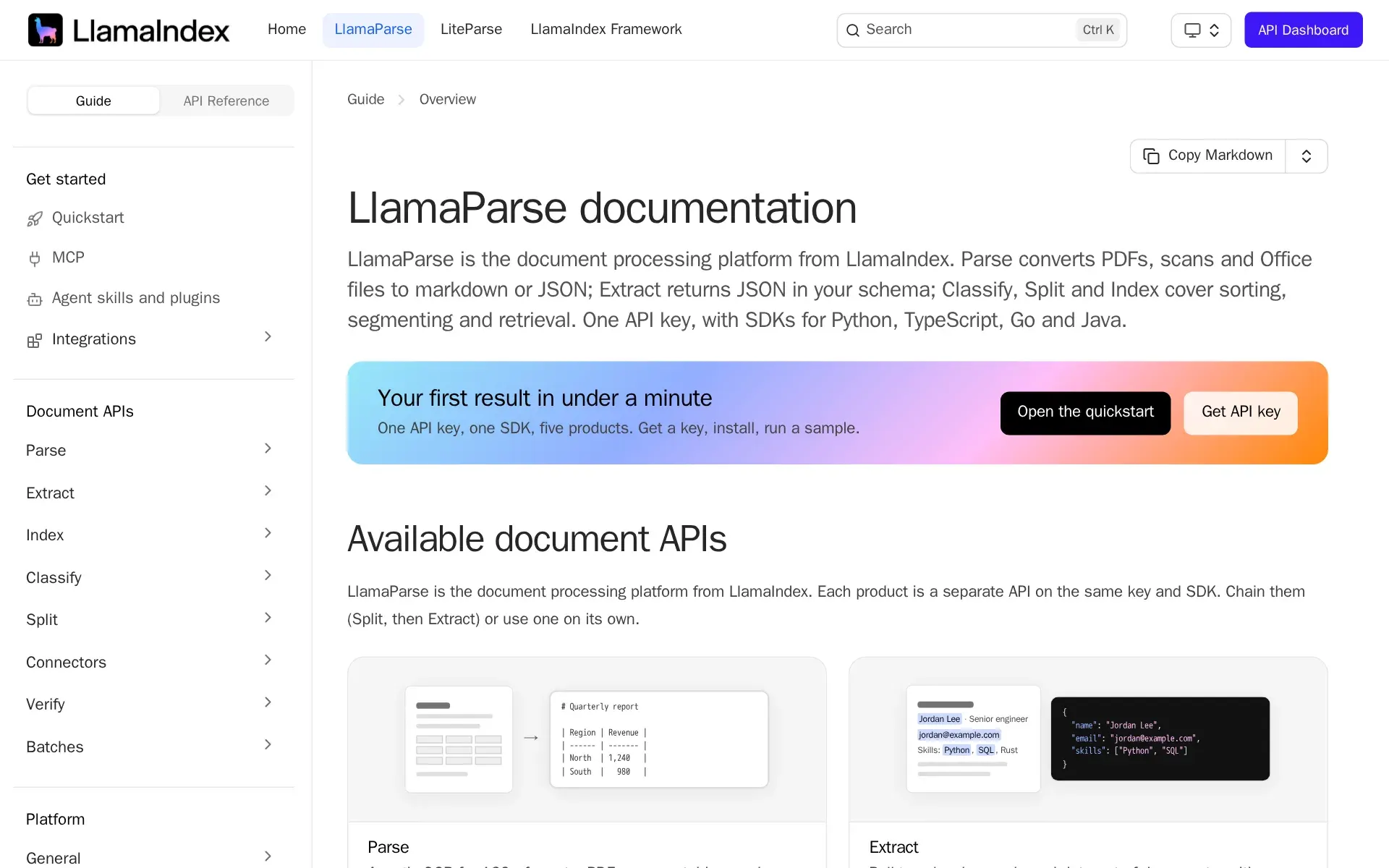
LlamaParse is the enterprise platform for turning documents into production AI pipelines. One API key, one SDK, and five composable products
developers.llamaindex.ai/llamaparse
How much it does unattended
- Runs autonomously
- PartlyParse/extract/classify jobs run unattended via API, SDK or MCP; multi-step workflows are explicitly built to include human review.
Workflows is used to stitch together multiple steps, including combining human-in-the-loop review, document processing, and more, all in a single…
llamaindex.ai/workflows - Multi-agent
- YesWorkflows orchestrates multi-step systems and can combine several agents in one run.
Workflows allows developers to build highly controlled multi-step workflows that can even combine multiple agents.
llamaindex.ai/workflows - Agent permissions
- PartlyFramework exposes human-in-the-loop and state as building blocks the developer wires up; the vendor publishes no policy engine that gates agent actions.
Leverage core components like memory, state management, human-in-the-loop, reflection, and more.
llamaindex.ai/llamaindex
Which models it runs on
- Claude
- YesAnthropic Claude is one of three model families the platform runs, via Anthropic API or AWS Bedrock.developers.llamaindex.ai/llamaparse/sel…
- GPT
- YesOpenAI models are supported directly or through Azure OpenAI.developers.llamaindex.ai/llamaparse/sel…
- Open models
- PartlyThe open-source framework integrates HuggingFace and local models; the hosted platform's enumerated model families are OpenAI, Anthropic and Google only.
We support integrations with OpenAI, HuggingFace, Anthropic, and more.
developers.llamaindex.ai/python/framewo… - Model choice
- Partlyv1 API lets you name the model per page; the recommended v2 tier system picks the model for you.
In the v2 API, parsing uses a simplified tier-based system. Choose a tier and the platform handles model selection automatically.
developers.llamaindex.ai/llamaparse/gen…
Where you use it
- In your editor
- PartlyReached inside IDE agents through the hosted MCP server and coding-agent skills, not as a first-party IDE extension.
The LlamaParse MCP is a Model Context Protocol server that exposes the LlamaParse Platform's document-processing capabilities (Parse, Classify,…
developers.llamaindex.ai/llamaparse/for… - On the command line
- YesSkills and plugins install into terminal coding agents Claude Code and Codex; a Go CLI (llp) is a documented install path.
LlamaParse ships agent skills (focused capabilities that teach coding agents how to parse and extract content from documents) and agent plugins that…
developers.llamaindex.ai/llamaparse/for… - In your pipeline
- PartlyCI use is deployment only: a spec kept in source control, applied on every push.
Use llamactl deployments apply -f in GitHub Actions when you want a deployment spec in source control and an automated update on every push.
developers.llamaindex.ai/python/llamaag… - In a browser
- YesEvery product is usable from the hosted dashboard as well as SDK and REST API.
It's available as a web UI, Python SDK, and REST API.
developers.llamaindex.ai/llamaparse/gen…
Whose machine it runs on
- Self-hosted
- PartlyFull platform deploys into your own Kubernetes/VPC, but only on Enterprise plans.
Self-hosted LlamaCloud is available on Enterprise plans.
developers.llamaindex.ai/llamaparse/sel… - Open source
- PartlyLlamaIndex and Workflows are open source; the LlamaParse commercial platform is not.
Our open source projects, LlamaIndex and Workflows, provide AI builders with the foundational building blocks for creating AI apps.
llamaindex.ai/pricing
What it costs to run
- How it meters
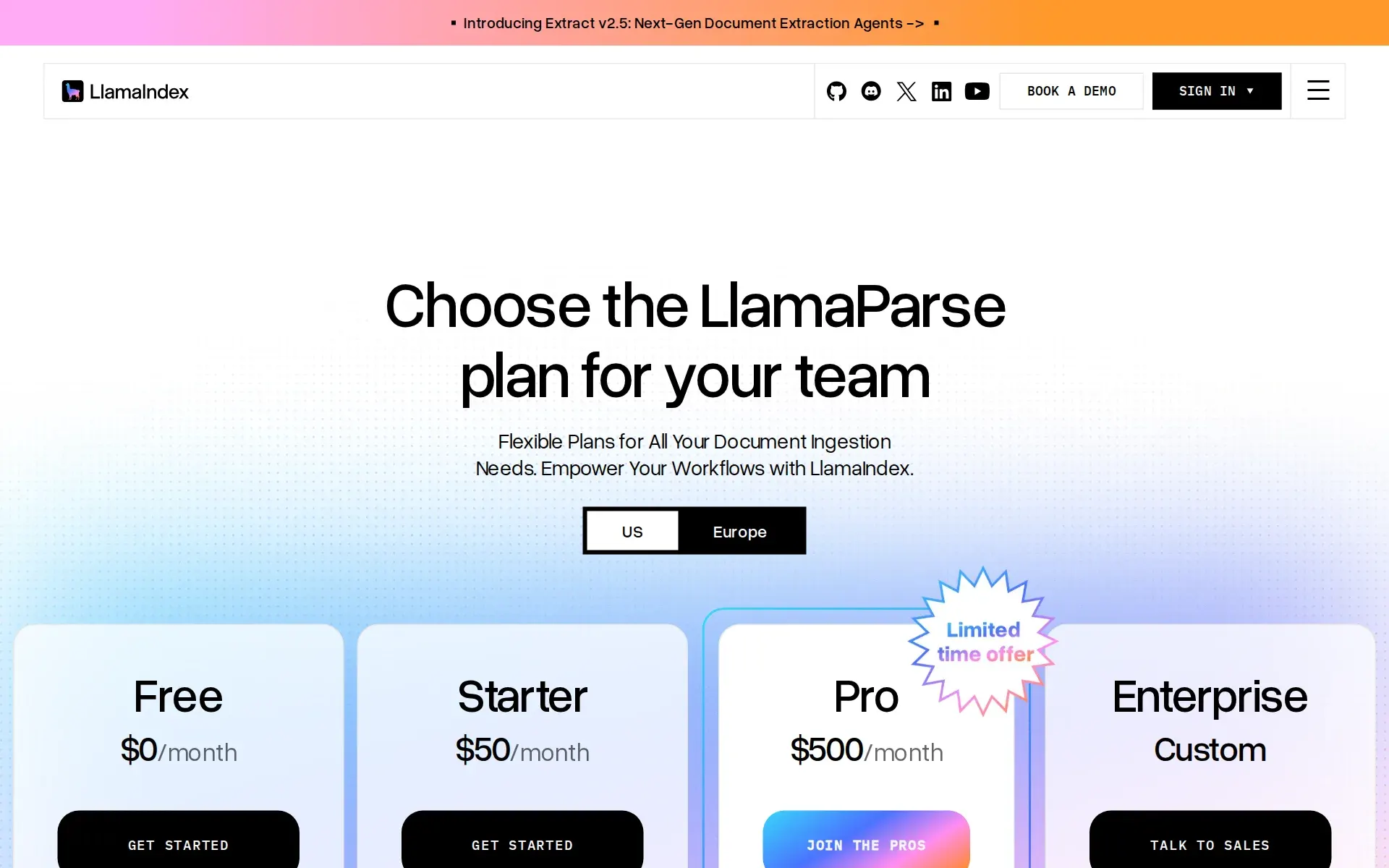
- YesBilling is credit-metered on top of a flat monthly plan fee: each parse, index or extract action spends credits at 1,000 credits for $1.25, plans bundle 10K to 400K credits, and pay-as-you-go above the bundle is capped per plan ($500/mo on Starter, $5,000/mo on Pro).
The LlamaIndex platform operates on a credit-based system, where each action—such as parsing, indexing, or extracting—costs a certain number of…
llamaindex.ai/pricing - Free credit
- Yes$12.50 of free usage (10,000 credits at $0.00125 each), a month.
It provides a generous provision of 10k free credits a month to all new users, but is not open source.
llamaindex.ai/pricing - Free tier
- YesFree plan self-serve with 10,000 credits a month, no sales call.llamaindex.ai/pricing
- API access
- YesOne API key drives every product from Python, TypeScript, Go, Java or REST.
One API key, one SDK, and five composable products: Parse (agentic OCR), Extract (structured data), Classify, Split, and Index.
developers.llamaindex.ai/llamaparse - MCP server
- YesHosted MCP server with OAuth exposes parse, classify, extract, split and index tools to any MCP client, in NA and EU.
Instead of wiring up the REST API or SDK yourself, you connect your agent to the MCP server once and let it parse documents, extract structured data,…
developers.llamaindex.ai/llamaparse/for… - Bring your own key
- YesSelf-hosted deployments call providers with your own keys; on the v1 hosted API 'Use your own API key' bills 1 credit per page.
All LLM calls go directly from your cluster to providers using your own API keys and contracts.
developers.llamaindex.ai/llamaparse/sel…
Buying it for a team
- A company can buy it
- YesOrganizations hold members and projects; Enterprise is contracted with sales.
This is done through the use of Organizations, which has a list of team members that have access to all resources under that organization.
developers.llamaindex.ai/llamaparse/gen… - Seat model
- NoNot sold per seat: Free, Starter and Pro each include 100 users and price on credits instead.llamaindex.ai/pricing
- Pooled budget
- PartlyPlan credits belong to the organization, but API keys and incurred billing stay scoped to the individual user.
Every user within an organization has the same level of access to the projects and other resources under that organization. However, API keys and any…
developers.llamaindex.ai/llamaparse/gen… - Admin controls
- NoManaged service has no role separation: organization members all hold the same access level.
Every user within an organization has the same level of access to the projects and other resources under that organization.
developers.llamaindex.ai/llamaparse/gen… - Audit log
- NoThe plan comparison's security rows stop at compliance, VPC, SSO/MFA and custom BAAs; no audit log is offered on any tier.
SOC2, HIPAA, and GDPR compliance
llamaindex.ai/pricing - Single sign-on
- PartlySSO & MFA is an Enterprise-only row; self-hosted deployments integrate OIDC with Entra ID or Okta.
Enterprise authentication - OIDC integration with your identity provider (Microsoft Entra ID, Okta, and others)
developers.llamaindex.ai/llamaparse/sel…
What happens to your code
- Opt out of training
- YesNothing is used for training by default, and do_not_cache=True skips the 48-hour cache entirely.
Your data is kept private to you only and is used only to return your results, never for model training.
developers.llamaindex.ai/llamaparse/gen… - Data residency
- YesChoose North America (us-east-1) or Europe (eu-central-1); uploaded data stays in its region, and regions cannot be migrated or linked.
Data will be stored within the region it is uploaded to. If interacting with LlamaCloud EU for example, all data provided will remain within the EU…
developers.llamaindex.ai/llamaparse/gen… - Getting out
- PartlyResults export as markdown, JSON, XLSX or parquet and files can be deleted, but credits do not roll over and bonus credits vanish on downgrade.
Unused bonus credits expire immediately if you downgrade.
llamaindex.ai/pricing - Certifications
- YesSOC 2 Type 2 certified, HIPAA compliant and GDPR-adherent; BAAs are Enterprise-only.
LlamaCloud adheres to the General Data Protection Regulation (GDPR) and all other applicable laws and regulations governing our services. We are also…
developers.llamaindex.ai/llamaparse/gen…
Plans and pricing
Price and terms
- Free plan
- YesYes
The terms in full
Free plan at $0/month with 10K credits included (the page's FAQ calls it 10k free credits a month), 100 users, 5 concurrent parse jobs, 5 indexes, 50 files per index, 1 project, file upload only as a data source, community support, and no pay-as-you-go.
What needs a higher plan
- Enterprise
- Self-hosted, Single sign-on
From llamaindex.ai/pricing, checked .
The Agents Index digest
Price changes and new agents like LlamaIndex, at most once a week.
Last issue: Devin vs Claude Code: Which Should You Pick? · 13 October 2026
Works with
 Claude
 GPT
GPT- PartlyOpen models
LlamaIndex open-source framework
For AI agents
- MCP server
- Yes
- API
- Yes
Screenshots
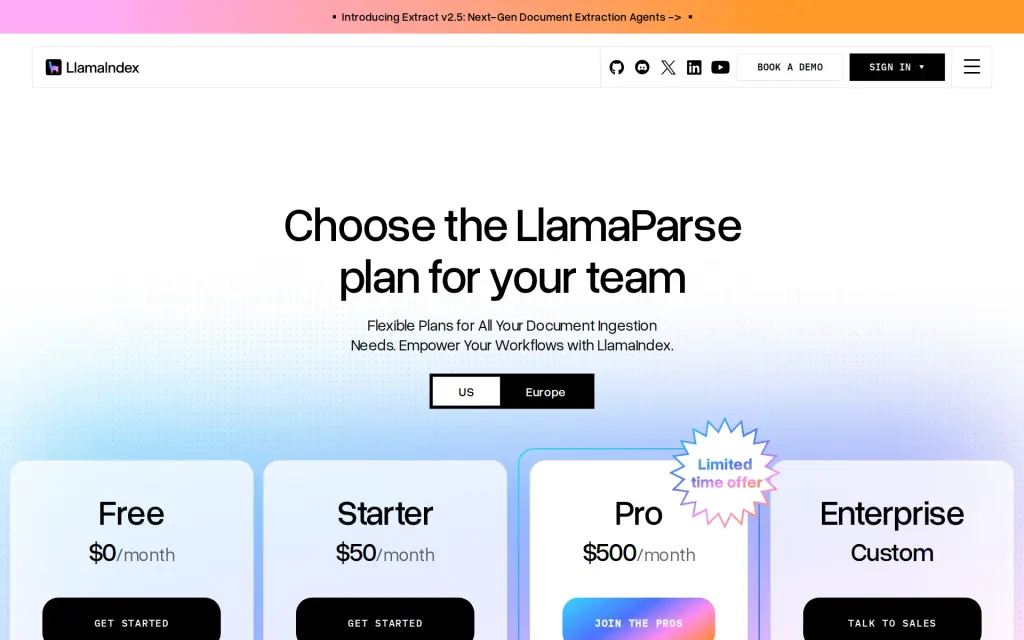
Pricing page, llamaindex.ai, captured 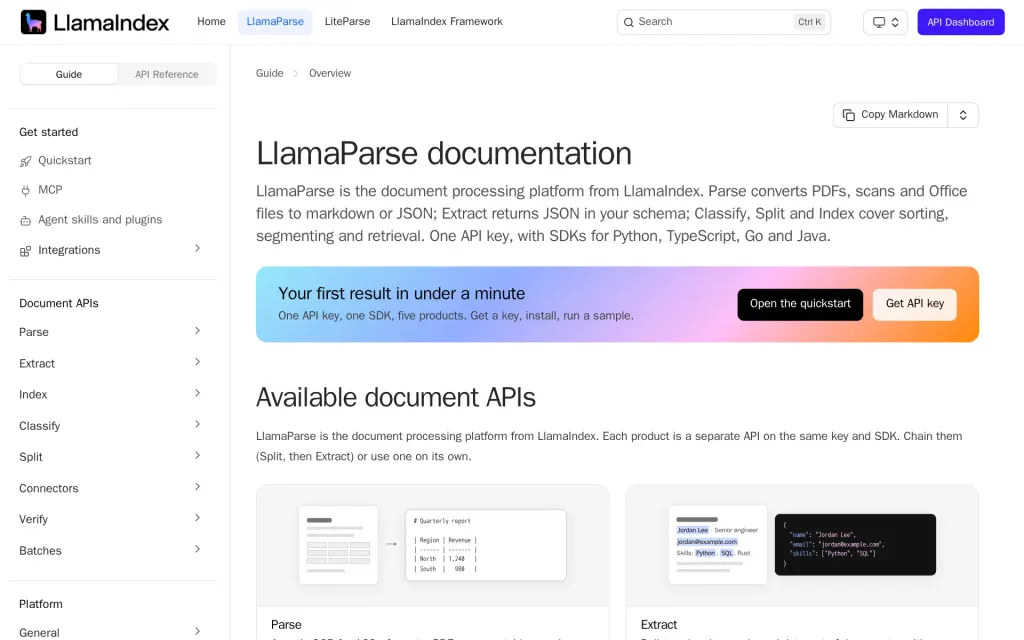
Docs, llamaindex.ai, captured
Filed under
Sources and updates
Last changed
Sources23
- llamaindex.ai/pricing
- developers.llamaindex.ai/llamaparse/self_hosting
- llamaindex.ai/llamaindex
- developers.llamaindex.ai/llamaparse/general/organizations
- developers.llamaindex.ai/llamaparse
- developers.llamaindex.ai/llamaparse/for-agents/mcp
- developers.llamaindex.ai/llamaparse/general/faq
- developers.llamaindex.ai/llamaparse/general/pricing
- developers.llamaindex.ai/llamaparse/general/regions
- llamaindex.ai/workflows
- llamaindex.ai/
- developers.llamaindex.ai/for-agents
- developers.llamaindex.ai/llamaparse/extract
- developers.llamaindex.ai/llamaparse/for-agents/skills
- developers.llamaindex.ai/llamaparse/general/api_key
- developers.llamaindex.ai/llamaparse/general/billing
- developers.llamaindex.ai/llamaparse/self_hosting/configuration/user-roles
- developers.llamaindex.ai/python/framework/getting_started/starter_example_local
- developers.llamaindex.ai/python/framework/module_guides/models/llms
- developers.llamaindex.ai/python/framework/understanding/agent/human_in_the_loop
- developers.llamaindex.ai/python/llamaagents/llamactl/cd-with-github-actions
- developers.llamaindex.ai/python/llamaagents/llamactl/getting-started
- api.github.com/repos/run-llama/llama_indexRepository
Repository30 August 2026
- Licence
- MIT
- Stars
- 51,919
- Forks
- 8,054
- Last push
- 29 August 2026
The Agents Index in AI answers0 of 1
- PerplexityDoes not cite The Agents IndexAsked
LlamaIndex alternatives
on Other sources: g2.com, unsiloed.ai, vantaige.io, spotsaas.com, costbench.com, us.fitgap.com
Updates6
- Capabilities · Free tier · Plan limits
- Capabilities · Free tier · Terms
- Capabilities · Free tier · Price · Terms
- Alternatives · Documentation link · LinkedIn link · Repository · Summary · Tagline
- Tag:claude
- Summary · Tagline
Is this yours? Claim it free and edit it in your dashboard, or feature it in Agent frameworks.