
Not for Teams needing complex branching workflows, automatic step-by-step checkpointed state or compliance-grade audit trails. A graph framework like LangGraph fits better.
The facts, with their sources
What it does
- Writes code
- PartlyThe SDK is a toolkit for building a code-writing agent rather than a ready-made one: sandbox agents get filesystem editing and an apply_patch tool, but you supply the agent, prompt and model.
Sandbox Agents in the Agents SDK give the model a persistent workspace where it can search large document sets, edit files, run commands, generate…
openai.github.io/openai-agents-python/s… - Debugs and fixes
- PartlySandbox agents can run commands and edit files in a real workspace, which covers diagnosing and fixing, but the vendor documents this as a harness you configure, not a diagnosis capability it guarantees.
Run a coding, review, or document agent inside a real isolated workspace
openai.github.io/openai-agents-python - Writes tests
- PartlyAdding a regression test is given as a sandbox multi-step workflow example; no dedicated test-generation feature is documented. The SDK's own testing utilities test agent workflows, not application code.
multi-step workspace tasks, for example fixing a bug in one run and adding a regression test later, or resuming from snapshot or sandbox session state
openai.github.io/openai-agents-python/s… - Reviews code
- PartlyThe docs present reviewing as one of the workloads a sandbox agent can be pointed at, but no review-specific tooling, diff ingestion or pull-request integration is documented by the vendor.openai.github.io/openai-agents-python
- Whole-codebase work
- PartlyA sandbox manifest can stage a whole local directory or git repository into the workspace, so repository-wide work is possible, but the vendor documents staging and sessions rather than any migration or indexing capability.
default_manifest: the files, repos, directories, and mounts for fresh sandbox sessions
openai.github.io/openai-agents-python/s… - Done-for-you service
- NoThere is no service engagement of any kind: this is a Python package you install and operate yourself, with the vendor supplying only the library, docs and examples.
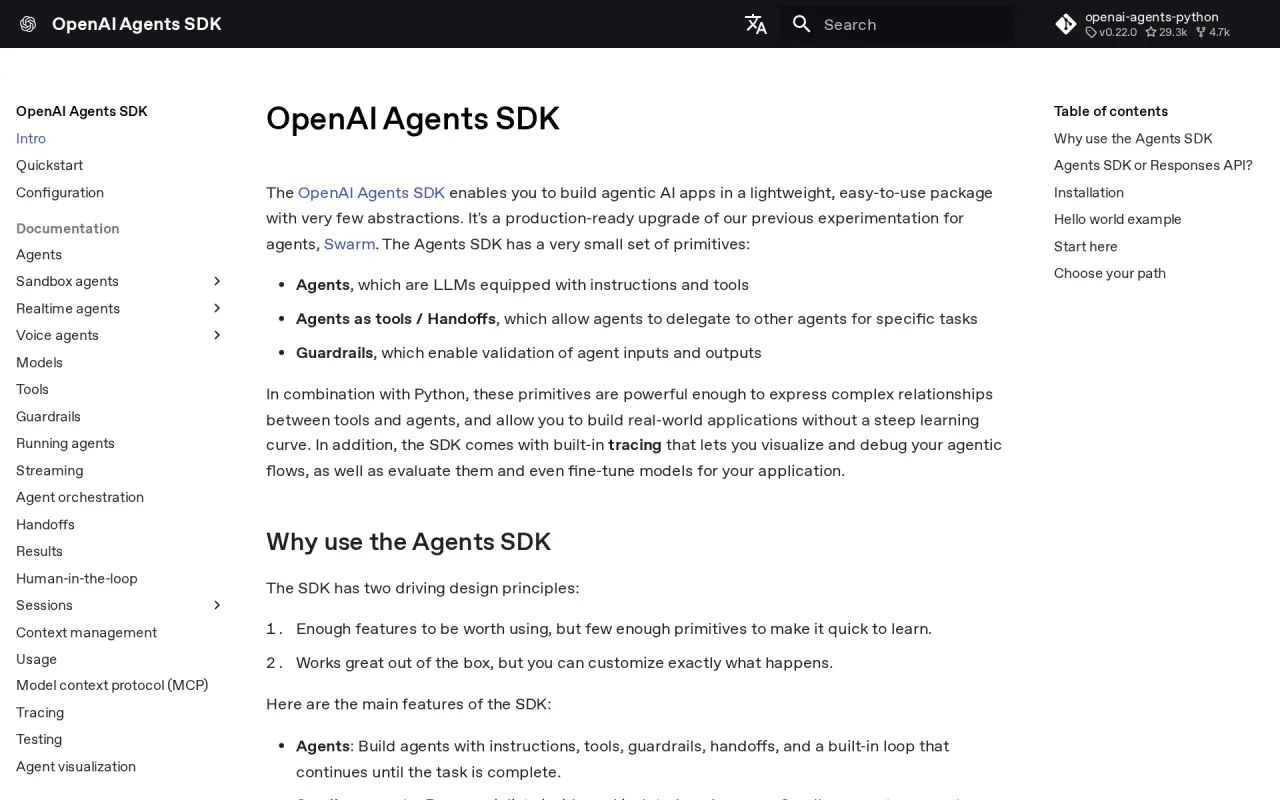
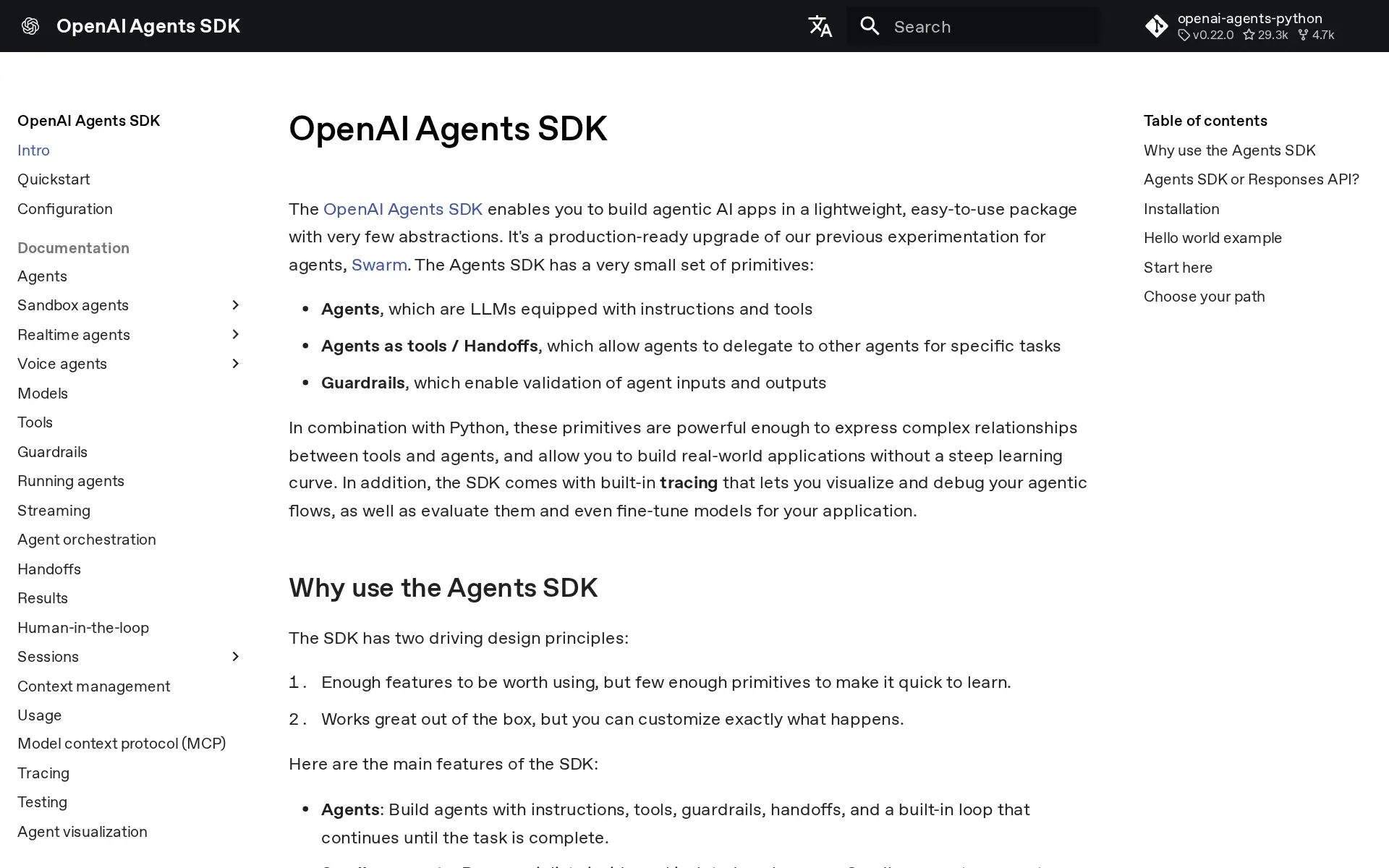
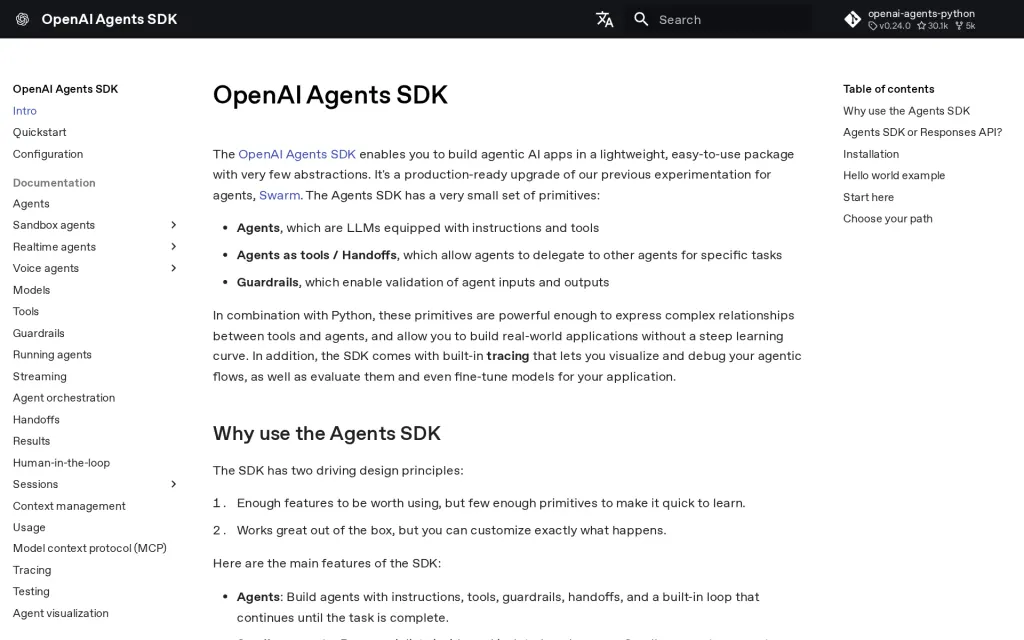
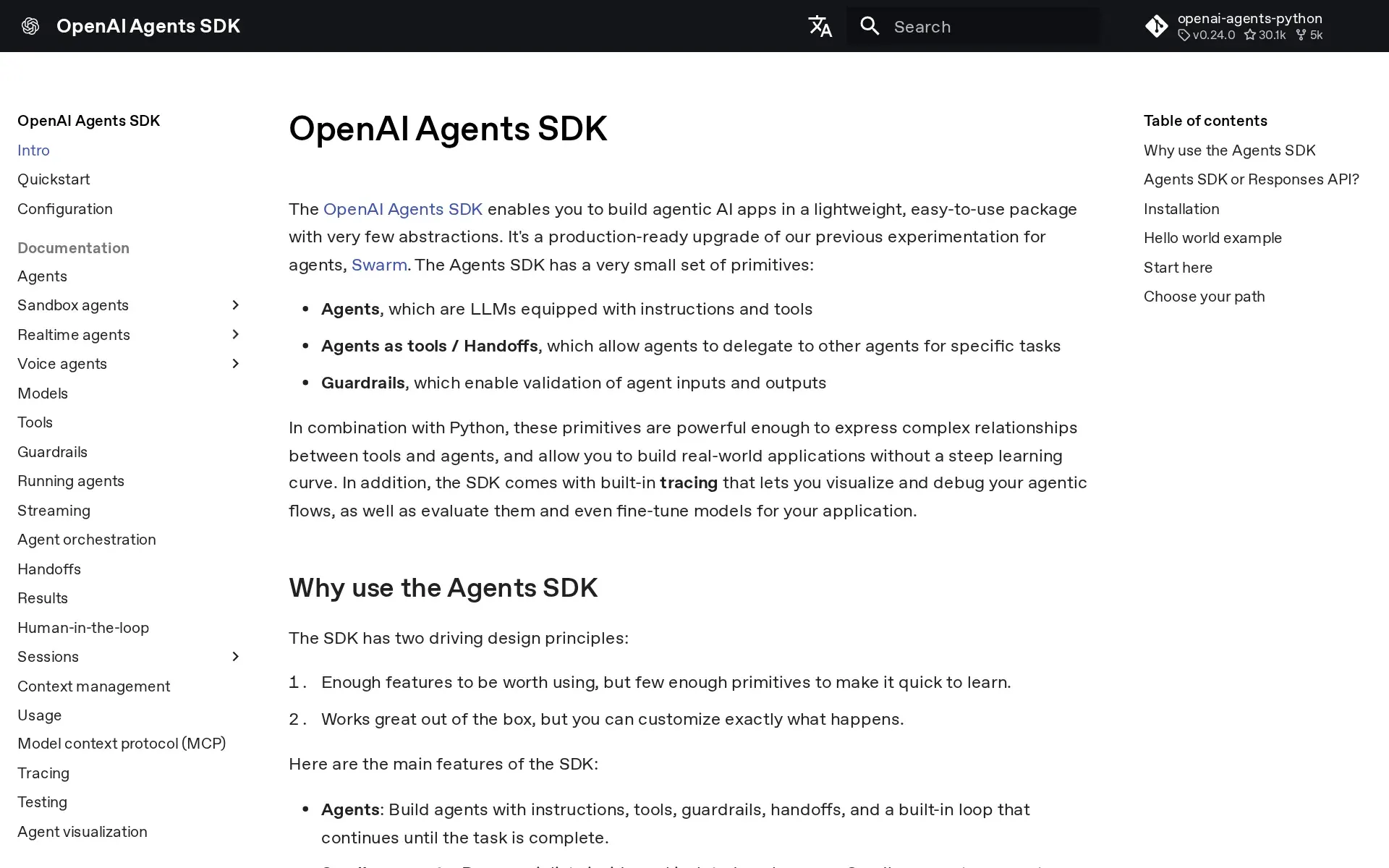
The OpenAI Agents SDK is a lightweight yet powerful framework for building multi-agent workflows.
github.com/openai/openai-agents-python
How much it does unattended
- Runs autonomously
- YesThe runner drives its own loop across model turns, tool calls and handoffs until the task finishes, so a run can complete with no human intervention unless you attach approvals.
Agents: Build agents with instructions, tools, guardrails, handoffs, and a built-in loop that continues until the task is complete.
openai.github.io/openai-agents-python - Multi-agent
- YesCoordination is a core primitive: agents can hand off the conversation to a specialist, or an orchestrator can call other agents as tools within one run.
Agents as tools / Handoffs: A powerful mechanism for coordinating and delegating work across multiple agents.
openai.github.io/openai-agents-python - Agent permissions
- YesTools declare when they need approval, the run pauses and surfaces interruptions, and the serialized run state can be approved or rejected before resuming, including for shell, apply_patch and MCP tools.
Use the human-in-the-loop (HITL) flow to pause agent execution until a person approves or rejects sensitive tool calls.
openai.github.io/openai-agents-python/h…
Which models it runs on
- Claude
- PartlyThe SDK names only OpenAI models; non-OpenAI providers are reached through OpenAI-compatible endpoints or the beta Any-LLM and LiteLLM adapters, and Claude is never named in the docs.
It is provider-agnostic, supporting the OpenAI Responses and Chat Completions APIs, as well as 100+ other LLMs.
github.com/openai/openai-agents-python - GPT
- YesOpenAI models are the default path, supported natively through both the Responses API and the Chat Completions API, with a GPT-5 family model used when an agent sets none.
The Agents SDK comes with out-of-the-box support for OpenAI models in two flavors:
openai.github.io/openai-agents-python/m… - Open models
- PartlyAny OpenAI-compatible endpoint or the beta Any-LLM/LiteLLM adapters can be used, which covers self-hosted open-weight serving, but no open-weight model or local runtime is named in the docs.
set_default_openai_client is useful in cases where you want to globally use an instance of AsyncOpenAI as the LLM client. This is for cases where the…
openai.github.io/openai-agents-python/m… - Model choice
- YesYou choose the model per agent, per run or globally, and any OpenAI-compatible endpoint can be substituted by setting a base URL and key; adapters extend this to further providers.github.com/openai/openai-agents-python
Where you use it
- On the command line
- Yesrun_demo_loop gives an interactive terminal chat session with streaming and retained history; it is a demo/testing loop, not a packaged CLI binary.
The SDK provides run_demo_loop for quick, interactive testing of an agent's behavior directly in your terminal.
openai.github.io/openai-agents-python/r… - In a browser
- PartlyThere is no hosted web application for building or running agents; the only web surface is OpenAI's Traces dashboard, where runs recorded by built-in tracing can be inspected.
Using the Traces dashboard, you can debug, visualize, and monitor your workflows during development and in production.
openai.github.io/openai-agents-python/t…
Whose machine it runs on
- Self-hosted
- YesThe framework and its local runtime tools execute entirely in your own process or environment; only model inference and optional trace export leave your infrastructure.
Local runtime tools execute outside the model response itself. The model still decides when to call them, but your application or configured…
openai.github.io/openai-agents-python/t… - Open source
- YesThe full source is published on GitHub under the permissive MIT licence, allowing use, modification, redistribution and commercial sublicensing without fee.
Permission is hereby granted, free of charge, to any person obtaining a copy of this software and associated documentation files (the "Software"), to…
raw.githubusercontent.com/openai/openai…
What it costs to run
- How it meters
- PartlyThe framework itself is charged for in no unit at all, being MIT-licensed and free; what a buyer actually pays is their model provider's token metering plus any hosted tool usage, billed outside this product.
Permission is hereby granted, free of charge, to any person obtaining a copy of this software
raw.githubusercontent.com/openai/openai… - Free tier
- YesNo sales contact, account or subscription is involved: the package installs from PyPI and the licence grants use free of charge, though running an agent needs a model provider key.raw.githubusercontent.com/openai/openai…
- API access
- YesThe product is itself a programmatic interface: agents, tools and the runner are ordinary Python objects you compose inside your own application, with no separate API tier or key to obtain.
Python-first: Use built-in language features to orchestrate and chain agents, rather than needing to learn new abstractions.
openai.github.io/openai-agents-python - MCP server
- PartlyThe SDK acts as an MCP client across stdio, SSE, Streamable HTTP and hosted transports, so agents can consume MCP tools; no documentation describes exposing the SDK itself as an MCP server another agent could query.
The Agents Python SDK understands multiple MCP transports. This lets you reuse existing MCP servers or build your own to expose filesystem, HTTP, or…
openai.github.io/openai-agents-python/m… - Bring your own key
- YesYou always bring your own inference credentials, and any OpenAI-compatible endpoint can be pointed at by setting base URL and key, so the vendor never resells inference through this package.
This is for cases where the LLM provider has an OpenAI compatible API endpoint, and you can set the base_url and api_key.
openai.github.io/openai-agents-python/m…
Buying it for a team
- Admin controls
- PartlyConstraints are real but developer-defined in code — approval rules, guardrails and tool filters, plus network policy on hosted shell containers — rather than an administrator console governing what a fleet of agents may do.
require_approval enables human-in-the-loop approval policies on local MCP tools.
openai.github.io/openai-agents-python/m… - Audit log
- PartlyBuilt-in tracing records a detailed run history of model calls, tool calls, handoffs and guardrails, but that is execution telemetry rather than a log of administrative actions, and it can be disabled outright.
The Agents SDK includes built-in tracing, collecting a comprehensive record of events during an agent run: LLM generations, tool calls, handoffs,…
openai.github.io/openai-agents-python/t…
What happens to your code
- Getting out
- PartlyPaused run state serialises to JSON you store yourself and sessions can be backed by your own SQLite or Redis, so data stays portable; nothing is documented about exporting traces already sent to OpenAI's backend.
Use state.to_json() or state.to_string() to store pending work in a database or queue and recreate it later with RunState.from_json(...) or…
openai.github.io/openai-agents-python/h…
Plans and pricing
Price and terms
- Free plan
- YesYesThe framework is MIT-licensed and free to install and run with no tier, quota or expiry
The terms in full
Costs arise only outside the package: model inference is billed by whichever provider's API key you supply, and hosted tools such as web search, file search or container shell are billed by OpenAI.
Checked .
The Agents Index digest
Price changes and new agents like OpenAI Agents SDK (Python), at most once a week.
Last issue: Devin vs Claude Code: Which Should You Pick? · 13 October 2026
Works with
 Claude
Partly
 GPT
GPT- PartlyOpen models
For AI agents
- MCP server
- Partly
- API
- Yes
Screenshots
Docs, openai.github.io, captured
Filed under
Sources and updates
Last changed
Sources15
- openai.github.io/openai-agents-python
- github.com/openai/openai-agents-pythonRepository
- openai.github.io/openai-agents-python/models
- openai.github.io/openai-agents-python/sandbox/guide
- raw.githubusercontent.com/openai/openai-agents-python/main/LICENSE
- openai.github.io/openai-agents-python/sandbox_agents
- openai.github.io/openai-agents-python/human_in_the_loop
- openai.github.io/openai-agents-python/mcp
- openai.github.io/openai-agents-python/tracing
- github.com/openai/openai-agents-python/blob/main/LICENSERepository
- openai.github.io/openai-agents-python/config
- openai.github.io/openai-agents-python/repl
- openai.github.io/openai-agents-python/tools
- openai.github.io/openai-agents-python/usage
- api.github.com/repos/openai/openai-agents-pythonRepository
Repository30 August 2026
- Licence
- MIT
- Stars
- 29,068
- Forks
- 4,632
- Last push
- 28 August 2026
Coverage elsewhere3
The Agents Index in AI answers0 of 1
- PerplexityDoes not cite The Agents IndexAsked
OpenAI Agents SDK (Python) alternatives
on Other sources: beri.net, infrabase.ai, videosdk.live, futureagi.com, libhunt.com, hostinger.com
Updates4
- Capabilities · Free tier · Price · Terms
- Capabilities · Free tier · Terms
- Capabilities · Free tier · Terms
- Alternatives · Documentation link · Repository · Summary · Tagline
Is this yours? Claim it free and edit it in your dashboard, or feature it in Agent frameworks.