
The facts, with their sources
What it does
- Writes code
- YesAn Issue labelled ai-ready is implemented by a coding session in an isolated git worktree, so new code is authored from the Issue description rather than from a chat prompt.
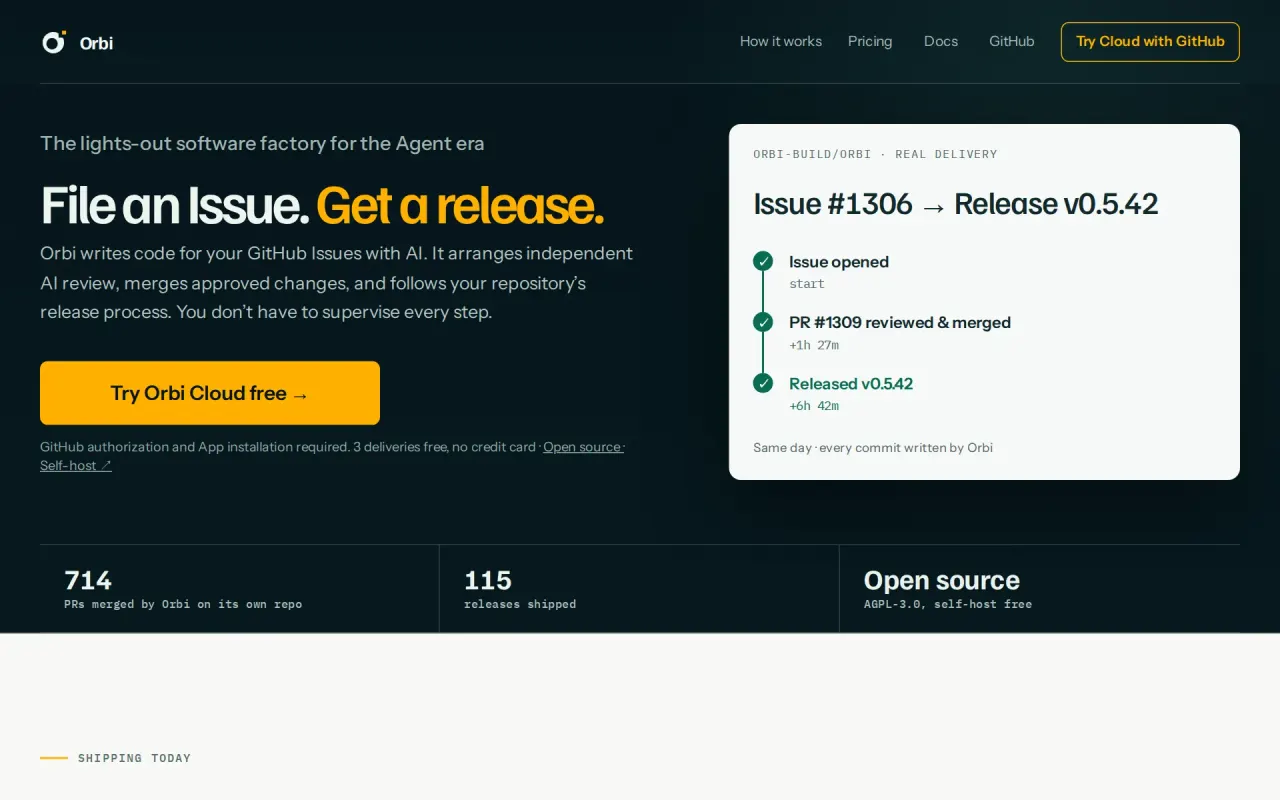
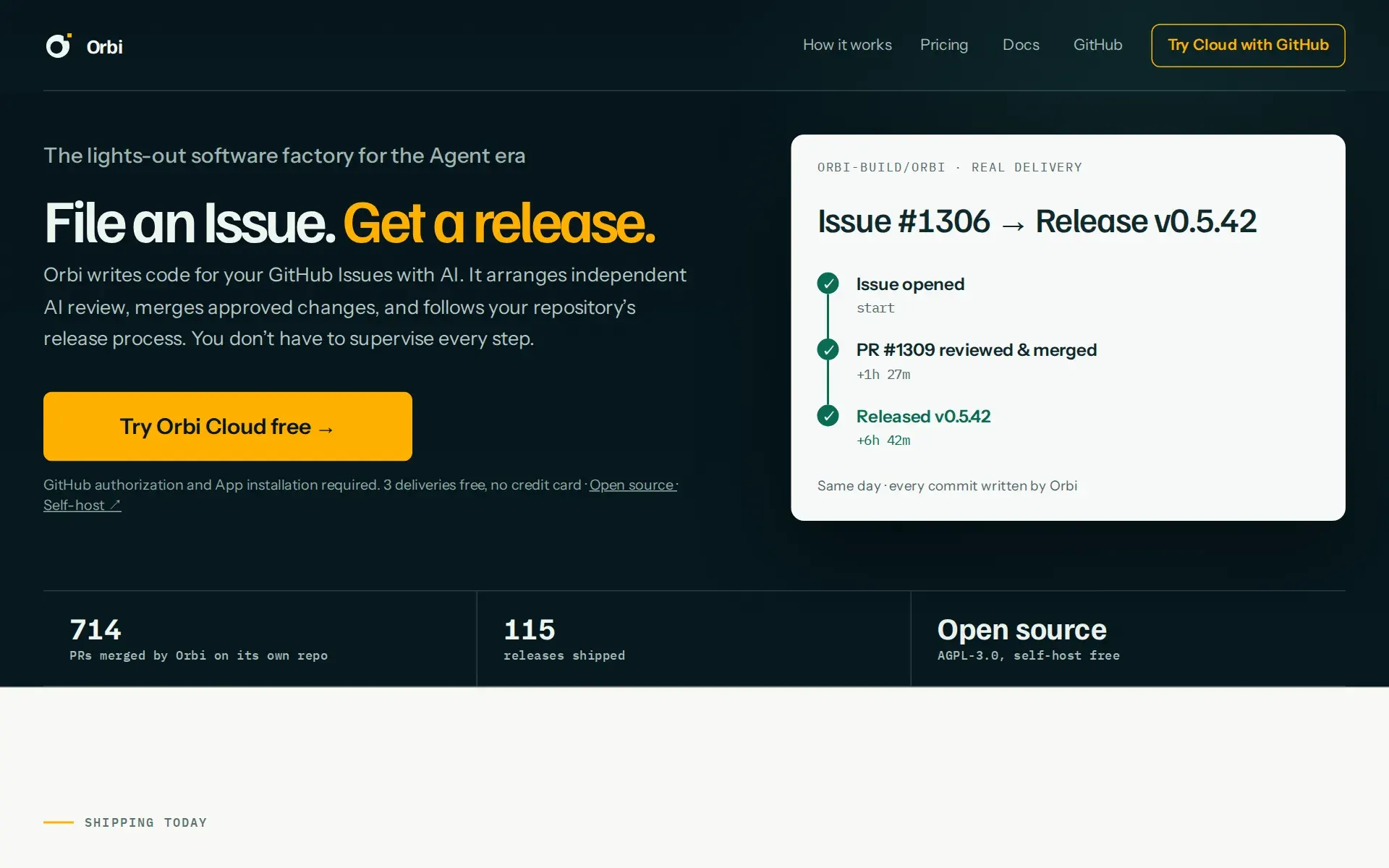
Orbi picks it up and writes the code in an isolated worktree.
orbi.build - Debugs and fixes
- YesThe independent review session does not only comment: it edits the branch, reruns the full suite against its own repairs and judges the repaired head, which is the diagnose-and-fix loop.
The reviewer changes code, reruns the suite, and judges the repaired head.
orbi.build - Writes tests
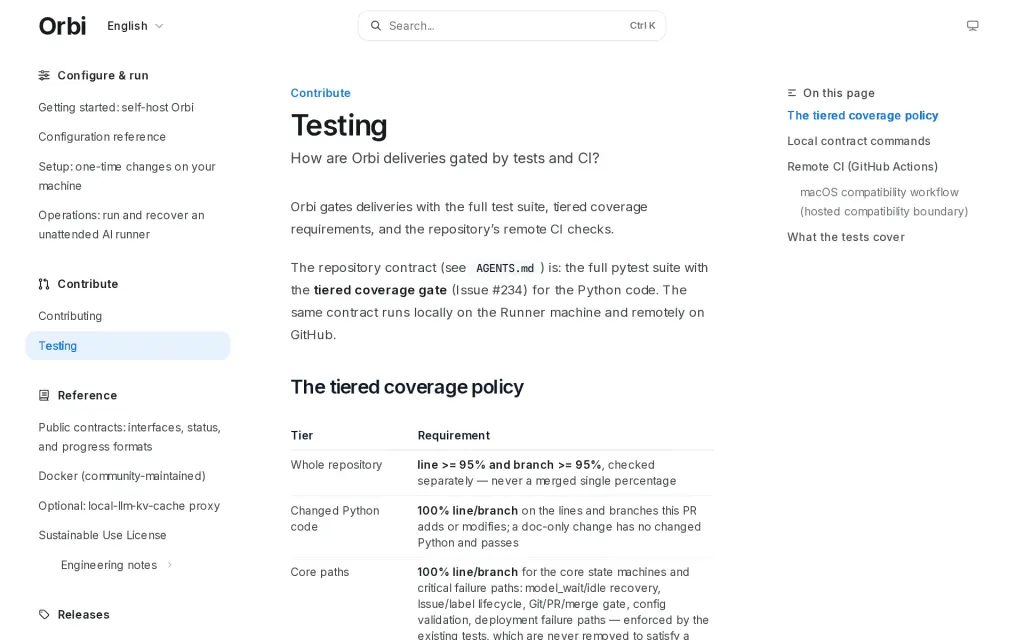
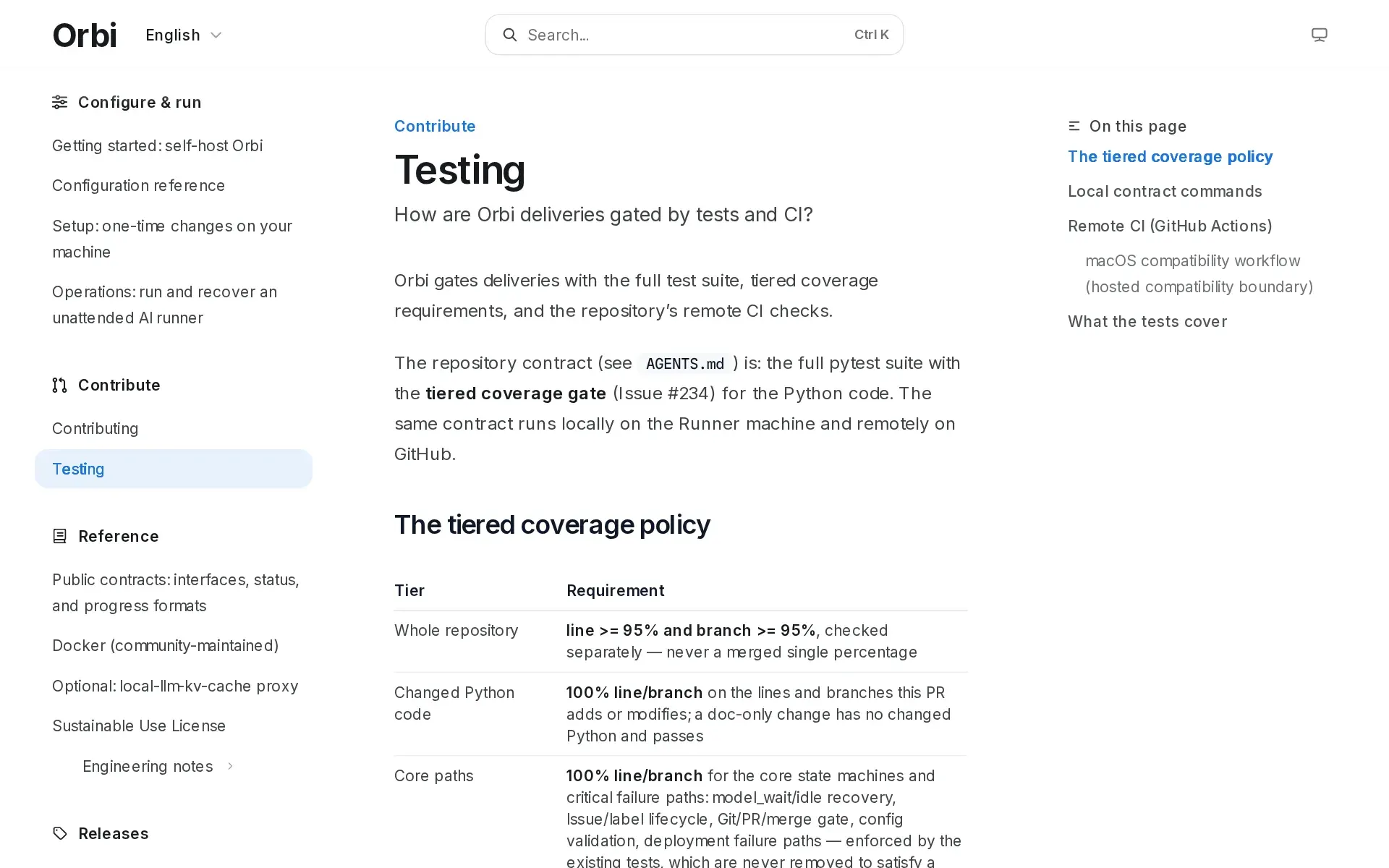
- PartlyDeliveries are gated by the repository's own test suite and coverage tiers, and the documented contract requires tests in the same PR, but the site never advertises test authoring as a standalone capability.
When you change code, update or add tests in the same PR and keep the coverage gate green.
docs.orbi.build/testing - Reviews code
- PartlyReview is the core of the product, but it reviews the diff Orbi's own implementing session produced; the site documents no path for reviewing a pull request a human opened.
It checks the PR against the Issue's acceptance criteria and fixes what fails.
orbi.build - Whole-codebase work
- PartlyIt works inside a whole existing repository including large ones, but each tick handles at most one Issue and the vendor states there is no task DAG, so a staged multi-Issue migration is not orchestrated for you.
Orbi has no task DAG, multi-agent parallelism, risk model, policy engine, or fallback path.
docs.orbi.build/security - Ships it
- PartlyIt goes past the diff to a merged commit, a frozen SHA, a git tag and a published GitHub Release, but a human must label the release Issue and nothing is deployed to your infrastructure.
Releases are never automatic. You open the release Issue and apply the ai-release label — a label only humans set.
orbi.build/cloud - Done-for-you service
- NoNo people are sold with it: you either run the open-source runner yourself or subscribe to a hosted runner on the vendor's machines, with setup described as a GitHub sign-in and App install.
Orbi Cloud runs the same GitHub-native delivery line as self-hosted Orbi — Issue in, worktree, tests, independent review and repair, exact-head merge…
orbi.build/cloud
How much it does unattended
- Runs autonomously
- YesFrom a labelled Issue to a merged pull request nobody is required in the loop; the human gates are the ai-ready label at the start, branch protection, and the release label at the end.
AI coding agents write the code, a separate AI reviews it, and Orbi merges and ships the release with nobody watching.
orbi.build - Multi-agent
- PartlyTwo separate sessions act on one delivery, implementer and independent reviewer, optionally on different models, but the vendor explicitly denies multi-agent parallelism or a task graph.
A second session that did not write the code reviews the PR and fixes findings in-session. review_pi_* lets that session run on another model.
docs.orbi.build - Agent permissions
- PartlyThe agent is fenced hard: it commits but never pushes, never opens the PR, never merges and never touches protected branches; only the runner process merges, and only the reviewed head.
The Pi does not merge, does not push main/master, does not force push, and never auto-resolves conflicts.
docs.orbi.build/security
Which models it runs on
- Claude
- PartlyThe vendor states Orbi can wrap Claude Code as the coding engine inside its delivery line, but no Anthropic entry appears in the published provider template catalogue, so it is a claim without a configuration recipe.
Orbi is not a Claude Code alternative: it can run Claude Code as the engine inside its own delivery line.
orbi.build/compare/claude-code - GPT
- YesAn OpenAI path is documented two ways: a ChatGPT/Codex subscription login inside an interactive session, and a GitHub Models template pinning an OpenAI model id in the provider catalogue.
A ChatGPT/Codex subscription works too: run /login codex inside an interactive pi session.
orbi.build/guides/self-hosted-coding-ag… - Open models
- YesOpen-weight models are a first-class path: a local Qwen template ships with the provider catalogue, and any OpenAI-compatible local server fills the same slot with no vendor key.
The providers guide ships a Local Qwen template (local-qwen.json, Qwen3.8-27B), and any OpenAI-compatible endpoint fits the same slot.
orbi.build/guides/self-hosted-coding-ag… - Model choice
- YesYou choose the model when self-hosting and can change it later by editing two selectors; Cloud includes a default model instead, with bring-your-own-key supported there as well.
Orbi drives the agent through your credentials, using any OpenAI-compatible API or a locally hosted model, and you can change your mind later without…
orbi.build
Where you use it
- In your editor
- NoThe vendor positions Orbi against editors rather than inside them: there is no IDE or editor extension, and the product is defined as what runs when nobody is typing.
Those are editors — they make you faster while you are typing. Orbi is what happens when nobody is typing
orbi.build - On the command line
- YesThe self-hosted product is a command-line runner: an orbi CLI with setup, doctor and sync subcommands, started by a systemd user timer on Linux or launchd on macOS.
orbi setup checks the prerequisites; it never installs system packages or gh for you.
orbi.build/guides/self-hosted-coding-ag… - In your pipeline
- YesIt acts on pull requests end to end and is bound to your CI result: the merge gate requires a concluded, mergeable check state, and the release gate uses the repository's GitHub Actions run.
The release's test acceptance is your repository's CI result — the GitHub Actions check runs on the release commit
orbi.build/cloud - In a browser
- PartlyCloud adds a hosted web path, with GitHub sign-in, a connect page and a status page, while the self-hosted core is documented as having no web UI at all.
GitHub Issues and labels are the only state store; Orbi has no database, message queue, or web UI.
docs.orbi.build/security
Whose machine it runs on
- Self-hosted
- YesRunning it on your own machine is the primary mode, with your repository, keys and test suite staying local and nothing uploaded to the vendor.
Self-hosted: your repository, keys, and test suite stay on your machine; nothing is uploaded to us.
orbi.build - Open source
- YesThe core runner is published source under a copyleft licence, with an alternative non-AGPL licence offered for teams whose policy rules out AGPL, and self-hosting free under either.
Open source under AGPL-3.0, or the Sustainable Use License if your policy rules out AGPL.
orbi.build
What it costs to run
- How it meters
- YesCloud is a flat monthly subscription with a monthly token allowance and a repository count, not a seat price; self-hosting carries no platform fee and you pay your model provider per use.
Solo includes 400M tokens a month and Pro includes 1.2B tokens a month. When the applicable allowance runs out, new deliveries pause — there is no…
orbi.build/cloud - Free tier
- YesTwo free routes with no sales call: the self-hosted core is free forever under either licence, and Cloud starts with three merged deliveries without a credit card.
Self-hosted: US$0 under AGPL-3.0 or the Sustainable Use License; bring your own model key.
orbi.build/cloud - API access
- PartlyYou drive it from your own stack through GitHub itself and the orbi CLI rather than an Orbi API: the vendor states the product exposes no database, queue or web service of its own.
GitHub Issues and labels are the only state store; Orbi has no database, message queue, or web UI.
docs.orbi.build/security - Bring your own key
- YesBring your own model is the self-hosted default and spend goes straight to your provider; Cloud also accepts a customer-configured key, stored encrypted and decrypted only for runner injection.
Model API keys: BYOK keys are stored AES-GCM encrypted in the control plane; API reads return only a masked value, and decryption is only for runner…
orbi.build/cloud
Buying it for a team
- A company can buy it
- PartlyAnyone can subscribe through Stripe self-serve, but the only published plans are a single-repository Solo and a five-repository Pro; no organisation, team or enterprise tier is offered.
Cloud has two paid plans, Solo and Pro.
orbi.build/cloud - Seat model
- NoNothing is priced or counted per user: the plan limits are connected repositories and monthly tokens, so there is no seat floor, ceiling or per-user charge to negotiate.
Solo connects up to 1 repository at a time; Pro connects up to 5. Once you reach the limit, deactivate a repository on the connect page before…
orbi.build/cloud - Pooled budget
- YesOne monthly token allowance belongs to the subscription and is consumed by every connected repository, so Pro's five repositories draw on the same balance and pause together when it is gone.
Solo includes 400M tokens a month and Pro includes 1.2B; when the applicable allowance runs out, new deliveries pause — there is no per-token overage…
orbi.build/cloud - Admin controls
- YesA repository may carry a delivery-policy file whose keys are whitelisted, credential-routing and prompt keys stay host-only, and a file declaring a host-only key fails the claim immediately.
A repository file that declares any host-only key fails the claim fast and the Issue becomes ai-blocked with the offending keys named.
docs.orbi.build/security - Audit log
- PartlyEvery delivery action is recorded as inspectable GitHub evidence plus a local journal with run ids and merge facts, but there is no administrative audit log of account or policy changes.
Issues, labels, comments and the PR are the complete delivery record. Orbi uses no database or second task system.
docs.orbi.build - Single sign-on
- PartlySign-in is GitHub OAuth only, with no separate Orbi credential to manage; no SAML or OIDC identity-provider integration is documented on any plan.
Sign in with GitHub One OAuth click. Your repositories, your account — no separate Orbi credential.
orbi.build/cloud
What happens to your code
- Opt out of training
- PartlySelf-hosting removes the question entirely since nothing is uploaded, but on Cloud the delivery data reaches a model provider and the vendor defers retention and processing to that provider's terms.
With a customer-configured key, the selected model provider receives that delivery data instead. Provider retention and processing are governed by…
orbi.build/privacy - Data residency
- PartlyThe vendor names its hosting provider and the control-plane store, and worktrees are destroyed after a quiet period, but no country, region or choice of jurisdiction is published.
The hosted runner runs on machines operated by Orbi at Vultr and clones the connected repository for the duration of a delivery.
orbi.build/privacy - Getting out
- PartlyYour work never leaves GitHub so there is nothing to export, and account deletion is by email request rather than self-serve; monthly token allowances are stated per month, not as carried credits.
To request deletion of your Orbi account and associated Cloud records, email privacy@orbi.build with the GitHub account or tenant to identify.
orbi.build/privacy
Plans and pricing
Price and terms
- Free plan
- YesYesSelf-hosting is free forever under AGPL-3.0 or the Sustainable Use License (US$0, bring your own model key)
The terms in full
Separately, Orbi Cloud starts with a trial of 3 successful merged deliveries, no credit card required, and failed deliveries don't count.
Checked .
Works with
 Claude
Partly
 GPT
- YesOpen models
For AI agents
- API
- Partly
Screenshots
Docs, orbi.build, captured
Filed under
Sources and updates
Sources9
Updates2
- Website
- Capabilities · Free tier · Price · Terms