
Summary
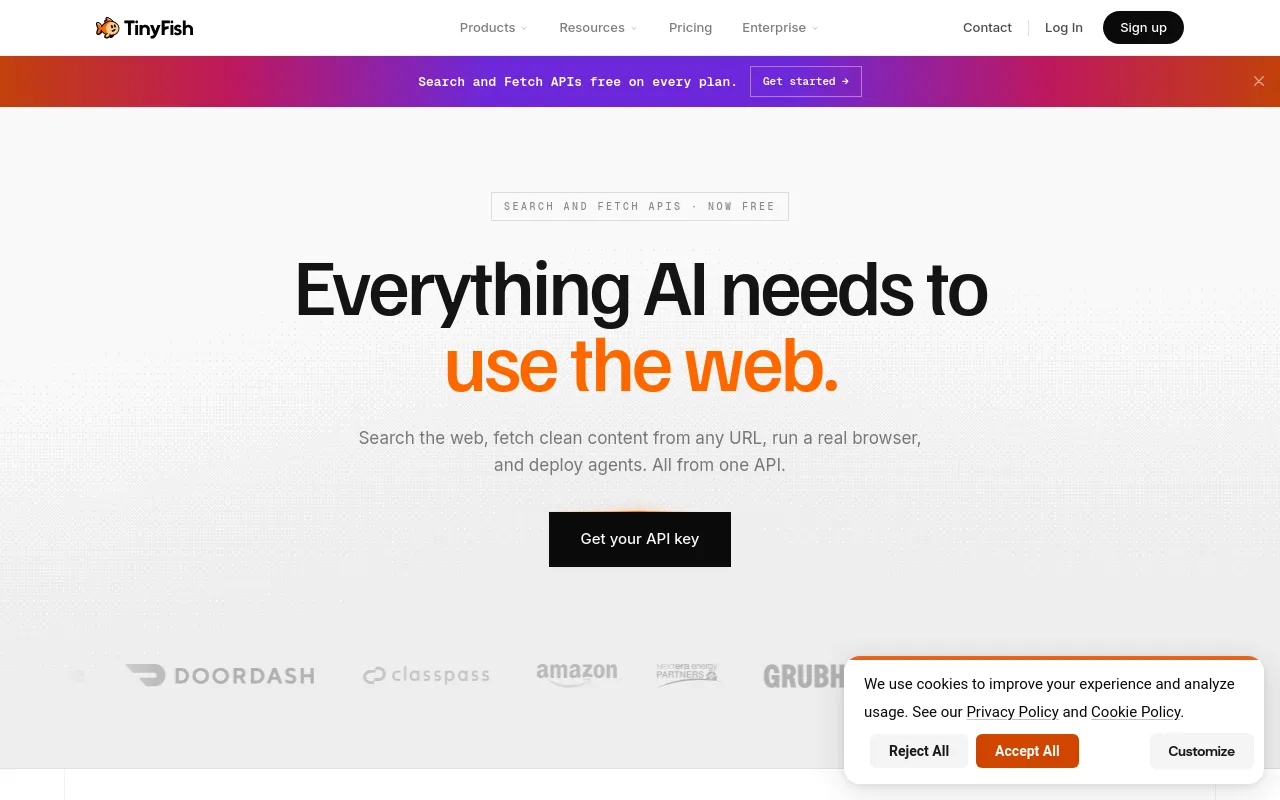
TinyFish is web infrastructure for AI agents: a search API, a page-fetch API, remote stealth browser sessions, and a web agent that navigates and authenticates into live sites. It runs on Mako, TinyFish's own web-native model.
- Best for
- Developers who need free structured web data plus paid browser automation on one key
- Not for
- Teams that need airtight CAPTCHA bypass out of the box: TinyFish still routes the toughest CAPTCHAs to third-party solvers like CapSolver, adding extra tooling and cost for sites with aggressive bot defenses.
- From
- Freethen $0.016/agent step
- Free tier
- YesSearch free at 30 requests/min and 500 requests/hour; Fetch free at 150 urls/min and 1,000 urls/day, at any Wallet balance. New accounts also start with $8 of Wallet funds for Agent and Browser, no card required.
What it does
- Done-for-you service
- NoYou run software: four self-serve APIs, with a contract and tuned limits on Enterprise.
TinyFish gives you four public API surfaces: Agent, Search, Fetch, and Browser.
docs.tinyfish.ai
How much it does unattended
- Runs autonomously
- YesGiven a goal it navigates, adapts and continues until the goal is complete.
Give Web Agent the result you need. It moves through the website, observes what changed, adjusts the next step, and continues until the goal is…
tinyfish.ai/agent - Multi-agent
- NoRuns execute in parallel but each works independently toward its own goal; no coordination is claimed.
Run Web Agent across many accounts, sites, records, filings, products, or locations at once. Each browser run works independently toward its own goal…
tinyfish.ai/agent - Agent permissions
- PartlyRuns unattended, but credentials are scoped per run through a connected password vault and the agent never sees them.
Select credentials per run and TinyFish handles login securely — the AI agent never sees your actual passwords.
docs.tinyfish.ai/faq.md
Which models it runs on
- Claude
- NoInference is TinyFish's own; Claude appears only as an MCP client, not as a selectable model.
LLM inferenceAgent The model the agent reasons with. No key to bring, no provider bill on top.
tinyfish.ai/pricing - GPT
- NoNo provider model selection; the run includes TinyFish's own inference.
LLM inferenceAgent The model the agent reasons with. No key to bring, no provider bill on top.
tinyfish.ai/pricing - Open models
- NoRuns on Mako, the vendor's own web-native model; no open-weight option is offered.
The web-native AI model that completes real workflows on the live web. Reliable at scale, at a fraction of frontier-model cost.
tinyfish.ai/mako - Model choice
- NoThe vendor picks the model; inference is bundled into the per-step rate.
You pay for the agent work performed. TinyFish handles token costs, browsers, storage, retries, proxies, and run infrastructure.
tinyfish.ai/agent
Where you use it
- In your editor
- YesHosted MCP server installs into Cursor, Windsurf, Claude Code, Codex and OpenCode.
Connect TinyFish to Claude, Codex, OpenCode, Grok, Cursor, ChatGPT, or any MCP-compatible AI assistant.
docs.tinyfish.ai/mcp-integration.md - On the command line
- YesA CLI ships alongside the SDKs and MCP endpoint and can start a run from a goal.
Start from a goal in the CLI, MCP, SDK, API, or your own automation stack.
tinyfish.ai/agent - In your pipeline
- PartlyThe CLI documents a headless CI/CD authentication path, but nothing acts on a pull request or reports into a build.
TINYFISH_API_KEY | API key — takes priority over saved config
docs.tinyfish.ai/cli - In a browser
- YesA hosted dashboard and playground run goals, manage profiles and hold Wallet controls.
Wallet top-ups and auto-reload changes happen in the dashboard, not through this tool.
docs.tinyfish.ai/mcp-integration.md
Whose machine it runs on
- Self-hosted
- PartlyCloud-hosted by default; VPC deployment is an Enterprise item and on-premises needs a separate written agreement.
The Services are provided as a hosted, cloud-based offering. On-premises deployment of the Services, if any, requires a separate written agreement.
tinyfish.ai/terms - Open source
- NoThe service is closed; only the cookbook of examples is published openly.
reproduce, modify, translate, enhance, decompile, disassemble, reverse engineer, or create derivative works of the Services
tinyfish.ai/terms
What it costs to run
- How it meters
- YesMetered per agent step and per browser-minute against a prepaid Wallet; Search and Fetch are free.
Agent Limit: 2 concurrent runs $0.016 per step Browser Limit: 5 concurrent sessions $0.002 per minute
tinyfish.ai/pricing - Free tier
- YesSearch and Fetch are free at any balance, and new accounts get $8 of Wallet funds before adding a card.
New accounts start with $8 in Wallet funds, so you can run Agent and Browser before you add a card.
tinyfish.ai/pricing - API access
- YesFour REST APIs (Agent, Search, Fetch, Browser) with Python and TypeScript SDKs and webhooks.
| Agent | `https://agent.tinyfish.ai/v1/automation/...` |
docs.tinyfish.ai - MCP server
- YesHosted MCP server with OAuth 2.1 exposes automation, search, fetch, browser-session and wallet tools.
TinyFish MCP uses OAuth 2.1 for secure authentication. The first time you connect, your browser will open to complete the OAuth flow.
docs.tinyfish.ai/mcp-integration.md - Bring your own key
- NoInference, browsers and proxies are supplied by TinyFish; there is no key to bring.
The model the agent reasons with. No key to bring, no provider bill on top.
tinyfish.ai/pricing
Buying it for a team
- A company can buy it
- YesEnterprise path adds a contract, a security review and workload-set limits; Order Forms bill net 30.
For teams that need limits set to their workload, a contract, and a security review.
tinyfish.ai/pricing - Seat model
- NoNo seats and no subscription; you fund a Wallet and pay for usage.
There is no subscription and no seats. You add funds and spend them on what you run.
tinyfish.ai/pricing - Pooled budget
- YesOne prepaid balance per account that all Agent and Browser usage draws from; no per-seat allowances exist.
A prepaid balance on your account. Agent and Browser draw from it as they run; Search and Fetch never do. There is no subscription and no seats.
tinyfish.ai/pricing - Admin controls
- PartlyRole-based access over credential handling is described as an Enterprise governance capability; no self-serve policy controls are published.
Encrypted credential handling with role-based access and audit logging
tinyfish.ai/enterprise - Audit log
- PartlyAudit logs are listed as an Enterprise addition; pay-as-you-go accounts get run logs, screenshots and source URLs instead.
Adds –Rate limits and concurrency set to your workload –ISO 27001 –Enterprise SSO –Audit logs –VPC deployment –99.99% uptime SLA
tinyfish.ai/pricing - Single sign-on
- PartlyEnterprise SSO is an Enterprise-tier addition; the protocol is not named, and self-serve auth is API keys or OAuth 2.1 for MCP.
Adds –Rate limits and concurrency set to your workload –ISO 27001 –Enterprise SSO –Audit logs –VPC deployment –99.99% uptime SLA
tinyfish.ai/pricing
What happens to your code
- Opt out of training
- NoThe standard terms license customer data for model training, with no published opt-out; a negotiated Custom Agreement controls over these terms.
train, fine-tune, evaluate, and improve Tiny Fish's artificial intelligence and machine learning models, subject to commercially reasonable…
tinyfish.ai/terms - Data residency
- PartlyThe privacy policy allows cross-border processing with safeguards but names no jurisdiction; the country codes in proxy_config route requests, they do not place data.
Your information may be transferred to and processed in countries other than your country of residence.
tinyfish.ai/privacy-policy - Getting out
- PartlyRuns and their artifacts are retrievable through the API, and paid balance never expires, but promotional balance expires in 12 months and is forfeited on termination.
Purchased Balance does not expire. Promotional Balance may expire, be modified, or be revoked as stated in the applicable offer or notice and, if no…
tinyfish.ai/terms - Certifications
- PartlyISO 27001:2022 is certified and published in a Vanta trust center; no SOC 2 is listed, and GDPR/CCPA appear only as data-subject rights.
Information about Tiny Fish's security and compliance posture, including its ISO 27001 certification, is available at https://trust.tinyfish.ai.
tinyfish.ai/terms
29 sourced claims on this page. Checked 2026-09-03. How we check.
Filed under
Sources and updates
The pages we read15
Every fact below comes from the vendor. Nothing here is independently corroborated yet.
- tinyfish.ai/pricing17 fields
- tinyfish.ai/agent5 fields
- tinyfish.ai/terms5 fields
- docs.tinyfish.ai/mcp-integration3 fields
- docs.tinyfish.ai/mcp-integration.md3 fields
- docs.tinyfish.ai/2 fields
- docs.tinyfish.ai/cli2 fields
- docs.tinyfish.ai/faq2 fields
- tinyfish.ai/integrations2 fields
- tinyfish.ai/mako2 fields
- tinyfish.ai/1 field
- tinyfish.ai/enterprise1 field
- docs.tinyfish.ai/faq.md1 field
- docs.tinyfish.ai/plugins1 field
- tinyfish.ai/privacy-policy1 field
Coverage elsewhere1
Updates6
- Capabilities · Commercial terms · Free tier
- Capabilities · Commercial terms
- Capabilities · Commercial terms · Free tier · Links · Price
- Capabilities · Commercial terms · Links
- Deployment
- Created · One-liner · Summary