
The facts, with their sources
What it does
- Writes code
- PartlyAutopilot generates and extends agent logic from a prompt inside the canvas, and third-party coding agents can author the same projects, but what it writes is agent configuration on a low-code canvas rather than source code in your repository.
Autopilot generates and extends agent logic inside the canvas.
uipath.com/platform/agentic-automation/… - Writes tests
- PartlyIt ships an evaluation harness rather than a test writer: evals score agent outcomes against ground truth before deploy and Optimize proposes changes, but you author the eval sets and none of this produces unit tests for a codebase.
Evals score outcomes against ground truth before deploy. Optimize proposes targeted changes. Drift between deploys becomes visible.
uipath.com/platform/agentic-automation/… - Ships it
- YesIt does not stop at a design: the agent is published and deployed as an Orchestrator process, the CLI provisions a serverless machine and robot user for it, and Orchestrator then schedules and monitors the runs.
On the UiPath Platform, governed and orchestrated alongside robots, APIs, and humans. UiPath Maestro coordinates long-running cases; Orchestrator…
uipath.com/platform/agentic-automation/… - Done-for-you service
- NoThis is licensed software the customer operates, pitched explicitly at the business user building the agent themselves; UiPath sells no build-and-run service on this page, only a trial and a demo.
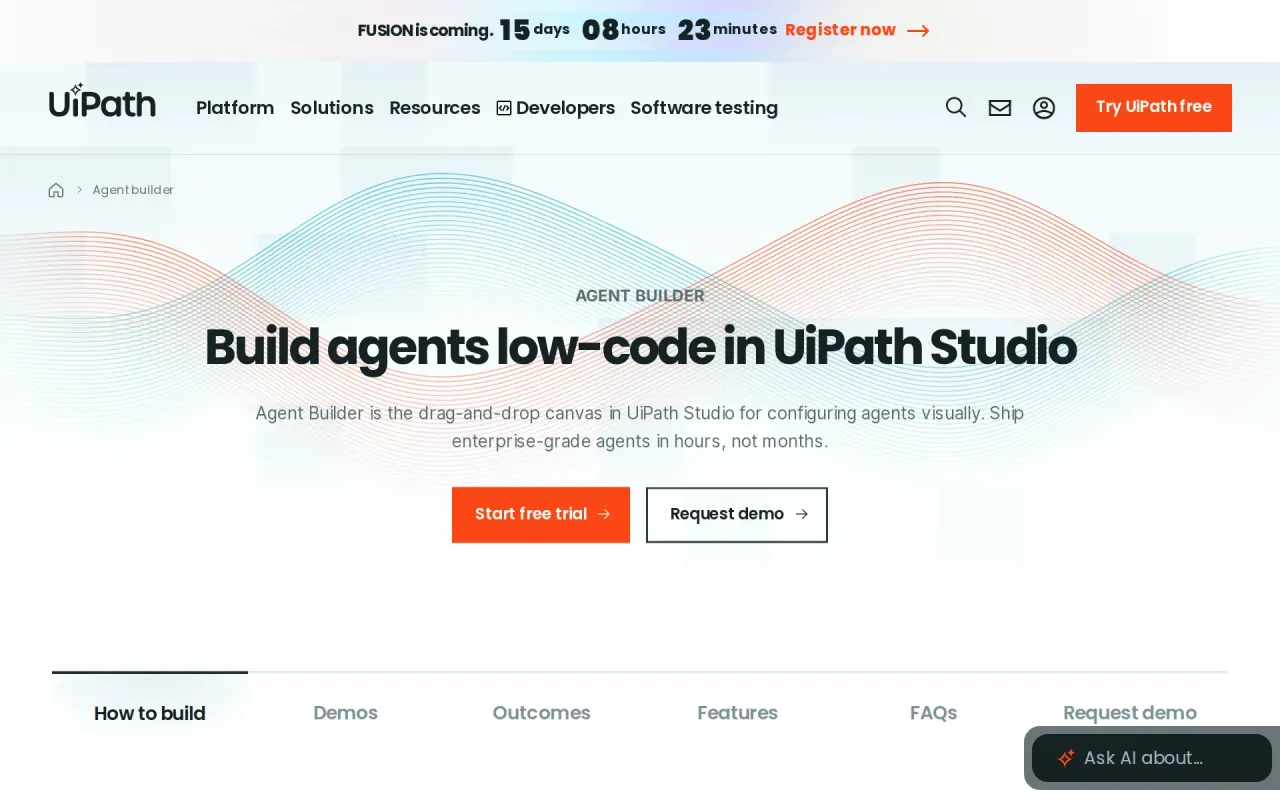
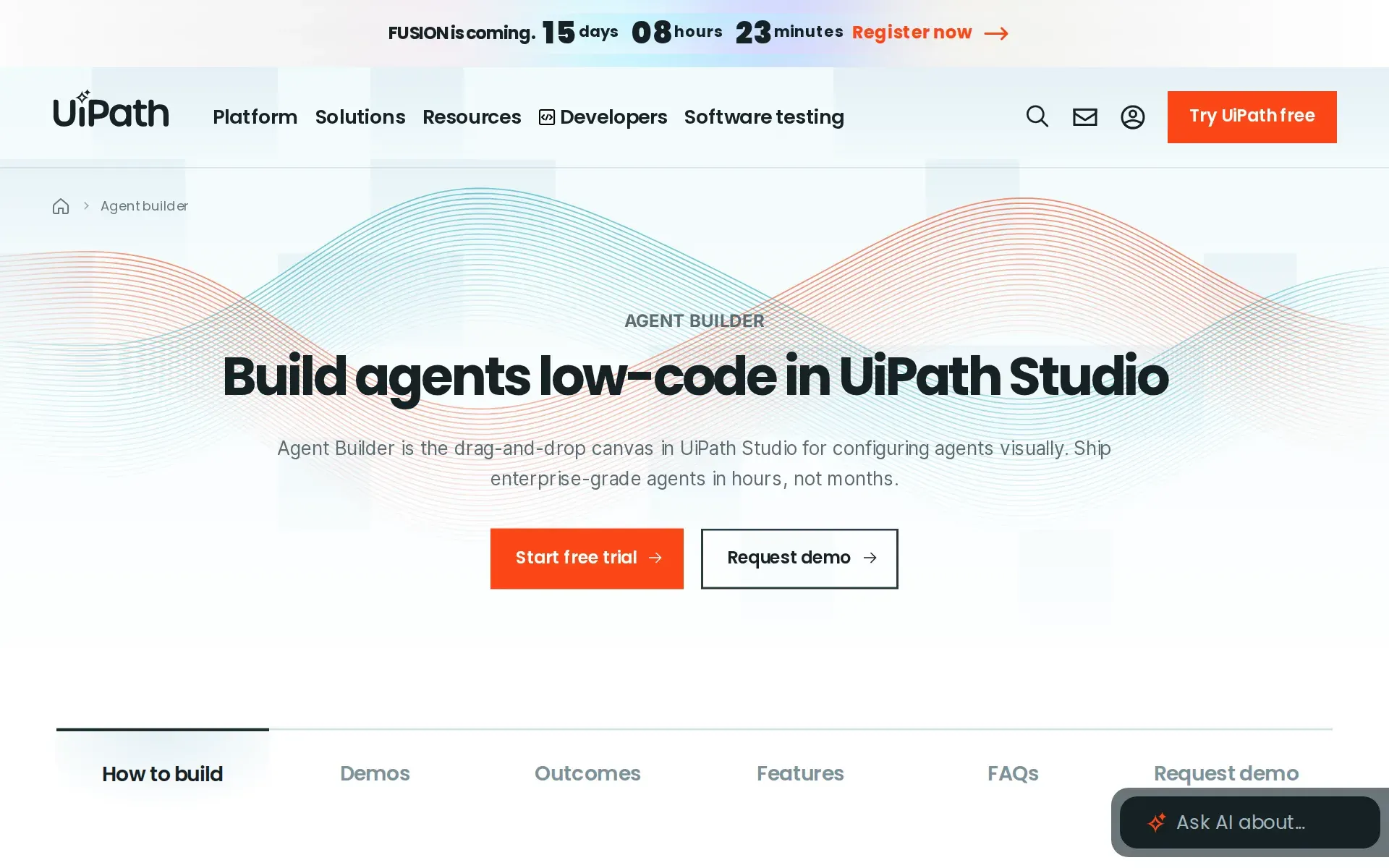
Agent Builder in UiPath Studio gives the people closest to the process a visual canvas to configure, test, and ship agents, without handing off to a…
uipath.com/platform/agentic-automation/…
How much it does unattended
- Runs autonomously
- YesAutonomous is one of the two agent types you pick at creation, human escalation is marked optional in the build flow, and a deployed agent runs as an unattended Orchestrator job; UiPath itself steers high-stakes regulated work back to deterministic automation.
Autonomous: Create an agent that acts independently to complete a given task.
docs.uipath.com/agents/automation-cloud… - Multi-agent
- YesTwo separate mechanisms: an agent can add another published agent as a tool and chain capabilities, and Maestro coordinates several agents, robots and people across one BPMN process.
An agent can invoke other agents published in your tenant, letting you compose more complex workflows by chaining agent capabilities together.
docs.uipath.com/agents/automation-cloud… - Agent permissions
- YesThe agent can act only through tools you explicitly grant it, per-tool guardrails evaluate deterministic rules before and after each call with Log, Filter, Block or Escalate actions, and a max-iterations setting caps its reasoning loops.
Without giving an agent explicit access to a tool, the agent is not able to execute functions (outside of Context Grounding and Escalations, which…
docs.uipath.com/agents/automation-cloud…
Which models it runs on
- Claude
- YesAnthropic is one of only three model providers the Agents documentation lists as selectable for an agent, served through AWS Bedrock, and you choose it per agent in the Properties panel.
Anthropic models through AWS Bedrock
docs.uipath.com/agents/automation-cloud… - GPT
- YesOpenAI is a first-class provider in the Agents model documentation and in the platform LLM configuration table, selectable per agent alongside Anthropic and Google.
OpenAI GPT models
docs.uipath.com/agents/automation-cloud… - Open models
- PartlyNo open-weight family appears in the closed docs table of models supported for Agents, which lists only Google, OpenAI and Anthropic; open-source models are offered only for on-premises Automation Suite, plus a generic connector for any OpenAI-V1-compatible endpoint.
Route inference to OpenAI GPT, Anthropic Claude, or Google Gemini. Or run UiPath-recommended open-source models entirely on-premises. Your governance…
uipath.com/product/automation-suite - Model choice
- YesYou pick the model per agent from the Properties panel, models are provisioned through the AI Trust Layer, and the vendor states a model can be swapped later without rebuilding the agent.
Model-agnostic by design. Connect any third-party LLM or use UiPath-curated models. Switch models without rebuilding the agent. AI Trust Layer…
uipath.com/platform/agentic-automation/…
Where you use it
- In your editor
- PartlyThe canvas lives in an IDE, but it is UiPath's own browser IDE Studio Web, not your editor: the Studio product page assigns AI agents to Studio Web and names Studio Desktop for RPA and coded workflows, and there is no VS Code or JetBrains extension for the low-code canvas.
Studio Desktop is the Windows IDE for complex RPA, desktop automation, and coded C# workflows. Studio Web is the browser-based IDE for AI agents, API…
uipath.com/product/studio - On the command line
- YesA dedicated CLI drives the low-code agent projects themselves, not just the Python path: it scaffolds, validates, packs, pushes back into the Agent Builder UI, deploys and runs them, and is separate from the coded-agent tool.
uip agent is the Agent tool: it scaffolds, configures, validates, packages, and operates low-code agents — the agent.json-driven projects authored in…
docs.uipath.com/uipath-cli/standalone/l… - In your pipeline
- PartlyUiPath publishes a complete GitHub Actions recipe that packs and deploys agent solutions, but the pricing comparison puts pipeline integration in the Enterprise column only, with an em dash against both Basic and Standard.
Manage the code of your automation projects in external repositories via source control and pipelines Integrate or build a CI/CD pipeline
uipath.com/pricing - In a browser
- YesThe build surface is hosted: you open studio.uipath.com in a browser, and UiPath positions Studio Web as the cloud-native IDE whose primary use case is AI agents.
Best for: AI agents, API workflows, agentic process modeling, apps, and cross-platform teams. Cloud-native, continuously updated.
uipath.com/product/studio
Whose machine it runs on
- Self-hosted
- PartlySelf-hosting is real but doubly bounded: Agent Builder is named as included in Automation Suite on AKS, EKS or OpenShift including air-gapped, while the Automation Suite on Linux flavour has agentic AI only planned, and the Basic plan carries an em dash for deploying in your own environment.
Automation Suite brings UiPath agentic capabilities to self-hosted environments. Orchestrate multi-agent workflows with Maestro. Design and deploy…
uipath.com/product/automation-suite - Open source
- NoThe only open source UiPath claims here is third-party framework support on the code-first path; the platform and the Agent Builder canvas are proprietary, distributed as licensed software with no published source.
Open-source framework support for LangChain and LlamaIndex. AI coding agents like Claude Code, Codex, and Cursor as a first-class build path.
uipath.com/platform/agentic-automation/…
What it costs to run
- How it meters
- YesTwo meters at once: named-user seats plus consumption units drawn per LLM call inside an agent run, charged in 64k input-token increments, with customer-managed models instead billed once per agent run.
For UiPath-hosted models, consumption is based on the number of LLM calls made during an agent run, with rates varying by model tier.
docs.uipath.com/agents/automation-cloud… - Free tier
- YesYou can start without a sales call three ways: a standing Community plan that includes building agents in Studio Web, a self-serve 60-day trial, and the self-serve 25 dollar Basic tier bought by card at checkout.
The Community plan gives you free access to the UiPath agentic platform.
docs.uipath.com/automation-cloud/automa… - API access
- YesAn OpenAPI 3.0 Orchestrator API plus OAuth external applications let your own stack drive the platform, and API triggers start an agent job over HTTP; the feature table marks API triggers for agents unavailable on Public Sector and Dedicated.
API triggers offer a streamlined way of starting a job via HTTP, through a custom request URL created by you.
docs.uipath.com/orchestrator/automation… - MCP server
- YesBoth directions are documented: an agent can add external MCP servers as tools, and a UiPath MCP Server exposes deployed agents and automations as tools at a URL the docs say external MCP clients connect to.
This URL is used by both UiPath agents and external MCP clients to connect to the server.
docs.uipath.com/orchestrator/automation… - Bring your own key
- PartlyBring-your-own-subscription and bring-your-own-model are both documented and the Agents row says custom models are supported, but the two pages disagree on who gets it: the pricing table shows bring your own model only in the Enterprise column.
Add your own LLM: Use any LLM that meets the product's compatibility criteria.
docs.uipath.com/automation-cloud/automa…
Buying it for a team
- A company can buy it
- YesTwo of the three tiers are sold only through sales to organisations, licences are allocated per named user across tenants and folders, and the Enterprise tier is described in company-wide terms.
Businesses and enterprises looking to establish a professional agentic automation program with the ability to scale rapidly
uipath.com/pricing - Seat model
- YesNamed-user seats in three developer grades, capped hard on the Basic plan and uncapped above it; each named user covers up to three devices, and the Express seat can neither build nor run agents.
Up to 5 Basic, 5 Plus, and 1 Pro User
uipath.com/pricing - Pooled budget
- PartlyIt splits by phase: run-time consumption defaults to a zero tenant allocation and draws from the organisation pool, while the design-time AI and Agentic allowance is sized per seat grade and the docs say plainly it cannot be pooled.
The monthly limit is assigned individually to each named user and is not poolable at tenant or organization level.
docs.uipath.com/agents/automation-cloud… - Admin controls
- PartlyAdmins get Automation Ops governance policies that can override an agent's model settings, plus custom roles and access policies, but both rows carry an em dash on the Basic tier and start at Standard.
Configure policies to govern how automations are developed to ensure development standards
uipath.com/pricing - Audit log
- PartlyEvery agent inherits platform audit logging, but the searchable and exportable audit row is an em dash on Basic and starts at Standard, and the docs limit audit export itself to the Enterprise licensing plan.
Search, filter, and export audit events
uipath.com/pricing - Single sign-on
- PartlySingle sign-on through your own identity provider begins at Standard and is an em dash on the entry-priced Basic tier; UiPath words it as bring your own IdP and directories rather than naming SAML or OIDC on this page.
Integrate with your identity provider (IdP) and directories to leverage single sign-on (SSO) and reuse your established identities in UiPath
uipath.com/pricing
What happens to your code
- Opt out of training
- YesAgent data is off the training path by default: the Agent Builder row shows no fine-tuning of UiPath models and no training of third-party models, and product-improvement processing can be opted out contractually or by ticket, though that opt-out row is an em dash on Basic.
We do not process customer data for model training.
docs.uipath.com/overview/other/latest/o… - Data residency
- YesAgents is provisioned per tenant and marked available across eleven published regions, with Community and Basic confined to the European Union, and UiPath warns that AI features may transit a nearby region for model availability without storing data there.
If a product uses AI-powered features, data may be temporarily routed to a nearby region where a specific model is available. UiPath does not store…
docs.uipath.com/automation-cloud/automa… - Getting out
- PartlyYou can export agent audit data from the AI Trust Layer Audit tab and request deletion, but export is documented as an Enterprise-plan feature, exports expire after seven days, and no UiPath page states what becomes of unused Platform or Agent units at contract end.
Customer data is deleted in accordance with the contractual provisions or upon request.
docs.uipath.com/overview/other/latest/o… - Certifications
- YesThe Agent Builder page claims independent ISO 42001 and AIUC-1 certification, and UiPath's privacy page adds ISO 27001 and SOC 2 Type II, a GDPR commitment and a HIPAA business associate agreement; FedRAMP Moderate is scoped to Public Sector only.
Identity, access controls, audit logs, AI Trust Layer, and PII filtering. Independently certified to ISO 42001 and AIUC-1.
uipath.com/platform/agentic-automation/…
Plans and pricing
Price and terms
- Free plan
- YesYes
The terms in full
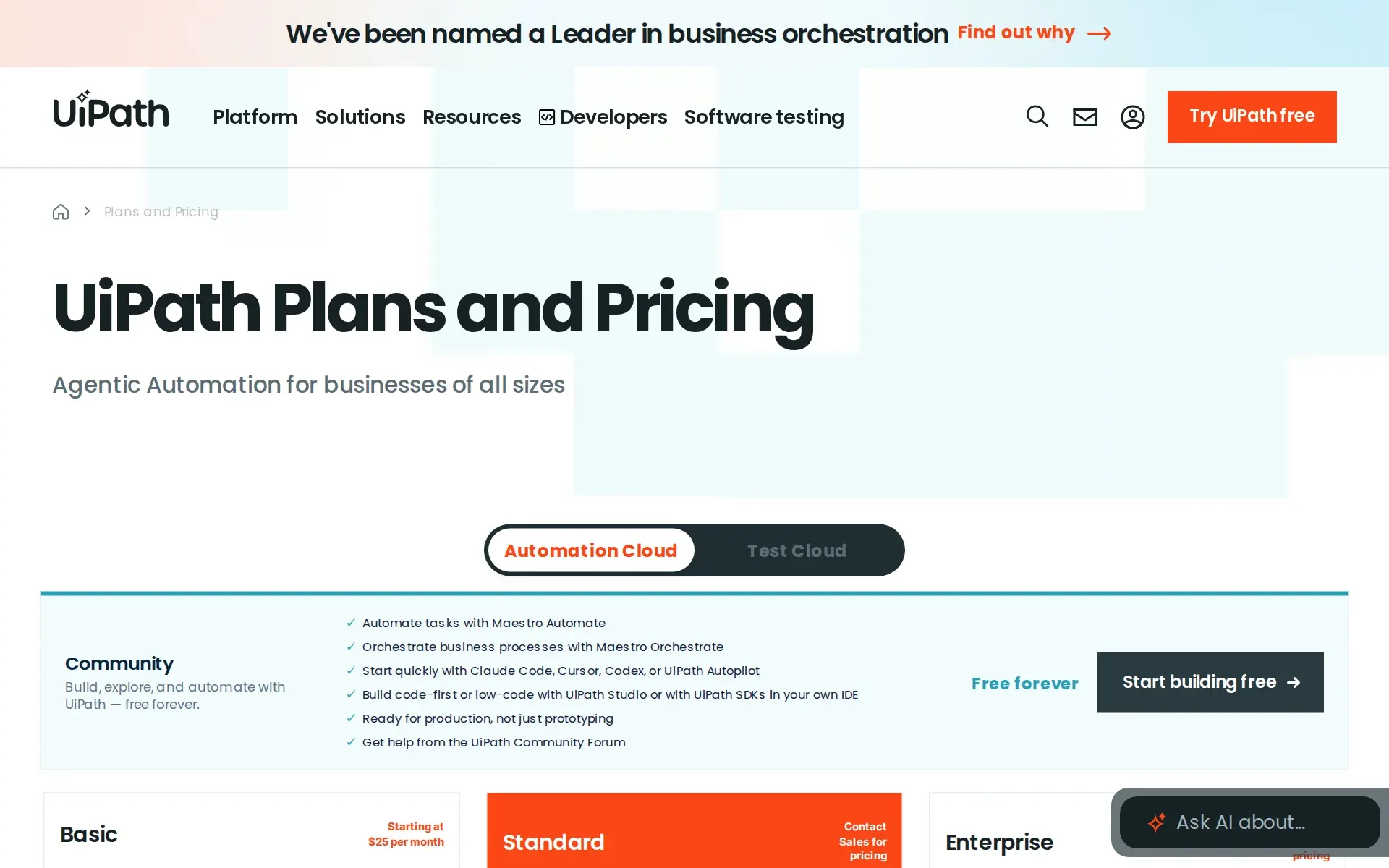
Standing Community plan, not a trial: free access to the agentic platform for individual builders, bundling 1 Plus User, 1 Pro User, 1 Unattended Robot and a monthly Credits pool, and it explicitly covers building agents in Studio Web. Capped at 250 LLM calls per organisation per day on UiPath-managed models, 350 on customer-managed, with no preview features and no AI and Agentic usage pool. Separately, the 60-day Basic and Standard trials downgrade to a 'Free' plan that has no direct sign-up and can neither develop nor run agents.
What needs a higher plan
- Enterprise
- In your pipeline
- Standard
- Admin controls, Audit log, Single sign-on
Checked .
The Agents Index digest
Price changes and new agents like UiPath Agent Builder, at most once a week.
Last issue: Devin vs Claude Code: Which Should You Pick? · 13 October 2026
Works with
 Claude
 GPT
GPT- PartlyOpen models
Automation Suite
For AI agents
- MCP server
- Yes
- API
- Yes
Screenshots
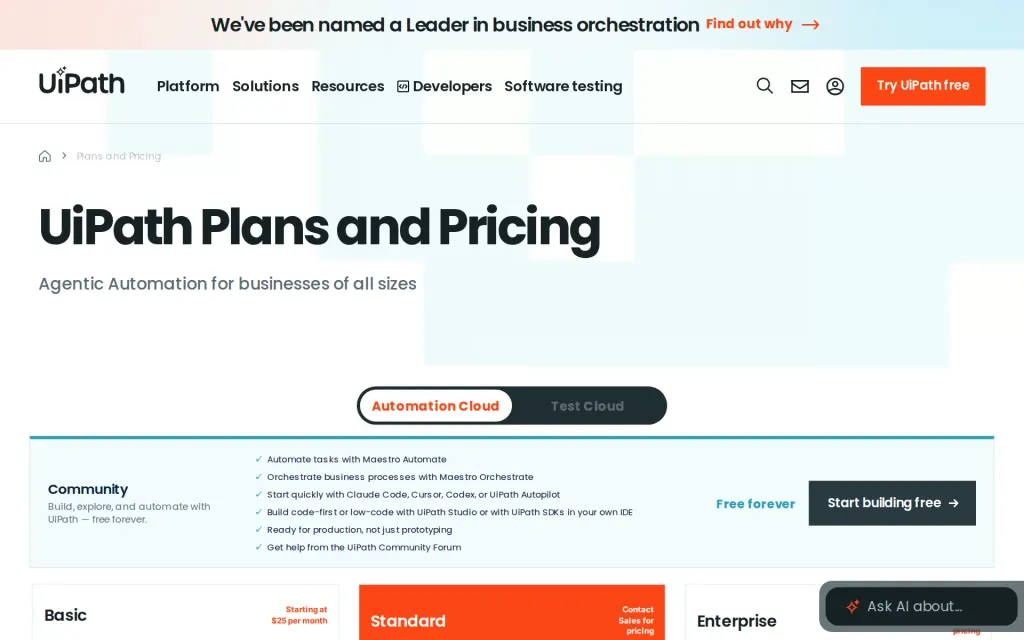
Pricing page, uipath.com, captured 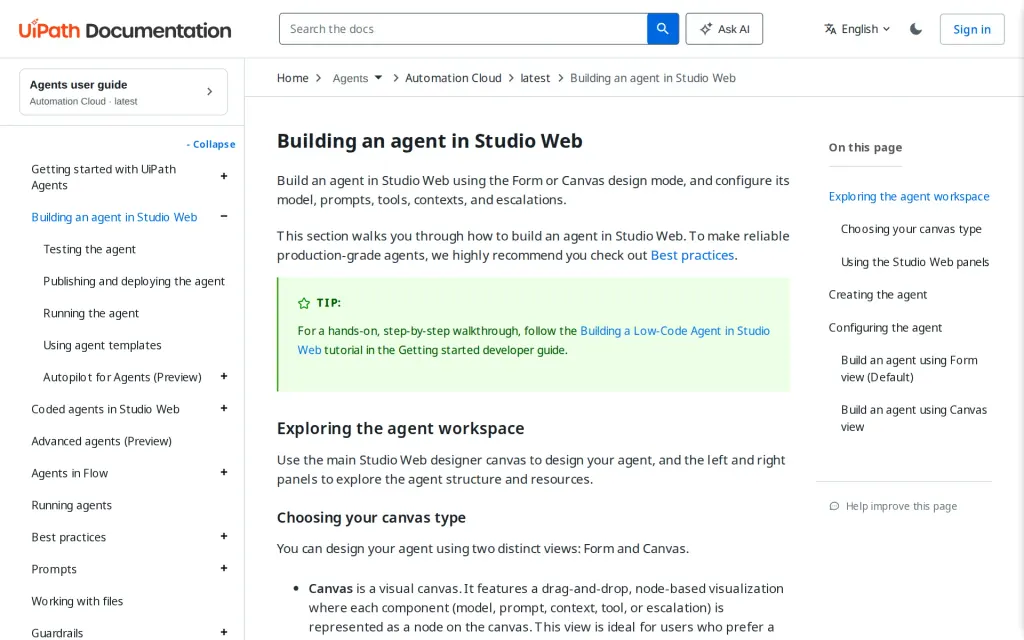
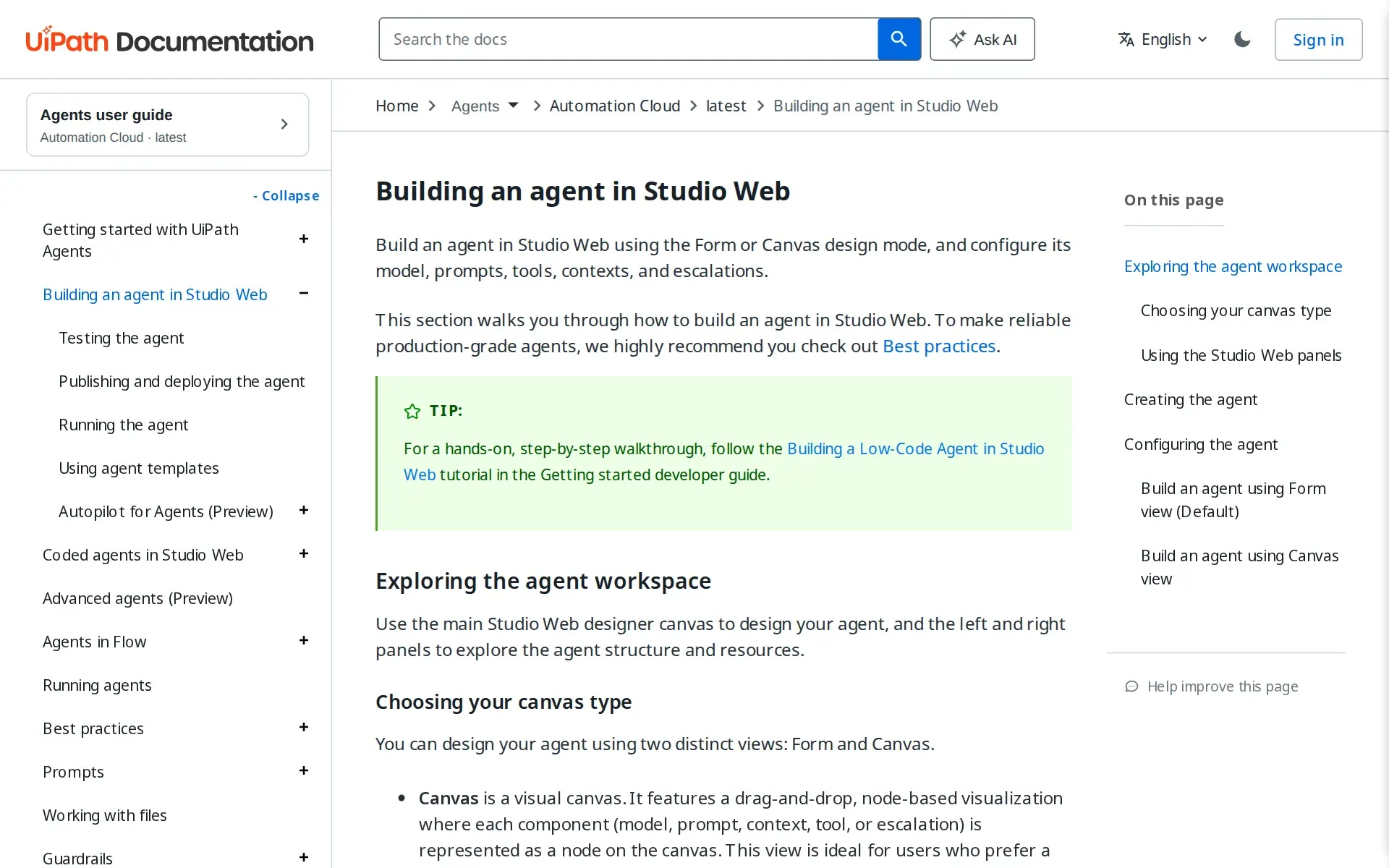
Docs, uipath.com, captured
Filed under
Sources and updates
Sources17
- uipath.com/platform/agentic-automation/agentic-ai/agent-builder
- uipath.com/pricing
- docs.uipath.com/agents/automation-cloud/latest/user-guide/analyze-files
- docs.uipath.com/agents/automation-cloud/latest/user-guide/licensing
- docs.uipath.com/overview/other/latest/overview/use-of-customer-data-with-agents
- uipath.com/product/automation-suite
- uipath.com/product/studio
- docs.uipath.com/agents/automation-cloud/latest/user-guide/agent-tools
- docs.uipath.com/agents/automation-cloud/latest/user-guide/building-an-agent-in-studio-web
- docs.uipath.com/agents/automation-cloud/latest/user-guide/tools-agents
- docs.uipath.com/automation-cloud/automation-cloud/latest/admin-guide/configuring-llms
- docs.uipath.com/automation-cloud/automation-cloud/latest/admin-guide/global-cloud-regions
- docs.uipath.com/automation-cloud/automation-cloud/latest/admin-guide/unified-pricing-licensing-plan-framework
- docs.uipath.com/orchestrator/automation-cloud/latest/user-guide/api-triggers
- docs.uipath.com/orchestrator/automation-cloud/latest/user-guide/mcp-server-url
- cloud.uipath.com/portal_/directbuy/presets
- docs.uipath.com/uipath-cli/standalone/latest/user-guide/uip-agent
The Agents Index in AI answers0 of 1
- PerplexityDoes not cite The Agents IndexAsked
UiPath Agent Builder alternatives
on Other sources: g2.com, itechguides.com, trycaddi.com, clickup.com, sistava.com, dronahq.com
Updates1
- Capabilities · Free tier · Price · Terms
Is this yours? Claim it free and edit it in your dashboard, or feature it in Agent platforms.