
Summary
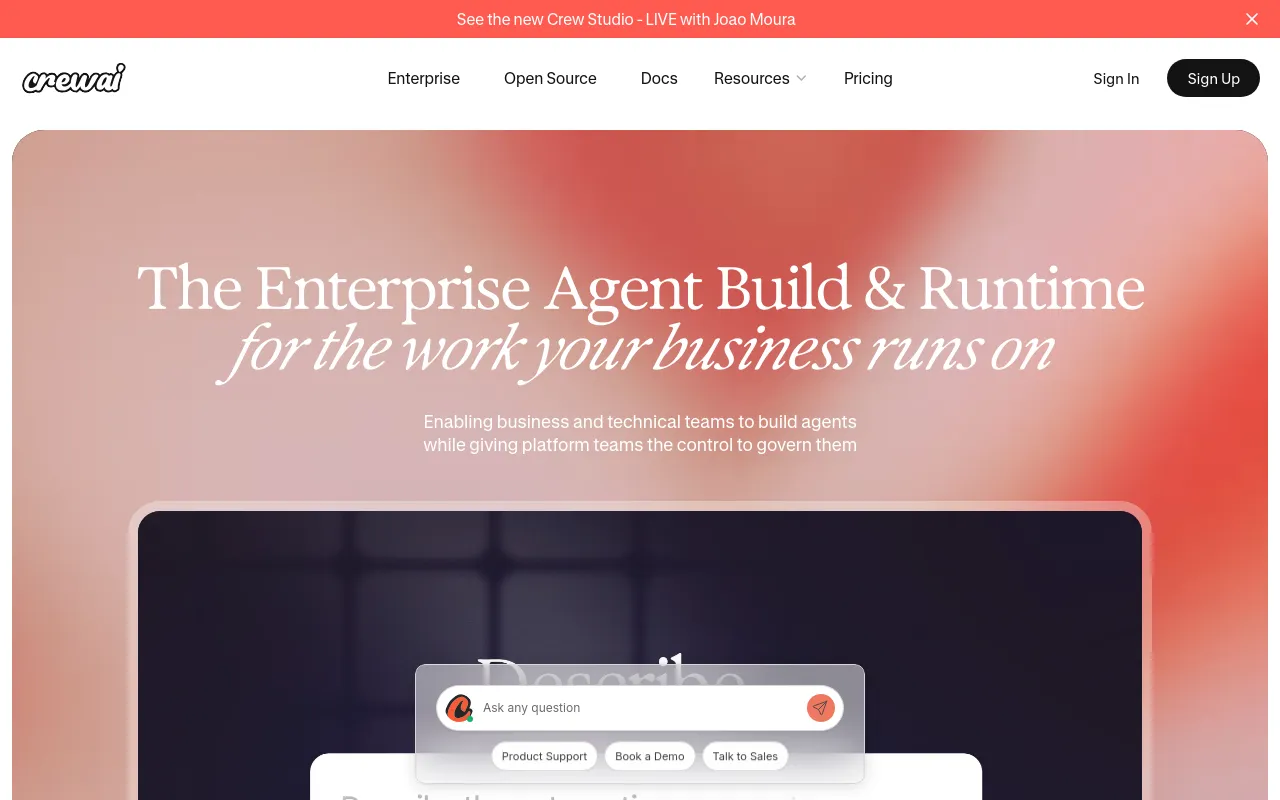
CrewAI is an open-source Python framework for building crews of role-playing AI agents and event-driven flows. A managed platform, CrewAI AMP, adds a visual studio, deployment, tracing and governance on top of that same framework.
- Best for
- Developers who want to stand up a role-based, collaborating multi-agent system quickly in Python, with a stable MIT-licensed core and a hosted build and runtime for production.
- Not for
- Teams wanting a transparently-priced self-serve paid tier: CrewAI jumps directly from a 50-execution free Basic plan to a custom Enterprise sales conversation, with nothing published in between.
- From
- Free
- Free tier
- YesBasic plan, $0 and self-serve: 2 automations, 50 included workflow executions per month with a hard maximum of 50 and no purchasable overage. Includes Crew Studio, GitHub integration, tracing, OpenTelemetry, guardrails, human-in-the-loop input, cron scheduling and community support. Enterprise connectors, dedicated VPC, SSO and role-based access control are Enterprise-only.
What it does
- Writes code
- PartlyAgents you build can author and run Python when code execution is switched on, but this is a capability of agents inside the framework rather than a product that ships code for you.
CrewAI Agents now have the powerful ability to write and execute code, significantly enhancing their problem-solving capabilities.
docs.crewai.com/en/learn/coding-agents - Debugs and fixes
- PartlyA code-executing agent receives the exception from its own generated code and retries, capped by max_retry_limit; nothing documents diagnosing or fixing a failure in an existing repository.
If executed code raises an exception, the agent will receive the error message and can attempt to correct the code or provide alternative solutions.
docs.crewai.com/en/learn/coding-agents - Ships it
- PartlyIt ships the automation itself rather than landing code changes in your repository: crewai deploy create pushes a crew or flow to AMP.
Deploy the crew or flow to CrewAI AMP.
docs.crewai.com/en/concepts/cli - Done-for-you service
- PartlyYou run the software yourself, but the Enterprise plan sells forward-deployed engineers, onboarding and training separately, so people-delivered build help exists as a paid extra.
Forward deployed engineering and training, available a la carte
crewai.com/pricing
How much it does unattended
- Runs autonomously
- YesThe vendor positions crews as autonomous workers that interact with enterprise applications unattended, with hierarchical delegation and cron scheduling available on both plans.
Build a crew of AI agents that autonomously interact with enterprise applications and use tools to automate workflows and tasks, with or without…
crewai.com/agent-management-platform - Multi-agent
- YesMulti-agent coordination is the core abstraction: crews of specialised agents delegate between themselves, with MCP for tooling and A2A for cross-agent discovery.
CrewAI transforms a set of AI agents into a crew of AI agents that supporting protocols such as MCP for tooling and A2A for agent collaboration and…
crewai.com/open-source - Agent permissions
- PartlyCode execution is off by default in the framework and the platform adds human-in-the-loop checkpoints and guardrails, but the governance layer described here is an Enterprise plan feature.
Every agent runs inside a scalable governance layer with role-based access, audit trails, human-in-the-loop checkpoints, and compliance controls…
crewai.com/agent-management-platform
Which models it runs on
- Claude
- YesAnthropic is one of the natively integrated providers, configured with your own key, and Claude models are also reachable through Bedrock and Snowflake Cortex.
CrewAI provides native integration with Anthropic through the Anthropic Python SDK.
docs.crewai.com/en/concepts/llms - GPT
- YesOpenAI has a native SDK integration covering both Chat Completions and the Responses API, and gpt-4o-mini is the framework's documented default model.
CrewAI provides native integration with OpenAI through the OpenAI Python SDK.
docs.crewai.com/en/concepts/llms - Open models
- YesLocal and open-weight serving is documented end to end, with step-by-step Ollama setup plus Hugging Face, Together, Groq and local NVIDIA NIM examples via LiteLLM.
This flexibility allows you to choose the most suitable model for your specific needs, whether you prioritize performance, cost-efficiency, or local…
docs.crewai.com/en/learn/llm-connections - Model choice
- YesYou choose the model per agent, per task or per crew; five providers have native SDKs and everything else routes through LiteLLM or any OpenAI-compatible base URL.
CrewAI connects to LLMs through native SDK integrations for the most popular providers (OpenAI, Anthropic, Google Gemini, Azure, and AWS Bedrock),…
docs.crewai.com/en/learn/llm-connections
Where you use it
- In your editor
- PartlyThere is no CrewAI editor extension; instead the vendor publishes a skill pack that teaches Claude Code, Cursor and Codex to scaffold CrewAI projects inside your editor.
They teach coding agents—like Claude Code, Cursor, and Codex—how to scaffold Flows, configure Crews, use tools, and follow CrewAI patterns.
docs.crewai.com/en/skills - On the command line
- YesA first-class terminal surface covers scaffolding, running, training, testing, replaying and deploying crews and flows, including login against enterprise SSO.
The CrewAI CLI provides a set of commands to interact with CrewAI, allowing you to create, train, run, and manage crews & flows.
docs.crewai.com/en/concepts/cli - In your pipeline
- PartlyDeployments connect to GitHub repositories and agents can file issues and cut releases, but the documented action list contains no pull-request review or CI job step.
Enable your agents to manage repositories, issues, and releases through GitHub. Create and update issues, manage releases, track project development,…
docs-platform.crewai.com/platform/en/in… - In a browser
- YesBoth plans include the hosted Crew Studio visual editor at app.crewai.com, where workflows are built, tested and run without writing code.
Studio (visual editor) Yes Yes
crewai.com/pricing
Whose machine it runs on
- Self-hosted
- YesThe open-source framework installs and runs on your own machines on any tier, while self-hosting the managed platform (VPC, own infrastructure, Factory) is an Enterprise option.
Deploy on CrewAI cloud, your own VPC, or your own infrastructure
crewai.com/pricing - Open source
- YesThe framework is genuinely open source under a permissive MIT-style licence in the vendor's own repository; the AMP platform around it is closed and commercial.
Permission is hereby granted, free of charge, to any person obtaining a copy of this software and associated documentation files (the "Software"), to…
github.com/crewAIInc/crewAI/blob/main/L…
What it costs to run
- How it meters
- PartlyMetering is per workflow execution rather than per seat, and the free tier states its allowance, but Enterprise volumes are sized case by case with unpriced overage.
Included executions 50 Sized to workflow
crewai.com/pricing - Free tier
- YesA standing free Basic plan is self-serve from the sign-up page, with the visual editor, GitHub integration and a monthly execution allowance, no sales call required.
Visual editor and AI copilot GitHub integration 50 workflow executions/month
crewai.com/pricing - API access
- YesEvery deployed crew exposes REST kickoff and status endpoints behind a bearer token, and a separate platform-wide v1 API manages automations, users and teams though it is still beta.
You can also kickoff crews programmatically using the CrewAI AMP REST API.
docs-platform.crewai.com/platform/en/gu… - MCP server
- YesBoth plans can publish a built workflow as an MCP server so other agents can call it, and agents can equally consume any external MCP server as tooling.
Export as MCP server Yes Yes
crewai.com/pricing - Bring your own key
- YesInference runs on your own provider accounts: you supply each provider key, or manage LLM connections centrally in the platform, and Enterprise can host the runtime in your cloud.
Once you specify the model you are using, you will need to provide the configuration (like an API key) for each of the model providers you use.
docs.crewai.com/en/concepts/llms
Buying it for a team
- A company can buy it
- YesAccounts are organisations with members, teams, roles and billing under organisation settings, and the Enterprise plan is sold to the organisation rather than the individual.
Manage billing, plans, and organization configuration
docs-platform.crewai.com/platform/en/fe… - Pooled budget
- PartlyThe published allowance is stated per plan per month rather than per member, so usage is drawn from one plan-level pool, but no per-seat or per-team budget split is documented.
50 workflow executions/month
crewai.com/pricing - Admin controls
- PartlyAdmins get feature-level roles plus entity permissions over individual automations, env vars, LLM connections and repos, but the pricing table lists RBAC as Enterprise-only.
In addition to organization‑wide roles, CrewAI supports fine‑grained entity-level permissions that restrict access to individual resources.
docs-platform.crewai.com/platform/en/fe… - Audit log
- PartlyThe vendor claims audit trails inside the governance layer and revoked role grants are retained for audit, but audit logging is not a listed row on either plan and governance is Enterprise-gated.
Every agent runs inside a scalable governance layer with role-based access, audit trails, human-in-the-loop checkpoints, and compliance controls…
crewai.com/agent-management-platform - Single sign-on
- PartlySAML 2.0 and OIDC against Entra ID, Okta, Auth0 or Keycloak are supported, including CLI device flow, but the pricing table gives SSO to the Enterprise plan only.
SAML 2.0 and OAuth 2.0 / OIDC protocol support
docs-platform.crewai.com/platform/en/fe…
What happens to your code
- Opt out of training
- PartlyFramework telemetry excludes prompts and agent data by default and is disabled with one environment variable, but no page states whether platform execution data trains vendor models.
Users can disable CrewAI telemetry by setting CREWAI_DISABLE_TELEMETRY to true, 1, yes, or on (any case).
docs.crewai.com/en/telemetry - Data residency
- PartlyEnterprise buyers can keep execution in their own VPC or infrastructure, but no region menu is published for the managed cloud and the trust centre lists AWS in the US as cloud subprocessor.
Deploy on CrewAI cloud, your own VPC, or your own infrastructure
crewai.com/pricing - Getting out
- PartlyAutomation source can be pulled back as a ZIP over the API and traces can be shipped to your own OpenTelemetry collector; nothing published covers rollover of unused executions.
Downloads an Automation source archive as a ZIP file.
docs-platform.crewai.com/api/v1/referen… - Certifications
- YesThe trust centre publishes a SOC 2 Type 2 programme with reports on request, plus a HIPAA audit report and pen test, and Enterprise adds FedRAMP High and SAM deployment options.
We maintain a SOC 2 Type 2 certified security program with comprehensive controls across our infrastructure, endpoints, and identity management.
trust.crewai.com
Checked · How we check
Alternatives
Open source agent frameworks plus LangSmith, a hosted platform to trace, evaluate, deploy and govern agents.
Open-source Python agent framework from the Pydantic team, with a typed agent loop and swappable models.
Python SDK plus self-hosted AgentOS runtime and hosted control plane for building and operating agents.
Open-source orchestration framework and runtime for stateful, long-running LLM agents, from LangChain.
Filed under
Sources and updates
Sources23
- crewai.com/pricing
- docs.crewai.com/en/concepts/llms
- crewai.com/agent-management-platform
- trust.crewai.com/
- docs.crewai.com/en/concepts/cli
- docs.crewai.com/en/learn/coding-agents
- docs.crewai.com/en/learn/llm-connections
- crewai.com/open-source
- docs-platform.crewai.com/platform/en/features/rbac
- docs-platform.crewai.com/platform/en/resources/frequently-asked-questions
- docs-platform.crewai.com/api/introduction
- docs-platform.crewai.com/api/v1/reference/automations/export-an-automation-zip
- github.com/crewAIInc/crewAI/blob/main/LICENSE
- docs.crewai.com/en/installation
- docs.crewai.com/en/skills
- docs.crewai.com/en/telemetry
- docs-platform.crewai.com/platform/en/features/crew-studio
- docs-platform.crewai.com/platform/en/features/sso
- docs-platform.crewai.com/platform/en/guides/kickoff-crew
- docs-platform.crewai.com/platform/en/integrations/github
- docs-platform.crewai.com/platform/en/introduction
- api.github.com/repos/crewAIInc/crewAIRepository
- crewai.com/terms-of-use
Repository2026-08-30
- Licence
- MIT
- Stars
- 57,822
- Forks
- 8,287
- Last push
- 2026-08-28
Updates5
- Capabilities · Free tier · Price · Terms
- Capabilities · Free tier · Terms
- Capabilities · Free tier · Terms
- Alternatives · Documentation link · Repository · Summary · Tagline
- Summary · Tagline