Summary
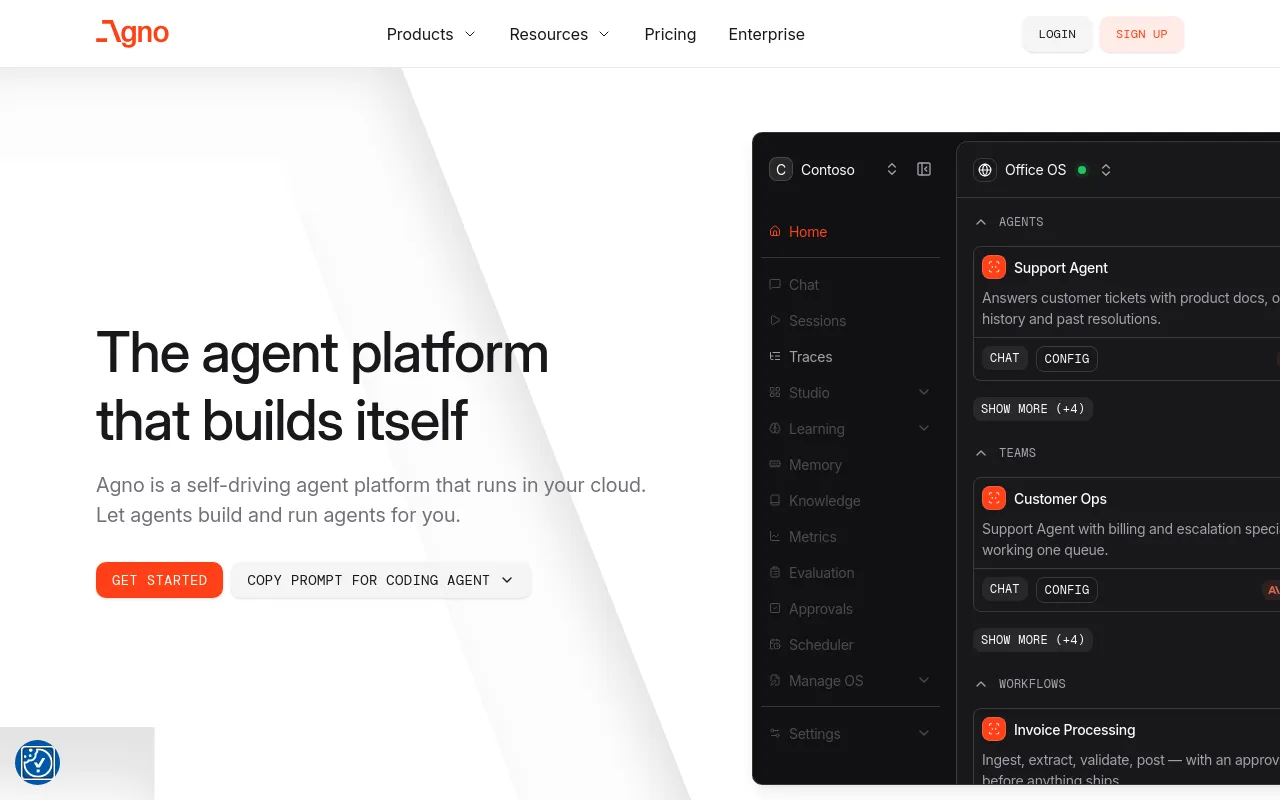
Agno is an open-source Python SDK, runtime and control plane for building and operating agent platforms in your own infrastructure. It serves agents, teams and workflows through APIs, MCP and chat interfaces while tying operations to databases you configure.
- Best for
- Python developers who want an Apache 2.0 SDK with memory, knowledge, learning, guardrails and a Control Plane they run inside their own cloud account, and who are comfortable running Docker or a cloud deploy template themselves.
- Not for
- Teams that want a fully managed, zero-infrastructure cloud runtime with no cloud account of their own to operate. CrewAI's managed cloud or a no-code agent platform fits that need better than Agno's paid tier, which still requires running your own Postgres and container host.
- From
- Freethen $150/month
- Free tier
- YesFree plan is $0/month; it runs the platform in your own cloud and includes the full control plane against a local AgentOS.
What it does
- Writes code
- YesShips a CodingTools toolkit whose documented job is editing files and running commands in a scoped project directory.
Build coding agents that inspect repositories, edit files, run commands, and verify changes.
docs.agno.com/use-cases/coding-agents - Debugs and fixes
- YesBug fixing is a documented pattern: reproduce, patch, rerun the failing tests.
Reproduce a failure, make a focused change, and rerun the failing tests.
docs.agno.com/use-cases/coding-agents - Writes tests
- PartlyThe documented Verify stage runs the repository's existing gates; test authoring appears only in the example prompt, not as a capability claim.
Run the repository's tests, lint, type checks, and build inside the execution environment.
docs.agno.com/use-cases/coding-agents - Reviews code
- YesCode review over a diff is one of the documented coding-agent patterns.
Inspect a diff, run targeted checks, and return prioritized findings.
docs.agno.com/use-cases/coding-agents - Whole-codebase work
- PartlyRepository-wide migrations are a named pattern, but the docs expect unresolved cases to be reported rather than fully landed.
Apply repeatable changes across files and report unresolved cases.
docs.agno.com/use-cases/coding-agents - Ships it
- PartlyPublishing is deliberately outside the default loop; commits, PRs and deploys must be exposed as separately gated tools.
Keep commits, pushes, pull requests, and deployments outside the default loop or expose them as separately gated tools.
docs.agno.com/use-cases/coding-agents - Done-for-you service
- NoAgno is delivered as a Python SDK and runtime software, rather than a managed agency service.
Agno is a Python SDK for building agent platforms.
agno.com/products/sdk
How much it does unattended
- Runs autonomously
- YesAgentOS can invoke agent, team, and workflow endpoints on recurring schedules without an interactive user request.
AgentOS stores schedules and run history in the platform database, invokes existing agent, team, or workflow endpoints
docs.agno.com/features/scheduling - Multi-agent
- YesTeams coordinate multiple agents or nested teams, with a leader able to delegate tasks to members.
A Team coordinates agents or nested teams. In the default coordinate mode, the leader can delegate tasks
docs.agno.com/teams/overview - Agent permissions
- PartlyTool execution can be gated for human confirmation, but the documentation does not present one mandatory approval policy for every action.
Pending tool executions can require human confirmation. Approvals pause runs until an admin resolves the request.
docs.agno.com/agent-os/control-plane
Which models it runs on
- Claude
- YesAgno documents an Anthropic provider integration that calls the Messages API with Claude models.
Call Anthropic's Messages API with Claude models.
docs.agno.com/models/providers/model-in… - GPT
- YesAgno documents OpenAI model configuration and illustrates selecting an OpenAI GPT model identifier for an agent.
model=OpenAIResponses(id="gpt-5.4")
docs.agno.com/models/overview - Open models
- YesThe framework supports local model runtimes including llama.cpp, for local GGUF model inference, rather than only hosted providers.
Connect to llama.cpp for local GGUF model inference.
docs.agno.com/models/providers/model-in… - Model choice
- YesBuilders choose among supported providers and can switch providers without rewriting their agent implementations.
Agno is model-agnostic: bring OpenAI, Anthropic, Google or any supported provider and switch without rewriting your agents.
agno.com
Where you use it
- In your editor
- PartlyThere is no Agno IDE extension; instead the CLI registers your running AgentOS as an MCP server inside Cursor, Claude Code and Codex, which is a connection rather than an editor surface.
CONNECT YOUR AGENTOS TO CLAUDE CODE, CODEX AND CURSOR
agno.com/pricing - On the command line
- YesInstalling the SDK includes command-line tools that scaffold, run, connect, and administer AgentOS projects.
Installing `agno` 2.7 or later gives you the Agno CLI alongside the SDK
docs.agno.com/faq/agno-cli - In your pipeline
- NoThe enumerated serving surfaces are REST, MCP in Claude/ChatGPT and chat apps; no pull-request or CI surface appears.
Serve your agents in your product, AI apps (ChatGPT, Claude) or chat apps (Slack, Discord). Bring your agents everywhere using REST, MCP or…
agno.com - In a browser
- YesThe hosted Control Plane provides a browser-based interface for managing and monitoring connected AgentOS runtimes.
lets you manage and monitor connected AgentOS runtimes
docs.agno.com/agent-os/control-plane
Whose machine it runs on
- Self-hosted
- YesAgentOS runs in customer infrastructure with runtime state written to databases the customer configures.
AgentOS runs in your infrastructure and writes runtime state to databases you configure.
docs.agno.com/agent-os/introduction - Open source
- YesThe SDK and AgentOS are published as open-source components, including on the free plan.
The SDK and AgentOS are open source
agno.com/pricing
What it costs to run
- How it meters
- PartlyPro combines a monthly platform charge with included team seats and separately priced seats and live connections.
Pro ($150/month) points that control plane at a live deployment: one live AgentOS connection, three team seats
agno.com/pricing - Free tier
- YesA standing Free plan costs zero dollars monthly and includes the runtime, SDK, AgentOS, and local control plane.
the Free plan ($0/month) builds your agent platform, runs it in your own cloud at any scale
agno.com/pricing - API access
- YesAgentOS supplies REST endpoints for agents, teams, workflows, and operational data that applications can call.
AgentOS provides REST endpoints for agents, teams, and workflows, plus sessions, memory, knowledge, traces, evaluations, schedules, approvals, and…
docs.agno.com/features/api - MCP server
- YesAgentOS can expose registered components through an MCP endpoint so MCP clients can discover and run them.
Set `mcp=True` to serve an MCP endpoint at `/mcp` alongside the AgentOS REST API.
docs.agno.com/features/mcp-server - Bring your own key
- YesCustomers bring their chosen model providers and can run the agent platform in their own cloud.
bring OpenAI, Anthropic, Google or any supported provider and switch without rewriting your agents.
agno.com
Buying it for a team
- A company can buy it
- YesThe paid Pro plan includes team seats and role-based access control, while Enterprise adds end-user management.
one live AgentOS connection, three team seats, role-based access control
agno.com/pricing - Seat model
- PartlyPro includes three team seats, with additional seats sold monthly; the vendor does not state a maximum seat count.
three team seats, role-based access control and email support, with extra seats at $30/month
agno.com/pricing - Pooled budget
- PartlyThere is no metered balance to pool; seats share access to the same connected runtimes and usage inside a connection is unlimited.
Everyone on those seats shares access to the same connected runtimes.
agno.com/pricing - Admin controls
- YesAdministrators can manage members, roles, settings, and resources, while endpoint access is constrained by role scopes.
Administrator | Manage members, roles, settings, and resources
docs.agno.com/agent-os/control-plane - Audit log
- PartlyEnterprise includes audit logs for end-user management; the public Pro plan description does not promise that capability.
Enterprise (custom pricing) is end-user management for the people your agents serve: end-user identity, roles and audit logs
agno.com/pricing - Single sign-on
- PartlySAML SSO is separately priced as a monthly Pro add-on, rather than included in the stated entry subscription.
SAML SSO at $300/month
agno.com/pricing
What happens to your code
- Opt out of training
- YesThere is nothing to opt out of by design: the browser talks straight to your runtime, so the vendor states it never holds a copy of your data at all.
The control plane reads from your runtime directly in the browser. Agno never holds a copy of your data.
agno.com/pricing - Data residency
- PartlyRuntime state resides in customer-configured infrastructure and databases, so deployment location is customer-selected rather than a stated vendor region.
AgentOS runs in your infrastructure and writes runtime state to databases you configure.
docs.agno.com/agent-os/introduction - Getting out
- PartlySelf-hosted runtime state lives in databases customers configure, but Agno does not document a formal export process or credit expiry terms.
AgentOS runs in your infrastructure and writes runtime state to databases you configure.
docs.agno.com/agent-os/introduction - Certifications
- PartlySOC 2 compliance is asserted in the trust band on the enterprise and SDK pages, but no ISO 27001 or GDPR statement is published; security reviews are an Enterprise item.
SOC 2 COMPLIANT
agno.com/enterprise
35 sourced claims on this page. Checked 2026-10-10. How we check.
Alternatives
Where we would send a reader instead, in that listing's own words.
Open-source multi-agent framework with a managed platform for deploying and governing agent workflows.
Open-source Python agent framework from the Pydantic team, with a typed agent loop and swappable models.
Open source agent frameworks plus LangSmith, a hosted platform to trace, evaluate, deploy and govern agents.
Filed under
Sources and updates
The pages we read30
1 of 30 independent of the vendor.
- agno.com/pricing16 fields
- docs.agno.com/use-cases/coding-agents9 fields
- agno.com/7 fields
- agno.com/products/sdk7 fields
- agno.com/products/runtime5 fields
- docs.agno.com/agent-os/control-plane3 fields
- docs.agno.com/agent-os/introduction3 fields
- docs.agno.com/models/providers/model-index3 fields
- docs.agno.com/features/api2 fields
- docs.agno.com/models/overview2 fields
- agno.com/products/control-plane2 fields
- docs.agno.com/reference/cli/agnoctl2 fields
- docs.agno.com/agent-os/approvals/overview1 field
- github.com/agno-agi/agno1 field
- docs.agno.com/cli/connect1 field
- docs.agno.com/cli/overview1 field
- agno.com/compare/agno-vs-langgraph1 field
- agno.com/enterprise1 field
- docs.agno.com/faq/agno-cli1 field
- docs.agno.com/faq/default-model1 field
- docs.agno.com/faq/environment-variables1 field
- docs.agno.com/features/control-plane1 field
- docs.agno.com/features/mcp-server1 field
- docs.agno.com/features/scheduling1 field
- docs.agno.com/features/sdk1 field
- docs.agno.com/features/security-and-auth1 field
- docs.agno.com/models/providers/native/anthropic/overview1 field
- api.github.com/repos/agno-agi/agnoPlatform record1 field
- docs.agno.com/teams/overview1 field
- docs.agno.com/use-cases/workflow-automation1 field
Platform record2026-08-30
- Licence
- Apache-2.0
- Stars
- 41,969
- Forks
- 5,844
- Last push
- 2026-08-30
Updates6
- Capabilities · Commercial terms · Free tier
- Capabilities · Commercial terms · Free tier
- Capabilities · Commercial terms · Free tier
- Capabilities · Commercial terms · Free tier
- Capabilities · Commercial terms · Free tier · Price
- Alternatives · Documentation link · One-liner · Summary