
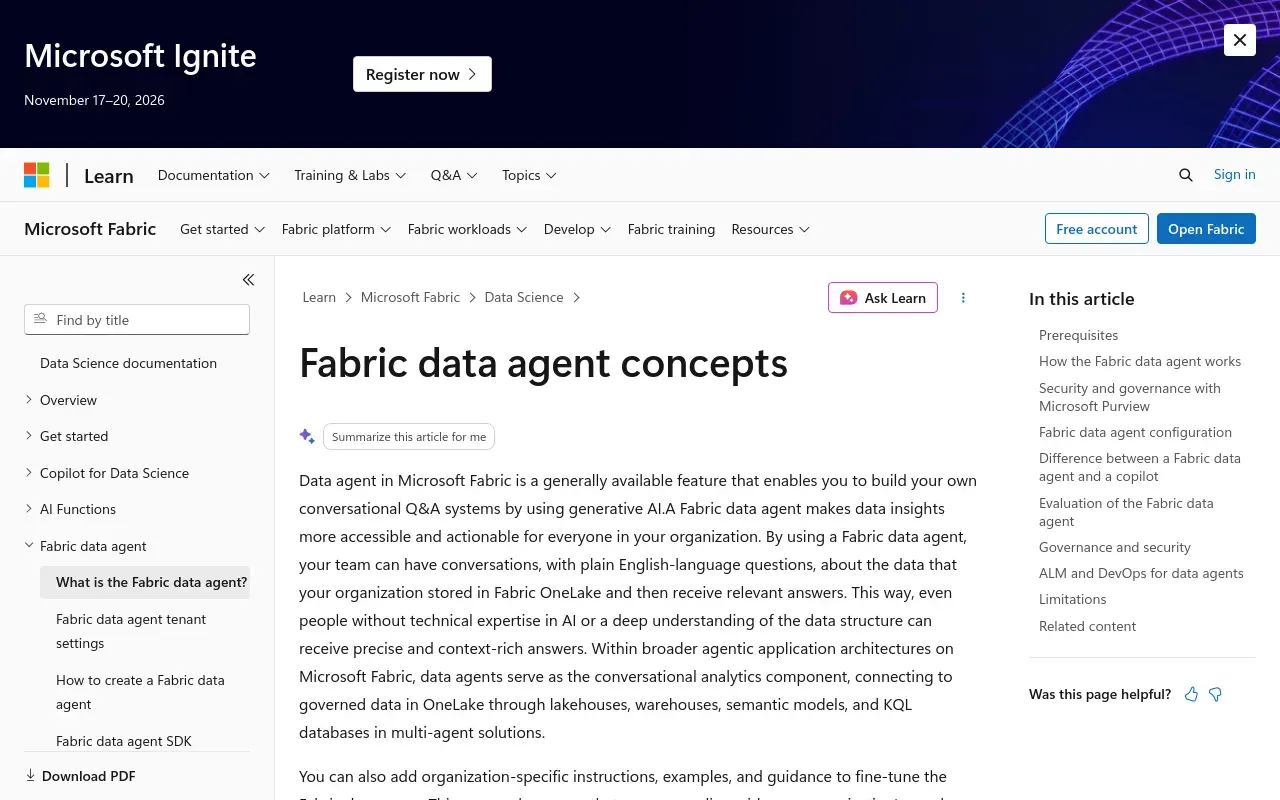
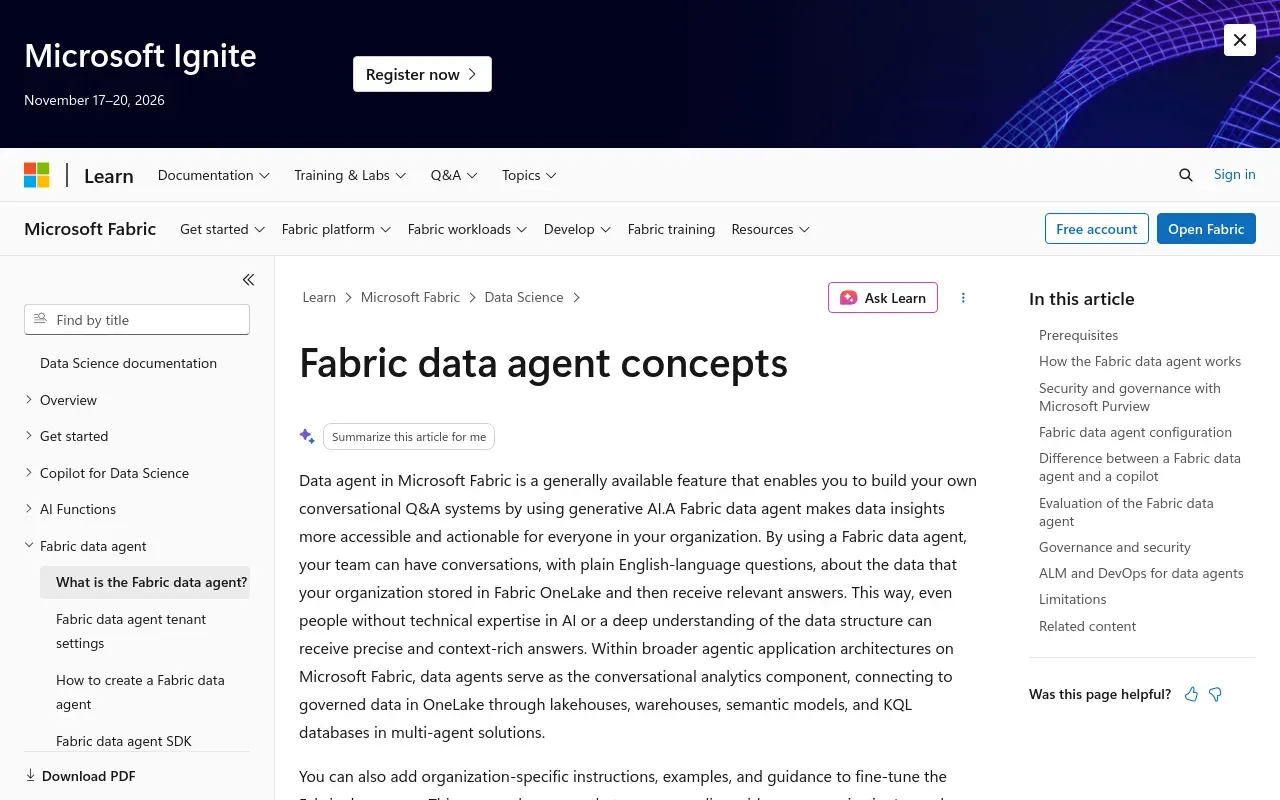
Not for Teams without an existing Fabric or Power BI Premium capacity investment (there is no free or trial way to try it), buyers who need PDFs and unstructured content out of the box without standing up their own Azure AI Search index, anyone wanting to query non-English content, or buyers who want to choose or fine-tune their own underlying model.
The facts, with their sources
What it does
- Writes code
- PartlyIt authors query code only: natural language becomes T-SQL, DAX or KQL read statements against selected tables, never application code or files.
Natural language to SQL (NL2SQL) for relational databases (Lakehouse/Warehouse).
learn.microsoft.com/en-us/fabric/data-s… - Ships it
- NoIt stops at the answer: the vendor documents read-only connections and explicitly no create, update or delete queries, and no triggering of jobs or notebooks.
The Fabric data agent only generates SQL, DAX, and KQL "read" queries. It doesn't generate SQL, DAX, or KQL queries that create, update, or delete…
learn.microsoft.com/en-us/fabric/data-s… - Done-for-you service
- NoMicrosoft ships software you configure yourself inside your own Fabric tenant; no vendor team builds or operates the agent for you.
Configuring a Fabric data agent is similar to building a Power BI report—you start by designing and refining it to ensure it meets your needs, then…
learn.microsoft.com/en-us/fabric/data-s…
How much it does unattended
- Runs autonomously
- PartlyEach question runs end to end unattended - routing, query generation, validation, execution - but it only answers; the vendor recommends human escalation paths and no action workflows exist.
Once validated, the Fabric data agent executes the query against the chosen data source. The results are formatted into a human-readable response
learn.microsoft.com/en-us/fabric/data-s… - Multi-agent
- YesPublished agents are invocable by other agents and orchestrators - Copilot Studio connected agents, Foundry, Teams - as the data-access member of a multi-agent solution.
External orchestrators and multi-agent runtimes can invoke Fabric data agents to support end-to-end agentic workflows, while the data agents remain…
learn.microsoft.com/en-us/fabric/data-s… - Agent permissions
- YesTightly bounded: read-only connections, the asking user's own credentials and RLS/CLS, scoped data sources, and tenant policy overriding developer or user instructions.
The Fabric data agent strictly enforces read-only access, maintaining read-only data connections to all data sources.
learn.microsoft.com/en-us/fabric/data-s…
Which models it runs on
- Claude
- NoThe model is fixed to Microsoft-hosted Azure OpenAI models and the vendor states outright that the LLM cannot be changed, so Claude cannot power the agent.
You can't change the LLM that the Fabric data agent uses.
learn.microsoft.com/en-us/fabric/data-s… - GPT
- YesRuns on Microsoft-hosted Azure OpenAI GPT models through the Assistant API; the model is fixed by Microsoft, not chosen by you.
The Fabric data agent applies Azure OpenAI Assistant APIs as the underlying agent to process user questions.
learn.microsoft.com/en-us/fabric/data-s… - Open models
- NoOnly Microsoft-hosted Azure OpenAI models serve the agent, and the documented limitation forbids substituting any model, open-weight included.
You can't change the LLM that the Fabric data agent uses.
learn.microsoft.com/en-us/fabric/data-s… - Model choice
- NoThe vendor picks the model: no key, deployment or model choice is exposed, and the limitation list says the LLM is not changeable.
You don't need to create or supply an Azure OpenAI key or an access token to use a Fabric data agent. Fabric uses a Microsoft-managed Azure OpenAI…
learn.microsoft.com/en-us/fabric/data-s…
Where you use it
- In your editor
- YesA published agent is addable to Visual Studio Code as an MCP HTTP server, and in agent mode the editor's orchestrator routes questions to it.
Visual Studio Code can act as an MCP client. The following steps add the data agent MCP server and ask questions from the editor.
learn.microsoft.com/en-us/fabric/data-s… - On the command line
- PartlyNo vendor-shipped terminal client, but a standalone Python script speaking MCP over streamable HTTP is a documented client, and any MCP client works.
You can consume the data agent MCP server from any MCP client, not just one tool or editor.
learn.microsoft.com/en-us/fabric/data-s… - In your pipeline
- NoThe agent cannot act in a pipeline: it is read-only and triggers no jobs, notebooks or other write workflows. Fabric Git integration versions the agent's own configuration, not its actions.
Fabric data agents remain read-only and don't trigger anomaly detection jobs, notebooks, or other write or action workflows in Eventhouse.
learn.microsoft.com/en-us/fabric/data-s… - In a browser
- YesThe primary surface is the hosted Fabric portal, where you create the item, pick data sources and chat with it, then publish it for colleagues.
To create a new Fabric data agent, first navigate to your workspace, and then select the + New Item button. In the All items tab, search for Fabric…
learn.microsoft.com/en-us/fabric/data-s…
Whose machine it runs on
- Self-hosted
- NoFabric is Microsoft-operated SaaS; the agent runs on purchased Fabric capacity and a Microsoft-managed Azure OpenAI deployment that you cannot host yourself.
Microsoft Fabric is a software as a service (SaaS) platform that lets users get, create, share, and visualize data.
learn.microsoft.com/en-us/fabric/securi… - Open source
- NoThe agent is a closed Fabric SaaS item; only the client-side Python SDK is distributed publicly on PyPI, and the service itself has no source release.
Microsoft Fabric is a software as a service (SaaS) platform that lets users get, create, share, and visualize data.
learn.microsoft.com/en-us/fabric/securi…
What it costs to run
- How it meters
- YesMetered per token against your shared Fabric capacity: 100 CU-seconds per 1,000 input tokens and 400 per 1,000 output, with generated queries billed to their own engine.
AI Query | The input prompt | Per 1,000 Tokens | 100 CU seconds
learn.microsoft.com/en-us/fabric/fundam… - Free tier
- NoNo free path exists: a paid F2 or higher capacity is required, and the 60-day Fabric trial capacity explicitly excludes the Data agent experience.
AI Experiences such as Data agent, AI functions and AI services aren't supported.
learn.microsoft.com/en-us/fabric/fundam… - API access
- YesA public REST API plus a preview Python SDK create, configure and publish agents, and the MCP endpoint serves runtime queries from your own code.
It runs on the Fabric public REST API, which is the same surface you already use for other workspaces and items, so authentication and the request…
learn.microsoft.com/en-us/fabric/data-s… - MCP server
- YesPublishing turns the agent into a hosted MCP server exposing one question-answering tool over streamable HTTP, with a Fabric bearer token per request.
When you publish a Fabric data agent, it becomes an MCP server that exposes a single MCP tool.
learn.microsoft.com/en-us/fabric/data-s… - Bring your own key
- NoNo bring-your-own-key or own-cloud path: Microsoft manages the Azure OpenAI deployment and authentication, and no key field is exposed.
You don't need to create or supply an Azure OpenAI key or an access token to use a Fabric data agent. Fabric uses a Microsoft-managed Azure OpenAI…
learn.microsoft.com/en-us/fabric/data-s…
Buying it for a team
- A company can buy it
- YesIt is bought as organisational Azure infrastructure - a Fabric capacity SKU on pay-as-you-go or reservation - not as an individual subscription.
Get a shared pool of capacity that powers all capabilities in Microsoft Fabric, from data modeling and data warehousing to business intelligence and…
azure.microsoft.com/en-us/pricing/detai… - Seat model
- NoNot sold per seat: you buy capacity units, and the published rate card has no seat floor or ceiling for the agent itself.
Simplified purchasing with a single pool of compute for every workload.
azure.microsoft.com/en-us/pricing/detai… - Pooled budget
- YesEveryone draws on one shared capacity balance, and the vendor warns that exhausting it stops all operations - so agent usage competes with every other Fabric workload.
However, once the capacity is exhausted, all operations will shut down.
learn.microsoft.com/en-us/fabric/fundam… - Admin controls
- YesAdmins gate it hard: tenant switches for AI and cross-geo processing, Purview DLP and access-restriction policies, and workspace outbound access rules.
Organizational intent: Tenant-wide policies and compliance requirements set by your organization's administrators. These constraints take the highest…
learn.microsoft.com/en-us/fabric/data-s… - Audit log
- YesAgent activity lands in the Microsoft Purview audit log alongside other Fabric operations, and prompts and responses can be audited and eDiscovered.
Agent interactions might be logged and discoverable through Microsoft Purview Audit and eDiscovery.
learn.microsoft.com/en-us/fabric/data-s… - Single sign-on
- YesAccess rides on Microsoft Entra ID, the tenant identity provider, so every request is authenticated there and Conditional Access and MFA apply.
Every interaction with Fabric is encrypted by default and authenticated using Microsoft Entra ID.
learn.microsoft.com/en-us/fabric/securi…
What happens to your code
- Opt out of training
- YesNothing to opt out of by the vendor's account: data sent to the Azure OpenAI service behind the agent is not used to train models or shared with other customers.
Your data isn't used to train models and isn't available to other customers.
learn.microsoft.com/en-us/fabric/fundam… - Data residency
- PartlyData at rest stays in your home or chosen capacity region, but agents outside the EU/US need cross-geo processing and storing switched on, and conversation history persists up to 28 days.
Required for customers using Fabric data agent whose capacity's geographic region is outside of the EU data boundary and the US.
learn.microsoft.com/en-us/fabric/data-s… - Getting out
- PartlyAgent configuration can be version-controlled out through Git integration, and chat history is user-deletable, but data agent config export is tied to Fabric's own Git and pipeline tooling rather than a generic export.
Git integration: Connect your Fabric workspace to a Git repository to version-control agent configurations, including instructions, example queries,…
learn.microsoft.com/en-us/fabric/data-s… - Certifications
- PartlyFabric docs point to the Microsoft Trust Center and the Online Services Terms rather than naming SOC 2 or ISO 27001; the telemetry store is stated as EU Data Boundary compliant.
For compliance information, the Microsoft Trust Center is the primary resource for Fabric.
learn.microsoft.com/en-us/fabric/securi…
Plans and pricing
Price and terms
- Free plan or trial
- NoNo
Checked .
Works with
 GPT
GPT
For AI agents
- MCP server
- Yes
- API
- Yes
Screenshots
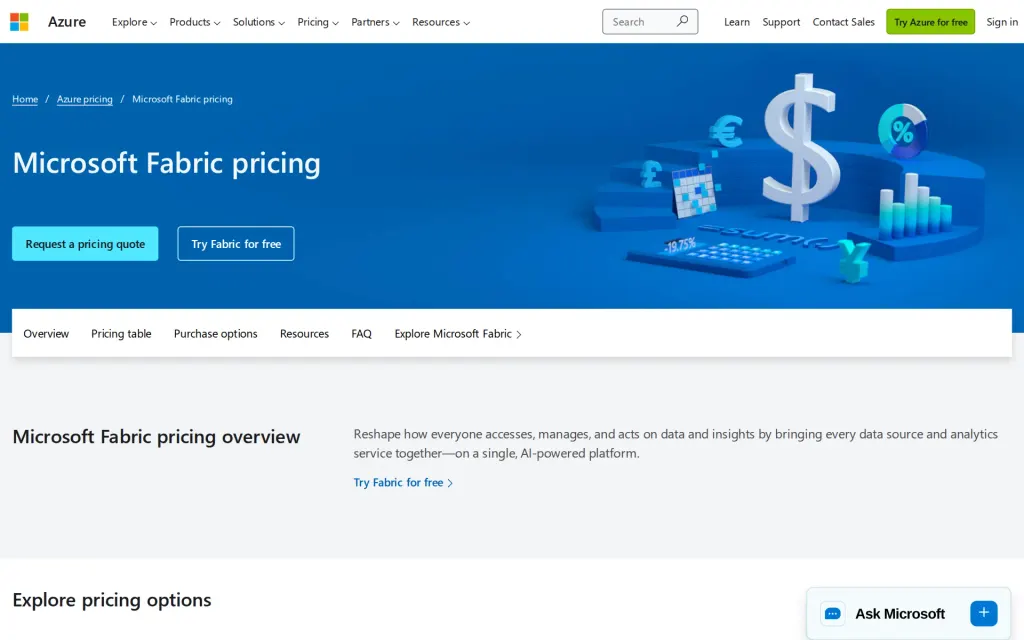
Pricing page, learn.microsoft.com, captured 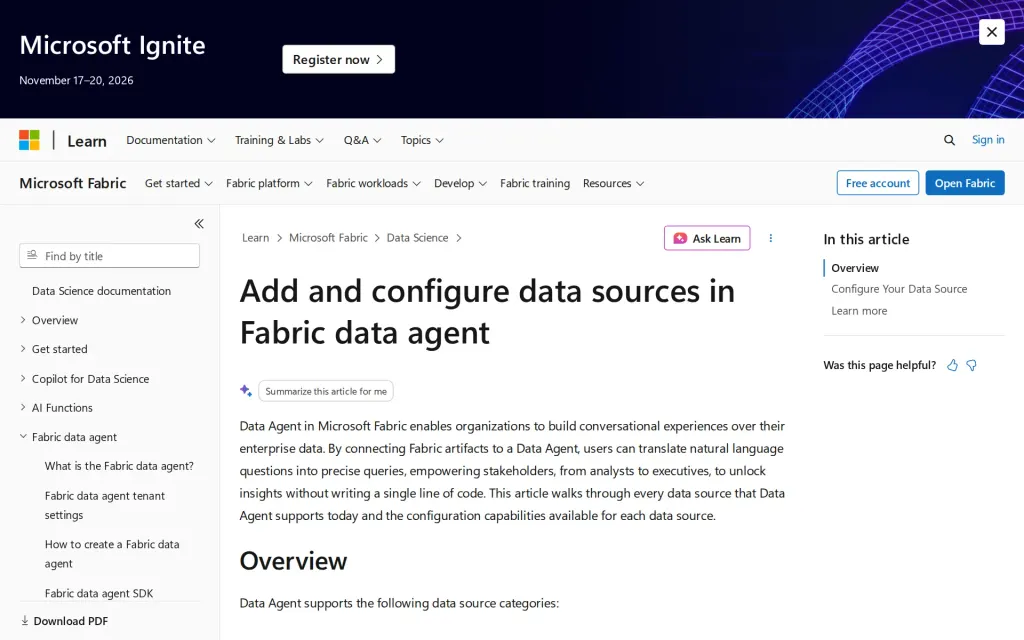
Docs, learn.microsoft.com, captured
Filed under
Sources and updates
Sources13
- learn.microsoft.com/en-us/fabric/data-science/concept-data-agent
- learn.microsoft.com/en-us/fabric/security/security-fundamentals
- learn.microsoft.com/en-us/fabric/data-science/data-agent-mcp-server
- learn.microsoft.com/en-us/fabric/data-science/how-to-create-data-agent
- azure.microsoft.com/en-us/pricing/details/microsoft-fabric
- learn.microsoft.com/en-us/fabric/security/security-overview
- learn.microsoft.com/en-us/fabric/enterprise/licenses
- learn.microsoft.com/en-us/fabric/fundamentals/data-agent-consumption
- learn.microsoft.com/en-us/fabric/data-science/data-agent-tenant-settings
- learn.microsoft.com/en-us/fabric/data-science/fabric-data-agent-sdk
- learn.microsoft.com/en-us/fabric/fundamentals/copilot-fabric-consumption
- learn.microsoft.com/en-us/fabric/fundamentals/copilot-privacy-security
- learn.microsoft.com/en-us/fabric/fundamentals/fabric-trial
Coverage elsewhere1
Updates5
- Website
- Capabilities · Free tier · Terms
- Capabilities · Free tier · Price · Terms
- Alternatives · Documentation link · Summary · Tagline
- Summary
Is this yours? Claim it free and edit it in your dashboard, or feature it in Research & data agents.