
Not for Teams starting a new long-term production build who need active feature development. Microsoft itself points them to the Microsoft Agent Framework.
Changed since our last check
- Claude: now Partly. It was Yes when we checked on .
- Open models: now Partly. It was Yes when we checked on .
The facts, with their sources
What it does
- Writes code
- YesShips a dedicated coder agent whose system prompt specialises it for writing code and creating artifacts, used inside Magentic-One teams alongside a terminal agent.
Coder: This is an LLM-based agent specialized through its system prompt for writing code, analyzing information collected from the other agents, or…
microsoft.github.io/autogen/stable/user… - Debugs and fixes
- PartlyMicrosoft describes iterative troubleshooting through tool use and code execution, but documents no claim that it diagnoses and lands a fix in an existing repository unattended.
Enables effective coding-related tasks, like tool use with back-and-forth troubleshooting.
github.com/microsoft/autogen/blob/main/… - Reviews code
- PartlyThe reflection design pattern pairs a coder agent with a reviewer agent that critiques the generated code; no surface reviews a diff or pull request someone else wrote.
For example, given a task to write code, the first LLM can generate a code snippet, and the second LLM can generate a critique of the code snippet.
microsoft.github.io/autogen/stable/user… - Whole-codebase work
- PartlyFileSurfer navigates directories and reads local files while the executors run commands in a work_dir, so file-by-file work is possible; no repository indexing or repo-wide migration is documented.
The FileSurfer can also perform common navigation tasks such as listing the contents of directories and navigating a folder structure.
microsoft.github.io/autogen/stable/user… - Ships it
- PartlyA team can execute the code it writes in a shell or Docker container, but nothing in the docs claims it opens pull requests or deploys to an environment.
ComputerTerminal: Finally, ComputerTerminal provides the team with access to a console shell where the Coder's programs can be executed, and where…
microsoft.github.io/autogen/stable/user… - Done-for-you service
- NoThis is software you install and run yourself as Python packages; Microsoft offers no build-and-run service here, and the project is now community managed.
AutoGen is now in maintenance mode. It will not receive new features or enhancements and is community managed going forward.
github.com/microsoft/autogen
How much it does unattended
- Runs autonomously
- YesMicrosoft states agents can act autonomously, and the Magentic-One orchestrator plans, delegates and self-reflects until a task completes without a human turn.
AutoGen is a framework for creating multi-agent AI applications that can act autonomously or work alongside humans.
github.com/microsoft/autogen - Multi-agent
- YesCoordination of several agents is the core design: a lead orchestrator decomposes tasks and assigns subtasks to web, file, coder and terminal agents.
Orchestrator: the lead agent responsible for task decomposition and planning, directing other agents in executing subtasks, tracking overall…
microsoft.github.io/autogen/stable/user… - Agent permissions
- PartlyPermission gating is something the developer wires in: a user proxy agent can be inserted for approvals, and the guidance is that users confirm code before execution, but there is no policy engine.
Human involvement: AutoGen prioritizes human involvement in multi agent conversation. The overseers can step in to give feedback to agents and steer…
github.com/microsoft/autogen/blob/main/…
Which models it runs on
- Claude
- PartlyA first-party Anthropic client exists in the extensions package, but Microsoft labels the section experimental rather than a supported integration.Was Yes before our last check.
To use the AnthropicChatCompletionClient, you need to install the anthropic extra. Underneath, it uses the anthropic python sdk to access the models.
microsoft.github.io/autogen/stable/user… - GPT
- YesOpenAI is the primary documented model client, installed as an extra, and GPT models are used in nearly every example throughout the guides.
To access OpenAI models, install the openai extension, which allows you to use the OpenAIChatCompletionClient.
microsoft.github.io/autogen/stable/user… - Open models
- PartlyOpen-weight models run through the Ollama client or OpenAI-compatible endpoints, but that client is marked experimental and Microsoft warns local models are less capable.Was Yes before our last check.
Ollama is a local model server that can run models locally on your machine.
microsoft.github.io/autogen/stable/user… - Model choice
- YesYou choose the model per agent, and Microsoft states teams can mix heterogeneous models to match capability or cost for different roles.
Magentic-One is model agnostic and can incorporate heterogonous models to support different capabilities or meet different cost requirements when…
microsoft.github.io/autogen/stable/user…
Where you use it
- In your editor
- NoThe documented surfaces are the Python and .NET libraries plus two developer tools, Studio and Bench; no IDE or editor extension is offered.
AutoGen Studio provides a no-code GUI for building multi-agent applications.
github.com/microsoft/autogen - On the command line
- PartlyA built-in Console UI streams a run to the terminal and UserProxyAgent can take console input, but there is no standalone agent CLI; the autogenstudio command only launches the web UI.
The Console() method provides a convenient way to print messages to the console with proper formatting.
microsoft.github.io/autogen/stable/user… - In a browser
- YesAutoGen Studio provides a browser-based low-code interface for building and running teams, though Microsoft calls it a prototyping tool, not a production app.
AutoGen Studio is a low-code interface built to help you rapidly prototype AI agents, enhance them with tools, compose them into teams and interact…
microsoft.github.io/autogen/stable/user…
Whose machine it runs on
- Self-hosted
- YesEverything runs on your own machines: agents execute in your process, and a gRPC host plus worker runtimes let you distribute them across your own infrastructure.
A distributed agent runtime facilitates communication and agent lifecycle management across process boundaries. It consists of a host service and at…
microsoft.github.io/autogen/stable/user… - Open source
- YesThe code is published under the MIT licence in the microsoft/autogen repository, granting use, modification and redistribution without fee.
MIT License Copyright (c) Microsoft Corporation. Permission is hereby granted, free of charge, to any person obtaining a copy of this software and…
github.com/microsoft/autogen/blob/main/…
What it costs to run
- How it meters
- PartlyThe framework itself carries no meter at all; your only spend is whatever your chosen model provider bills against the API key you supply.
The following samples call OpenAI API, so you first need to create an account and export your key as export OPENAI_API_KEY="sk-...".
github.com/microsoft/autogen - Free tier
- YesNo account, sales call or payment is involved: the packages install from PyPI under an MIT licence granted free of charge.
Permission is hereby granted, free of charge, to any person obtaining a copy of this software and associated documentation files (the "Software"), to…
github.com/microsoft/autogen/blob/main/… - API access
- YesIt is itself a programming interface you import into your own stack, with layered Python packages for core runtime, agent teams and extensions.
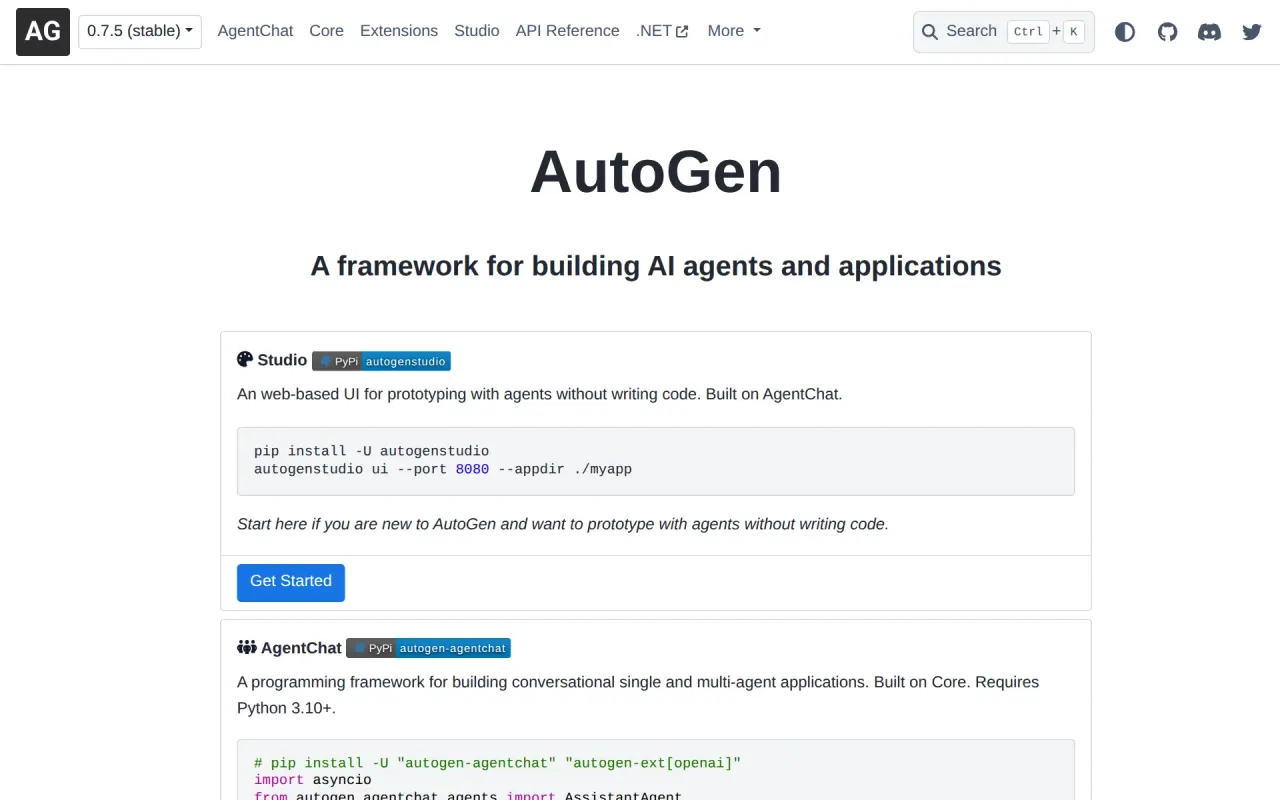
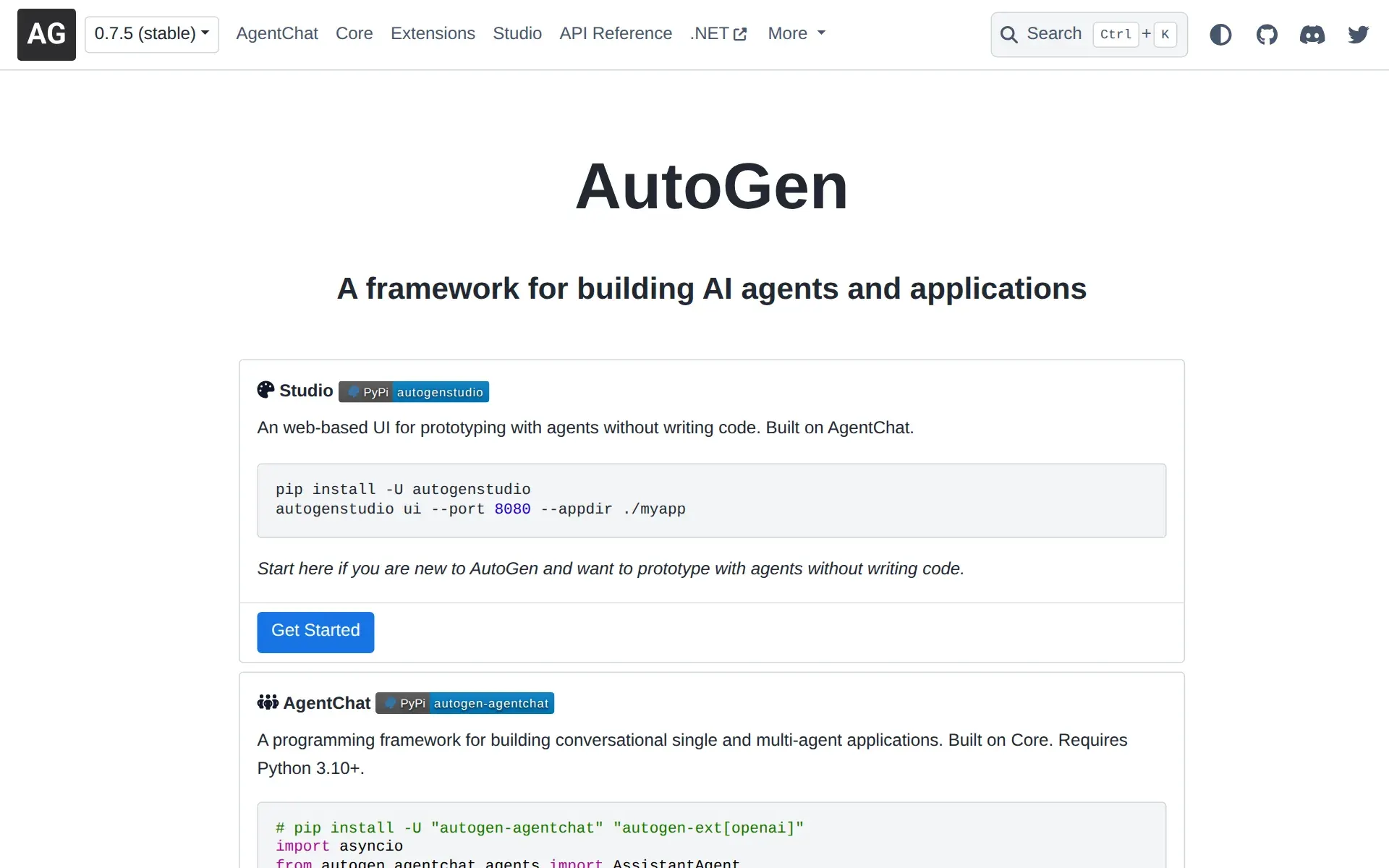
A programming framework for building conversational single and multi-agent applications. Built on Core. Requires Python 3.10+.
microsoft.github.io/autogen/stable - MCP server
- PartlyAutoGen consumes MCP servers as agent tools through McpWorkbench, but the docs do not describe exposing an AutoGen agent as an MCP server another agent could query.
McpWorkbench for using Model-Context Protocol (MCP) servers.
microsoft.github.io/autogen/stable - Bring your own key
- YesYou bring your own inference throughout: your OpenAI key, your Azure deployment and AAD identity, or a local Ollama server on your own hardware.
To use the client, you need to provide your deployment id, Azure Cognitive Services endpoint, api version, and model capabilities. For…
microsoft.github.io/autogen/stable/user…
Buying it for a team
- Admin controls
- PartlyConstraints are developer-level: the runtime enforces identity and privacy boundaries, code executes in a Docker sandbox, and an approval callback can gate each execution. There is no admin console or policy engine.
the framework provides a runtime environment, which facilitates communication between agents, manages their identities and lifecycles, and enforce…
microsoft.github.io/autogen/stable/user… - Audit log
- PartlyRuntime events including model calls are emitted through Python logging for you to capture, but this is application telemetry rather than a tamper-evident administrative audit trail.
AutoGen uses standard Python logging module to log events like model calls and responses. The logger name is autogen_core.EVENT_LOGGER_NAME, and the…
microsoft.github.io/autogen/stable/user… - Single sign-on
- NoNo identity integration ships anywhere in the project; Microsoft explicitly tells developers to implement authentication themselves when building on the framework.
It is not meant to be a production-ready app. Developers are encouraged to use the AutoGen framework to build their own applications, implementing…
microsoft.github.io/autogen/stable/user…
What happens to your code
- Getting out
- YesTeams, agents and conditions serialise to JSON via dump_component and save_state, and Studio persists sessions in your own SQLite or PostgreSQL database. No credits exist to expire.
State is a dictionary that can be serialized to a file or written to a database.
microsoft.github.io/autogen/stable/user…
Plans and pricing
Price and terms
- Free plan
- YesYesThe entire framework, including AutoGen Studio, is MIT-licensed and installable from PyPI at no cost
The terms in full
the only spend is your own model provider's inference bill.
Checked .
The Agents Index digest
Price changes and new agents like AutoGen, at most once a week.
Last issue: Devin vs Claude Code: Which Should You Pick? · 13 October 2026
Works with
 Claude
Partly
 GPT
GPT- PartlyOpen models
For AI agents
- MCP server
- Partly
- API
- Yes
Filed under
Sources and updates
Last changed
Sources19
- github.com/microsoft/autogenRepository
- microsoft.github.io/autogen/stable/user-guide/agentchat-user-guide/magentic-one.html
- microsoft.github.io/autogen/stable/user-guide/agentchat-user-guide/tutorial/models.html
- microsoft.github.io/autogen/stable
- microsoft.github.io/autogen/stable/reference/python/autogen_agentchat.agents.html
- github.com/microsoft/autogen/blob/main/LICENSE-CODERepository
- microsoft.github.io/autogen/stable/user-guide/agentchat-user-guide/tutorial/teams.html
- microsoft.github.io/autogen/stable/user-guide/autogenstudio-user-guide/index.html
- microsoft.github.io/autogen/stable/user-guide/core-user-guide/core-concepts/architecture.html
- github.com/microsoft/autogen/blob/main/TRANSPARENCY_FAQS.mdRepository
- microsoft.github.io/autogen/stable/user-guide/agentchat-user-guide/index.html
- microsoft.github.io/autogen/stable/user-guide/agentchat-user-guide/tutorial/human-in-the-loop.html
- microsoft.github.io/autogen/stable/user-guide/agentchat-user-guide/tutorial/state.html
- microsoft.github.io/autogen/stable/user-guide/core-user-guide/components/workbench.html
- microsoft.github.io/autogen/stable/user-guide/core-user-guide/design-patterns/reflection.html
- microsoft.github.io/autogen/stable/user-guide/core-user-guide/framework/distributed-agent-runtime.html
- microsoft.github.io/autogen/stable/user-guide/core-user-guide/framework/telemetry.html
- github.com/microsoft/autogen/blob/main/python/packages/magentic-one-cli/pyproject.tomlRepository
- api.github.com/repos/microsoft/autogenRepository
Repository30 August 2026
- Licence
- CC-BY-4.0
- Stars
- 60,699
- Forks
- 9,164
- Last push
- 15 April 2026
Coverage elsewhere5
The Agents Index in AI answers0 of 1
- PerplexityDoes not cite The Agents IndexAsked
AutoGen alternatives
on Other sources: g2.com, softwr.com, toolradar.com, futureagi.com, modelroost.com, thinking.inc
Updates5
- Capabilities · Free tier · Price · Terms
- Capabilities · Free tier · Terms
- Website
- Capabilities · Free tier · Terms
- Alternatives · Summary · Tagline
Is this yours? Claim it free and edit it in your dashboard, or feature it in Agent frameworks.