
Summary
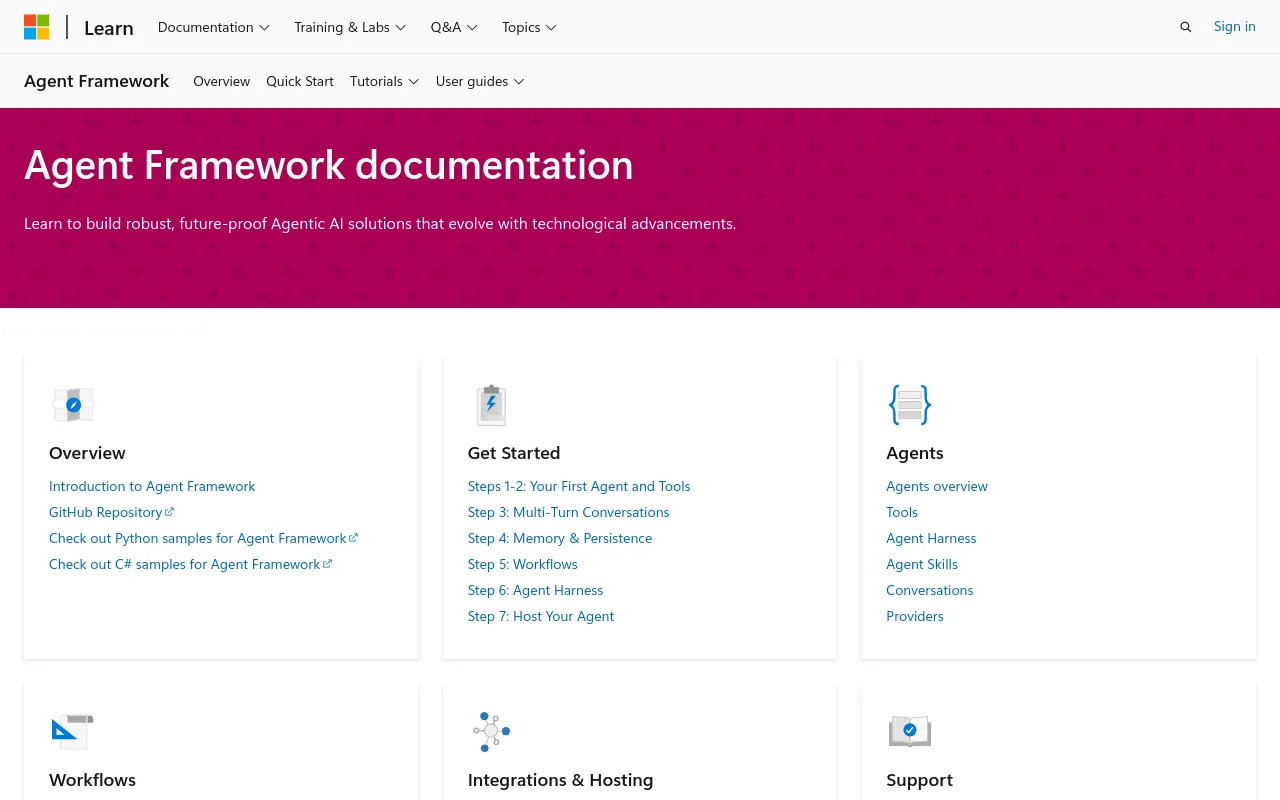
Microsoft Agent Framework is Microsoft's SDK for building and orchestrating AI agents in .NET, Python and Go, spanning single agents, graph workflows and a batteries-included harness. It is the direct successor to Semantic Kernel and AutoGen, created by the same teams.
- Best for
- .NET or Python teams already invested in Azure or Microsoft Foundry who want one supported agent SDK, an optional managed hosting path, and a documented migration off AutoGen or Semantic Kernel.
- Not for
- Teams with no Azure or Microsoft affinity who want the largest third-party integration ecosystem and the longest production track record: LangChain or CrewAI carry more years of battle-testing today.
- From
- Free
- Free tier
- YesThe whole framework is free and MIT-licensed: pip install agent-framework, or the Microsoft.Agents.AI NuGet packages, with no Microsoft account and no usage cap. Costs start at the model provider or Azure service you configure; some documented integrations require paid Microsoft products (Foundry Hosted Agents, Purview middleware with an M365 E5 licence).
What it does
- Writes code
- PartlyAn SDK rather than a coding product: the GitHub Copilot SDK backend supplies coding-oriented capabilities including file operations and shell execution, but what the agent writes is what you build.
GitHub Copilot agents provide access to powerful coding-oriented AI capabilities, including shell command execution, file operations, URL fetching,…
learn.microsoft.com/en-us/agent-framewo… - Whole-codebase work
- PartlyThe Harness targets long multi-step work with context compaction, file memory and todo tracking, and shell tools default to working-directory confinement; the vendor documents no repository indexing or repo-wide migration.
A harness wraps a chat client with the scaffolding an agent needs to work through long, multi-step tasks - planning / execution modes, a todo list to…
learn.microsoft.com/en-us/agent-framewo… - Ships it
- PartlyThe beta agent-framework-tools package gives an agent local or Docker shell execution, so it can run any command you approve; no deploy, release or pull-request step is documented.
Shell execution can modify files, launch processes, access credentials, and communicate with external systems. Use the least-privileged execution…
learn.microsoft.com/en-us/agent-framewo… - Done-for-you service
- NoYou run the software. Microsoft publishes an SDK and support is community channels: docs, GitHub issues, discussions and office hours.
Microsoft Agent Framework is an open-source SDK for building AI agents that can reason, use tools, and interact with users and other agents.
learn.microsoft.com/en-us/agent-framewo…
How much it does unattended
- Runs autonomously
- YesThe Harness keeps an agent progressing through long multi-step tasks, with todo tracking and plan/execute modes on by default and optional bounded looping.
It drives model and tool calls, manages conversation state and context, applies approval policies, and can keep the agent progressing through a…
learn.microsoft.com/en-us/agent-framewo… - Multi-agent
- YesFive built-in orchestration patterns (sequential, concurrent, handoff, group chat and magentic manager), plus agents callable as tools and experimental background child agents.
Agent Framework provides several built-in multi-agent orchestration patterns:
learn.microsoft.com/en-us/agent-framewo… - Agent permissions
- YesApproval is per tool and declarative: LocalShellTool asks for every command and disabling that requires acknowledge_unsafe, ShellPolicy pre-filters commands, and the Copilot backend cannot touch shell, files or URLs without a permission handler.
It defaults to a persistent shell, a 30-second timeout, 64-KiB output truncation, working-directory confinement, and approval for every command.
learn.microsoft.com/en-us/agent-framewo…
Which models it runs on
- Claude
- YesAnthropic is a first-class provider, reachable through Anthropic direct, Microsoft Foundry, Amazon Bedrock or Vertex AI, with function tools, code interpreter, web search and MCP tools supported.
Anthropic — Claude inference through Anthropic, Foundry, Amazon Bedrock, or Vertex AI.
learn.microsoft.com/en-us/agent-framewo… - GPT
- YesOpenAI and Azure OpenAI are supported through both Chat Completions and Responses clients; the provider table marks function tools, structured outputs, code interpreter, file search, MCP tools and background responses for both.
OpenAI — OpenAI Chat Completions and Responses APIs.
learn.microsoft.com/en-us/agent-framewo… - Open models
- YesOllama, Foundry Local and ONNX Runtime GenAI run models locally, with reduced capability: Ollama function tools depend on the chosen model and the provider table gives ONNX no tool support at all.
Ollama — Local open-source model inference.
learn.microsoft.com/en-us/agent-framewo… - Model choice
- YesYou choose the model: eleven providers are documented with a per-capability comparison table, and in .NET any client implementing the IChatClient abstraction can back an agent.
Any inference service that provides a Microsoft.Extensions.AI.IChatClient implementation can back a ChatClientAgent.
learn.microsoft.com/en-us/agent-framewo…
Where you use it
- In your editor
- NoNot an editor product. The documented client surfaces are OpenAI-compatible HTTP, A2A, AG-UI web apps, Telegram and MCP; no IDE or editor extension appears in the docs.
After choosing a host, select the client integration that fits your scenario:
learn.microsoft.com/en-us/agent-framewo… - On the command line
- PartlyThe devui command launches agents discovered from a directory with flags for port, host, headless, tracing and auth, but DevUI is documented as a sample app 'not intended for production use'.
If you have agents and workflows organized in a directory structure, launch DevUI from the command line:
learn.microsoft.com/en-us/agent-framewo… - In a browser
- YesDevUI is a dev-time web interface with an OpenAI-compatible backend and trace viewer; for shipping your own web front end the documented integrations are AG-UI event streaming and ChatKit.
It provides a web interface for interactive testing along with an OpenAI-compatible API backend, allowing you to visually debug, test, and iterate on…
learn.microsoft.com/en-us/agent-framewo…
Not established: In your pipeline
Whose machine it runs on
- Self-hosted
- YesSelf-hosting is one of the two documented hosting models; your application owns routing, identity, authorization, storage, deployment and scaling. The self-hosting packages are prerelease in both Python and .NET.
Self-hosting lets you run an Agent Framework agent or workflow in your own web application, container, service, or runtime.
learn.microsoft.com/en-us/agent-framewo… - Open source
- YesMIT-licensed on GitHub, with the Go SDK in a separate microsoft/agent-framework-go repository; the docs site itself is open to public contributors.
Yes, Agent Framework is open source and available on GitHub.
learn.microsoft.com/en-us/agent-framewo…
What it costs to run
- How it meters
- PartlyMicrosoft charges nothing for the framework itself; every unit of cost is metered by whichever model provider or Azure service you point it at, and the vendor assigns that cost to you explicitly.
You are responsible for any usage and associated costs.
learn.microsoft.com/en-us/agent-framewo… - Free tier
- YesNo call, no account with Microsoft: the packages are MIT-licensed and installable from PyPI and NuGet. You still need credentials for a model provider, or a local runtime.
Permission is hereby granted, free of charge, to any person obtaining a copy of this software and associated documentation files (the "Software"), to…
github.com/microsoft/agent-framework/bl… - API access
- YesIt is a library you call directly, and the hosting helpers expose an agent or workflow over HTTP: OpenAI Responses and Chat Completions-compatible endpoints, A2A, or your own routes.
OpenAI-compatible endpoints for Responses and Chat Completions-compatible APIs.
learn.microsoft.com/en-us/agent-framewo… - MCP server
- PartlyExposing your agent or workflow as an MCP tool is Python-only today: .NET support is 'coming soon' and Go is 'not currently available'. Consuming MCP servers as tools works in all three languages.
Use agent-framework-hosting-mcp to expose an Agent Framework agent or workflow as a tool on the native Model Context Protocol SDK.
learn.microsoft.com/en-us/agent-framewo… - Bring your own key
- YesYou bring the inference: your provider account and credentials (Azure identity, provider API key) or a local runtime such as Ollama, Foundry Local or ONNX. Microsoft supplies no inference with the SDK.
Model providers supply the inference client used by an Agent Framework agent.
learn.microsoft.com/en-us/agent-framewo…
Buying it for a team
- Admin controls
- PartlyOrganisation-level policy needs the Purview middleware plus Microsoft Purview and an M365 E5 licence; everything in the framework itself (tool approval, ShellPolicy allow/deny lists, FIDES flow policies) is set by the developer in code, not by an admin.
Prevent sensitive data leaks: Inline blocking of sensitive content based on Data Loss Prevention (DLP) policies.
learn.microsoft.com/en-us/agent-framewo… - Audit log
- PartlyAdministrative audit comes from the Purview integration, which requires Purview and an M365 E5 licence; the framework on its own emits OpenTelemetry traces, logs and metrics of agent and tool activity, which is telemetry rather than an admin trail.
Enable governance: Log AI interactions in Purview for Audit, Communication Compliance, Insider Risk Management, eDiscovery, and Data Lifecycle…
learn.microsoft.com/en-us/agent-framewo…
What happens to your code
- Opt out of training
- PartlyThere is no Microsoft-side switch because the SDK runs in your process and sends data only where you point it; training use is governed by the model provider's terms, and the vendor tells you to review third-party retention and handling yourself.
We recommend reviewing all data being shared with and received from Third-Party Systems and being cognizant of third-party practices for handling,…
learn.microsoft.com/en-us/agent-framewo… - Data residency
- YesYou hold the data: it runs in your process or your host, so residency follows your infrastructure and chosen provider, and Microsoft assigns that boundary decision to you in writing.
It is your responsibility to manage whether your data will flow outside of your organization's Azure compliance and geographic boundaries and any…
learn.microsoft.com/en-us/agent-framewo… - Getting out
- YesConversation and session state live wherever you put them, in a custom history provider or session store over your own database, Redis or blob storage, so there is no vendor-held data to export and no credits that can expire.
For database/Redis/blob-backed history, implement a custom history provider.
learn.microsoft.com/en-us/agent-framewo…
Not established: Certifications
26 sourced claims on this page. Checked 2026-09-02. How we check.
Alternatives
Where we would send a reader instead, in that listing's own words.
Microsoft's open-source Python framework for building single- and multi-agent applications; now in maintenance mode.
Google Agent Development Kit (ADK)
Open-source framework for building, evaluating and deploying AI agents in Python, TypeScript, Go, Java or Kotlin.
Python and TypeScript library that runs Claude Code's agent loop and tools inside your own application.
Open source agent frameworks plus LangSmith, the platform for tracing, evaluating and deploying agents.
Filed under
Sources and updates
The pages we read21
1 of 21 independent of the vendor.
- learn.microsoft.com/en-us/agent-framework/integrations/by-component/model-providers5 fields
- learn.microsoft.com/en-us/agent-framework/hosting/self-hosting4 fields
- learn.microsoft.com/en-us/agent-framework/overview4 fields
- learn.microsoft.com/en-us/agent-framework/hosting2 fields
- learn.microsoft.com/en-us/agent-framework/integrations/by-component/middleware/purview2 fields
- learn.microsoft.com/en-us/agent-framework/integrations/by-component/model-providers/openai2 fields
- learn.microsoft.com/en-us/agent-framework/integrations/by-component/tools/shell-tools2 fields
- learn.microsoft.com/en-us/agent-framework/integrations/by-component/ui/devui2 fields
- learn.microsoft.com/en-us/agent-framework/support/faq2 fields
- github.com/microsoft/agent-framework/blob/main/LICENSE2 fields
- learn.microsoft.com/en-us/agent-framework/agents/code-act1 field
- learn.microsoft.com/en-us/agent-framework/agents/planning-and-todos1 field
- learn.microsoft.com/en-us/agent-framework/concepts/agents/conversations/storage1 field
- learn.microsoft.com/en-us/agent-framework/concepts/agents/safety1 field
- learn.microsoft.com/en-us/agent-framework/concepts/harness1 field
- learn.microsoft.com/en-us/agent-framework/get-started/harness1 field
- learn.microsoft.com/en-us/agent-framework/hosting/self-hosting/mcp1 field
- learn.microsoft.com/en-us/agent-framework/integrations1 field
- learn.microsoft.com/en-us/agent-framework/integrations/by-component/agent-services/github-copilot1 field
- learn.microsoft.com/en-us/agent-framework/workflows/orchestrations1 field
- api.github.com/repos/microsoft/agent-frameworkPlatform record1 field
Platform record2026-08-30
- Licence
- MIT
- Stars
- 13,219
- Forks
- 2,240
- Last push
- 2026-08-30
Coverage elsewhere1
Updates4
- Capabilities · Commercial terms · Free tier
- Capabilities · Commercial terms · Free tier
- Alternatives · Documentation link · One-liner · Repository · Summary
- One-liner · Summary