
Not for Teams that just need a stateless orchestration or workflow graph for a bounded task. LangChain, CrewAI or the OpenAI Agents SDK have larger ecosystems for that narrower job, and the TypeScript-only active harness is a poor fit for Python-only teams.
The facts, with their sources
What it does
- Writes code
- YesAgents edit and create files in your repository, including from GitHub issues and PRs.
Read and search files in your repository Make edits and create new files Run shell commands (git, npm, etc.)
docs.letta.com/platform/github-action/i… - Debugs and fixes
- YesVendor states coding agents debug failures and run test suites.
They can review pull requests, run test suites, debug failures, and maintain documentation.
docs.letta.com/handbook/index.md - Writes tests
- PartlyVendor claims agents run test suites; it never claims they author tests.docs.letta.com/handbook/index.md
- Reviews code
- YesReviews diffs on demand or on every PR via the GitHub action's prompt input.
prompt: "Review this PR for bugs and security issues"
docs.letta.com/platform/github-action/i… - Whole-codebase work
- PartlySubagents read across large repositories and memory persists project knowledge, but no repo-wide migration claim.
That subagent may use hundreds of thousands of tokens to read hundreds of files, but the main agent will only see the final answer
docs.letta.com/configuration/subagents/… - Ships it
- PartlyCommits, pushes and opens pull requests; it cannot approve PRs and no deployment step is claimed.
Commit and push changes Create pull requests
docs.letta.com/platform/github-action/i…
How much it does unattended
- Runs autonomously
- YesHeadless CLI runs, scheduled prompts and subagents execute without a human turn; unrestricted mode auto-allows tools.
The subagent runs autonomously with its own system prompt, tools, and model.
docs.letta.com/configuration/subagents/… - Multi-agent
- YesSeven built-in subagent types plus deploying any existing stateful agent as a subagent, in parallel or background.
It is also possible to deploy an arbitrary Letta agent as a subagent by specifying its agent_id.
docs.letta.com/configuration/subagents/… - Agent permissions
- YesFour modes from strict to unrestricted, plus allow/deny tool patterns and a cross-agent memory guard.
standard | Ask before running tools that require approval, such as shell commands, edits, and subagents
docs.letta.com/configuration/permission…
Which models it runs on
- Claude
- YesAnthropic API, Amazon Bedrock and GitHub Copilot connections; supported both locally and signed in with Letta.
Letta agents are model-agnostic. Agents can use Claude, GPT, Gemini, or other supported models.
docs.letta.com/configuration/models/ind… - GPT
- YesOpenAI API keys and ChatGPT Plus/Pro Codex subscriptions both connect; toolsets switch per model family.docs.letta.com/configuration/models/ind…
- Open models
- YesOllama, LM Studio and llama.cpp endpoints are local-only integrations; DeepSeek, Mistral and Together are also listed.
direct integrations with local inference providers such as LM Studio, Ollama, and llama.cpp are available only for local agents
docs.letta.com/configuration/models/ind… - Model choice
- YesYou pick the model and can switch mid-conversation; memory travels with the agent across providers.
Users can change an agent's underlying model at any time, even mid-conversation.
docs.letta.com/configuration/models/ind…
Where you use it
- In your editor
- YesThe letta-acp adapter runs Letta as a custom agent in Zed, JetBrains IDEs and Obsidian.
Editors with ACP support can launch letta-acp as a custom agent. The following examples cover Zed, JetBrains IDEs, and Obsidian
docs.letta.com/platform/acp/index.md - On the command line
- YesThe primary surface is a terminal harness installed from npm, with headless mode for automation.
Run the following command to install the Letta CLI via your terminal (requires Node.js version 22.19+)
docs.letta.com/platform/cli/index.md - In your pipeline
- YesA GitHub Action triggers agents from issues and PR comments, or automatically on pull_request events.
The Letta Code GitHub action lets you trigger Letta agents directly from GitHub issues and pull requests.
docs.letta.com/platform/github-action/i… - In a browser
- Yeschat.letta.com serves cloud-hosted agents only; self-hosted agents are not reachable there.
The web app works only with agents hosted in Letta Cloud.
docs.letta.com/reference/faq/index.md
Whose machine it runs on
- Self-hosted
- YesLocal runtime keeps all state on-device with no account, or run the App Server via Docker, Railway or Fly.io.
all agent state, including messages, memory, and provider connections, stays on-device, and no Letta account is required.
docs.letta.com/self-hosting/index.md - Open source
- YesThe harness and Agent SDK are Apache-2.0 on GitHub; Letta Cloud itself is a hosted proprietary service.
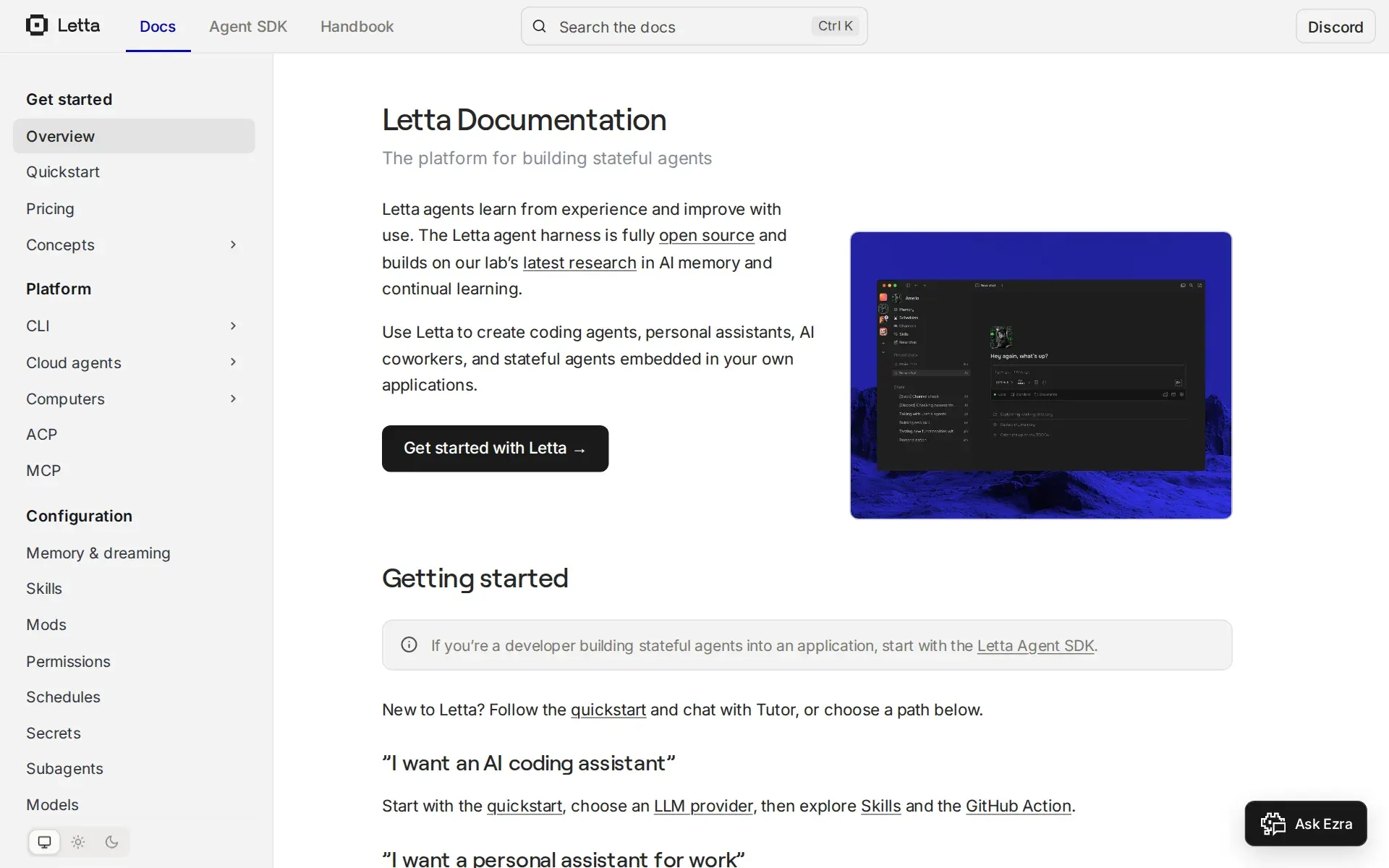
The Letta agent harness is fully open source and builds on our lab's latest research in AI memory and continual learning.
docs.letta.com/llms.txt
What it costs to run
- How it meters
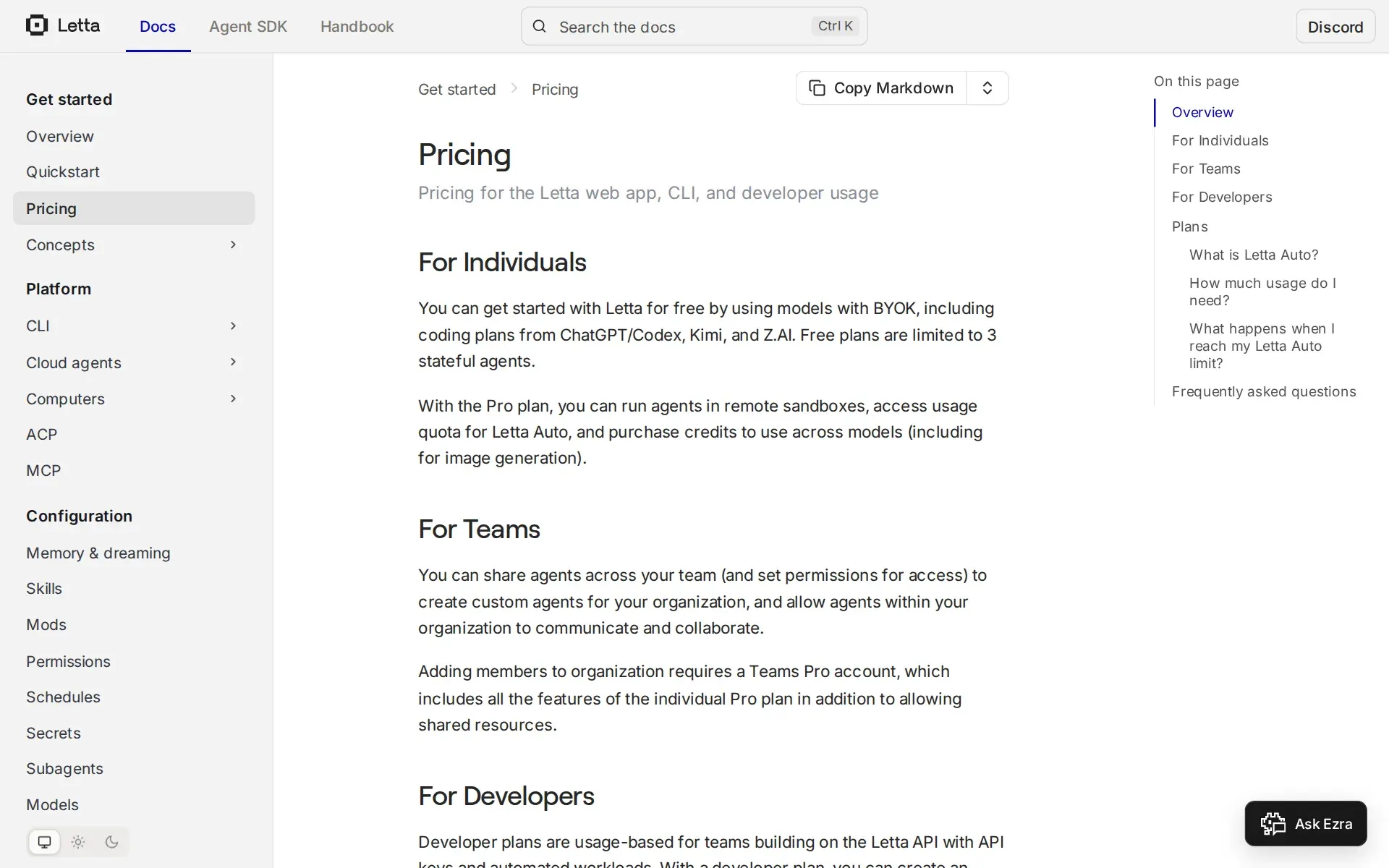
- YesMixed metering the page states plainly: a flat or per-seat $20 monthly fee, then usage billed in credits for LLM inference and CPU time, plus $0.10 per active agent per month and $0.00015 per second of server-side tool execution on the API Plan.
API Plan — $20 /month — Unlimited agents; $0.10 / active agent / mo; $0.00015 / sec tool execution; API key authentication; Pay-as-you-go LLM usage
docs.letta.com/pricing - Free tier
- YesA standing $0 plan, not a trial: limited agents, 5 MiB per memory repository, limited Letta Auto usage, and you may bring your own API keys or an external coding plan instead of paying Letta.
Free — Get started at no cost. $0 /month — Limited agents; 5 MiB of storage per memory repository; Limited usage of Letta Auto; Bring your own API…
docs.letta.com/pricing - API access
- YesCloud agents are drivable via the Letta REST API with an API key; the recommended path is the TypeScript Agent SDK.
Agents hosted in Letta Cloud are also accessible through the Letta REST API using a LETTA_API_KEY.
docs.letta.com/reference/faq/index.md - MCP server
- NoMCP runs inbound only: Letta sessions consume stdio, HTTP and SSE MCP servers; no Letta MCP server is published.
MCP tools are discovered from servers supplied through mcpServers and proxied by the SDK host to the MCP server.
docs.letta.com/agent-sdk/mcp/index.md - Bring your own key
- YesEvery plan supports your own provider keys or coding subscriptions, and usage then bypasses Letta credits.
Yes. All plans support bringing your own API keys (BYOK). When you connect your own keys (via /connect in the Letta CLI), usage goes directly through…
docs.letta.com/pricing/index.md
Buying it for a team
- A company can buy it
- YesAn organisation can buy it directly: Teams Pro sells per seat at $20 and adds shared agents and access control, with an Enterprise tier offering volume pricing, RBAC and SAML/OIDC SSO.
Teams Pro — For teams. $20 /seat/month — Add teammates to your organization; Letta Auto weekly + monthly quota; Share agents and set access control
docs.letta.com/pricing - Seat model
- PartlyPriced per seat on Teams Pro; no seat minimum or maximum is published, and Enterprise seat pricing is by contact.
If you would like to configure managed per-seat pricing for your business, please contact us
docs.letta.com/pricing/index.md - Pooled budget
- NoQuota attaches to each purchased Pro seat; unpaid seats get no Letta-hosted inference at all.
By default, users you add will be on Free seats, which means they will be unable to use Letta-hosted models for inference.
docs.letta.com/teams/quickstart/index.md - Admin controls
- PartlyOrg roles gate who reaches an agent; what the agent may run is set per machine or project, not centrally by an admin.
Agent access and tool permissions are separate. Sharing an agent does not automatically allow every tool call on every connected computer. Each…
docs.letta.com/teams/permissions/index.… - Audit log
- NoNo administrative audit log is published; the Enterprise list stops at RBAC, SSO, quotas and dedicated support.
Volume-based pricing Increased quotas Role-based access control SAML/OIDC SSO Dedicated support
docs.letta.com/pricing/index.md - Single sign-on
- PartlySAML/OIDC SSO is an Enterprise-only line item; Pro and Teams Pro cards do not list it.docs.letta.com/pricing/index.md
What happens to your code
- Opt out of training
- PartlyHosted messages may train future models; running your own model backend or local state means nothing is collected.
We do NOT collect data on any of your messages or prompts unless you are using our hosted services (for example, if you are running your own model…
letta.com/privacy-policy - Data residency
- PartlyYou choose the machine, local or your own App Server host, but no Letta Cloud region or jurisdiction is published.
Agent state and the execution environment live on the App Server machine, so multiple clients can share the same agents and the server can run on…
docs.letta.com/self-hosting/index.md - Getting out
- PartlyMemory is git-backed files you can inspect and sync to your own GitHub repo; credit expiry is never stated.
Agent memory is represented as git-backed files that you can inspect, edit, and version.
docs.letta.com/handbook/index.md - Certifications
- PartlyGDPR and US state privacy rights are documented; no SOC 2 or ISO 27001 attestation appears anywhere on the site.
If you are located in a country that falls under the scope of the GDPR, data protection laws give you certain rights with respect to your personal…
letta.com/privacy-policy
Plans and pricing
Price and terms
- Free plan
- YesYes
The terms in full
Free plan at $0/month: limited agents (free plans are limited to 3 stateful agents), 5 MiB of storage per memory repository, limited usage of Letta Auto, and bring your own API keys and external coding plans.
What needs a higher plan
- Teams Pro
- Seat model
- Enterprise
- Single sign-on
From docs.letta.com/pricing, checked .
The Agents Index digest
Price changes and new agents like Letta, at most once a week.
Last issue: Devin vs Claude Code: Which Should You Pick? · 13 October 2026
Works with
 Claude
 GPT
GPT- YesOpen models
For AI agents
- MCP server
- No
- API
- Yes
Screenshots
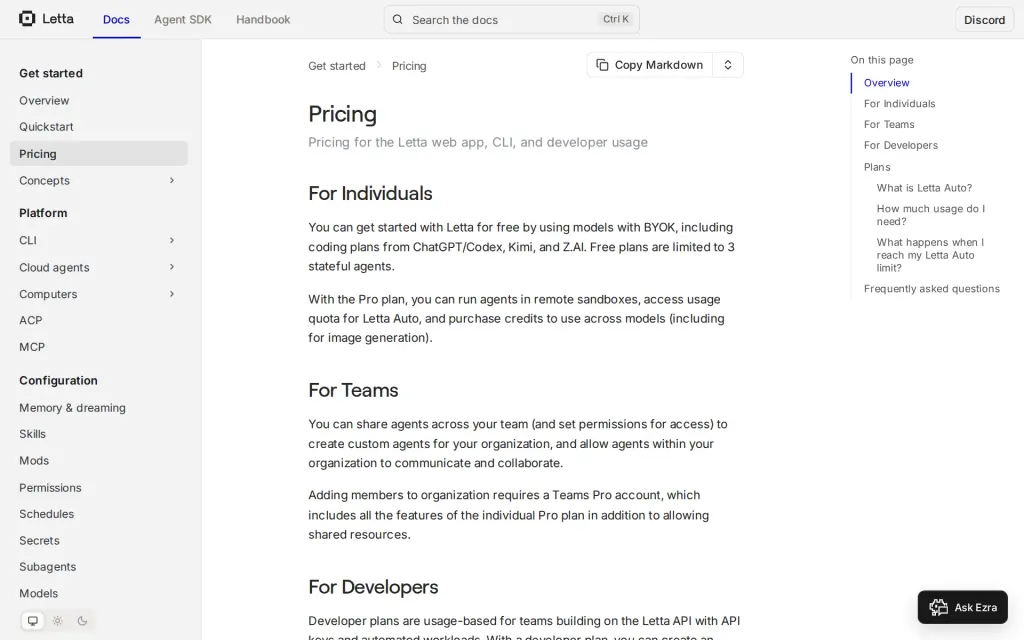
Pricing page, letta.com, captured 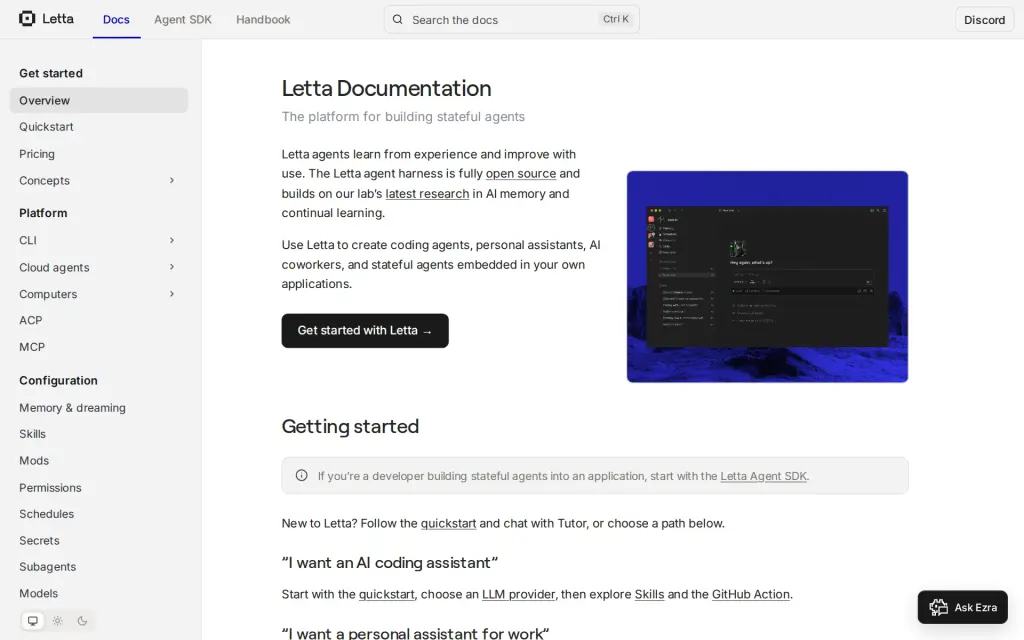
Docs, letta.com, captured
Filed under
Sources and updates
Last changed
Sources20
- docs.letta.com/pricing/index.md
- docs.letta.com/configuration/models/index.md
- docs.letta.com/platform/github-action/index.md
- docs.letta.com/pricing
- docs.letta.com/configuration/subagents/index.md
- docs.letta.com/handbook/index.md
- letta.com/privacy-policy
- docs.letta.com/quickstart/index.md
- docs.letta.com/reference/faq/index.md
- docs.letta.com/self-hosting/index.md
- docs.letta.com/teams/quickstart/index.md
- docs.letta.com/agent-sdk/mcp/index.md
- docs.letta.com/configuration/permissions/index.md
- docs.letta.com/index.md
- docs.letta.com/llms.txt
- docs.letta.com/platform/acp/index.md
- docs.letta.com/platform/cli/headless/index.md
- docs.letta.com/platform/cli/index.md
- api.github.com/repos/letta-ai/letta-codeRepository
- docs.letta.com/teams/permissions/index.md
Repository30 August 2026
- Licence
- Apache-2.0
- Stars
- 3,155
- Forks
- 381
- Last push
- 30 August 2026
Coverage elsewhere1
The Agents Index in AI answers0 of 1
- PerplexityDoes not cite The Agents IndexAsked
Letta alternatives
on Other sources: ebool.com, g2.com, toolradar.com, infrabase.ai, costbench.com, startuphub.ai
Updates5
- Capabilities · Free tier · Plan limits
- Capabilities · Free tier · Terms
- Capabilities · Free tier · Price · Terms
- Alternatives · Crunchbase link · LinkedIn link · Repository · Summary · Tagline
- Summary · Tagline
Is this yours? Claim it free and edit it in your dashboard, or feature it in Agent frameworks.