
Not for Python-first teams and anyone needing a mature, multi-year-proven ecosystem with the largest tutorial and integration surface. LangChain remains the deeper-established choice there.
The facts, with their sources
What it does
- Writes code
- PartlyCode mode has the model author a TypeScript function that orchestrates your tools, executed in a sandbox; it is a beta tool-use optimisation, not a code-authoring product.
Instead of calling tools one turn at a time, the model writes a tailored function for the user query.
mastra.ai/docs/agents/code-mode - Whole-codebase work
- PartlyAgents you build get file tools over a mounted tree (grep and structural edits), but Mastra claims no repository-wide migration capability of its own.
ast_edit | Applies structural code edits. Available when @ast-grep/napi is installed.
mastra.ai/docs/sandbox/filesystem - Done-for-you service
- PartlyYou run the software, but Mastra sells professional services (Concierge, forward-deployed engineering) and enterprise support covering planning, prototyping and workshops.
Mastra Concierge and other professional, deployment, implementation, support, or forward-deployed engineering services, which are governed by a…
mastra.ai/terms-of-service
How much it does unattended
- Runs autonomously
- YesAgents iterate their own tool-use loop until a final answer or stopping condition; durable agents persist run state so a loop can outlive the request that started it.
Mastra agents use LLMs and tools to solve open-ended tasks, reasoning about goals, deciding which tools to use and iterating internally until the…
mastra.ai/agent-builder - Multi-agent
- YesSupervisor/subagent delegation is a first-class primitive, with delegation hooks, message filtering and per-subagent memory isolation.
Subagents are specialized agents that another agent can delegate tasks to.
mastra.ai/docs/subagents - Agent permissions
- YesTool approval can gate any tool call, per server or by predicate on tool name/arguments; approvals propagate up a subagent delegation chain.
Require a human or external system to approve or reject any tool call before it executes.
mastra.ai/ai-agent-framework
Which models it runs on
- Claude
- YesAnthropic is a named first-class provider in the model router; models are selected as provider/model-name strings.
Whether you're using OpenAI, Anthropic, Google, or a gateway like OpenRouter, specify the model as "provider/model-name" and Mastra handles the rest.
mastra.ai/models - GPT
- YesOpenAI is a named first-class provider in the model router, with provider-specific options such as reasoningEffort.mastra.ai/models
- Open models
- YesOpen-weight models run against any OpenAI-compatible endpoint on your own hardware; the vendor names gpt-oss, Qwen3 and DeepSeek.
Mastra also supports local models like gpt-oss, Qwen3, DeepSeek and many more that you run on your own hardware.
mastra.ai/models - Model choice
- YesYou choose the model per agent, per request or as a fallback chain; the router is explicitly positioned as provider-agnostic.
Mastra's unified model router supports more than 1,000 models across providers including OpenAI, Anthropic, Google and others.
mastra.ai/ai-agent-framework
Where you use it
- In your editor
- PartlyNo IDE extension of its own; Mastra ships an MCP docs server and a skill that coding agents inside editors consume.
It works with Cursor, Windsurf, Cline, Claude Code, VS Code, Codex or any tool that supports MCP.
mastra.ai/reference/build-with-ai - On the command line
- YesA Mastra CLI builds, starts and dev-serves the project (mastra build, mastra start, mastra dev).
Start the server using the Mastra CLI:
mastra.ai/docs/deployment/mastra-server - In your pipeline
- PartlyScorers and eval suites run in CI through Vitest/Jest via runEvals; the vendor claims no agent that acts on a pull request.
Running scorers in your CI pipeline provides quantifiable metrics for measuring agent quality over time.
mastra.ai/docs/evals/running-in-ci - In a browser
- YesStudio is a hosted web UI for running agents, editing prompts, annotating traces and building datasets; it runs locally at port 4111 or deployed for the team.
Mastra Studio provides an interactive environment for testing agents, tracing execution and refining prompts before and after you ship.
mastra.ai/ai-agent-framework
Whose machine it runs on
- Self-hosted
- Yesmastra build emits a self-contained Node server that runs on any Node/Bun/Deno host; Enterprise Edition can be deployed on-prem or in your own cloud.
Mastra deploys to any Node.js-compatible environment including Bun, Deno and Cloudflare. Server adapters let you run Mastra with Express, Hono or…
mastra.ai/ai-agent-framework - Open source
- YesThe framework (Community Edition) is Apache 2.0 on GitHub; enterprise features sit in a separately licensed Enterprise Edition.
Mastra is fully open source under the Apache 2.0 license, so you control your source code and infrastructure.
mastra.ai/ai-agent-framework
What it costs to run
- How it meters
- YesPlan fee plus consumption metering: observability events, CPU hours, egress, memory tokens, retrieval storage and database rows all have per-unit overage rates. Not per seat.
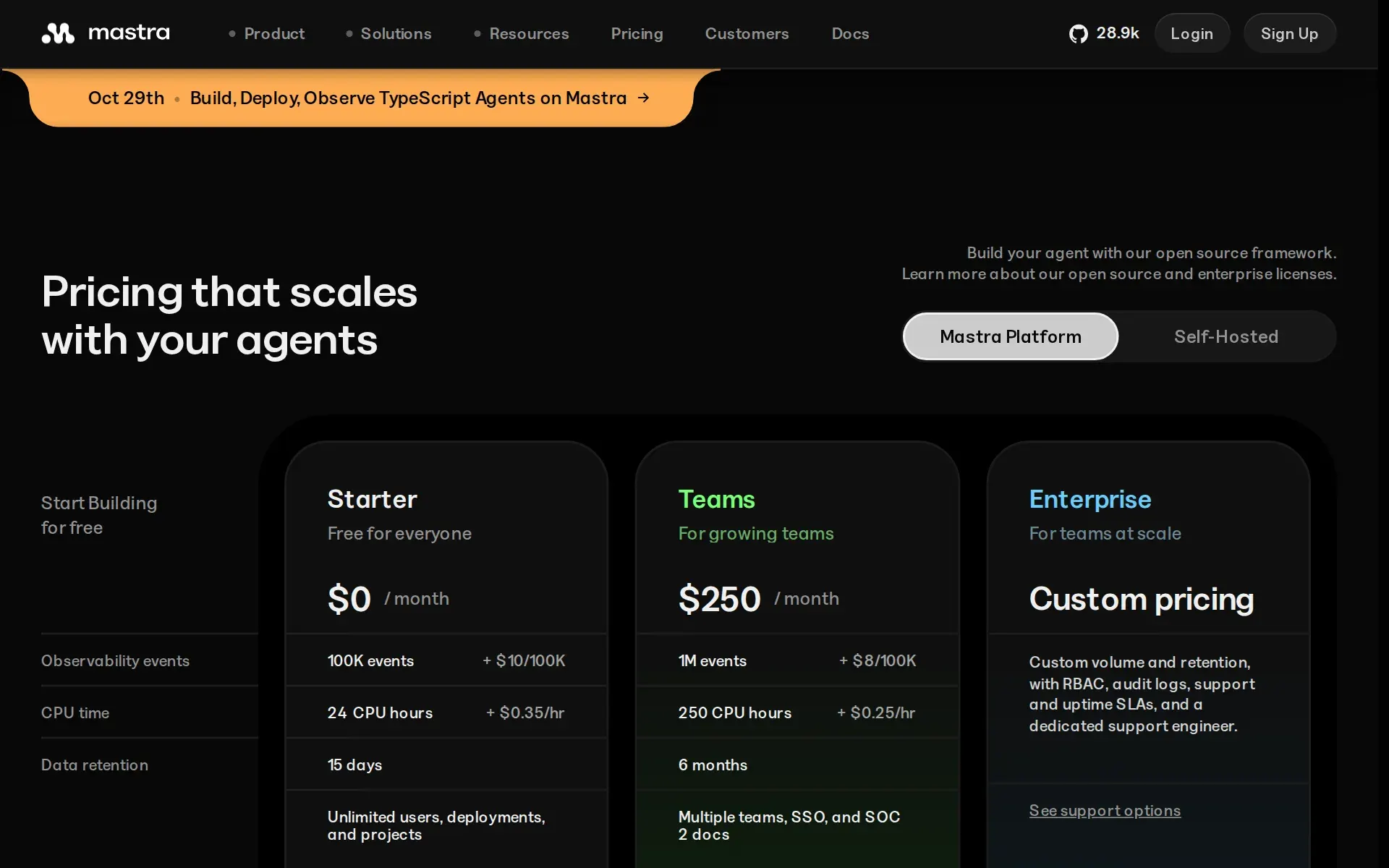
CPU Time 24 hours then $0.35/hr
mastra.ai/pricing - Free tier
- YesStarter plan is $0/month with no call required, and the framework itself is free under Apache 2.0.
Starter Free for everyone $0/ month
mastra.ai/pricing - API access
- YesEvery registered agent and workflow is exposed as an HTTP endpoint, with OpenAPI/Swagger, a typed client SDK and OpenAI-compatible Responses routes.
Mastra runs as an HTTP server that exposes your agents, workflows, and other functionality as API endpoints.
mastra.ai/docs/server/overview - MCP server
- YesBoth directions: MCPClient consumes external MCP servers, and MCPServer publishes your agents, tools and workflows to other MCP clients over stdio or HTTP.
Use MCPServer to expose Mastra agents, tools, workflows, prompts, and resources to other MCP-compatible systems.
mastra.ai/docs/connections/mcp - Bring your own key
- YesBYOK is an explicit Gateway access mode on every plan; keys are stored encrypted and used only to route your requests. Self-hosting your own inference endpoint is also supported.
Bring-Your-Own-Keys (BYOK), under which Customer provides its own API keys for one or more Model Providers (or for a third-party gateway provider)
mastra.ai/terms-of-service
Buying it for a team
- A company can buy it
- YesTeams plan is self-serve at a published price with multi-team support; Enterprise is bought through an Order Form with sales.
Teams For growing teams $250/ month
mastra.ai/pricing - Seat model
- NoNot licensed per seat: Starter and Teams both state unlimited users, and the self-hosted Enterprise offer explicitly rejects per-seat metering.
Predictable cost One flat annual fee — no per-trace or per-seat metering.
mastra.ai/pricing - Pooled budget
- YesAllowances are account-level (events, CPU hours, tokens, storage) and users are unlimited, so there is one shared balance rather than a per-user budget.
Unlimited users, deployments, and projects
mastra.ai/pricing - Admin controls
- PartlyRBAC restricts read/write/execute/delete per resource in Studio and on the API, but SSO and RBAC in production are Enterprise Edition features requiring a licence.
Studio Auth features (SSO login, RBAC, permission-based UI) are part of the Mastra Enterprise Edition.
mastra.ai/docs/studio/auth - Audit log
- PartlyAudit logs are named only in the Enterprise tier's bundle; Starter and Teams cards do not list them.
Custom volume and retention, with RBAC, audit logs, support and uptime SLAs, and a dedicated support engineer.
mastra.ai/pricing - Single sign-on
- PartlySSO starts at Teams on the hosted platform; on self-hosted deployments SSO login is an Enterprise Edition licensed feature. Providers include WorkOS, Okta, Clerk, Auth0.
Multiple teams, SSO, and SOC 2 docs
mastra.ai/pricing
What happens to your code
- Opt out of training
- YesContractual no-training default on customer inputs and outputs, for Mastra's and model providers' models, with training only on express opt-in.
Mastra does not, and will not, use Customer Inputs or Customer Outputs to train, fine-tune, or otherwise improve any foundation model or other Model…
mastra.ai/terms-of-service - Data residency
- PartlySelf-hosted Enterprise keeps traces, prompts and outputs inside your own VPC; for the hosted platform the vendor publishes no region or jurisdiction.
Data stays in your VPC No traces, prompts, or outputs leave your environment.
mastra.ai/pricing - Getting out
- PartlyYou own your data and can cancel any time, but retention is capped by plan (15 days to 6 months), backups are your responsibility and downgrading may delete data over the new limit.
Mastra has no obligation to store Customer Data indefinitely. ... You are responsible for maintaining your own back-up copies of Customer Data.
mastra.ai/terms-of-service - Certifications
- PartlySOC 2 documentation is offered from the Teams plan; a DPA covering GDPR, UK GDPR and CCPA/CPRA is published, and a Vanta-hosted trust centre carries the security programme. No ISO 27001 claim found.mastra.ai/pricing
Plans and pricing
Price and terms
- Free plan
- YesYes
The terms in full
Starter plan, $0/month, not a trial: 100K observability events, 24 CPU hours, 15 days data retention, 1GB data storage, 10GB egress, unlimited users, deployments and projects, with metered overages beyond each allowance. Separately, the framework itself is free under Apache 2.0 and can be self-hosted with no plan.
What needs a higher plan
- Mastra Enterprise Edition
- Admin controls
- Enterprise
- Audit log, Data residency
- Teams
- Single sign-on, Certifications
From mastra.ai/pricing, checked .
The Agents Index digest
Price changes and new agents like Mastra, at most once a week.
Last issue: Devin vs Claude Code: Which Should You Pick? · 13 October 2026
Works with
 Claude
 GPT
GPT- YesOpen models
For AI agents
- MCP server
- Yes
- API
- Yes
Screenshots
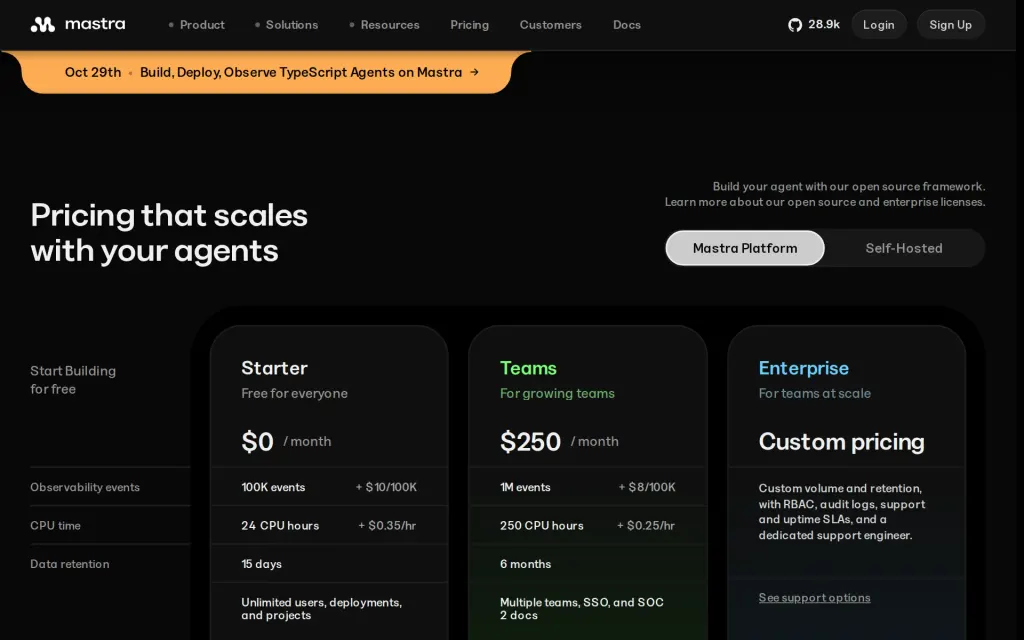
Pricing page, mastra.ai, captured 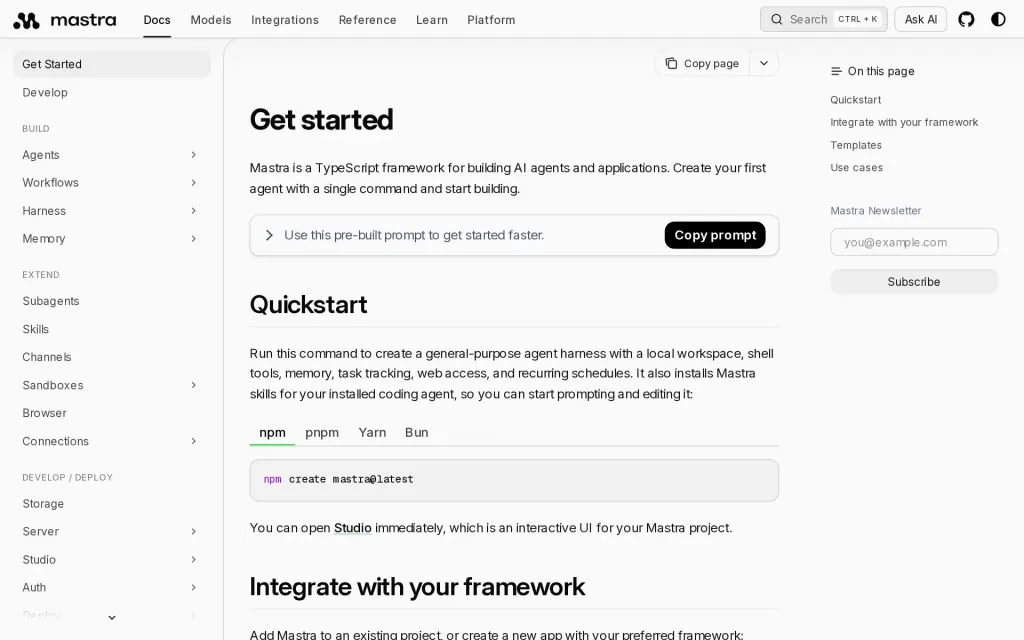
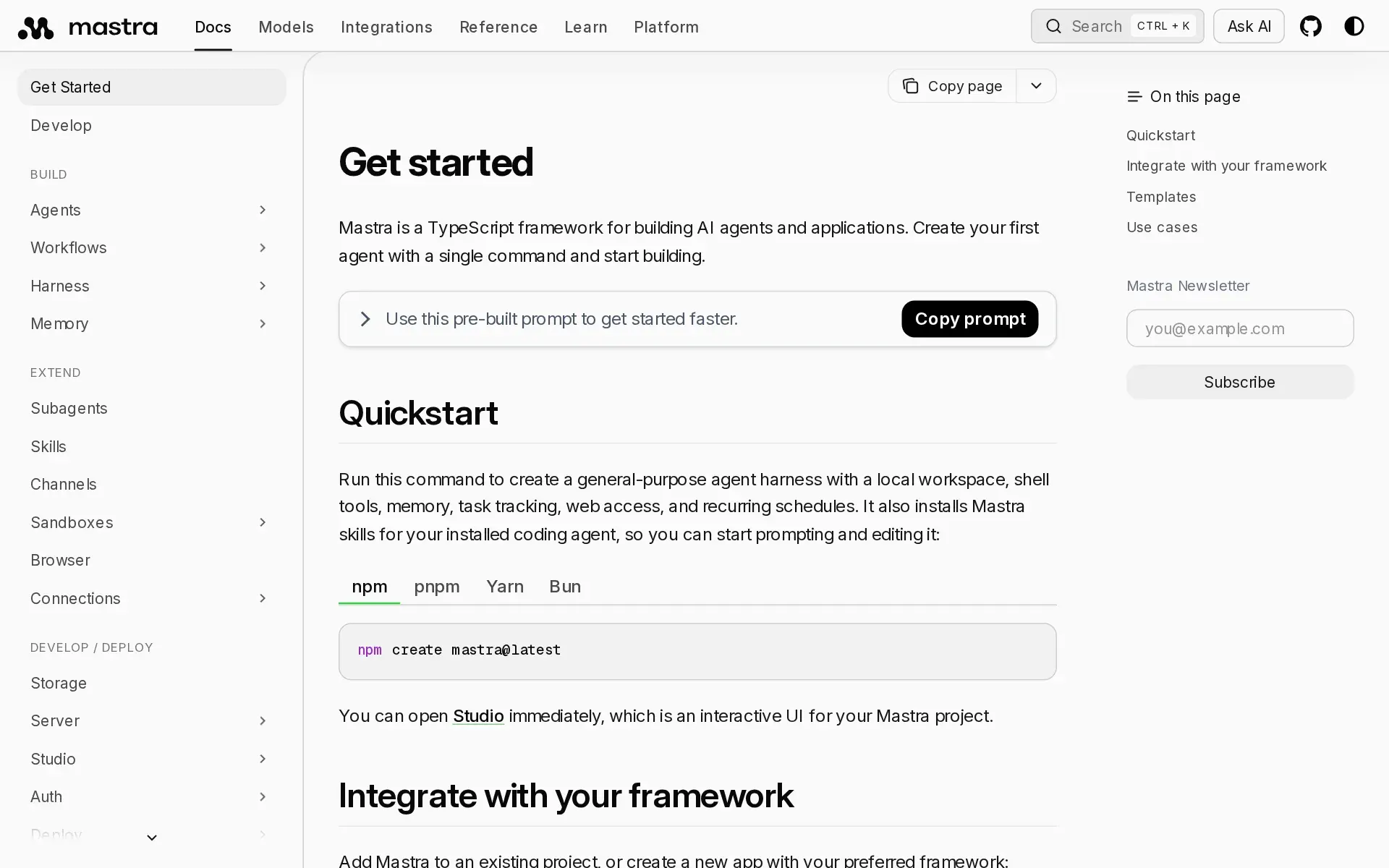
Docs, mastra.ai, captured
Filed under
Sources and updates
Last changed
Sources17
- mastra.ai/pricing
- mastra.ai/ai-agent-framework
- mastra.ai/models
- mastra.ai/terms-of-service
- mastra.ai/docs/develop
- mastra.ai/docs/studio/auth
- trust.mastra.ai/
- mastra.ai/agent-builder
- mastra.ai/docs/agents/code-mode
- mastra.ai/docs/connections/mcp
- mastra.ai/docs/deployment/mastra-server
- mastra.ai/docs/evals/running-in-ci
- mastra.ai/docs/sandbox/filesystem
- mastra.ai/docs/server/overview
- mastra.ai/docs/subagents
- mastra.ai/reference/build-with-ai
- api.github.com/repos/mastra-ai/mastraRepository
Repository30 August 2026
- Stars
- 27,570
- Forks
- 2,711
- Last push
- 30 August 2026
The Agents Index in AI answers1 of 1
- PerplexityCites The Agents IndexAsked
Mastra alternatives
on Other sources: g2.com, infrabase.ai, libhunt.com, evermind.ai, startuphub.ai, respan.ai
Updates3
- Capabilities · Free tier · Terms
- Capabilities · Free tier · Price · Terms
- Alternatives · LinkedIn link · Summary · Tagline
Is this yours? Claim it free and edit it in your dashboard, or feature it in Agent frameworks.