
Not for Non-technical teams who want a hosted dashboard and a working voice agent without writing or deploying code.
The facts, with their sources
What it does
- Done-for-you service
- NoYou run the software: an open-source SDK plus a self-serve cloud. Enterprise adds a designated solutions engineer, which is support, not a build-for-you engagement.
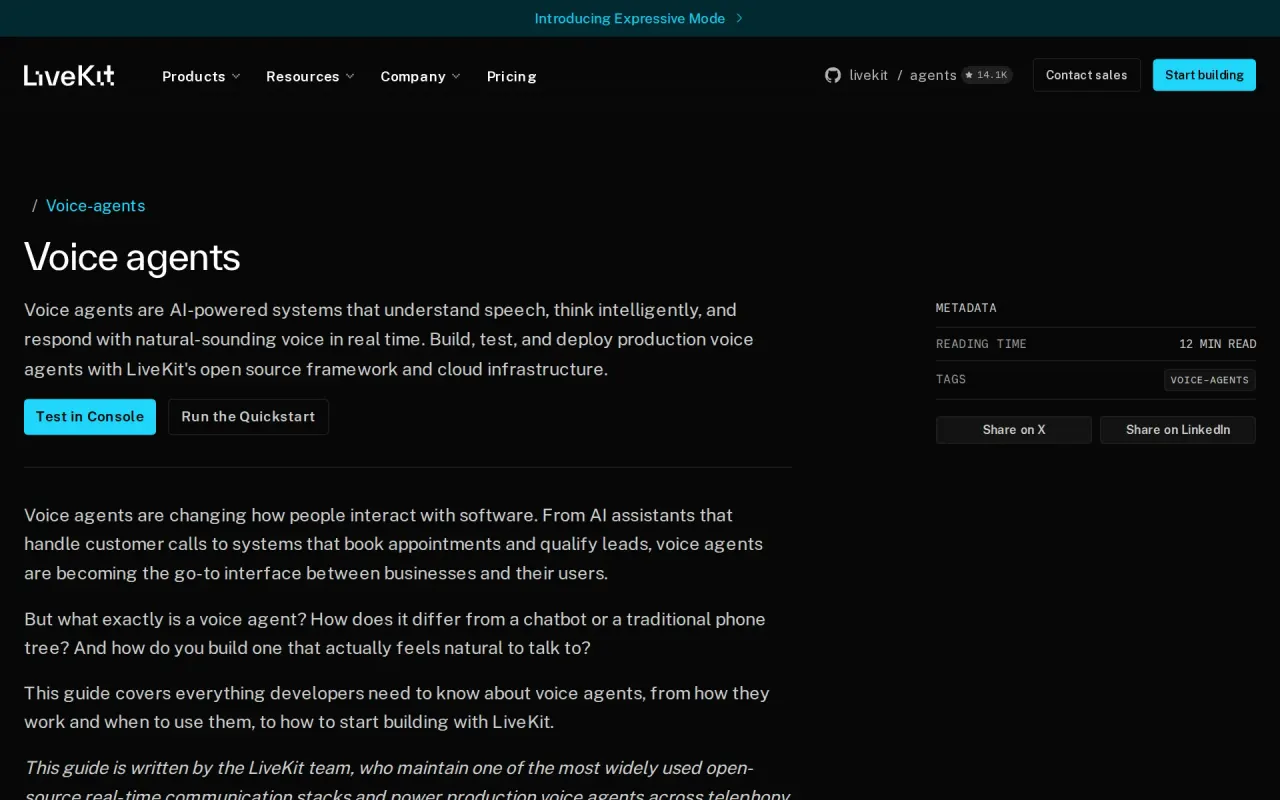
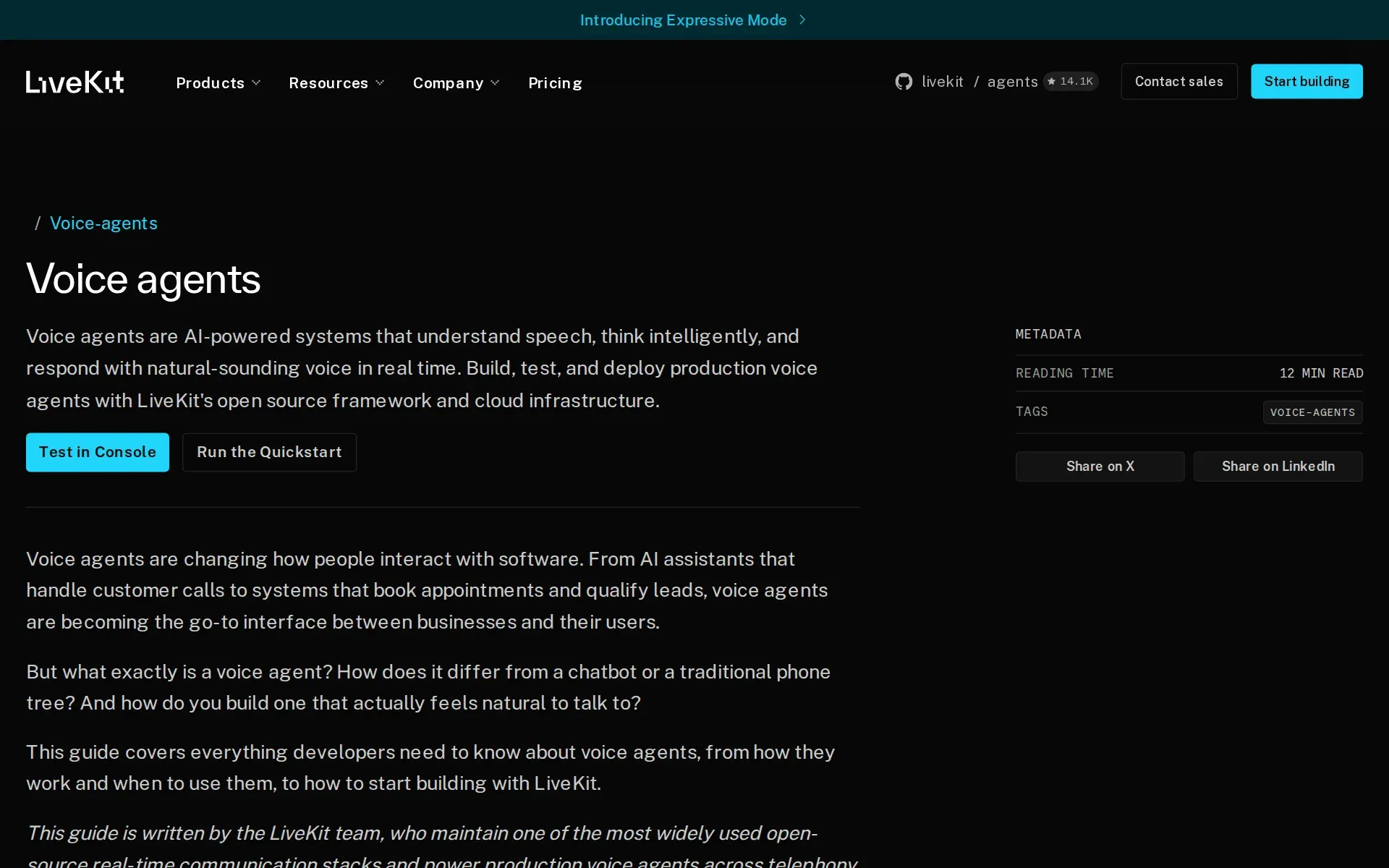
LiveKit is a developer platform for voice, video, and physical AI. Build agents with our open source SDKs, deploy them across a global network of…
livekit.com/products/agent-platform
How much it does unattended
- Runs autonomously
- YesAgents run as server-side workers dispatched into a live session, handling calls end to end and handing off to a human only when the flow transfers.
voice agents can handle inbound calls, make outbound calls, transfer to humans, and interact with traditional telephony systems. LiveKit supports…
livekit.com/voice-agents - Multi-agent
- YesMultiple agents in one session via handoffs, plus a supervisor pattern where one agent keeps control and delegates to scoped tasks.
The LiveKit Agents framework lets you build sophisticated voice AI apps with multiple personas, conversation phases, or specialized capabilities…
docs.livekit.io/agents/logic/workflows.… - Agent permissions
- PartlyNo built-in human-approval gate: the model calls whichever tools the developer exposes. Bounding is by construction: MCP toolsets can be filtered by tool name or set to require confirmation on a duplicate call.
Tool invocations are model-driven: the LLM chooses to call them based on context, and the returned results are fed back to the model for continued…
docs.livekit.io/agents/logic/workflows.…
Which models it runs on
- Claude
- YesAnthropic plugin for Python and Node.js, using your own Anthropic API key. Claude is not among the models served through LiveKit Inference, so it is a plugin-only path.
This plugin allows you to use the Claude API as an LLM provider for your voice agents.
docs.livekit.io/agents/models/llm/anthr… - GPT
- YesGPT-4o, GPT-4.1 and the GPT-5 families are served through LiveKit Inference with no separate OpenAI key, or via the OpenAI plugin on your own account.
OpenAI models are available in LiveKit Agents through LiveKit Inference and the OpenAI plugin.
docs.livekit.io/agents/models/llm/opena… - Open models
- YesOpen-weight models are the recommended default in LiveKit Inference (Gemma 4 31B, GPT OSS 120B, DeepSeek), and the Ollama plugin runs models locally.
Gemma 4 31B is the recommended default LLM. It's a latency-optimized, open-weight model served on LiveKit's infrastructure.
docs.livekit.io/agents/models/llm - Model choice
- YesYou pick every stage. STT, LLM and TTS are swappable through the plugin system, and realtime speech-to-speech models can replace the three-stage pipeline.
LiveKit works with all major STT, LLM, and TTS providers through a plugin system. Swap models in and out with a few lines of code.
livekit.com/voice-agents
Where you use it
- On the command line
- YesThe lk CLI creates projects, deploys agents and manages LiveKit Cloud; agents can also be run and talked to locally in console mode.
The LiveKit CLI (lk) is the primary interface for managing LiveKit Cloud projects, creating applications from templates, and deploying agents.
docs.livekit.io/reference/developer-too… - In your pipeline
- PartlyCI is a deployment surface, not an acting surface: an official GitHub Action deploys the agent on push. The agent itself never acts on a pull request.
To deploy from CI instead of running lk agent deploy by hand, use the livekit/deploy-action GitHub Action. Use it to deploy your agent whenever code…
docs.livekit.io/deploy/agents/managing-… - In a browser
- YesAgent Console in LiveKit Cloud runs and debugs a deployed agent in the browser; Agent Builder prototypes one with no code, and the dashboard is on every plan.
Agent Console lets you test and debug cloud-deployed voice agents in your browser.
livekit.com/voice-agents
Whose machine it runs on
- Self-hosted
- YesAgents are containers you can run on your own Kubernetes; the LiveKit media server and SIP service are separately self-hostable. Self-hosted agents still meter WebRTC participant minutes if they connect to LiveKit Cloud.
LiveKit Agents run as containers, so you can deploy them to LiveKit Cloud or to any Kubernetes cluster or similar container orchestration platform.
docs.livekit.io/deploy/custom/deploymen… - Open source
- YesApache 2.0 for the Agents SDK and for the media server, SIP, Egress, Ingress and client SDKs. LiveKit Cloud is the commercial hosted layer on top.
The LiveKit Agents SDK is open source under the Apache 2.0 license. You can self-host or deploy to LiveKit Cloud for managed infrastructure.
livekit.com/voice-agents
What it costs to run
- How it meters
- YesBilling is a monthly platform fee plus metered consumption: each plan includes allotments of agent session minutes, telephony minutes and inference credits, then overage is charged per minute, per 1,000 requests or per million tokens, so cost tracks usage rather than seats.livekit.com/pricing
- Price per 1,000 requests
- Yes$0.5 per 1,000 requests in Audio turn detection (EOT), Ship, its cheapest mode.
$0.50 per 1,000 requests
livekit.com/pricing - Free credit
- Yes$2.50 of free usage, a month.
$2.50 in credits (~50 minutes, based on model prices)
livekit.com/pricing - Free tier
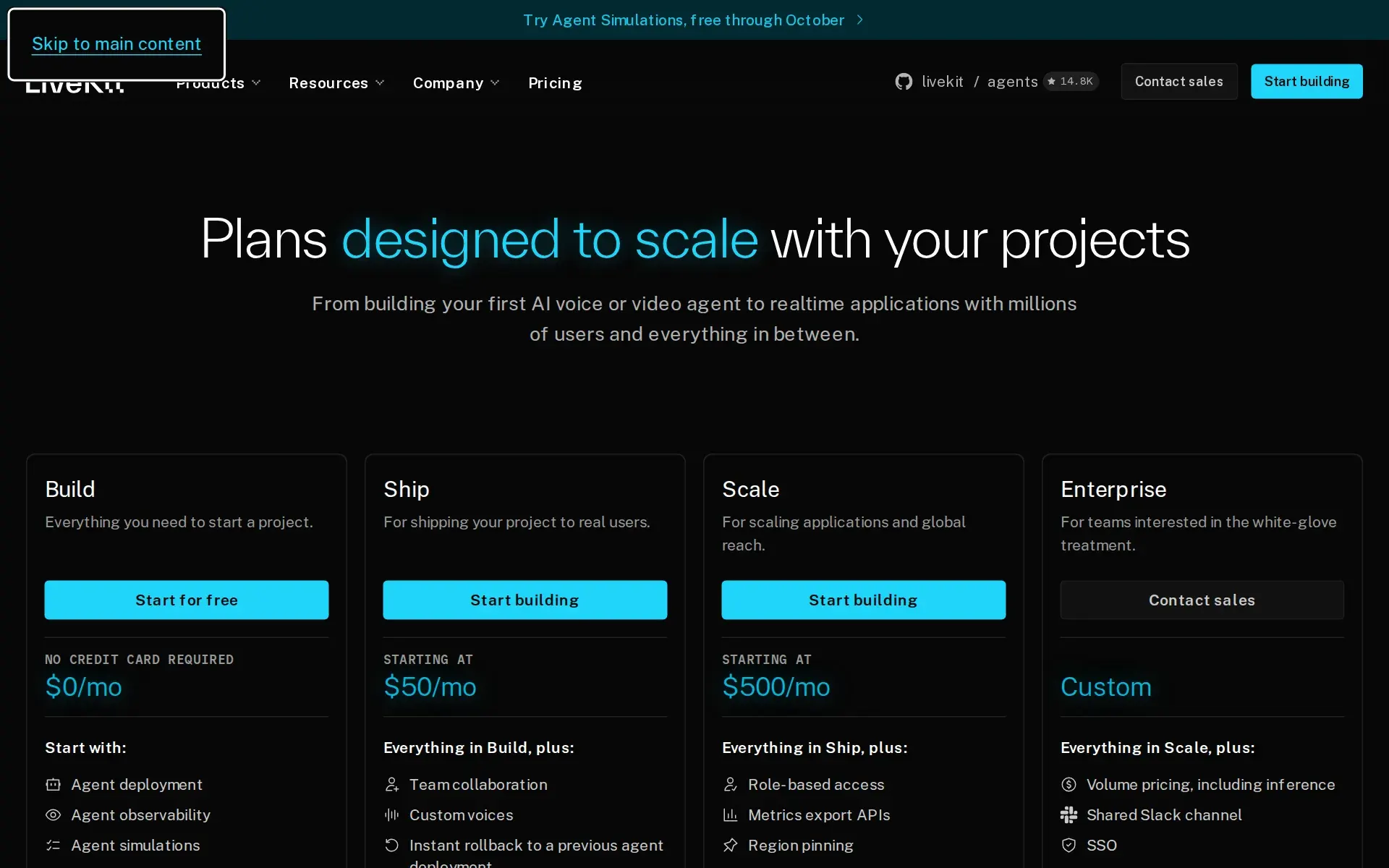
- YesThe Build plan costs $0 a month with no card required and carries real allowances: 1,000 agent session minutes, 5 concurrent sessions, one deployment and $2.50 of inference credits, so you can run an agent before paying anything.
Build — Everything you need to start a project. $0/mo No credit card required
livekit.com/pricing - API access
- YesServer APIs for rooms, participants, tracks, SIP and Egress, driven from your backend with signed tokens, at 1,000 requests per minute per project. Metrics export APIs are Scale and above.
LiveKit has built-in APIs that let you manage rooms, participants, and tracks. These APIs are designed for use by your backend and are fully…
docs.livekit.io/reference/other/roomser… - MCP server
- PartlyThe agent is the MCP client: it consumes tools from remote HTTP or local stdio MCP servers, Python only. LiveKit does not expose a running agent as an MCP server for another agent to query.
LiveKit Agents has first-class support for Model Context Protocol (MCP) servers.
docs.livekit.io/agents/logic/tools/mcp.… - Bring your own key
- PartlyProvider plugins run on your own account, key and billing, and self-hosted agents run in your own cloud. Bringing your own key to traffic routed through LiveKit Inference is not supported.
Use the plugin instead if you prefer to manage billing and rate limits yourself, or need access to a provider not currently available through LiveKit…
docs.livekit.io/agents/models/llm
Buying it for a team
- A company can buy it
- YesPaid plans are self-serve by card; Enterprise is quoted, adds non-credit-card billing and a support SLA, and requires an annual commitment. Team collaboration starts on Ship.
Enterprise plans can be configured with custom limits well above the published Build, Ship, and Scale numbers. They come with an annual commitment
docs.livekit.io/deploy/admin/quotas-and… - Seat model
- NoNot seat-priced. Plans are per project with usage allowances, and neither the plan cards nor the feature matrix publishes a seat count, floor or ceiling; dashboard users get admin, write or read roles.
LiveKit Cloud applies quotas to each project — limits on concurrency, request rates, session durations, and other per-project operations.
docs.livekit.io/deploy/admin/quotas-and… - Pooled budget
- PartlyNo per-user balances: allowances pool inside a project. Sharing one plan across projects, and quotas managed at workspace level, are Enterprise only.
On the Enterprise plan, quotas are managed at the workspace level.
docs.livekit.io/deploy/admin/quotas-and… - Admin controls
- PartlyThree dashboard roles only, and the role-based access row on the plan matrix is No for Build and Ship, Yes from Scale. Agent capability is bounded in code, not by console policy.
Role-based access control. LiveKit's dashboard currently supports admin, write, and read roles. We are actively expanding RBAC; finer-grained roles…
livekit.com/security/overview - Audit log
- PartlyConfig changes and observability access are logged internally, but there is no customer-facing audit log export; SIEM export is roadmap only and handled by the account team.
Audit logging. Access to observability data and modifications to project configuration are logged. Audit log export to external SIEMs (Splunk,…
livekit.com/security/overview - Single sign-on
- PartlySAML SSO exists but only on Enterprise; every lower tier authenticates to the dashboard with Google, GitHub OAuth or email. No OIDC is claimed.
Single sign-on. SAML-based SSO is available on the Enterprise tier and supports common identity providers including Okta, Microsoft Entra ID, and…
livekit.com/security/overview
What happens to your code
- Opt out of training
- YesNothing to opt out of: zero retention is the default on every plan, LiveKit logs no prompts, audio or completions, and voice-clone samples are opted out of provider training on your behalf.
Sub-processors do not retain, log, or use customer inference traffic for training or model improvement.
livekit.com/security/overview - Data residency
- PartlyUS, EU and India, configurable per project, though the region pinning row on the plan matrix is No for Build and Ship, Yes from Scale. Single-tenant deployments are not offered.
Customers can pin media routing, observability data, agent hosting, and stored data to a region. Today, supported regions include the United States,…
livekit.com/security/overview - Getting out
- PartlyRecordings go straight to your own S3, GCS or Azure bucket and traces export to any OpenTelemetry backend, but unused inference credits expire monthly, observability data is kept 30 days, and metrics export APIs are Scale and above.
Unused credits do not roll over to the next month.
docs.livekit.io/deploy/admin/quotas-and… - Certifications
- PartlySOC 2 Type II active, GDPR and CCPA/CPRA compliant, EU-US DPF certified; ISO 27001 and PCI DSS still in progress, HIPAA BAAs only for Scale and Enterprise, and the security reports row is Scale and above.
LiveKit's security measures are vetted by reputable third-party auditors. PCI DSS and ISO 27001 are in progress. Audit artifacts are available under…
livekit.com/security
Plans and pricing
Price and terms
- Free plan
- YesYes
The terms in full
Build plan is $0/mo with no credit card required and includes 1,000 agent session minutes, 5 concurrent agent sessions, 1 agent deployment, $2.50 in LiveKit Inference credits (~50 minutes), 1 free US local phone number with 50 inbound minutes, 5,000 WebRTC minutes, 1,000 agent session recording minutes and 100,000 observability events.
What needs a higher plan
- Enterprise
- Pooled budget, Single sign-on
- Scale
- Admin controls, Data residency
From livekit.com/pricing, checked .
The Agents Index digest
Price changes and new agents like LiveKit Agents, at most once a week.
Last issue: Devin vs Claude Code: Which Should You Pick? · 13 October 2026
Works with
 Claude
 GPT
GPT- YesOpen models
For AI agents
- MCP server
- Partly
- API
- Yes
Screenshots
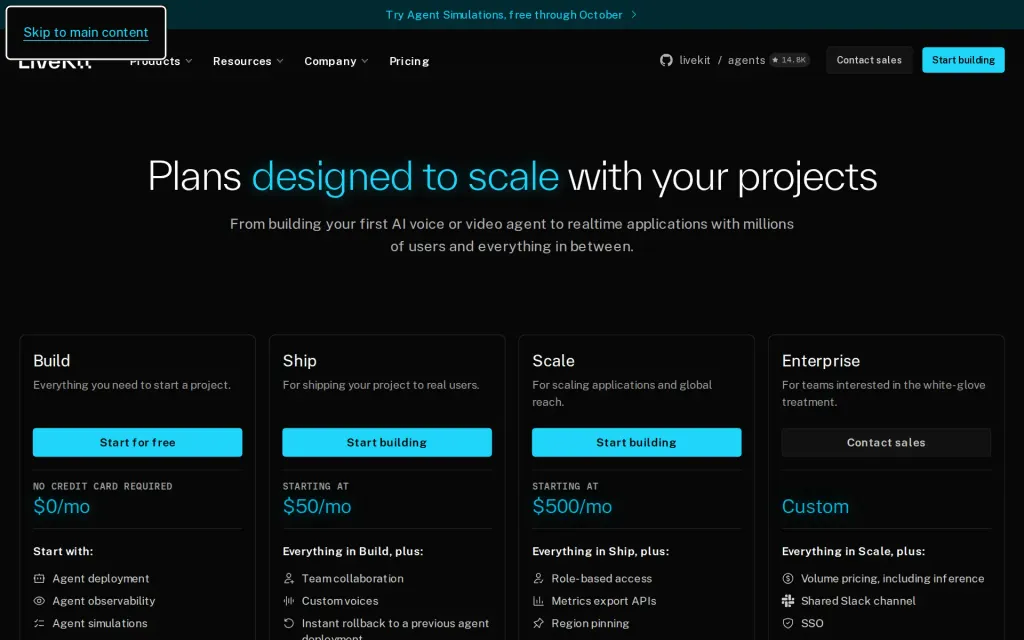
Pricing page, livekit.com, captured
Filed under
Sources and updates
Last changed
Sources22
- docs.livekit.io/deploy/admin/quotas-and-limits.md
- livekit.com/pricing
- livekit.com/security/overview
- livekit.com/security
- livekit.com/voice-agents
- docs.livekit.io/deploy/admin/billing.md
- docs.livekit.io/agents/logic/tools/mcp.md
- docs.livekit.io/agents/logic/workflows.md
- docs.livekit.io/agents/models
- docs.livekit.io/agents/models/llm
- docs.livekit.io/agents/models/llm.md
- docs.livekit.io/agents
- docs.livekit.io/agents/models/llm/anthropic.md
- docs.livekit.io/agents/models/llm/openai.md
- docs.livekit.io/deploy/agents/managing-deployments.md
- docs.livekit.io/deploy/custom/deployments.md
- livekit.com/legal/privacy-policy
- livekit.com/products/agent-platform
- docs.livekit.io/reference/developer-tools/livekit-cli.md
- docs.livekit.io/reference/other/roomservice-api.md
- api.github.com/repos/livekit/agentsRepository
- docs.livekit.io/transport/self-hosting.md
Repository30 August 2026
- Licence
- Apache-2.0
- Stars
- 13,594
- Forks
- 3,646
- Last push
- 30 August 2026
Coverage elsewhere1
The Agents Index in AI answers0 of 1
- PerplexityDoes not cite The Agents IndexAsked
LiveKit Agents alternatives
on Other sources: versusref.com, infrabase.ai, meetrix.io, open.cx, aitools.flocci.in, futureagi.com
Updates4
- Capabilities · Free tier · Plan limits
- Capabilities · Free tier · Terms
- Capabilities · Free tier · Price · Terms
- Alternatives · Documentation link · Summary · Tagline
Is this yours? Claim it free and edit it in your dashboard, or feature it in Voice agents.