
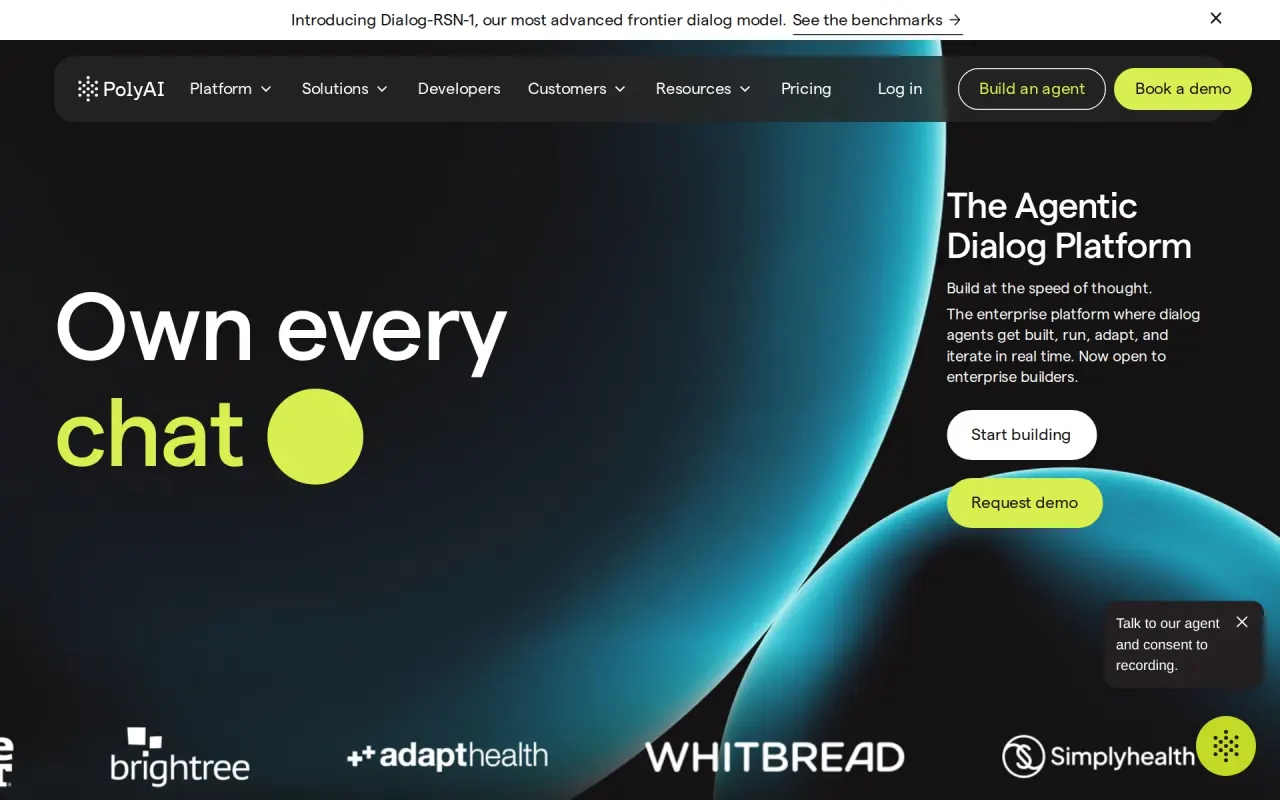
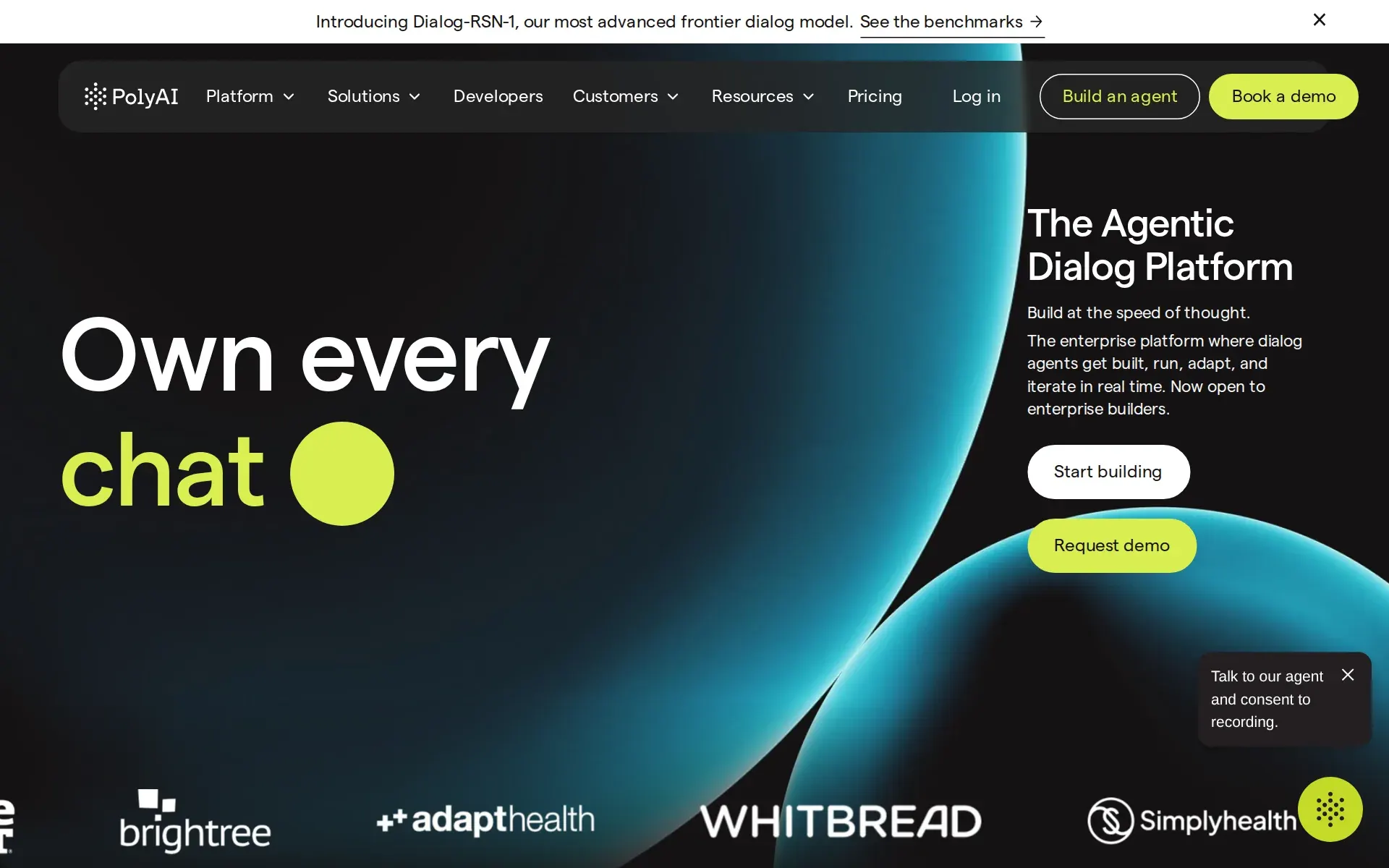
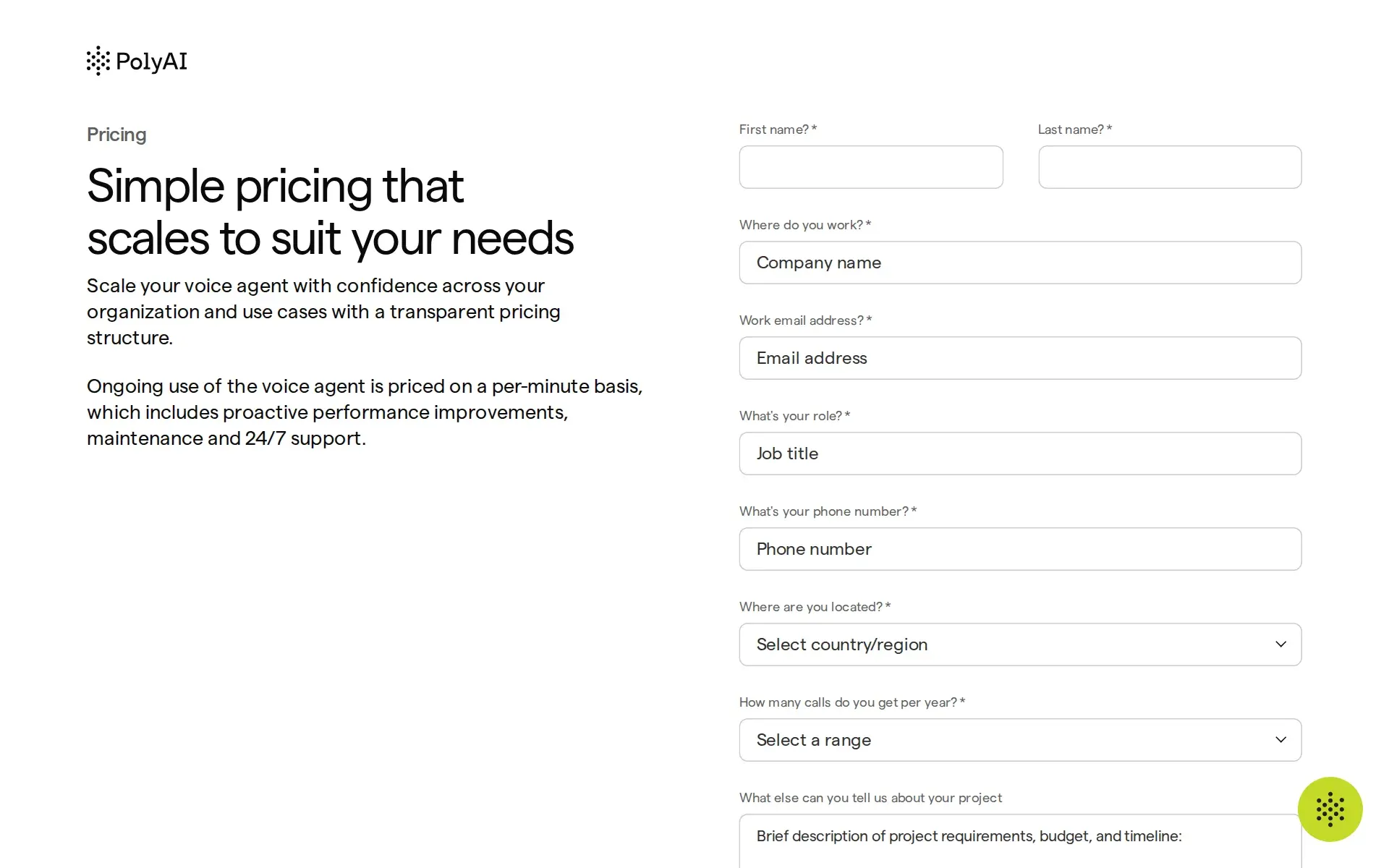
Not for Teams that want to try a working agent before talking to sales, or that need any public pricing to budget against. PolyAI publishes no rate card, and as of an August 2026 re-check no longer offers the self-serve, email-signup on-ramp it briefly ran from May 2026.
The facts, with their sources
What it does
- Writes code
- PartlyWren generates agent configuration and the Python tool functions that call your APIs from a description; it does not author application source code.
It makes a single read-only request against the endpoint and reads the real response, so the function it writes matches what your API actually…
docs.poly.ai/wren/building - Debugs and fixes
- PartlyWren diagnoses production conversations (tool calls, latency, drop-offs) and can implement the fix on a branch; the subject is agent behaviour, not application code.
Wren implements what it finds on a branch and tests the fix, instead of only reporting it.
docs.poly.ai/wren/automated-review - Writes tests
- PartlyIt authors and maintains conversation simulation tests that run in CI; these are agent scenario tests, not unit tests for source code.
Wren can author, run, and manage simulation tests directly from chat.
docs.poly.ai/wren/introduction - Whole-codebase work
- PartlyWren applies one change across every part of an agent project at once, but it is scoped to the project you are in and cannot reach other projects.
It drafts the change, across as many parts of the project as the change touches.
docs.poly.ai/wren/building - Ships it
- PartlyAgent versions ship through Draft, Sandbox, Pre-release and Live with rollback, drivable from the CLI or Agents API, but promotion to Live is always a manual step.
Drafts must be published to Sandbox, then promoted through Pre-release to Live.
docs.poly.ai/environments-and-versions/… - Done-for-you service
- PartlySelf-serve software plus vendor-delivered work: PolyAI builds and maintains managed dashboards, configures managed-service integrations, and runs an enterprise build of roughly six weeks.
Managed dashboards are dashboards that PolyAI builds and maintains for your organisation.
docs.poly.ai/analytics/dashboards/custom
How much it does unattended
- Runs autonomously
- YesThe voice agent conducts inbound and outbound calls unattended, handing off to a human only when its rules say to.
The agent will call the provided number and conduct the conversation autonomously.
docs.poly.ai/api-reference/agents/endpo… - Multi-agent
- NoThe only 'team of agents' feature is assigning several TTS voices to one agent; no coordination between multiple agents on a single task is documented, and the build assistant works one branch at a time.
Use multi-voice when you want callers to hear different voices across interactions – simulating a team of agents or varying the experience for repeat…
docs.poly.ai/voice-channel/multi-voice - Agent permissions
- PartlyWren plans and waits for approval by default, always asks before writing to the live environment, never receives secret values, and its API discovery requests are GET-only.
Because real-time config takes effect immediately, writes to the live environment always ask first.
docs.poly.ai/wren/building
Which models it runs on
- Claude
- YesClaude is one of the third-party models you can run instead of Raven; the model docs list Claude options under the Amazon Bedrock provider tab, selectable per channel.
If you need to, bring in GPT-5, Claude, Gemini, or others, since no single model fits every enterprise use case, language, or regulatory requirement.
poly.ai/blog/agentic-dialog-platform-op… - GPT
- YesOpenAI GPT is one of the third-party models you can run instead of Raven; the model docs list GPT options under the OpenAI provider tab, selectable per channel.poly.ai/blog/agentic-dialog-platform-op…
- Open models
- PartlyThe model catalogue enumerates only Raven, OpenAI and Amazon Bedrock (Claude, Nova) with no open-weight option, but you can attach your own LLM endpoint.
PolyAI supports bring-your-own-model (BYOM) with a simple API integration. If you run your own LLM, expose an endpoint that follows the OpenAI…
docs.poly.ai/behavior/models/byom - Model choice
- YesYou choose the model per channel in voice and chat configuration; Raven is the recommended default rather than the only option.
Choose which LLM powers your agent – including PolyAI Raven, our proprietary model family built for conversational AI.
docs.poly.ai/behavior/models/model-use
Where you use it
- In your editor
- YesThe ADK edits agent resources as local files in any editor, and Builder MCP plugs the same workflow into Cursor, Claude Code, Claude Desktop and Codex.
Edit agent flows, functions, and voice config entirely in your local environment. No browser UI required. Works with any IDE or editor.
poly.ai/developers - On the command line
- YesThe poly CLI pulls, branches, validates, pushes and chats against a project from the terminal.
The Agent Development Kit (ADK) is a Python CLI for building PolyAI agents locally.
docs.poly.ai/extend/adk - In your pipeline
- Yespoly push is CI-compatible and the Agents API lets a pipeline gate promotion on a passing simulation-test set.
A typical CI job publishes the current draft to Sandbox, runs the relevant test set, and only promotes to Pre-release if the set passes.
docs.poly.ai/testing/ci-automation - In a browser
- YesAgent Studio is the hosted build, analytics and deployment surface; a shareable hosted test call is available before anything goes live.
Agent Studio is PolyAI's visual interface for building, deploying, and monitoring voice and chat agents.
docs.poly.ai/get-started/introduction
Whose machine it runs on
- Self-hosted
- NoRuns only as PolyAI-hosted SaaS on AWS with region-specific workspaces; no on-premise or customer-cloud deployment appears anywhere in the vendor's docs or security pages.
Physical security – hosted on AWS providing robust physical data center security
poly.ai/security - Open source
- PartlyThe ADK CLI and Python package are Apache-2.0 in PolyAI's public repository; the platform, Agent Studio and the Raven model are proprietary.
This project is licensed under the Apache License 2.0.
github.com/PolyAI/adk
What it costs to run
- How it meters
- YesMetered by conversation volume, not seats: the MSA credits two CX Tokens per call minute and one per chat, with call time rounded up to 30-second increments.
Ongoing use of the voice agent is priced on a per-minute basis, which includes proactive performance improvements, maintenance and 24/7 support.
poly.ai/pricing - Free tier
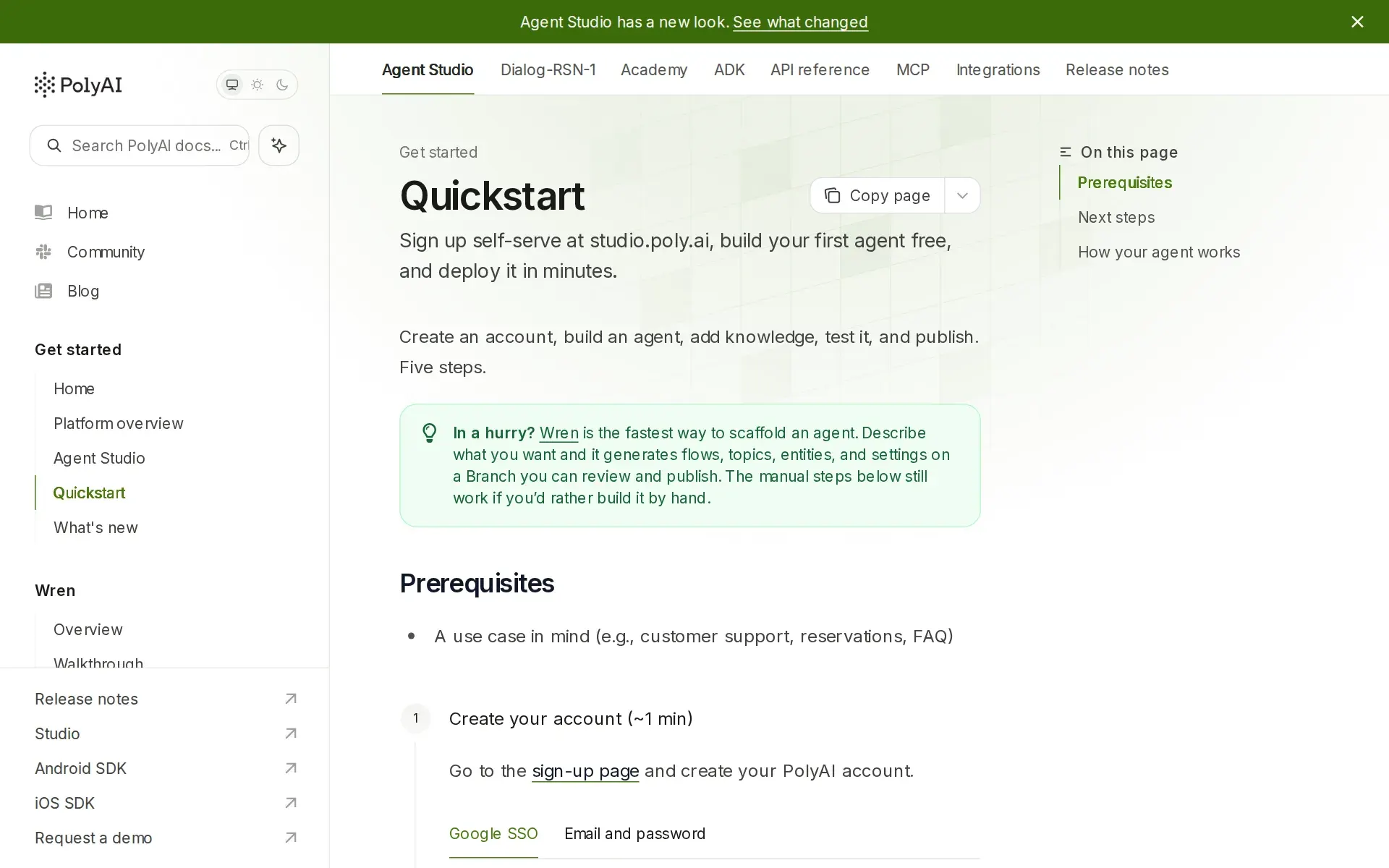
- YesSelf-serve sign-up at Agent Studio needs no sales call, and trial use is free of charge but evaluation-only, with limits set at PolyAI's discretion.
The Trial Services are provided free of charge and, unless otherwise approved by PolyAI in writing, are for internal evaluation and testing purposes…
poly.ai/trial-agreement - API access
- YesThree REST families (Agents, runtime/Conversations, Webhooks) plus WebSocket messaging and a WebRTC gateway, keyed per region.
Three REST API families cover the full lifecycle — ship agents, run conversations, and observe everything in production. No SDK required.
docs.poly.ai/api-reference/introduction - MCP server
- YesBuilder MCP exposes build/test/deploy tools and Data MCP exposes transcripts and metrics to any MCP client; agents can also call external MCP servers.
PolyAI hosts two authenticated MCP servers.
docs.poly.ai/mcp/overview - Bring your own key
- YesYour own LLM endpoint with your own key or bearer token, your own Twilio numbers and your own S3 bucket for recordings; the runtime itself stays PolyAI-hosted.
If you run your own LLM, expose an endpoint that follows the OpenAI chat/completions schema and PolyAI will treat it like any other provider.
docs.poly.ai/behavior/models/byom
Buying it for a team
- A company can buy it
- YesEnterprise workspaces are provisioned by PolyAI under a Master Services Agreement and Order Form; self-serve workspaces exist alongside them.
Enterprise customers - PolyAI provisions your workspace during onboarding; your PolyAI representative sets it up and grants you access.
docs.poly.ai/mcp/quickstart - Seat model
- NoNo per-seat price is published; billing tracks conversation volume, and team members are added by invitation with role-based permissions.
two CX Tokens may be credited against one Call minute; and (ii) one CX Token may be credited against one Chat
poly.ai/msa - Pooled budget
- PartlyConversation volume draws on one account-level Subscription Volume of CX Tokens, but the Wren builder allowance is per person and not shared.
each person gets their own allowance. It isn't a shared pool. A colleague running a long build doesn't eat into what you have left.
docs.poly.ai/wren/usage-and-limits - Admin controls
- YesFifteen navigation areas each set to None, Read or Edit, expandable to individual items, over an Admin/Member account role.
Agent Studio supports mixed permissions across different navigation areas. Give users edit access where they build, and restrict access where they…
docs.poly.ai/user-management/introducti… - Audit log
- PartlyPermission-change audit logging is stated for Enterprise accounts only; every published version and change is separately kept as project history.
Audit logs track permission modifications (for Enterprise accounts)
docs.poly.ai/user-management/introducti… - Single sign-on
- PartlyGoogle SSO sign-in is documented for Studio accounts; no SAML or OIDC enterprise SSO appears in the docs, and SSO assigns neither roles nor area permissions.
If your account uses Google SSO for sign-in, it only handles authentication.
docs.poly.ai/user-management/introducti…
What happens to your code
- Opt out of training
- PartlyCustomer conversations reach Raven training only where the contract authorises it, and the privacy notice relies on consent where law requires; no self-serve opt-out control is documented.
Data is sourced from PolyAI customers to the extent contractually authorized by customers and permitted by applicable law, or otherwise generated by…
docs.poly.ai/legal/training-data - Data residency
- YesEnterprise workspaces are pinned to a US, UK or EU region with matching API and MCP hosts; self-serve accounts live in the shared Studio region.
Enterprise workspaces are region-specific (US, UK, or EU).
docs.poly.ai/mcp/quickstart - Getting out
- PartlyTranscripts, recordings and metadata export via the Conversations API or a PolyAI-configured sync to your own S3 bucket, but unused CX Tokens expire each Contract Year and fees are non-refundable.
Any CX Tokens not used within the Contract Year for which they were issued shall expire automatically at the end of that Contract Year and shall not…
poly.ai/msa - Certifications
- YesISO/IEC 27001 and SOC 2 Type II certified, GDPR compliant, HIPAA and PCI-DSS where relevant, plus UK Cyber Essentials and Cyber Essentials Plus.
PolyAI has achieved SOC 2 Type II compliance, covering data security, availability, processing integrity, confidentiality, and privacy.
docs.poly.ai/legal/compliance
Plans and pricing
Price and terms
- Free trial
- YesYesTrial Services are free of charge but for internal evaluation and testing only, not production
The terms in full
service levels and support do not apply, and usage limits are set by PolyAI and extended at its sole discretion. Self-serve sign-up at Agent Studio needs no sales call.
What needs a higher plan
- Enterprise
- Audit log
From poly.ai/pricing, checked .
The Agents Index digest
Price changes and new agents like PolyAI, at most once a week.
Last issue: Devin vs Claude Code: Which Should You Pick? · 13 October 2026
Works with
 Claude
 GPT
GPT- PartlyOpen models
For AI agents
- MCP server
- Yes
- API
- Yes
Screenshots
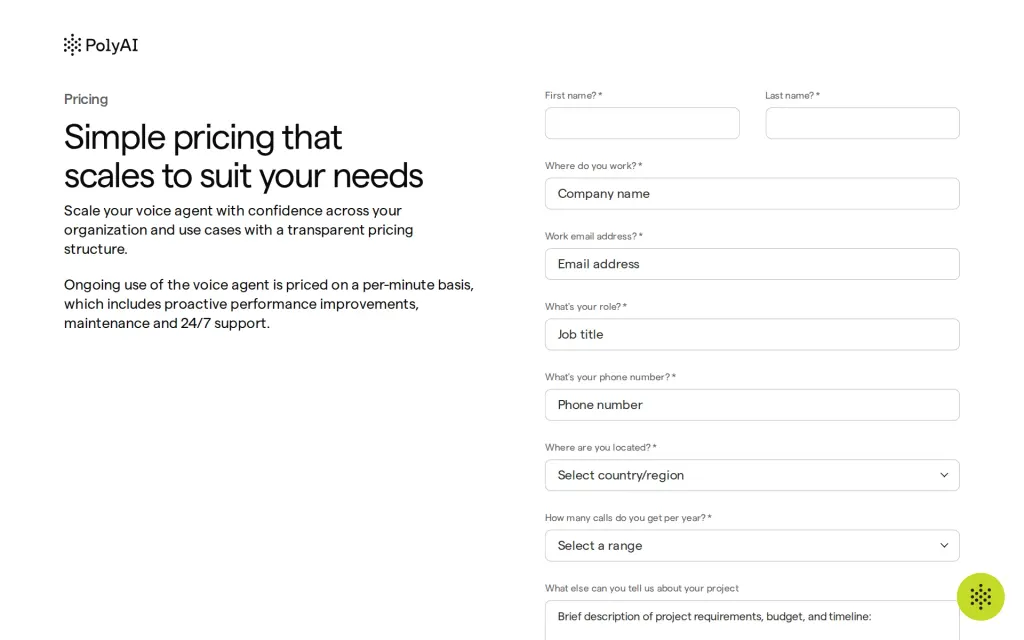
Pricing page, poly.ai, captured 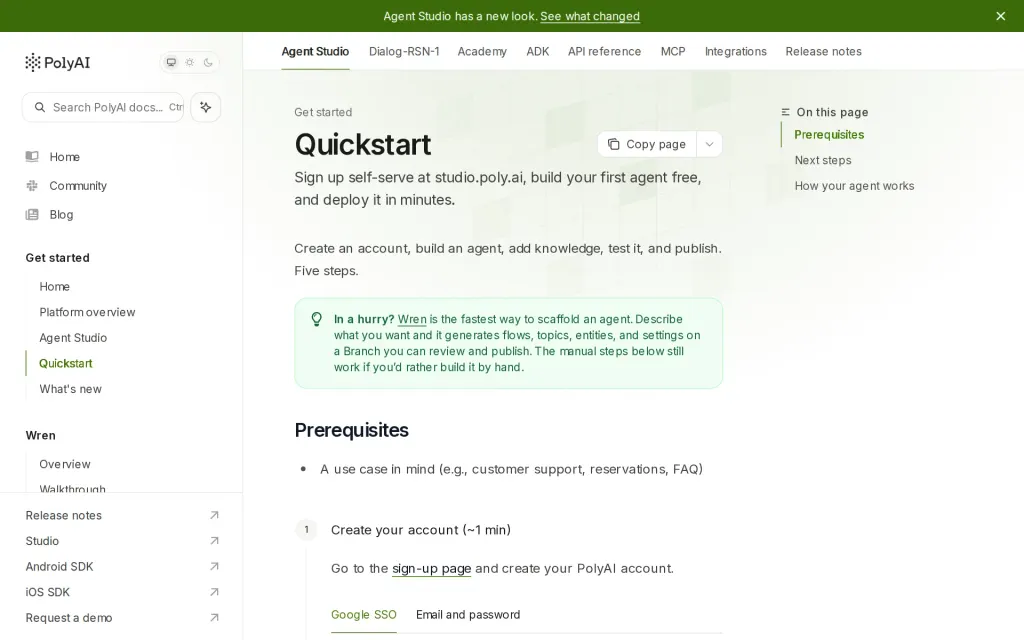
Docs, poly.ai, captured
Filed under
Sources and updates
Last changed
Sources33
- docs.poly.ai/user-management/introduction
- docs.poly.ai/behavior/models/model-use
- poly.ai/blog/agentic-dialog-platform-open-to-builders
- poly.ai/developers
- docs.poly.ai/wren/building
- docs.poly.ai/behavior/models/byom
- docs.poly.ai/mcp/quickstart
- poly.ai/msa
- poly.ai/pricing
- docs.poly.ai/wren/introduction
- docs.poly.ai/adk/get-started/get-started
- docs.poly.ai/analytics/dashboards/custom
- docs.poly.ai/api-reference/agents/endpoint/outbound-calls/trigger-outbound-call
- docs.poly.ai/api-reference/introduction
- docs.poly.ai/call-data/s3-to-s3
- docs.poly.ai/environments-and-versions/introduction
- docs.poly.ai/extend/adk
- docs.poly.ai/get-started/introduction
- docs.poly.ai/get-started/quickstart
- docs.poly.ai/legal/compliance
- docs.poly.ai/legal/training-data
- docs.poly.ai/mcp/builder/introduction
- docs.poly.ai/mcp/overview
- docs.poly.ai/platform/introduction
- github.com/PolyAI/adk
- github.com/polyai/adk/blob/main/CONTRIBUTING.md
- docs.poly.ai/secrets/introduction
- poly.ai/security
- docs.poly.ai/testing/ci-automation
- poly.ai/trial-agreement
- docs.poly.ai/voice-channel/multi-voice
- docs.poly.ai/wren/automated-review
- docs.poly.ai/wren/usage-and-limits
Coverage elsewhere7
The Agents Index in AI answers0 of 1
- PerplexityDoes not cite The Agents IndexAsked
PolyAI alternatives
on Other sources: g2.com, capterra.com, capacity.com, cloudtalk.io, startuphub.ai, peerspot.com
Updates4
- Capabilities · Free tier · Terms
- Capabilities · Free tier · Terms
- Documentation link · Summary
- Tagline
Is this yours? Claim it free and edit it in your dashboard, or feature it in Voice agents.