
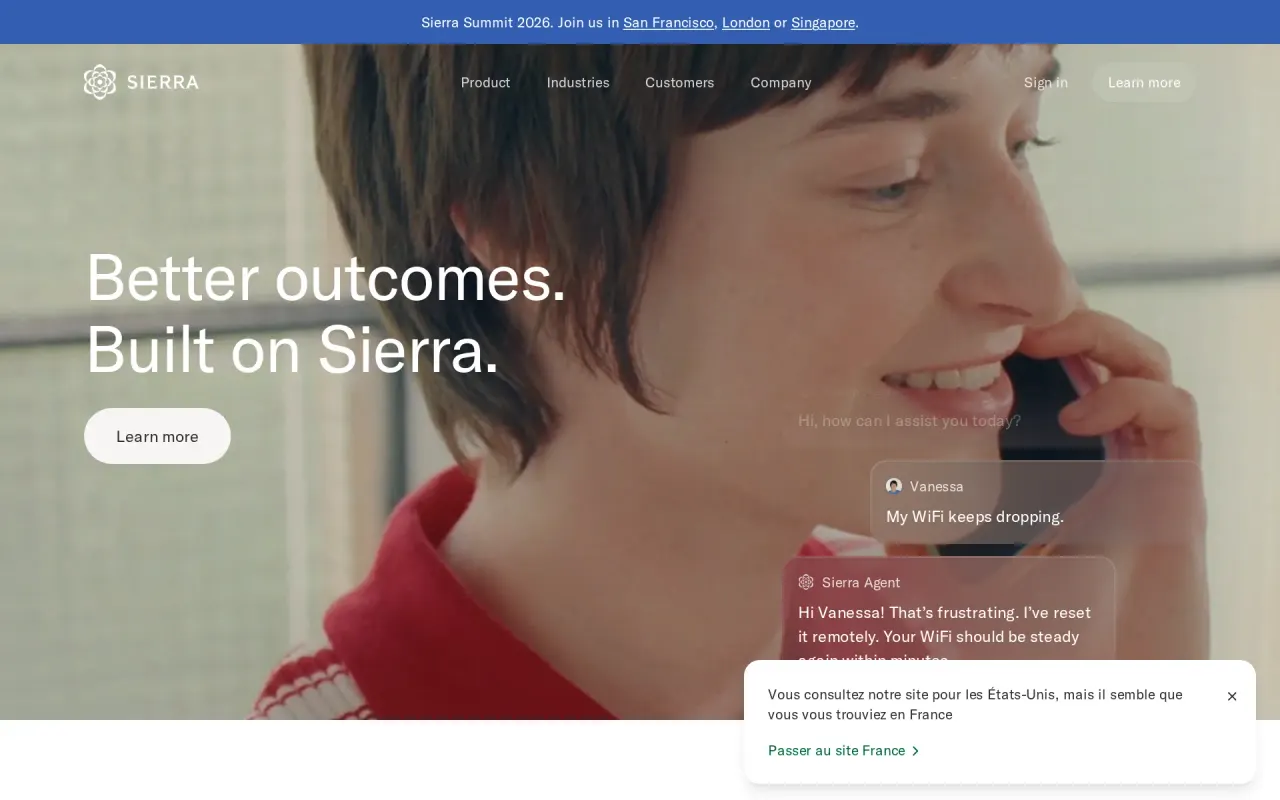
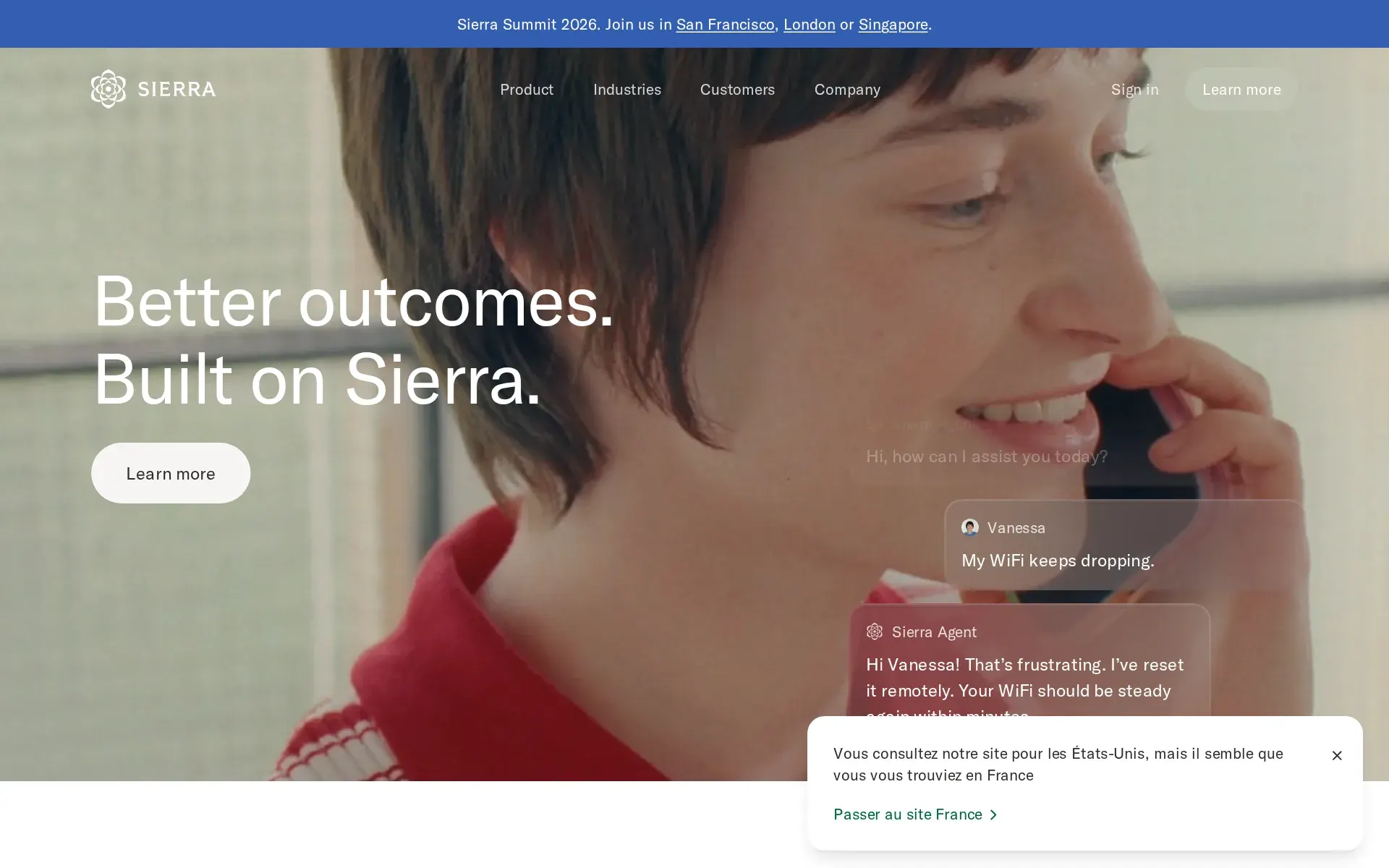
Not for SMBs or developers wanting a self-serve, transparently priced product or an open public API.
Changed since our last check
- Multi-agent: now Partly. It was Yes when we checked on .
- Agent permissions: now Yes. It was Partly when we checked on .
- Open models: now Partly. It was Yes when we checked on .
- MCP server: now Partly. It was Yes when we checked on .
- Getting out: now Partly. It was Yes when we checked on .
The facts, with their sources
What it does
- Writes code
- PartlyGhostwriter turns a prompt, an SOP or a transcript into a production agent journey with workflows and guardrails; what it authors is agent configuration, not application source code.
Build or modify agents by describing how you want them to behave. Update workflows, systems integrations, guardrails, tone, and style with simple…
sierra.ai/product/ghostwriter - Debugs and fixes
- PartlyGhostwriter diagnoses its own failed simulations and implements the fix; the failure it repairs is agent behaviour, never a defect in your software.
When a simulation fails, Ghostwriter diagnoses the issue and implements the fix, so your agent keeps improving without manual debugging.
sierra.ai/product/ghostwriter - Writes tests
- PartlyIt generates and runs conversational test suites for the agent you build, which is testing, but not unit tests over a code repository.
Build a test suite to detect and prevent potential regressions prior to releasing new versions of your agent.
sierra.ai/product/agent-studio - Ships it
- PartlyIt ships agent versions rather than code: publishing to ChatGPT can run through CI/CD, but nothing deploys application software.
Make your agent available on ChatGPT with the push of a button or via CI/CD.
sierra.ai/product/channels - Done-for-you service
- PartlyYou license software and get Sierra's own agent-development team alongside it, so delivery is a partnership rather than pure self-serve tooling.
Work with an expert agent development team that has supported hundreds of deployments — and will keep you ahead as AI evolves. Only pay for the value…
sierra.ai/product
How much it does unattended
- Runs autonomously
- YesAgents resolve end-to-end customer requests without a human in the loop, including email replies and multi-step actions in systems of record.
Autonomously respond to customer emails, reducing response times and freeing up your support team.
sierra.ai/product/channels - Multi-agent
- PartlyTwo vendor agents hand work to each other — Explorer's findings go straight to Ghostwriter — but customer-built agents coordinating on one task is not documented publicly.Was Yes before our last check.
Send any recommendation directly to Ghostwriter, and it implements the improvement automatically, without any manual work on your part.
sierra.ai/product/explorer - Agent permissions
- YesAutonomy is configurable per workflow: you set goals and guardrails and name the steps that require human sign-off before the agent proceeds.Was Partly before our last check.
Define what the agent can do on its own, and where human sign-off is required.
sierra.ai/product/horizon
Which models it runs on
- Claude
- PartlyAnthropic is a named AI-services subprocessor, so Claude is in the mix, but Sierra routes models itself and never exposes a Claude selector.
Anthropic, PBC • AI services • United States
trust.sierra.ai/subprocessors - GPT
- PartlyOpenAI is listed as an AI-services subprocessor, so GPT models are used under the hood, chosen by Sierra's router rather than by the buyer.
OpenAI, L.L.C. • AI services • Global (localization available in United States, European Union)
trust.sierra.ai/subprocessors - Open models
- PartlySierra states it blends open-weight models into its constellation, but the buyer neither picks nor supplies them and no model names are published.Was Yes before our last check.
Sierra is built on a constellation of LLMs—combining frontier, open-weight, and proprietary models—so your agent can execute seamlessly and reliably.
sierra.ai/product/trust-and-reliability - Model choice
- NoModel selection belongs to Sierra: it routes each turn to what it judges optimal and swaps providers on outages, with no published customer model choice.
Sierra automatically switches between LLM providers to optimize your agent’s performance and maintain service continuity in case one provider…
sierra.ai/product/trust-and-reliability
Where you use it
- In your editor
- PartlyAgent SDK journeys are written in your own editor and software lifecycle, but Sierra ships no editor extension and the agent itself runs in customer channels.
Develop agents in your existing programming environment and software development lifecycle.
sierra.ai/product/agent-sdk - In your pipeline
- PartlyPublishing an agent can be driven from CI/CD for the ChatGPT channel; Sierra publishes no broader pipeline or pull-request integration.sierra.ai/product/channels
- In a browser
- YesAgent Studio is a hosted web application where non-technical teams build journeys, manage knowledge and run simulations without code.
Empower teams to build and manage agents—no code required
sierra.ai/product/agent-studio
Whose machine it runs on
- Self-hosted
- NoSierra runs the platform in its own cloud on AWS, offering regional localization rather than deployment onto customer infrastructure.
Amazon Web Services, Inc. • Data storage, cloud hosting, and AI services • Global (localization available in United States, European Union, Southeast…
trust.sierra.ai/subprocessors - Open source
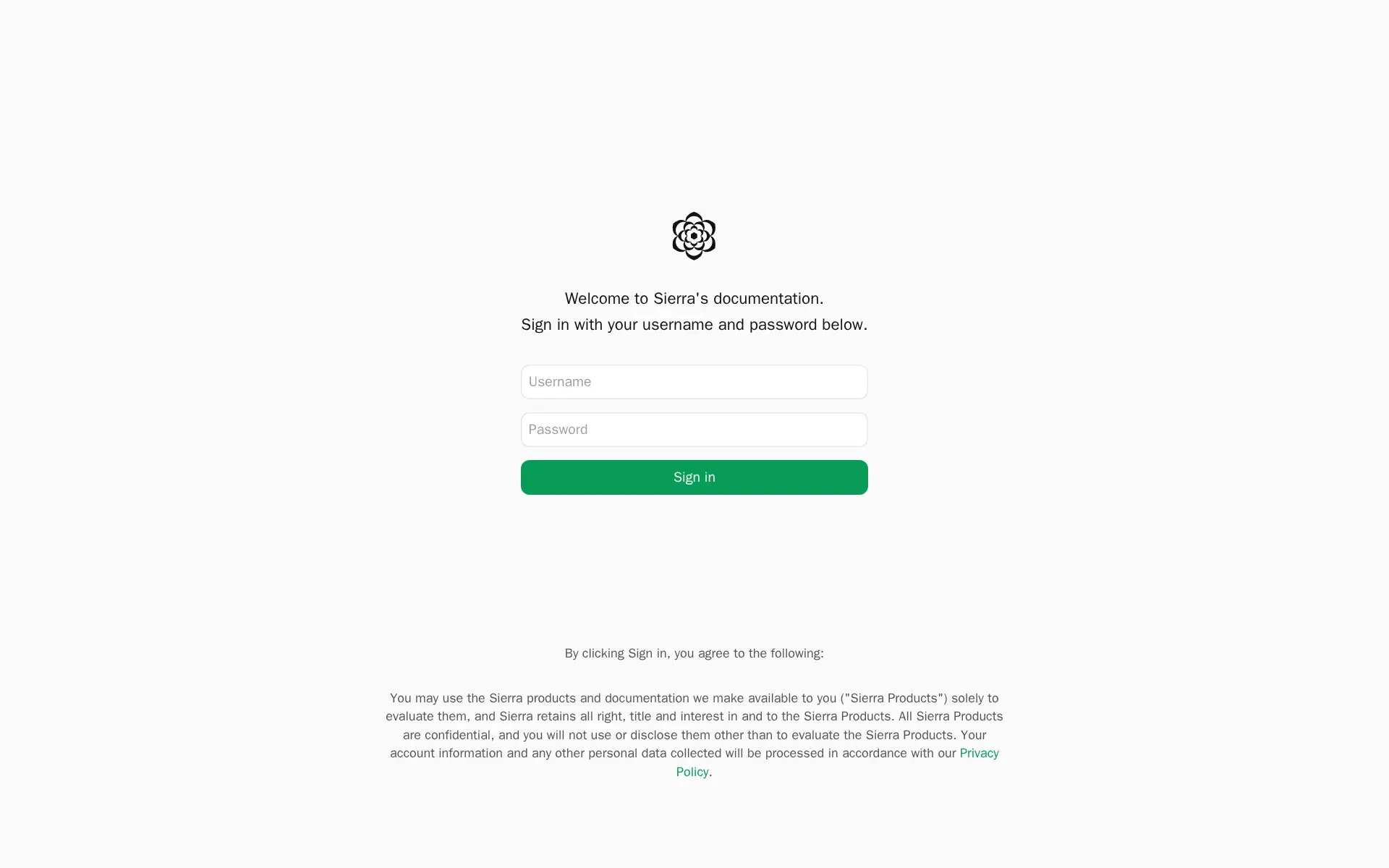
- NoThe platform and its documentation are contractually confidential, which rules out any source-available or open-source distribution.
All Sierra Products are confidential, and you will not use or disclose them other than to evaluate the Sierra Products.
docs.sierra.ai
What it costs to run
- How it meters
- YesBilling is per achieved outcome rather than per seat or per token, which Sierra states as its deliberate business model.
At Sierra, we've pioneered an entirely new business model - outcome-based pricing - where you pay only when the software achieves specific, valuable…
sierra.ai/product - Free tier
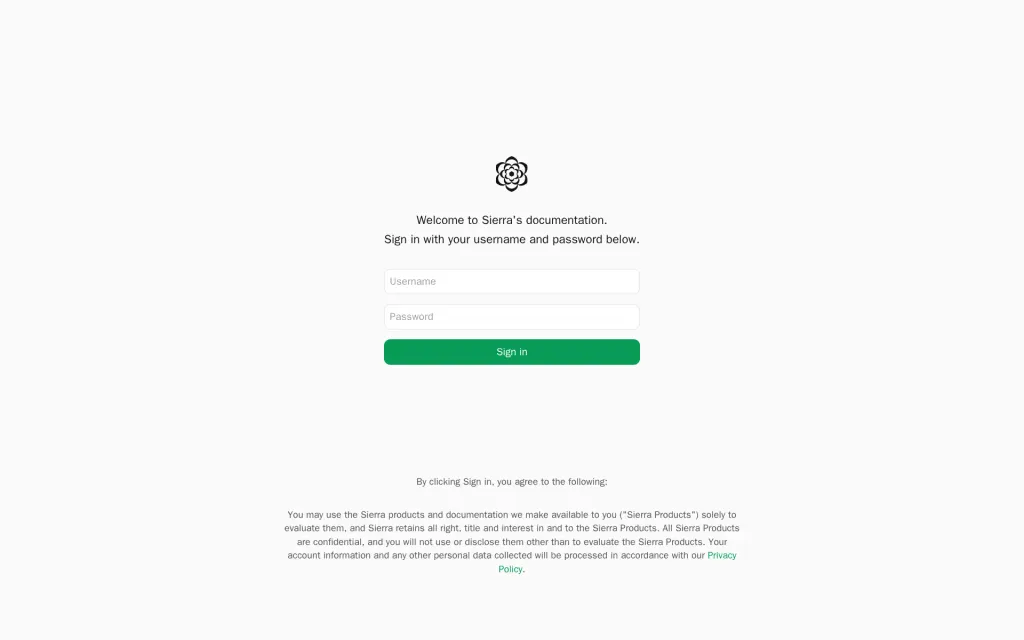
- NoNo free tier, trial or self-serve signup: sign-in requires a company deployment that already exists, and every call to action is a contact form.
Enter your company's Sierra URL
sierra.ai/login - API access
- YesA headless API is one of the published deployment surfaces; the reference is behind the docs sign-in, so endpoints, auth and limits are not public.
Because ADP is powered by Agent OS, you can build once and deploy everywhere you are — chat, phone, SMS, email, contact center conversations, or via…
sierra.ai/blog/agent-data-platform - MCP server
- PartlyAgents are exposed over MCP for the ChatGPT Apps channel; a general MCP server other agents may query is not documented publicly.Was Yes before our last check.
Sierra agents are natively compatible with ChatGPT Apps via Model Context Protocol (MCP).
sierra.ai/product/channels - Bring your own key
- NoSierra supplies and routes the inference itself through its own model subprocessors; no bring-your-own-key, own-model or own-cloud option is published.
Sierra will power your AI agent with the best available LLMs in the industry, so you (and your customers) are always benefiting from the latest…
sierra.ai/product/trust-and-reliability
Buying it for a team
- A company can buy it
- YesThis is sold only to organisations, with large regulated enterprises named as the customer base and no individual sign-up path.
40% of the Fortune 50 partner with Sierra.
sierra.ai/product - Seat model
- NoPricing is not seat-based: Sierra charges for delivered results, so no per-seat rate, floor or ceiling is published.
It's Sierra's outcomes-based model at scale: you pay for results, not tokens.
sierra.ai/product/horizon - Admin controls
- YesAdministrators constrain the agent through goals, guardrails, topic filters and human sign-off points defined before anything reaches customers.
Sierra has built-in filters and monitors for topics and keywords that are off-limits based on your company policies.
sierra.ai/product/trust-and-reliability - Audit log
- PartlyAgent decisions, tool calls and suppressions are auditable in Insights and Horizon; logging of administrative actions by staff is not documented publicly.
Understand the reasoning behind every agent action or answer—view knowledge sources, systems accessed, and more.
sierra.ai/product/insights
What happens to your code
- Opt out of training
- YesSierra states customer data is never used to train models at all, so there is no opt-out to negotiate per tier.
Your data is never used to train models, and we use industry-standard best practices to ensure its security.
sierra.ai/product/agent-sdk - Data residency
- PartlyRegional hosting localization is offered in the US, EU, Southeast Asia, Japan and Australia, but some AI subprocessors are US-only or global.
Global (localization available in United States, European Union, Southeast Asia, Japan, Australia)
trust.sierra.ai/subprocessors - Getting out
- PartlyA control commits to deleting customer data on departure, yet no customer-facing bulk export path or credit-expiry rule is published.Was Yes before our last check.
Customer data deleted upon leaving
trust.sierra.ai/controls - Certifications
- YesAn unusually wide certification set is claimed and mirrored in the Trust Center, covering SOC 2, ISO 27001, ISO 42001, GDPR, HIPAA, PCI and FedRAMP High.
Sierra is committed to maintaining the highest compliance standards for our customers, including SOC 2, HIPAA, GDPR, PCI, FedRAMP High, CCPA, CSA…
sierra.ai/product/trust-and-reliability
The Agents Index digest
Price changes and new agents like Sierra, at most once a week.
Last issue: Devin vs Claude Code: Which Should You Pick? · 13 October 2026
Works with
 Claude
Partly
 GPT
GPTPartly
- PartlyOpen models
For AI agents
- MCP server
- Partly
- API
- Yes
Screenshots
Docs, sierra.ai, captured
Filed under
Sources and updates
Last changed
Sources24
- sierra.ai/product/channels
- sierra.ai/product/trust-and-reliability
- sierra.ai/legal/u/platform-services-agreement
- sierra.ai/product
- sierra.ai/product/agent-sdk
- trust.sierra.ai/subprocessors
- sierra.ai/product/ghostwriter
- sierra.ai/product/horizon
- sierra.ai/blog/agent-studio-2-0
- sierra.ai/blog/outcome-based-pricing-for-ai-agents
- sierra.ai/legal/u/data-processing-addendum
- sierra.ai/product/agent-studio
- trust.sierra.ai/
- docs.sierra.ai/
- sierra.ai/blog/agent-data-platform
- trust.sierra.ai/controls
- sierra.ai/legal/u/horizons-service-specific-terms
- sierra.ai/login
- sierra.ai/product/context-engine
- sierra.ai/product/explorer
- sierra.ai/product/insights
- sierra.ai/product/meet-your-agent
- sierra.ai/terms-and-conditions
- trust.sierra.ai/updates
Coverage elsewhere4
The Agents Index in AI answers0 of 1
- PerplexityDoes not cite The Agents IndexAsked
Sierra alternatives
on Other sources: sierrahomealternatives.com, fin.ai, g2.com, itechguides.com, atlan.com, irisagent.com
Updates4
- Capabilities · Free tier · Price · Terms
- Capabilities · Free tier · Terms
- Capabilities · Free tier · Terms
- Summary
Is this yours? Claim it free and edit it in your dashboard, or feature it in Support agents.