Claude Agent SDK vs OpenAI Agents SDK (Python)
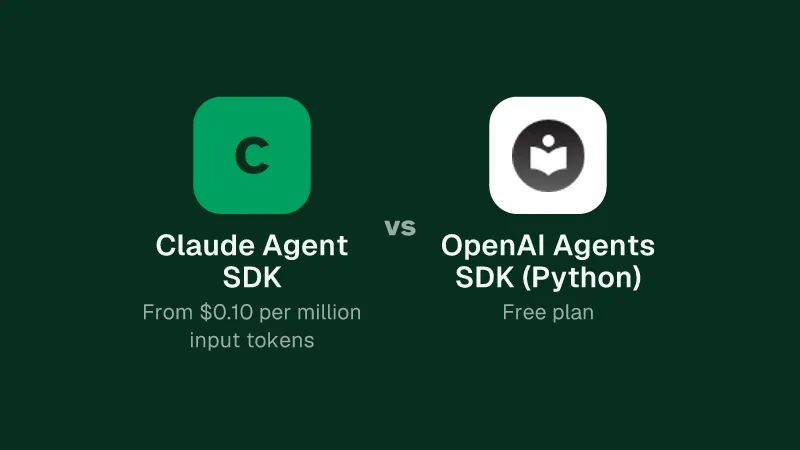
Claude Agent SDK suits developers already building on Claude; OpenAI Agents SDK (Python) is free, open source and reaches other model providers.
The short answer
Pick Claude Agent SDK if you already build on Claude and want Claude Code’s agent loop and tools inside your own app, bought and capped through one company account, and you accept Claude models only. Pick OpenAI Agents SDK (Python) if you want a free, open-source framework for a straightforward agent and the freedom to swap model providers, and you can manage long-running state yourself.
At a glance
| Claude Agent SDK | OpenAI Agents SDK (Python) | |
|---|---|---|
| Price to start | $0.10 per million input tokens, metered on usage | Free; you pay only for model API calls |
| Free plan or trial | Self-serve signup; every run bills tokens | Free to install and use; needs a model provider key |
| Models | Claude only, chosen per session and per subagent | OpenAI by default; any OpenAI-compatible endpoint, plus beta adapters for other providers |
| Built-in tools | File read, write and edit, shell commands, web search and fetch | Agent loop, handoffs, guardrails and tracing; sandbox agents run commands and edit files |
| Company account | Console organization with members, roles and workspaces | None needed: a package you install and run yourself |
| Permissions | Allow and deny rules, permission modes, hooks; organization settings can override | Approval rules, guardrails and tool filters written in code |
| Open source | Partly: wrapper packages are open, overall use falls under Anthropic’s Commercial Terms of Service | Yes |
| Languages | Python and TypeScript | Python |
Which models you can run
Claude Agent SDK runs Claude only, through the Anthropic API or a cloud provider’s Claude endpoint. You can pin a specific Claude model per session and per subagent. The cost to the buyer: there is no supported way to bring another vendor’s model into the same agent loop, so you are tied to Anthropic.
OpenAI Agents SDK (Python) uses OpenAI models by default, through the Responses API or the Chat Completions API. You choose the model per agent, per run or globally, and can point it at any OpenAI-compatible endpoint by setting a base URL and key. Beta adapters reach further providers. The SDK names only OpenAI models, so running Claude goes through one of those routes.
What comes in the box
Claude Agent SDK hands your app the Claude Code toolset by default: reading, writing and editing files, running shell commands, and web search and fetch, each call gated by allow and deny lists. One simple function covers one-off tasks and a stateful client covers multi-turn sessions. You can also turn your own Python or TypeScript functions into tools. Anthropic’s own quickstart is an agent that finds crash bugs in a file and edits in the fix.
OpenAI Agents SDK (Python) is lighter. It runs the call-tool-repeat loop for you and lets agents delegate to other agents, as tools for a manager-style setup or through handoffs for triage and routing. Input and output guardrails run in parallel with the agent and fail fast when a check does not pass. Tracing is included. Sandbox agents can run commands and edit files in a real workspace, which suits a sandboxed coding agent.
The gap that matters for longer workflows: the only saved state is a snapshot you capture by hand when a run pauses for human approval. With no automatic step-by-step checkpointing, a long workflow’s state is yours to manage.
Paying for it and controlling spend
Claude Agent SDK bills per token on an API key, from $0.10 per million input tokens (Haiku 5.5), with no per-seat price. A company buys usage through an Anthropic Console organization with members, roles, invites and workspaces. One organization funds every key, with monthly spend caps and alerts per workspace, and each query can carry its own budget cap. The embedding app sets permission modes and hooks that run before each tool call, and organization-managed settings can stop a subagent from bypassing permissions. Retained API data is not used for training without express permission. One thing to plan for: Anthropic changed how programmatic use is billed twice within about six weeks in 2026.
OpenAI Agents SDK (Python) costs nothing, with no sales contact, account or subscription. You pay only for the model API calls your agents make, to OpenAI or any other provider. Its controls (approval rules, guardrails, tool filters and network policy on hosted shell containers) live in the code developers write; there is no administrator console governing a fleet of agents.
Sources
- Claude Agent SDK code.claude.com
- Claude Agent SDK hosting code.claude.com
- Claude Agent SDK for Python on GitHub github.com
- OpenAI Agents SDK (Python) openai.github.io
- OpenAI Agents SDK (Python) on GitHub github.com
- openai-agents package pypi.org