
Not for Small sales teams without technical support, or anyone who needs simple, predictable flat-rate pricing.
The facts, with their sources
What it does
- Writes code
- NoNatural-language building produces Clay workflows, not source code; the coding agent is the caller, not the product.
Build workflows in natural language via Clay CLI, then manage observability in-product, using Clay Workflows.
clay.com/agent-plugin - Debugs and fixes
- NoThe agents diagnose GTM data questions; the reasoning trace explains agent decisions, not software failures.
Run GTM agents that reason over your data, and see exactly why they do what they do.
clay.com/claygent - Writes tests
- NoThe only testing Clay documents is trialling an agent prompt against sample rows before a full run.
Describe what you want in natural language, test against real data, and roll back instantly if needed.
clay.com/claygent - Reviews code
- NoReview in Clay means inspecting an agent run's inputs, outputs and cost, not a diff.
Every node's inputs, outputs, timing, and cost per record show up in the workflow run, and the agent's reasoning sits in the same trace.
university.clay.com/docs/account-agents… - Whole-codebase work
- NoScale here is records and accounts, not repositories. Bulk enrichment above 50K rows is on Enterprise.
Run enrichment in bulkEnrich more than 50K records at once
clay.com/pricing - Ships it
- NoIt ships GTM actions: CRM writes, sequences and ad audiences. It never deploys software.
Check against your CRM for duplicates, keep only net-new and validated contacts, then draft outreach and push straight to your sequencer and CRM —…
clay.com/mcp - Done-for-you service
- PartlyYou run the software yourself on every self-serve plan, but Enterprise buyers get Clay people doing hands-on onboarding and co-building plus a dedicated growth strategist who helps design their Clay roadmap.
Dedicated growth strategist (CSM) Clay's version of a CSM - your go-to partner for onboarding you to Clay, training your team, sharing best…
clay.com/pricing
How much it does unattended
- Runs autonomously
- PartlyThe global agent plans and executes multi-step work and can be scheduled to repeat unattended, but it deliberately stops short of launching campaigns, and newly created signals stay paused until a person resumes them.
It won't launch or send a campaign. The global agent drafts one, edits the copy and settings, runs a spam check, and sends a single test email.…
university.clay.com/docs/global-agent - Multi-agent
- PartlySeveral distinct agents exist and one can invoke another: the global agent can insert an Account Agent as a workflow step, and Sculptor remains a separate agent for tables. There is no documented peer-to-peer multi-agent orchestration.
Reads, builds, and updates workflows, adds enrichment steps, and can run an Account Agent as a step.
university.clay.com/docs/global-agent - Agent permissions
- YesEvery task and schedule carries an explicit permission level, so a buyer chooses between approval gates on live runs and deletions, or letting the agent act on everything unattended.
Every task and every schedule carries a permission level that decides what the global agent does without stopping to ask. Allow changes is the…
university.clay.com/docs/global-agent
Which models it runs on
- Claude
- YesAnthropic models are first-class inside Clay's AI actions and Claygents, with several Claude variants listed, and Claude is also named as an MCP client reps can work from.
Anthropic | Claude Opus 5 Claude 4.8 Opus Claude 4.7 Opus Claude Sonnet 5 Claude 4.6 Sonnet Claude 4.5 Haiku
university.clay.com/docs/ai-in-clay - GPT
- YesOpenAI models are available across Clay's AI features, with a long list of GPT variants, and ChatGPT is a supported MCP client for sales reps.
OpenAI | GPT 6 Sol GPT 6 Luna GPT 5.5 GPT 5.4, 5.4 Mini, 5.4 Nano GPT 5 Mini, 5 Nano o3, o4 Mini GPT 4.1, 4.1 Mini, 4.1 Nano GPT 4o, 4o Mini GPT…
university.clay.com/docs/ai-in-clay - Open models
- PartlyClay hosts models from open-weight families such as Kimi and Z.ai's GLM alongside the closed frontier models, but they run on Clay's infrastructure; nothing describes running open weights on hardware you control.
Kimi | Kimi K2.6 Kimi K3
university.clay.com/docs/ai-in-clay - Model choice
- YesThe buyer picks the model per AI action from a published catalogue spanning several providers, and can substitute their own provider account entirely by supplying an API key.
Access to models from OpenAI, Anthropic, Google, and other leading AI providers. Option to bring your own API keys for supported providers.
university.clay.com/docs/ai-in-clay
Where you use it
- In your editor
- PartlyA Clay plugin installs skills and the CLI into coding agents including Cursor, Claude Code and Codex, so the surface is the agent inside the editor rather than a native IDE extension with its own UI.
CLI — Build GTM workflows in natural language from coding agents (including Claude Code, Codex, and Cursor).
university.clay.com/docs/clay-api-cli - On the command line
- YesThere is a real terminal surface, the Clay CLI, installed via the agent plugin and signed in with clay login; it runs natively on Mac and Linux and through WSL on Windows.
The CLI and API run on Mac and Linux. On Windows, they run through WSL — there's no native Windows (PowerShell) version of the CLI.
university.clay.com/docs/clay-api-cli - In a browser
- YesThe primary surface is the hosted web workspace at app.clay.com, where tables, workflows, Audiences, the Agent tab and admin settings all live.
Agent is the main tab where you work with our global agent. Tell the global agent what you're trying to do, and it works across our products to help…
university.clay.com/docs/global-agent
Whose machine it runs on
- Self-hosted
- NoClay is a hosted multi-tenant service running in its own AWS region, and no plan, including Enterprise, offers a customer-infrastructure or private-cloud deployment anywhere in its plan comparison or docs.
Data location: Customer data is primarily processed in the United States (AWS US-East).
university.clay.com/docs/ai-in-clay - Open source
- PartlyThe agent plugin and CLI install from Clay's public GitHub repository; the platform itself is closed hosted software.
Set up the Clay plugin by following the steps in https://github.com/clay-run/agent-plugins
clay.com/agent-plugin
What it costs to run
- How it meters
- YesBilling is a plan fee plus two separate meters: Actions for platform orchestration and Data Credits for data and AI bought from the marketplace, with token-metered pricing on the heaviest models.
Actions measure platform usage: enrichment & GTM execution. Data credits buy data & AI from vendors in Clay's marketplace.
clay.com/pricing - Free tier
- YesA standing free plan exists with no call and no card mentioned, carrying 500 actions and 100 data credits a month, unlimited seats and Claygent access, capped at 200 rows per table.
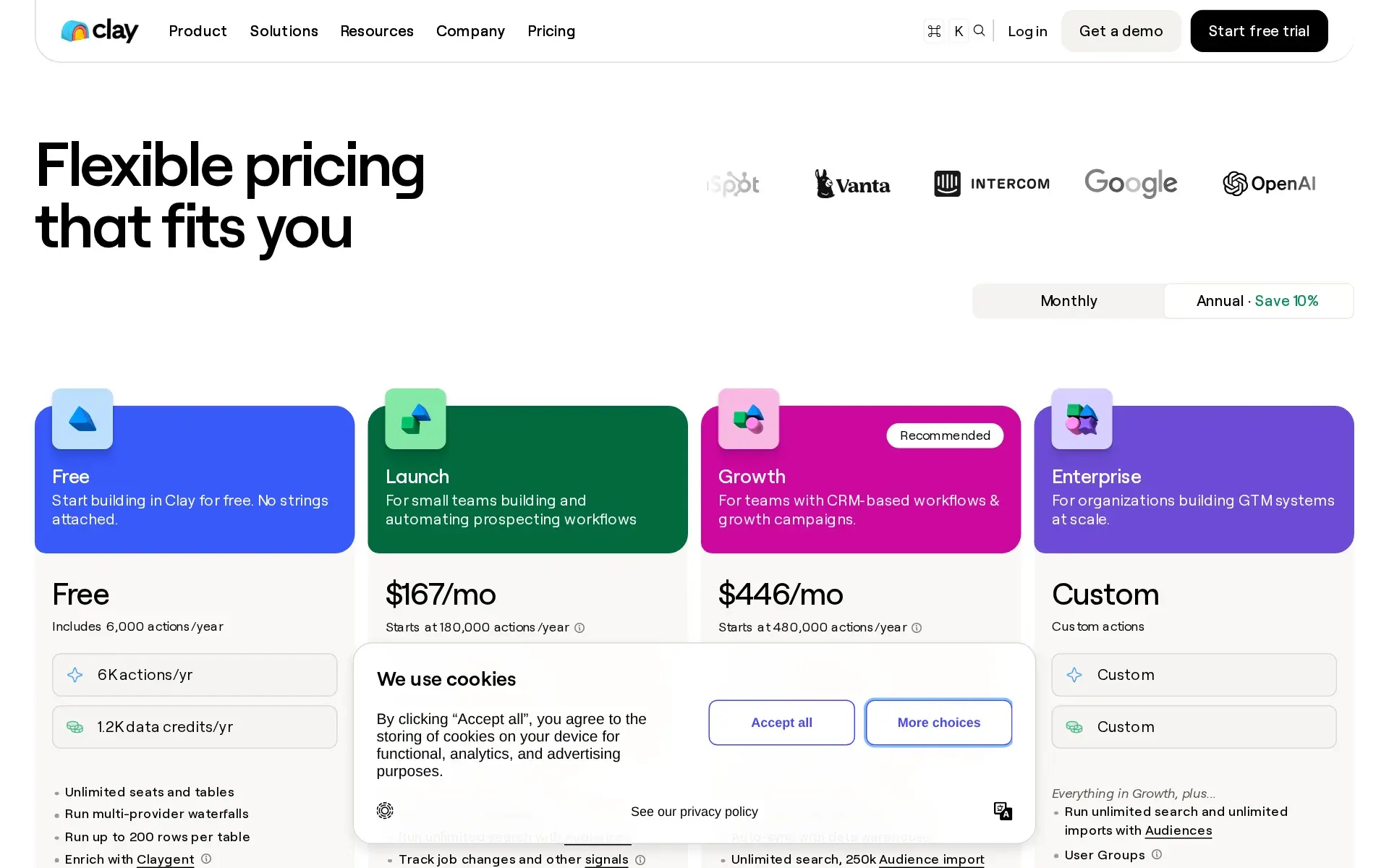
Start building in Clay for free. No strings attached.
clay.com/pricing - API access
- YesA documented Public API with its own key is available on every plan including free and trial, though tables are read-only and structured queries or paging past 100 rows need Enterprise API table sync.
The developer platform is available across all Clay plans, including free and trial plans. Legacy plans also have access for a limited time.
university.clay.com/docs/clay-api-cli - MCP server
- YesClay runs a hosted MCP server that other agents call over OAuth to run its find-and-enrich tools and workspace Functions, with admins choosing which clients are allowed and capping each rep's credit spend.
Clay exposes a Model Context Protocol (MCP) server that lets an external platform — an AI assistant, IDE, agent host, or partner product — run Clay's…
university.clay.com/docs/connect-to-cla… - Bring your own key
- YesBringing your own provider keys is included on every tier down to Free; doing so skips Data Credit charges entirely and only consumes one Action per run, though Clay's own keys run AI roughly twice as fast.
Customers are still welcome to use their own API keys for data enrichment or AI in Clay. Each run will count as one Action, but no Data Credit will…
clay.com/pricing
Buying it for a team
- A company can buy it
- YesOrganisations buy workspaces with team invites and role assignment, and the Enterprise tier is explicitly scoped to companies with custom agreements, RBAC and a named account contact.
Enterprise (custom pricing with annual commitment) — For GTM teams running at scale, with enterprise-grade security, support, and infrastructure.
clay.com/pricing - Seat model
- NoClay does not charge per seat at all: every tier from Free upward includes unlimited users and tables per workspace, so there is no seat floor or ceiling and spend scales on Actions and Data Credits instead.
Tables and users per workspace | Unlimited | Unlimited | Unlimited | Unlimited
clay.com/pricing - Pooled budget
- YesActions and Data Credits are one workspace-level balance everybody draws on, with Enterprise adding workbook-level credit budgets and MCP users capped by a default or per-user monthly credit limit.
Credit limits cap how many Clay credits a rep can spend through their AI tool in a given month. Credit spend resets on the 1st of each month at…
university.clay.com/docs/mcp-settings - Admin controls
- YesAdmins constrain the agent in several ways: a per-task permission level, an allow-list of MCP clients re-checked at every token issue, per-rep credit caps, and which Functions reps may invoke at all.
The AI tool can only call Clay tools and Functions that a workspace admin has explicitly enabled — it cannot browse tables, view raw workspace data,…
university.clay.com/docs/mcp-settings - Audit log
- PartlyClay records usage and configuration history rather than administrative actions: a credit usage dashboard broken down by table and integration, table version history for one month or six on Enterprise, and per-run agent traces. No admin audit log is documented.
Table version history Saves point-in-time snapshots of your table configuration for up to 1 or 6 months depending on your plan, so you can track and…
clay.com/pricing - Single sign-on
- PartlySingle sign-on is sold only on Enterprise and is marked not included on Free, Launch and Growth; the pricing table and docs never say whether it is SAML, OIDC or both.
Single sign-on (SSO) | Not included - | Not included - | Not included - | Included
clay.com/pricing
What happens to your code
- Opt out of training
- YesNo opt-out is needed because training is contractually excluded by default across Clay and its model providers, and the MCP docs restate it for Anthropic and OpenAI traffic specifically.
Your data is never used for AI model training. Clay has contractual agreements with all AI providers (OpenAI, Anthropic, Google, and others) that…
university.clay.com/docs/ai-in-clay - Data residency
- PartlyProcessing is stated as primarily United States, AWS US-East, and Clay acts as processor with you as controller; no EU or other region option is offered, and 'primarily' leaves the exceptions unspecified.
Data location: Customer data is primarily processed in the United States (AWS US-East). Data controller vs. processor: Clay acts as a data processor;…
university.clay.com/docs/ai-in-clay - Getting out
- PartlyYou can delete records, tables or the whole workspace at will, with deletion completing after 30 days, and exporting data out of Clay is a metered action; Actions never roll over, while Data Credits bank up to twice the monthly amount.
Actions reset each billing cycle and don't roll over, since they reflect the platform capacity your plan includes.
clay.com/pricing - Certifications
- YesClay publishes SOC 2 Type II, ISO 27001, ISO 42001, GDPR and CCPA posture on its pricing page, with the SOC 2 report requestable through its trust centre and a custom DPA reserved for Enterprise.
We are SOC 2 Type II compliant. Request our SOC 2 in our Trust Center.
clay.com/pricing
Plans and pricing
Price and terms
- Free plan
- YesYes
The terms in full
Free plan: 500 actions/mo and 100 data credits/mo, unlimited seats and tables, up to 200 rows per table, multi-provider waterfalls, Claygent and bring-your-own-key included; no phone number enrichment, no signals, no CRM or HTTP API integrations. Search via the developer platform is capped at 50 results per request and 100/mo. A separate 14-day trial is also offered (10k search results per 14 days).
What needs a higher plan
- Enterprise
- Done-for-you service, Single sign-on
From clay.com/pricing, checked .
Works with
 Claude
 GPT
GPT- PartlyOpen models
For AI agents
- MCP server
- Yes
- API
- Yes
Screenshots
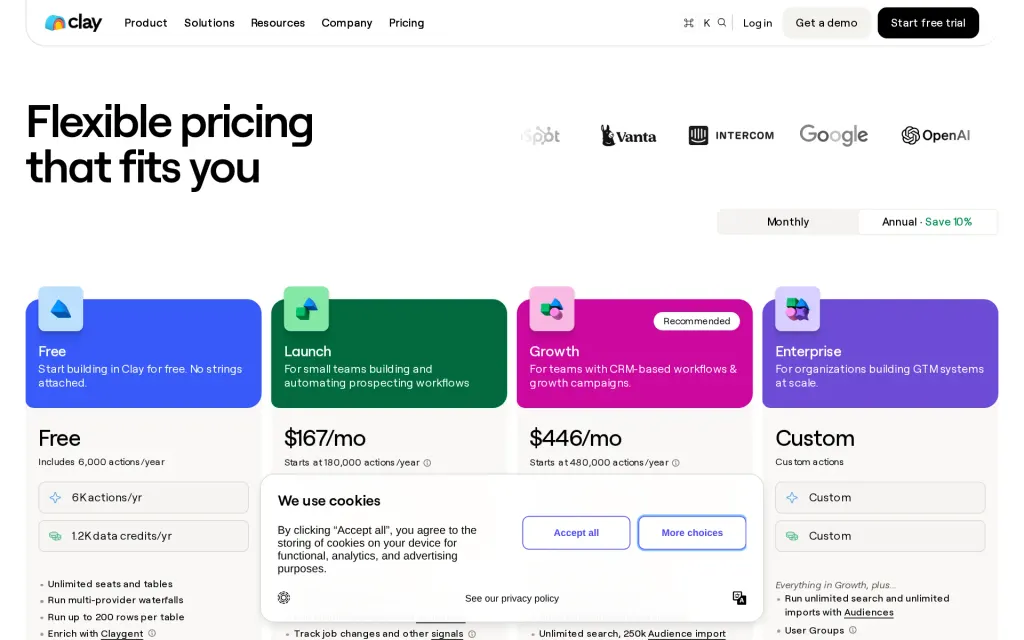
Pricing page, clay.com, captured 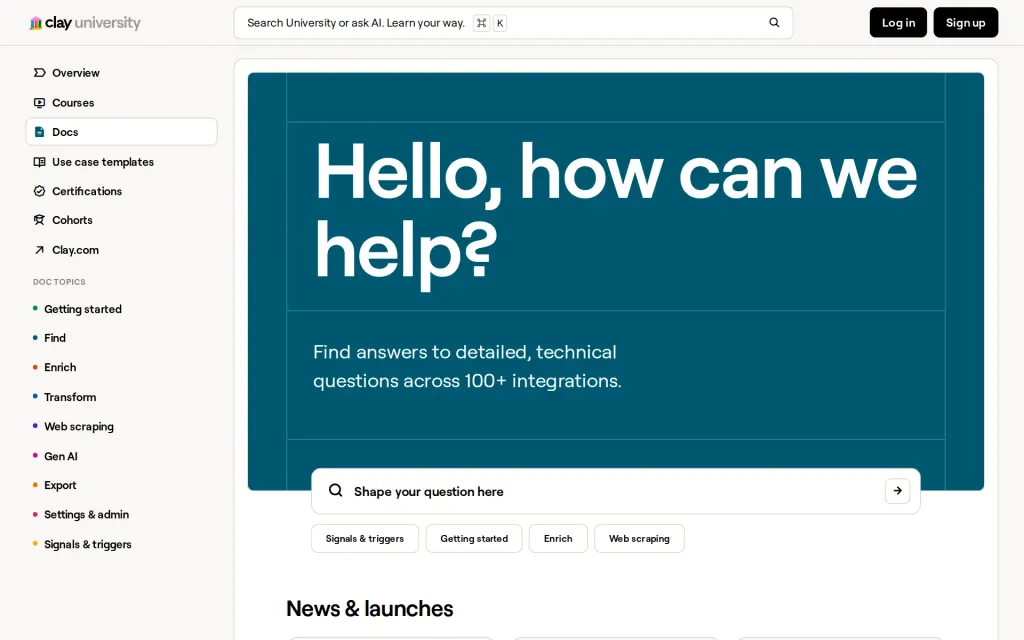
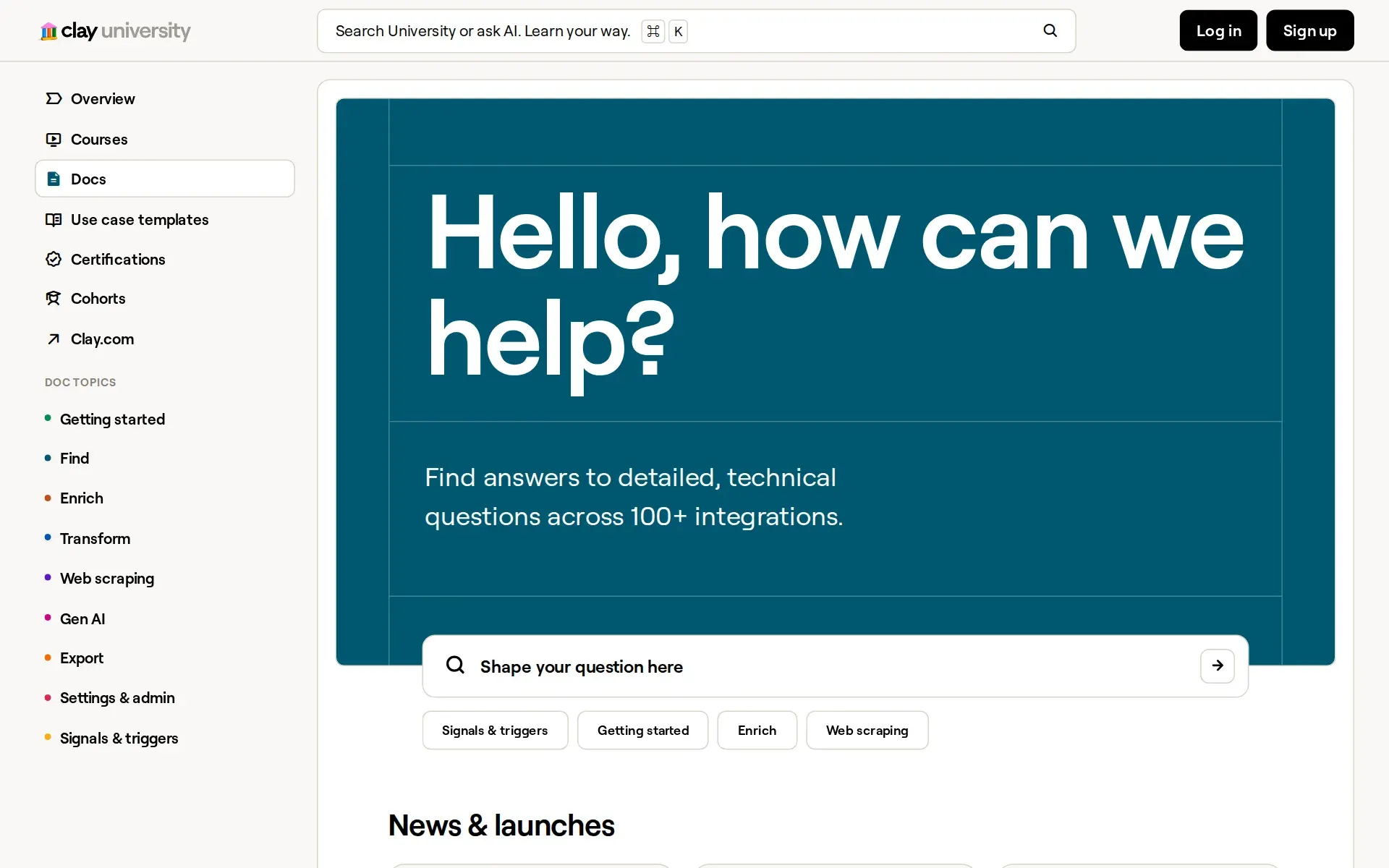
Docs, clay.com, captured
Filed under
Sources and updates
Sources18
- clay.com/pricing
- university.clay.com/docs/ai-in-clay
- university.clay.com/docs/mcp-security-privacy
- university.clay.com/docs/account-agents-in-workflows
- university.clay.com/docs/global-agent
- university.clay.com/docs/clay-api-cli
- developers.clay.com/
- clay.com/agent-plugin
- clay.com/claygent
- university.clay.com/docs/mcp-settings
- clay.com/mcp
- trust.clay.com/
- clay.com/changelog/new-open-weight-models-for-claygent
- university.clay.com/docs/ai-pricing
- university.clay.com/docs/audiences-security-privacy
- university.clay.com/docs/cli-security-privacy
- university.clay.com/docs/connect-to-clay-mcp
- developers.clay.com/public-api/authentication.md
Coverage elsewhere1
Updates4
- Capabilities · Free tier · Terms
- Capabilities · Free tier · Price · Terms
- Summary
- Alternatives · Summary · Tagline
Is this yours? Claim it free and edit it in your dashboard, or feature it in Sales & marketing agents.