
Not for Teams that specifically want full autonomous replacement of SDR headcount (11x's Alice and Artisan's Ava are built for that), or that need Clay's fully-customizable, build-your-own-workflow canvas across 200+ data providers.
Changed since our last check
- Runs autonomously: now Partly. It was Yes when we checked on .
- Model choice: now No. It was Partly when we checked on .
- Admin controls: now Partly. It was Yes when we checked on .
The facts, with their sources
What it does
- Done-for-you service
- NoYou run the software yourself on a self-serve subscription; the only managed element is Business-tier mailbox provisioning, not people doing your outbound.
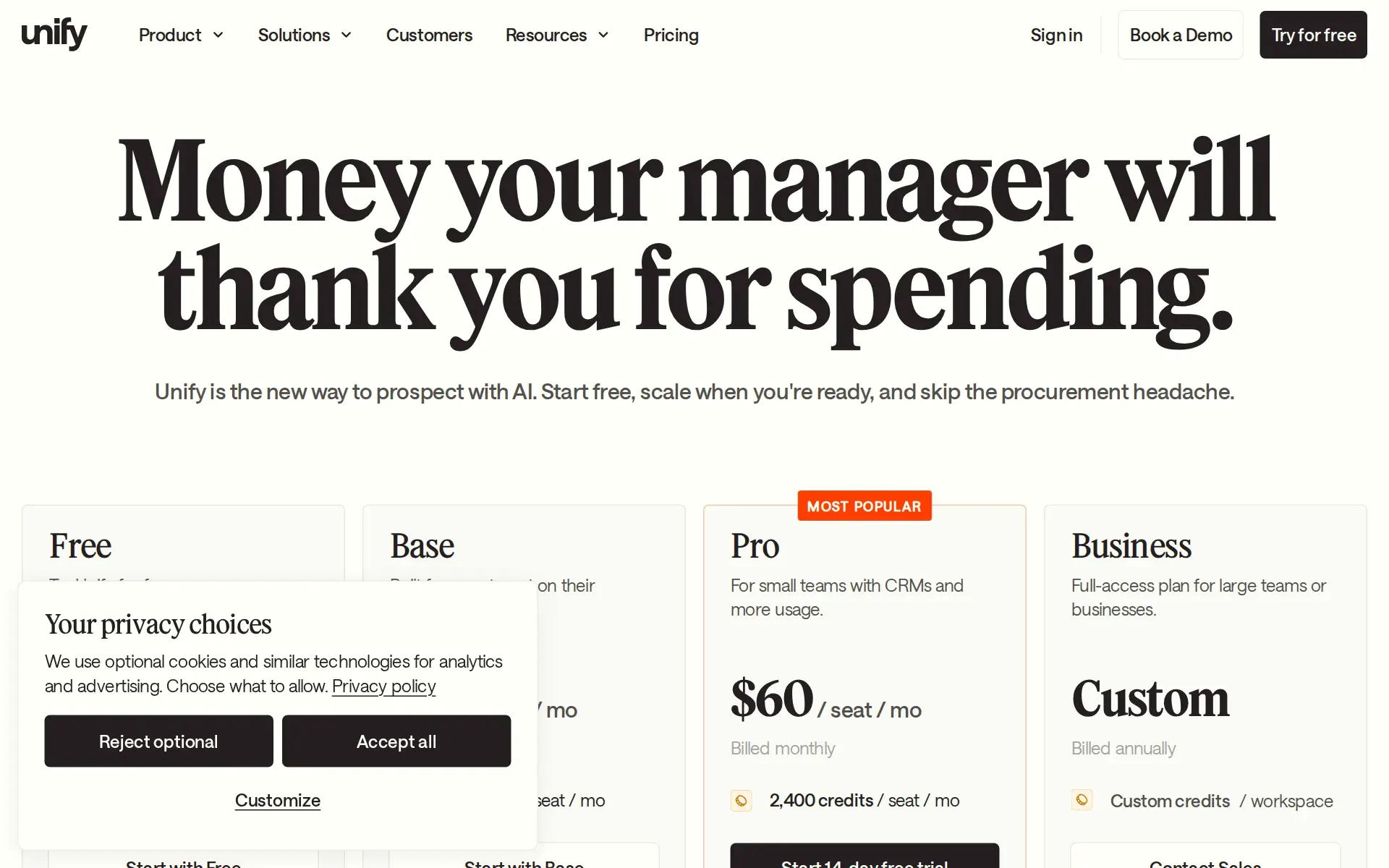
Unify is the new way to prospect with AI. Start free, scale when you're ready, and skip the procurement headache.
unifygtm.com/pricing
How much it does unattended
- Runs autonomously
- PartlyAgents research continuously without a human present, but signal-triggered automations and automated plays that act end to end are Business-tier only.Was Yes before our last check.
In Unify, agents run constantly in the background to study your business, observe changing data, and provide deep insights.
docs.unifygtm.com/reference/agents/over… - Multi-agent
- PartlyAgents are composable steps inside a Play rather than peers negotiating a task; multi-step agents research, qualify and personalise.
Leverage multi-step Agents that can research, qualify, and personalize messaging.
unifygtm.com/product/plays - Agent permissions
- PartlyTwo fixed roles gate what a user can configure, and exclusions plus a hard credit cap bound what agents may act on, but no per-action approval policy is published.
Admin — Designed for users who need access to all core Unify capabilities and settings in the organization.
docs.unifygtm.com/reference/management/…
Which models it runs on
- Claude
- NoThe plan comparison enumerates model access for every tier as GPT only; Claude appears solely as an MCP client that calls Unify, not as a model Unify runs on.
LLM model access GPT 5.4 GPT 5.4 GPT 5.4 GPT 5.4, 5.6
unifygtm.com/pricing - GPT
- YesEvery tier lists GPT model access, with the newer advanced model reserved for the Business plan.unifygtm.com/pricing
- Open models
- NoThe per-tier model inventory names GPT versions and nothing else, so no open-weight option is offered on any published plan.unifygtm.com/pricing
- Model choice
- NoUnify chooses the model for you and gates the advanced one behind Business; the tier decides, the buyer does not.Was Partly before our last check.
Standard models (GPT 5.4)
unifygtm.com/pricing
Where you use it
- In your editor
- PartlyUnify reaches Cursor through an official MCP plugin rather than a native editor extension, so the coding surface is assistant-mediated.
For Claude Code and Cursor, install Unify's official plugin, which bundles the Unify skills and MCP configuration.
docs.unifygtm.com/developers/mcp/gettin… - On the command line
- PartlyThere is no Unify CLI of its own; terminal use happens only by installing the Unify plugin inside Claude Code.docs.unifygtm.com/developers/mcp/gettin…
- In a browser
- YesThe primary surface is a hosted web app at app.unifygtm.com driven by chat, complemented by a Chrome extension on every tier.
Escape tab hell with a unified platform for prospecting, research, and sequencing all backed by frontier AI models.
unifygtm.com
Whose machine it runs on
- Self-hosted
- NoUnify is sold as a hosted platform reached through its own web app; no bring-your-own-infrastructure deployment is offered on any tier.
"Platform" means Unify's proprietary hosted software platform, as made available to Authorized Users from time to time.
unifygtm.com/legal/terms-and-conditions… - Open source
- NoThe platform is defined in Unify's own terms as proprietary, and reverse engineering is expressly prohibited; only the client-side MCP plugin is published openly.unifygtm.com/legal/terms-and-conditions…
What it costs to run
- How it meters
- YesBilling is a per-seat monthly fee plus a credit allowance consumed per action, with fractional rates published per feature.
Credits are consumed by various activities such as prospecting, enrichment, AI Agent runs, and certain intent signals.
docs.unifygtm.com/reference/management/… - Free tier
- YesA standing $0 plan with limited credits and up to three seats lets you sign up and run outbound without talking to sales.
Free Try Unify for free. $0 Free forever
unifygtm.com/pricing - API access
- PartlyData, Sequences, Tasks and Analytics APIs plus Python and TypeScript SDKs are documented, but the plan table restricts open API and webhooks to Business.
Open API + webhooks — — —
unifygtm.com/pricing - MCP server
- YesAn official MCP server exposes the same agent as Unify Chat to external assistants, with no separate charge beyond existing credits.
Unify MCP lets you connect Unify to Claude, Cursor, or any other MCP-compatible AI assistant.
docs.unifygtm.com/developers/mcp/gettin… - Bring your own key
- NoModel cost is passed through inside credits; there is no separate AI subscription or customer key.
AI usage is billed as part of your credit balance. We pass through the cost of running large language models to pay the foundation model providers.…
unifygtm.com/pricing
Buying it for a team
- A company can buy it
- YesBeyond the card-payable tiers there is a sales-sold Business plan billed annually per workspace with team management included.
Full-access plan for large teams or businesses. Custom pricing, billed annually.
unifygtm.com/pricing - Seat model
- YesPaid tiers are priced per seat per month with credits allocated per seat; the Free plan caps at three seats and Base upward is uncapped.
$20 / seat / mo Billed monthly
unifygtm.com/pricing - Pooled budget
- PartlyPlan credits are allocated per seat on Free through Pro, and only purchased top-ups or the Business workspace allocation are shared across the team.
If you have multiple seats, top-ups go into a shared pool available to everyone on your team.
unifygtm.com/pricing - Admin controls
- PartlyAdmins alone control billing, Plays and exclusion settings that stop agents touching named companies, but team management itself starts at Pro.Was Yes before our last check.
Edit Exclusion settings ✅ ❌
docs.unifygtm.com/reference/management/… - Audit log
- PartlyThe DPA commits to event logging of production infrastructure for security purposes; no customer-facing admin audit log is documented.
Event logs recording user activities, exceptions, faults and information security events are produced, kept and reviewed as appropriate.
unifygtm.com/legal/customer-data-proces… - Single sign-on
- PartlySAML 2.0 SSO with Okta, Azure AD or any compliant IdP exists, but the plan table marks it an add-on on Business and docs confirm an extra fee.
SSO is available for an additional fee, which is a direct passthrough cost from our provider.
docs.unifygtm.com/reference/management/…
What happens to your code
- Opt out of training
- PartlyOnly Google Workspace data carries an explicit no-training guarantee; the self-service terms otherwise grant Unify a perpetual licence over customer data within service data, with no published opt-out.
Google Workspace APIs are not and may not be used to develop, improve, or train generalized artificial intelligence and/or machine learning models.
unifygtm.com/legal/privacy-policy - Data residency
- PartlyHosting and every listed subprocessor are United States; no region choice is offered.
Amazon Web Services - Cloud Provider - United States. Primary cloud hosting platform. Includes database where customer data is held, servers where…
trust.unifygtm.com - Getting out
- PartlyA Bulk API exports large sequence datasets and unused top-up credits carry over twelve months, but the terms warn that account termination may destroy customer data.
They don't auto-renew, and unused credits carry over for up to 12 months.
unifygtm.com/pricing - Certifications
- PartlySOC 2 Type II is maintained with external audits and threat monitoring, and GDPR rights are documented, but no ISO 27001 certification is claimed.
We maintain SOC 2 Type II compliance, perform real-time threat monitoring, and regularly contract external security audits.
unifygtm.com/pricing
Plans and pricing
Price and terms
- Free plan
- YesYes
The terms in full
Free forever at $0 with limited credits, up to 3 seats, 1 mailbox per seat, 100 records per search and standard models (GPT 5.4); no credit top-ups and no CRM sync. Separately, Pro offers a 14-day free trial with no credit card required.
What needs a higher plan
- Business
- API access
From unifygtm.com/pricing, checked .
The Agents Index digest
Price changes and new agents like Unify, at most once a week.
Last issue: Devin vs Claude Code: Which Should You Pick? · 13 October 2026
Works with
 GPT
GPT
For AI agents
- MCP server
- Yes
- API
- PartlyBusiness
Screenshots
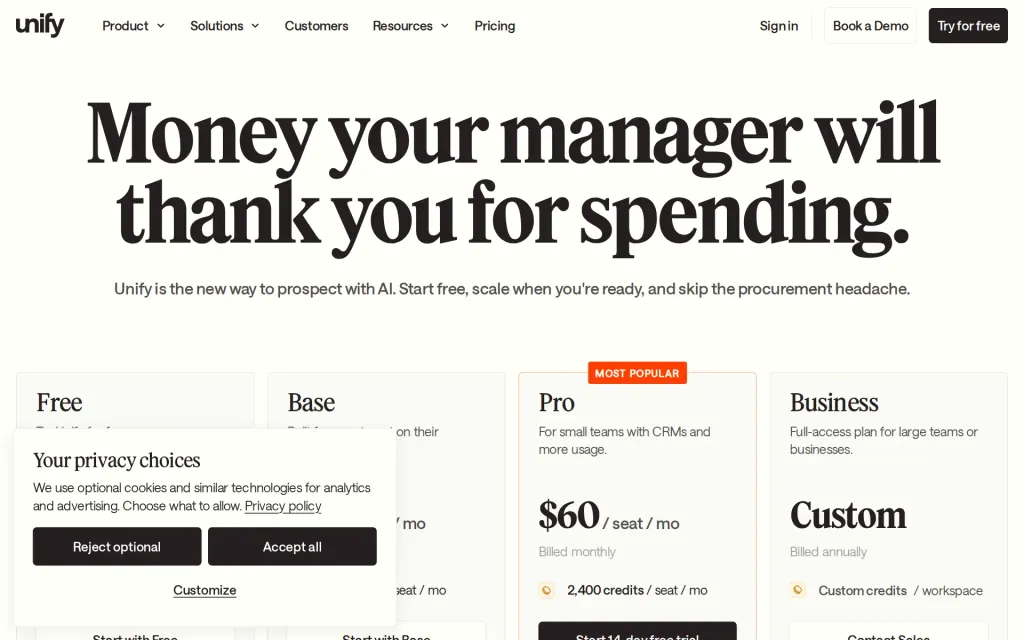
Pricing page, unifygtm.com, captured 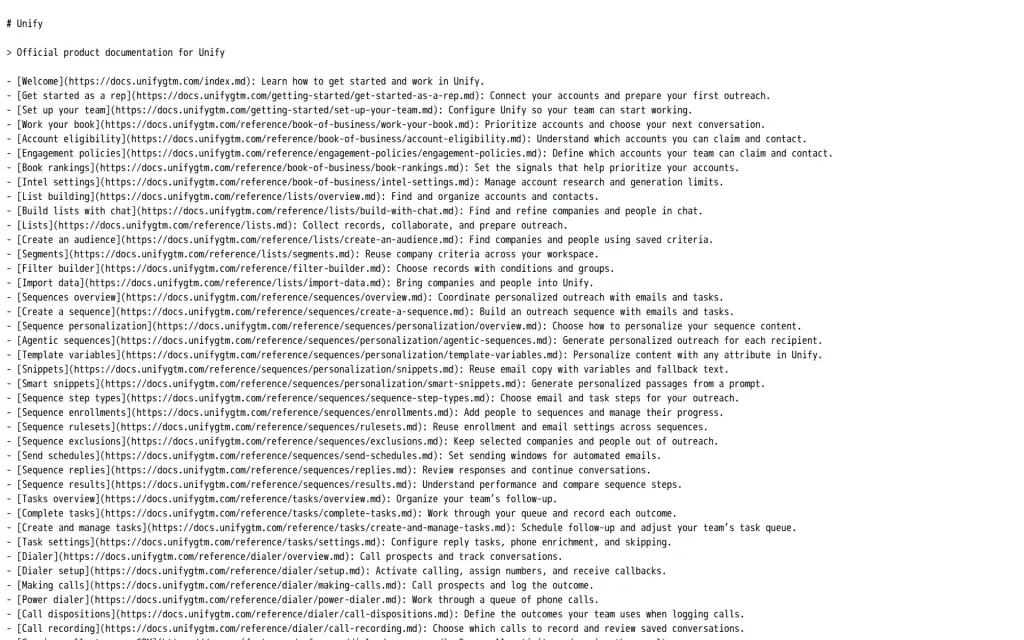
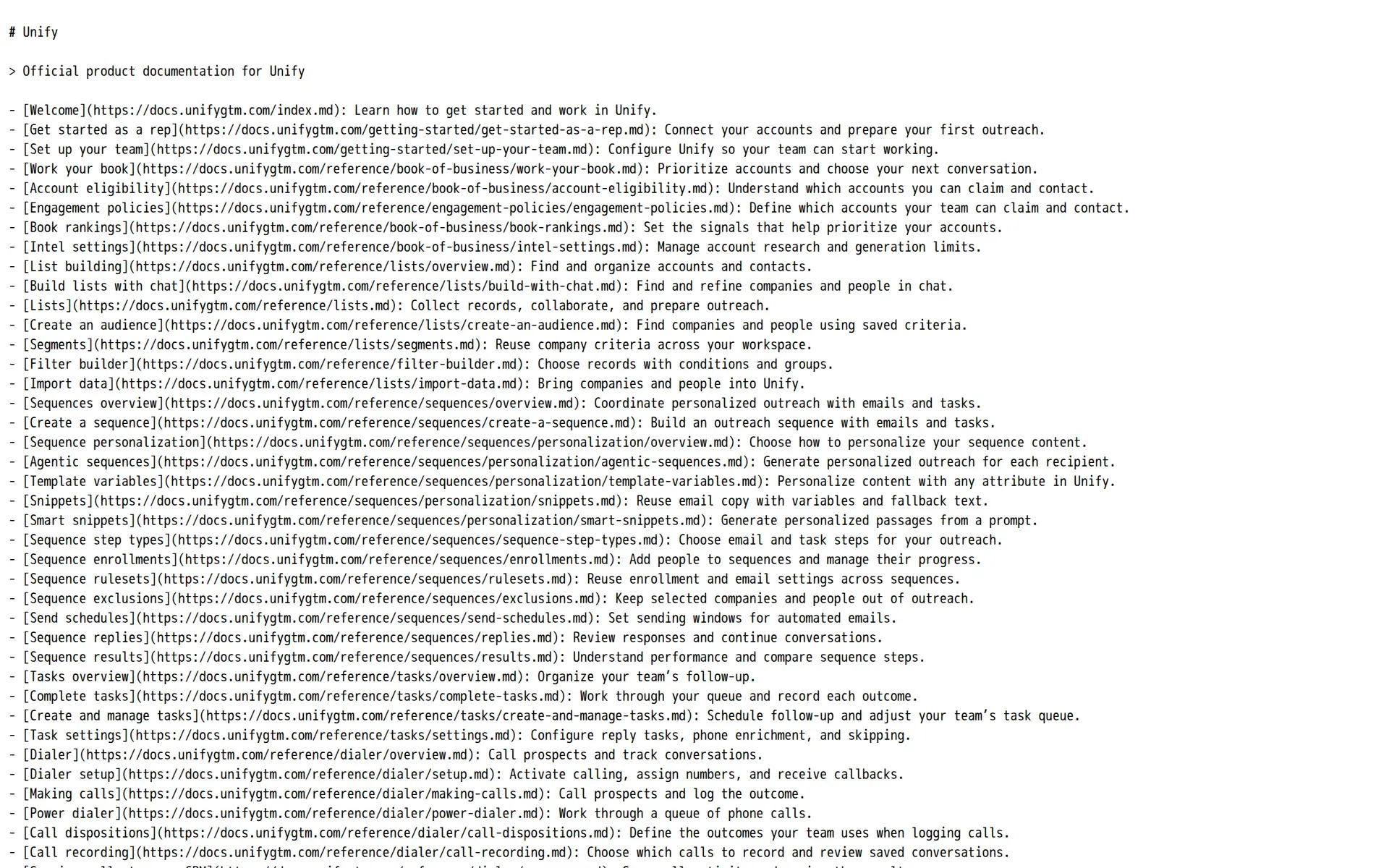
Docs, unifygtm.com, captured
Filed under
Sources and updates
Last changed
Sources13
- unifygtm.com/pricing
- docs.unifygtm.com/developers/mcp/getting-started
- unifygtm.com/legal/customer-data-processing-agreement
- unifygtm.com/legal/terms-and-conditions-self-service
- unifygtm.com/product/plays
- docs.unifygtm.com/reference/agents/overview
- docs.unifygtm.com/reference/management/user-management
- trust.unifygtm.com/
- unifygtm.com/
- unifygtm.com/legal/privacy-policy
- unifygtm.com/legal/terms-and-conditions
- docs.unifygtm.com/reference/management/authentication
- docs.unifygtm.com/reference/management/credit-system
Coverage elsewhere3
The Agents Index in AI answers0 of 1
- PerplexityDoes not cite The Agents IndexAsked
Unify alternatives
on Other sources: artisan.co, g2.com, gojiberry.ai, cleanlist.ai, salesmotion.io, prospeo.io
Updates6
- Capabilities · Free tier · Terms
- Capabilities · Free tier · Terms
- Capabilities · Free tier · Price · Terms
- Crunchbase link · LinkedIn link
- Summary
- Verdict,pricing tiers,cons,what it does
Is this yours? Claim it free and edit it in your dashboard, or feature it in Sales & marketing agents.