
Not for Teams that specifically need outbound-sequencing/AI-SDR automation (that's Clay, 11x or Artisan's job) or a public API for deep custom integration work.
The facts, with their sources
What it does
- Done-for-you service
- NoSoftware you run: sign up, connect Salesforce, invite the team. Enterprise adds a Rox deployment/support team and a ProServ integration-and-training line item, not an outsourced revenue team.
Rox Teams: The self-serve way to run Rox. You sign up, connect Salesforce, invite your team, and start running agents.
docs.rox.com/development/about-rox/rele…
How much it does unattended
- Runs autonomously
- PartlyAgents fire on schedules, deal events, transcript completion and webhooks, and auto-prospecting can enrol good-fit contacts without a manual pass; Rox's own engineering docs still say critical actions are queued for human review.
A custom agent takes work that used to wait on a person, someone remembering, someone checking, someone following up, someone pulling the pieces…
docs.rox.com/development/product/custom… - Multi-agent
- YesAn orchestrator builds pipelines of specialised worker agents (research, email composition, verification) per query; Rox brands the layer Agent Swarm.
Rox's Agent Swarm layer is a fleet of specialized worker agents, each scoped by specific context and downstream capabilities, that are orchestrated…
docs.rox.com/development/engineering/do… - Agent permissions
- YesAgentflows are scoped to a chosen tool set, agents inherit the acting user's record and field permissions, and sequence sends can be scheduled, previewed or cancelled before they go out.
Write what you want done and scope which tools the agent can use. The agent works out the steps, runs them, and iterates to fix errors as it goes.
docs.rox.com/development/about-rox/rele…
Which models it runs on
- Claude
- PartlyAnthropic is a named AI service-provider subprocessor under zero data retention, so Claude models are in the stack; Rox publishes no model names and no model picker, so a buyer cannot select Claude.
AI service provider (Zero Data Retention policies implemented)
docs.google.com/document/d/e/2PACX-1vQl… - GPT
- PartlyOpenAI, LLC is a named AI service-provider subprocessor under zero data retention; as with every model in Rox, the vendor routes it and the buyer cannot pick it.docs.google.com/document/d/e/2PACX-1vQl…
- Open models
- PartlyRox offers to integrate a customer's own trained models on request; it names no open-weight model and exposes no way to run one from the product.
And if your team is building or training its own models, Rox can work with you to integrate them securely — while still enforcing the same guardrails…
docs.rox.com/development/engineering/do… - Model choice
- PartlyRox meters by model class and lists six AI/inference providers as subprocessors, so it is multi-model internally, but the buyer never chooses the model; own-model integration is a bespoke conversation.
Each task requires a specific number of Agent Actions, which are measured based on the resources used, including the type of model and the data…
rox.com/pricing
Where you use it
- In your editor
- NoThe enumerated interface set is web app, Slack, MCP/API, mobile, Microsoft 365, Chrome extension and Google Workspace; no IDE or editor plugin appears on the site or in the docs.rox.com/platform
- On the command line
- NoNo terminal client in the published interface list, and the docs' only downloadable client is the Rox macOS app.rox.com/platform
- In a browser
- YesHosted web app at run.rox.com is the primary surface, with a macOS desktop app, an iOS app, a Chrome extension and Slack/Microsoft 365 entry points alongside it.
Voice Mode is available on the Rox mobile app and desktop at run.rox.com.
docs.rox.com/development/about-rox/rele…
Whose machine it runs on
- Self-hosted
- Partly'In VPC Deployment' is checked only in the Enterprise column: the warehouse stays the system of record and data need not leave the customer VPC, but compute runs in Rox's VPC, so this is not a customer-run install.
We can run directly in your warehouse so it stays the system of record, with data never leaving your VPC. In this setup, only compute runs in Rox’s…
docs.rox.com/development/engineering/do… - Open source
- NoProprietary hosted service: the terms grant no licence to the software and forbid attempts to discover its source code; no repository or licence is published anywhere on the site.
reverse engineer, decompile, disassemble or otherwise attempt to discover the source code, object code or underlying structure, ideas or algorithms…
rox.com/legal/terms-and-conditions
What it costs to run
- How it meters
- YesPer-action metering on top of a monthly allowance, with a published rate card: 2 actions per news insight, 6 per sequence output, 23 per deep Clever Column cell, 15 per connected dial-minute, variable actions per token for chat.
An Agent Action is the fundamental unit of measurement in Rox's pricing model.
rox.com/pricing - Free tier
- YesBoth self-serve plans start free and are upgraded to paid ('Try for free then upgrade for'); no card requirement and no free-tier action allowance is published.
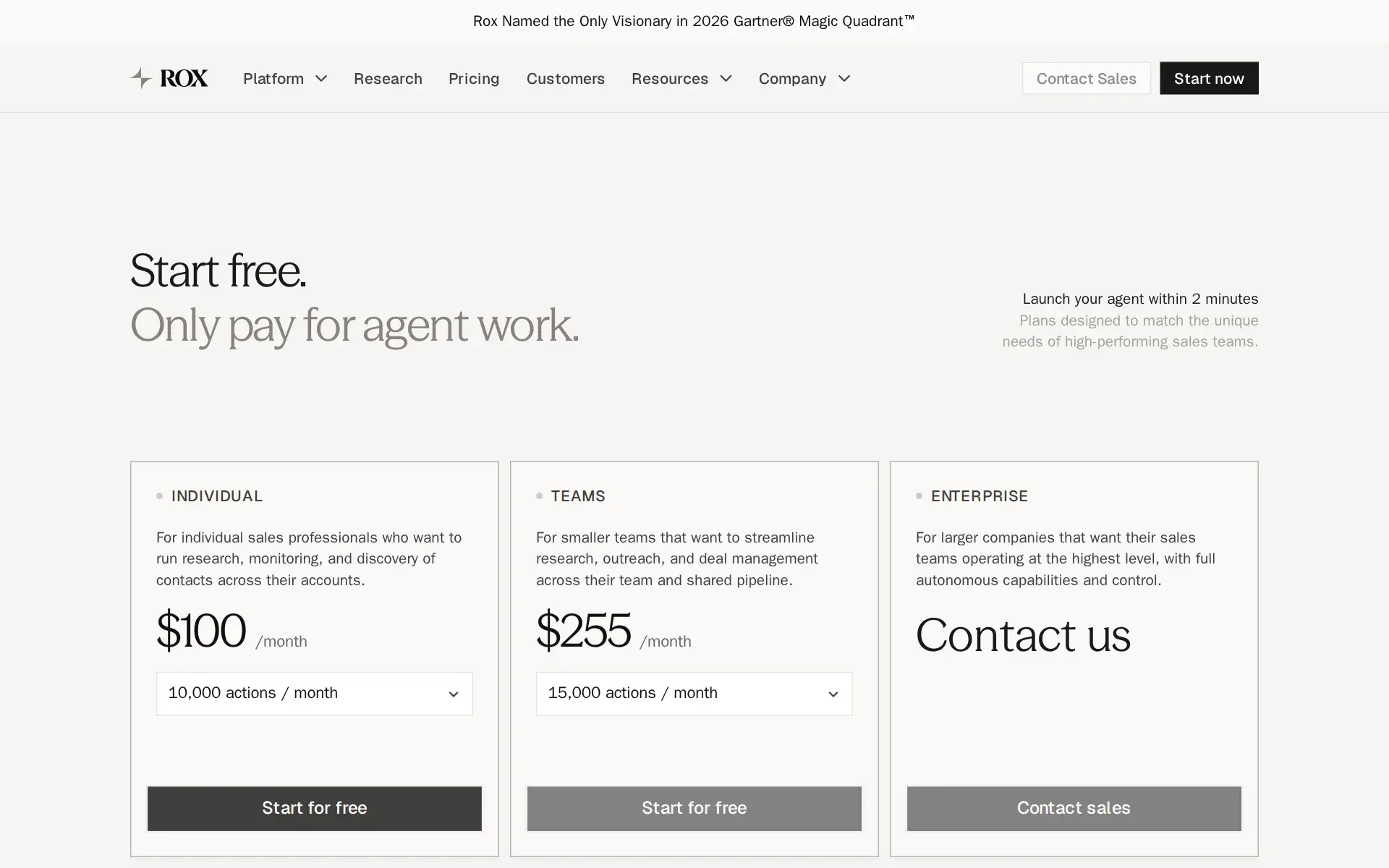
Start free. Only pay for agent work.
rox.com/pricing - API access
- PartlyInbound webhooks let your own systems start an agent with a JSON POST - 10 webhooks on Individual and Teams, unlimited on Enterprise - but no public REST API reference exists; /platform lists 'MCP / API' as an interface.
Webhook-triggered agents let an external system start an agent in Rox. Once the webhook arrives, Rox reads the payload, understands the event, and…
docs.rox.com/development/product/custom… - MCP server
- Partly'MCP Support' is ticked only in the Enterprise column of the plan comparison (dashes for Individual and Teams); no MCP server URL, tool list or setup guide is published in the docs.rox.com/pricing
- Bring your own key
- PartlyEnterprise customers supply their own enrichment-provider API keys and 'BYOK Encryption' is an Enterprise-only row in the plan comparison; self-serve accounts can add keys for HG Insights only, and inference keys are never the buyer's.
Rox allows Enterprise customers to supply their own API keys instead of using Rox’s shared keys.
docs.rox.com/development/product/people…
Buying it for a team
- A company can buy it
- YesTeams and Enterprise are organisation plans with shared workspaces and user/team management; Enterprise adds SAML, SCIM and a dedicated deployment team. Individual is single-user.
Teams includes multi-user workspaces with unlimited seats, CRM sync and writeback, and team and user management controls.
docs.rox.com/development/about-rox/rele… - Seat model
- PartlyNot licensed per seat - you buy Agent Actions - but Individual is capped at 1 user and the plan comparison caps Teams at 50 users while the Teams card claims unlimited seats; Enterprise is unlimited.
Usage is metered in Agent Actions. There's no per-seat licensing, so adding people to the workspace doesn't change what you pay.
docs.rox.com/development/about-rox/rele… - Pooled budget
- YesOne workspace-level action balance funds every user; admins can auto-reload it below a threshold under a monthly spend cap, and an admin view aggregates per-user consumption.
Auto-reload for Agent Actions: Keep agents running without interruption by topping up your action balance automatically when it drops below a…
docs.rox.com/development/about-rox/rele… - Admin controls
- PartlyOrg-wide defaults, permission sets and field-level access bound what users and their agents may touch, and agents inherit the acting user's clearance - but Role-Based Access Control and User & Team Management are dashed for Individual and ticked from Teams up.
They determine which actions users can perform, which records and fields they can access, and how access flows between linked records.
docs.rox.com/development/product/govern… - Audit log
- PartlyEvery CRM write-back is logged who/what/when/result and all plans get an agent activity log with an admin roll-up, but the 'Audit Logs' row is ticked only under Enterprise.
Audit logs for every write-back (who/what/when/result), retained in Rox’s sharded Postgres.
docs.rox.com/development/engineering/do… - Single sign-on
- PartlySAML and OpenID Connect, self-serve from workspace settings via Auth0, with SCIM listed alongside it - Enterprise organisations only, per both the plan card and the SSO doc.
Configure single sign-on for your organization directly from Rox admin settings, with no intervention from Rox required. Supports enterprise identity…
docs.rox.com/development/about-rox/rele…
What happens to your code
- Opt out of training
- YesZero-retention agreements with every model provider are the default and the site states customer data is never used to train generalised models - there is nothing to opt out of.
All model providers we work with run under strict zero-retention policies. That means prompts, outputs, and metadata are never stored or used for…
docs.rox.com/development/engineering/do… - Data residency
- PartlyIn-region and in-VPC options are offered to enterprises with residency needs, and the DPA commits to the EU Standard Contractual Clauses; no region list or default jurisdiction is published, and every AI and cloud subprocessor on the list is US-based.
For enterprises with residency or regulatory needs, Rox supports in-VPC deployments and in-region options. Your data doesn’t have to cross boundaries…
docs.rox.com/development/engineering/do… - Getting out
- PartlyUnused Agent Actions expire every cycle and do not roll over; on the way out the DPA obliges Rox to return or destroy customer personal data on written request, and agent-generated artefacts download as PPTX or DOCX.
Any unused actions expire at the end of each billing cycle, and your allocation resets on the renewal date.
rox.com/pricing - Certifications
- YesSOC 2 Type I and Type II and GDPR are claimed, with a self-serve Trust Center carrying the reports under click-wrap NDA; ISO 27001 is marked 'Coming soon', so it is not yet held.
Rox maintains SOC 2 Type II compliance and undergoes independent third-party security audits on an annual basis.
rox.com/security
Plans and pricing
Price and terms
- Free plan
- YesYesBoth self-serve plans begin on a free tier ('Start for free' / 'Try for free then upgrade for')
The terms in full
Rox publishes no free action allowance; the FAQ says the free plan keeps read access but stops task execution once actions run out: 'Starter plan users will still be able to access their existing information but will not be able to perform any tasks.'
What needs a higher plan
- Enterprise
- Self-hosted, MCP server, Bring your own key, Audit log, Single sign-on, Data residency
- Teams
- Admin controls
From rox.com/pricing, checked .
The Agents Index digest
Price changes and new agents like Rox, at most once a week.
Last issue: Devin vs Claude Code: Which Should You Pick? · 13 October 2026
Works with
 Claude
Partly
 GPT
GPTPartly
- PartlyOpen models
For AI agents
- MCP server
- PartlyEnterprise
- API
- Partly
Screenshots
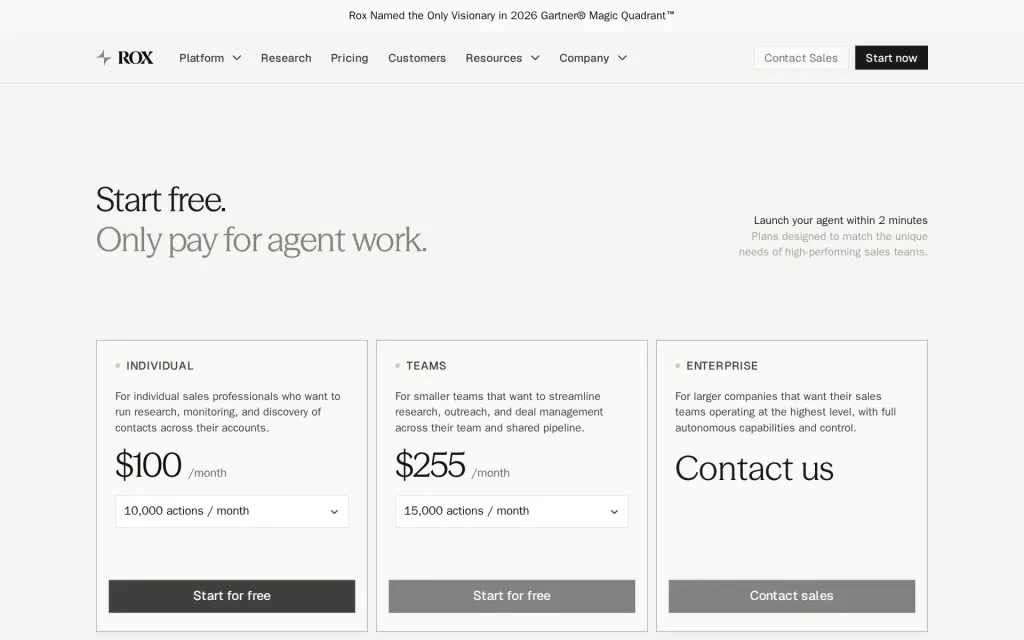
Pricing page, rox.com, captured 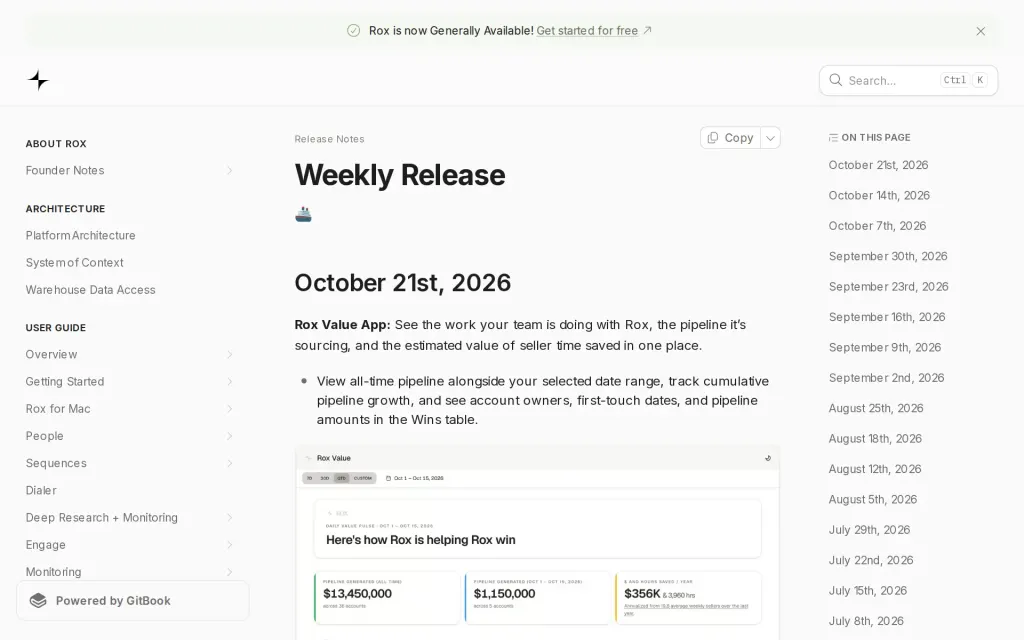
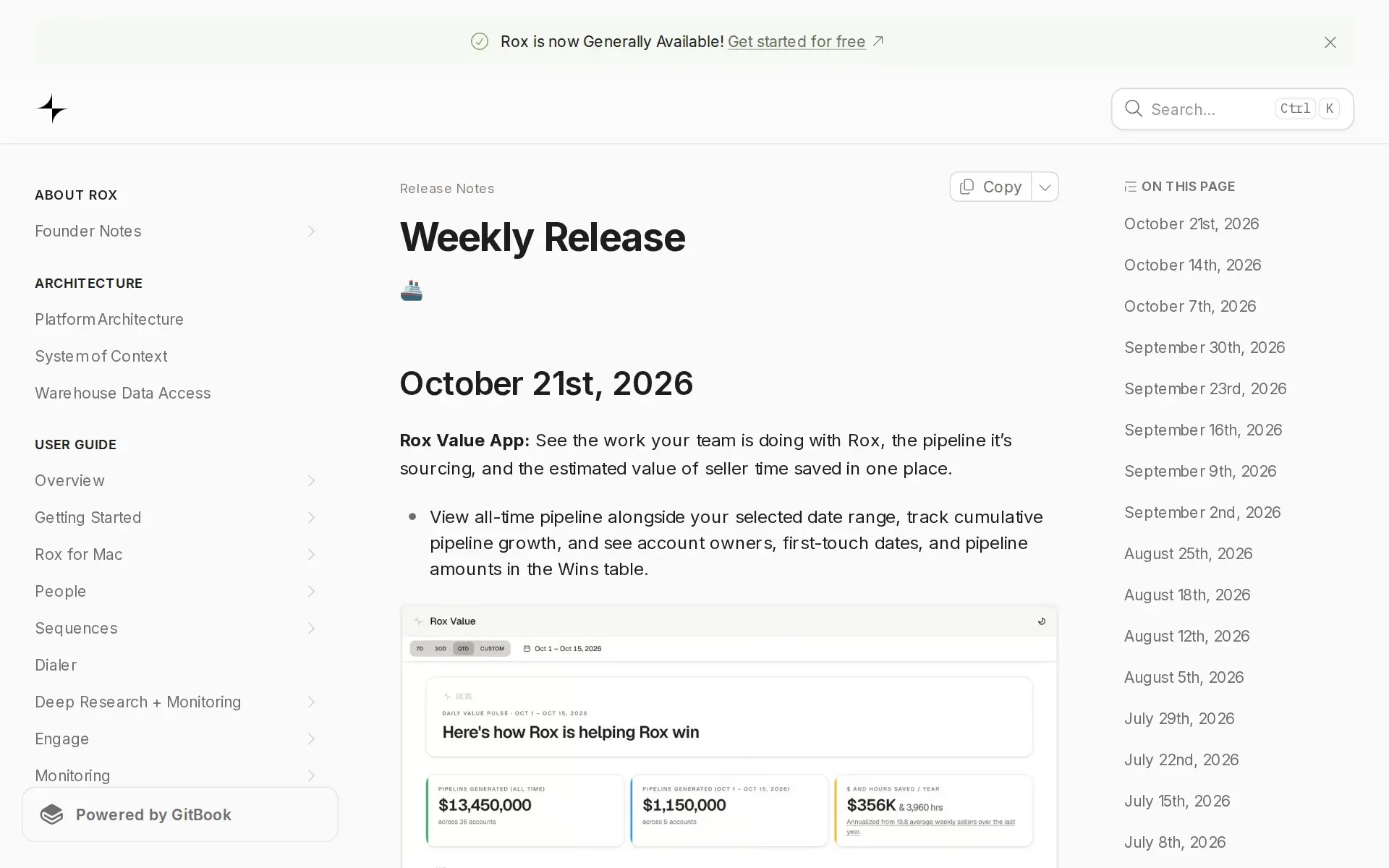
Docs, rox.com, captured
Filed under
Sources and updates
Last changed
Sources21
- docs.rox.com/development/about-rox/release-notes
- rox.com/pricing
- docs.rox.com/development/engineering/docs/secure-by-design
- docs.rox.com/development/engineering/docs/secure-by-design.md
- docs.rox.com/development/engineering/docs/agent-swarm-tm-layer.md
- docs.rox.com/development/engineering/docs/rox-architecture.md
- docs.google.com/document/d/e/2PACX-1vQl5mqWohdM-CHkz-86n3-C_VVAEonCsZH8B5yJVZoy9bQpwpCGA5SOlDvvmDD_1ZiOYXMZOELXbzeg/pubIndependent source
- rox.com/platform
- docs.rox.com/development/engineering/docs/agent-swarm-tm-layer
- docs.rox.com/development/engineering/docs/agent-swarm-tm-layer/human-agent-interaction.md
- docs.rox.com/development/engineering/docs/rox-enterprise-integrations/crm-integration
- docs.rox.com/development/engineering/docs/rox-enterprise-integrations/crm-integration.md
- docs.rox.com/development/engineering/docs/rox-enterprise-integrations/enterprise-sso-via-auth0.md
- docs.rox.com/development/product/custom-agents/using-webhooks
- docs.rox.com/development/product/custom-agents/using-webhooks.md
- docs.rox.com/development/product/custom-agents/what-is-a-custom-agent
- docs.rox.com/development/product/governance/organization-wide-defaults-owds
- docs.rox.com/development/product/people/adding-provider-keys
- docs.rox.com/development/product/people/adding-provider-keys.md
- rox.com/legal/terms-and-conditions
- rox.com/security
Coverage elsewhere3
The Agents Index in AI answers0 of 1
- PerplexityDoes not cite The Agents IndexAsked
Rox alternatives
on Other sources: prospeo.io, aviso.com, salesmotion.io, aiagentsdirectory.com, usecarly.com, revic.ai
Updates4
- Capabilities · Free tier · Terms
- Capabilities · Free tier · Links · Price · Terms
- Links
- Why use,limitations
Is this yours? Claim it free and edit it in your dashboard, or feature it in Sales & marketing agents.