
Not for Buyers wanting a general web-search answer engine (see Perplexity), a general-purpose autonomous agent that automates open-web tasks and deliverables beyond published literature (see Manus), or a cheaper literature-only discovery agent that does not run the formal PRISMA 2020 systematic review workflow (see Undermind). Elicit is scoped to the academic and scientific literature, not the open web.
Changed since our last check
- Runs autonomously: now Yes. It was Partly when we checked on .
- Agent permissions: now Partly. It was Yes when we checked on .
- Claude: now Yes. It was Partly when we checked on .
- GPT: now Yes. It was Partly when we checked on .
- In your editor: now Partly. It was No when we checked on .
- Open source: now No. It was Partly when we checked on .
- How it meters: now Partly. It was Yes when we checked on .
- Data residency: now Partly. It was Yes when we checked on .
- Getting out: now Partly. It was Yes when we checked on .
- Certifications: now Yes. It was Partly when we checked on .
The facts, with their sources
What it does
- Done-for-you service
- NoYou run the software yourself on a self-serve subscription. Enterprise adds people for onboarding and training, but Elicit does not staff a team to build or operate research agents on your behalf.
Dedicated customer success team providing training, onboarding, and success planning
elicit.com/pricing
How much it does unattended
- Runs autonomously
- YesOnce a session starts the agent plans and executes end to end without supervision (you can close the tab and return to a finished output), though it may ask clarifying questions before it begins.Was Partly before our last check.
The Research Agent breaks your prompt into a systematic plan, then executes it step by step. You can watch which sources it's consulting and how it's…
support.elicit.com/en/articles/14756886… - Agent permissions
- PartlyThe agent runs a whole plan unattended once launched; the only documented gates are the clarifying questions it asks up front, an effort slider, and an explicit approval before a new skill is saved.Was Yes before our last check.
Nothing is saved until you approve it, and the options at that point are create, revise, or cancel.
support.elicit.com/en/articles/16647708…
Which models it runs on
- Claude
- YesAnthropic is a named subprocessor whose models generate Elicit's AI responses, so Claude is in the stack, but as Elicit's own choice, with no Claude toggle exposed to the buyer.Was Partly before our last check.
Anthropic's models are used to give AI responses.
trust.elicit.com/subprocessors - GPT
- YesOpenAI appears in the same subprocessor inventory with the same purpose, so GPT models also serve responses, again chosen by Elicit rather than selected by the user.Was Partly before our last check.
OpenAI's models are used to give AI responses.
trust.elicit.com/subprocessors - Open models
- NoElicit's complete subprocessor inventory names exactly two model providers, both proprietary; the only other ML entry is Coreweave hosting Elicit's own custom models, and no open-weight option is offered to users.trust.elicit.com/subprocessors
- Model choice
- NoElicit picks and ensembles models itself as part of its accuracy approach; no plan, settings page or API parameter anywhere on the site lets a buyer choose which model runs.
We use strategies like process supervision, prompt engineering, ensembling multiple models, double-checking our results with custom models and…
support.elicit.com/en/articles/14757979…
Where you use it
- In your editor
- PartlyElicit ships no IDE or editor extension of its own; reaching it from an editor means connecting its hosted MCP server from any MCP-compatible client, which needs Pro or above.Was No before our last check.
All three are also available through the Elicit MCP server, so Elicit can return cited answers inside Claude, ChatGPT, Gemini, or any MCP-compatible…
support.elicit.com/en/articles/14757400… - On the command line
- PartlyThere is no first-party Elicit CLI product; the vendor publishes a CLI tool among its API integration examples, so terminal use means running that sample against the Pro-and-above API.
Working examples in curl, Python, and JavaScript, plus integrations (CLI tool, Slack bot, Claude Code skill)
docs.elicit.com - In your pipeline
- NoNo CI or pull-request surface; Elicit's own surface enumeration is the web app and the API, and the closest published case is a customer's own scheduled jobs.
The Research Agent is available through elicit.com or via API to bring into your workflows.
elicit.com/blog/introducing-elicit-rese… - In a browser
- YesThe primary surface is the hosted web app at elicit.com, where sessions, projects, library and admin settings all live; the API is the alternative rather than the main route.elicit.com/blog/introducing-elicit-rese…
Whose machine it runs on
- Self-hosted
- PartlyOnly the Enterprise column mentions custom deployments such as single-tenancy, and Elicit never documents that as running on customer infrastructure; every self-serve plan is vendor-hosted only.
Enterprise-level security and controls, including SSO & SAML, 2FA, user analytics, domain verification, and custom deployments (e.g. single-tenancy)
elicit.com/pricing - Open source
- NoThe terms reserve all rights in the service to Elicit and separately bar reverse engineering or decompiling it; only an API examples repo and a third-party licence list are public.Was Partly before our last check.
Using the Service does not give you ownership of any intellectual property rights in or to any part of the Service.
elicit.com/operations/terms
What it costs to run
- How it meters
- PartlyBilling is per seat per month, but the work itself draws on a monthly usage pool whose size Elicit never states in any unit; overage is sold in fixed $100 increments of extra usage.Was Yes before our last check.
Usage isn't a fixed amount per action, because the work varies from one task to the next.
support.elicit.com/en/articles/15646622… - Free tier
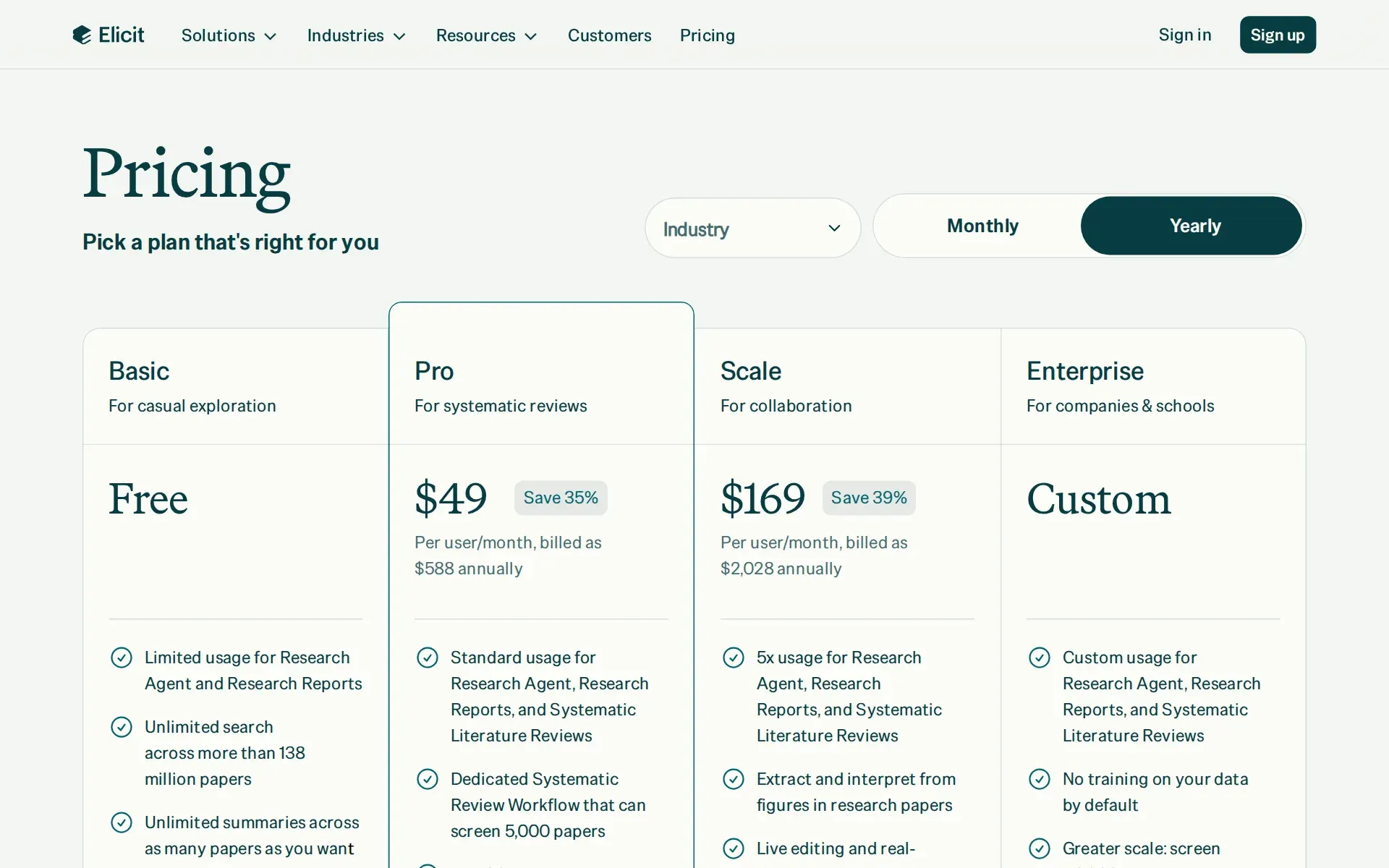
- YesBasic is a standing free plan rather than a trial, giving unlimited paper search, summaries and chat with limited Research Agent and Report usage; no call or card is mentioned.
Yes! While our most powerful workflows and features are on the paid plan, we also offer a generous free plan so you can use Elicit.
elicit.com - API access
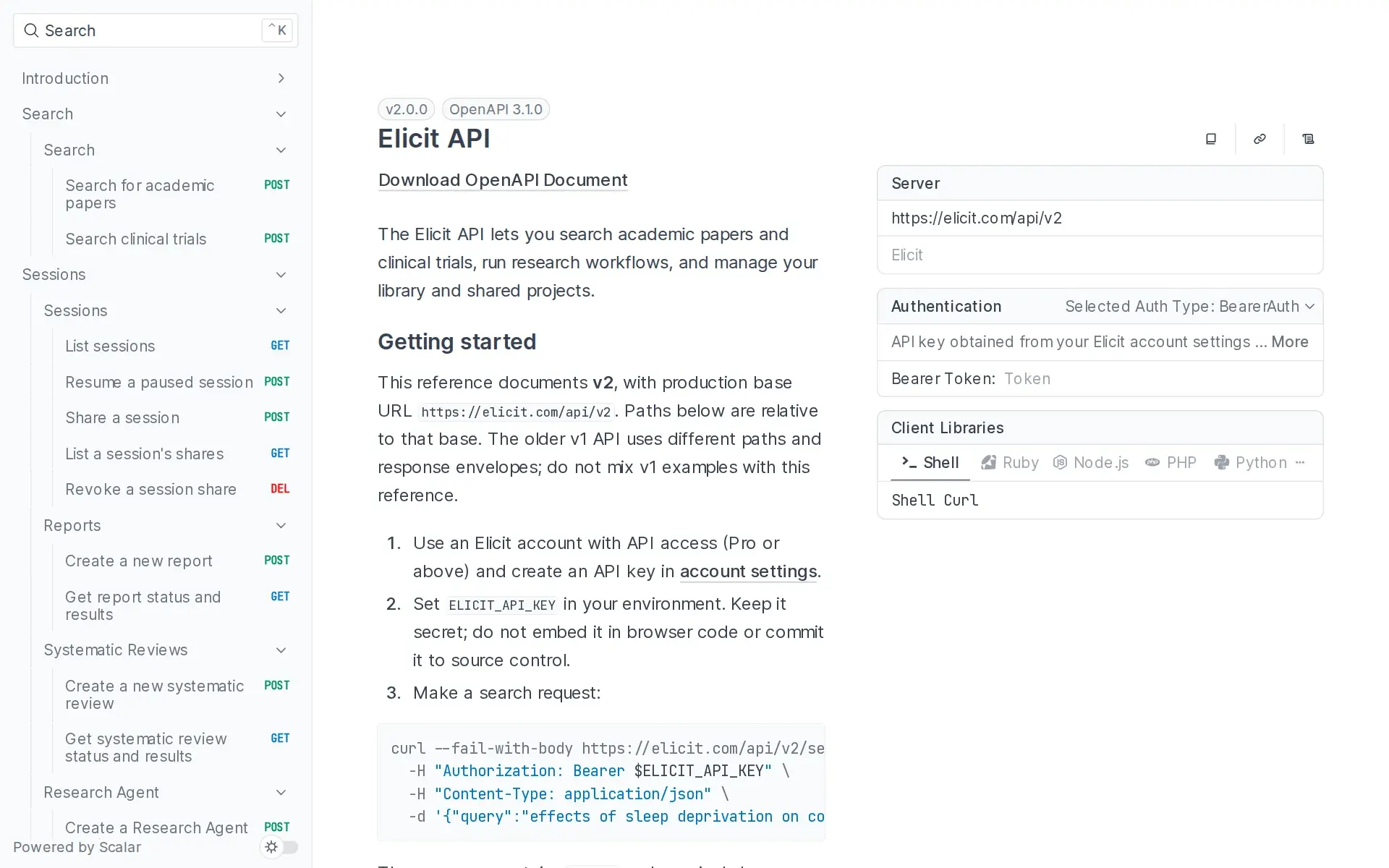
- PartlyA documented REST API covering search, reports and systematic review exists, but it starts at Pro; the docs list Basic and Plus as having no access at all to search requests.
The Elicit API is available on the Pro, Scale, and Enterprise plans.
support.elicit.com/en/articles/14757400… - MCP server
- PartlyElicit runs a hosted MCP server with OAuth 2.0 so another agent can query it directly, exposing the full API surface, but the entitlement begins at Pro rather than the free plan.
The Elicit MCP and API are available to customers on the Pro, Scale, and Enterprise plans.
support.elicit.com/en/articles/14757404… - Bring your own key
- PartlyYou bring your own documents and your institution's publisher subscriptions; the vendor documents no way to supply your own model keys or inference.
Upload your own documents and integrate company subscriptions to access more full-text papers.
elicit.com/solutions/research-agent
Buying it for a team
- A company can buy it
- YesAn organisation buys a Scale team subscription billed centrally to an admin, or an Enterprise contract; invoice-based billing and institutional contracts are both documented separately.
Centralized billing: All team members' subscriptions are billed to the Team Admin in a single purchase.
support.elicit.com/en/articles/14759330… - Seat model
- YesPricing is strictly per user per month with the buyer choosing seat count at signup and adding or removing seats later; no floor or ceiling is published, and removals get no prorated refund.
When signing up, choose the number of team members on your subscription. You can add or remove team members at any point in your subscription.
support.elicit.com/en/articles/14759330… - Pooled budget
- YesOn a Scale team the included usage is the sum of the seats and everyone draws from one shared pool, so a heavy user can consume a quiet colleague's share without any per-seat split.
A team's included usage is the sum of its seats, so a 4-member team has 4x an individual's usage, and the whole team draws from one pool.
support.elicit.com/en/articles/14759330… - Admin controls
- PartlyAdmin powers cover membership, seats, usage visibility and what happens to a departing member's work; nothing published lets an admin constrain what the agent may do or which sources it may reach.
User management: Team admins have access to an Admin Dashboard to invite or remove team members, view usage, and purchase additional seats.
support.elicit.com/en/articles/14759330… - Audit log
- PartlyEnterprise lists user analytics and Scale admins can view team usage, but no log of administrative actions is documented anywhere; the auditability Elicit advertises is of review decisions, not of admins.elicit.com/pricing
- Single sign-on
- PartlySAML SSO with 2FA and domain verification appears only in the Enterprise column; OIDC is never mentioned, and self-serve plans up to Scale sign in with email or a Google social login.elicit.com/pricing
What happens to your code
- Opt out of training
- PartlyOnly Enterprise is promised no training on your data by default; no opt-out control is documented for Basic, Plus, Pro or Scale, though uploaded PDFs are stated to stay private to the account.elicit.com/pricing
- Data residency
- PartlyJurisdiction is disclosed and it is the United States only: every one of the fifteen listed subprocessors is US-based; no EU or UK region is offered, with transfers handled contractually by SCCs.Was Yes before our last check.
Our servers are located in the United States.
elicit.com/operations/privacy - Getting out
- PartlyData export is broad (citations to RIS and BIB, review stages to CSV or XLSX, reports to PDF or DOCX), but unused monthly usage expires each cycle and cancelling refunds nothing already paid.Was Yes before our last check.
Unused usage does not roll over to the next month.
support.elicit.com/en/articles/15646622… - Certifications
- YesA Vanta trust centre publishes a SOC 2 Type 2 report plus SOC 3, Cyber Essentials, VPAT and HECVAT; GDPR and CCPA are handled through a DPA with standard contractual clauses.Was Partly before our last check.
Elicit Research, PBC SOC 2 Type 2 Report 07152025.pdf
trust.elicit.com
Plans and pricing
Price and terms
- Free plan
- YesYesBasic (free, standing): limited usage for Research Agent and Research Reports
The terms in full
unlimited paper search across 138M+ papers, unlimited summaries and unlimited chat with papers with full-text access; Zotero import. No Systematic Review workflow, no API or MCP access, no table columns/export tier, and Premium PDF parsing is unavailable on Basic. When the monthly usage pool is exhausted, Basic keeps Find Papers and Chat with Papers until the cycle resets.
What needs a higher plan
- Pro
- In your editor, On the command line, API access, MCP server
- Enterprise
- Self-hosted, Audit log, Single sign-on, Opt out of training
- Scale
- Pooled budget, Admin controls
From elicit.com/pricing, checked .
The Agents Index digest
Price changes and new agents like Elicit, at most once a week.
Last issue: Devin vs Claude Code: Which Should You Pick? · 13 October 2026
Works with
 Claude
 GPT
GPT
For AI agents
- MCP server
- PartlyPro
- API
- PartlyPro
Screenshots
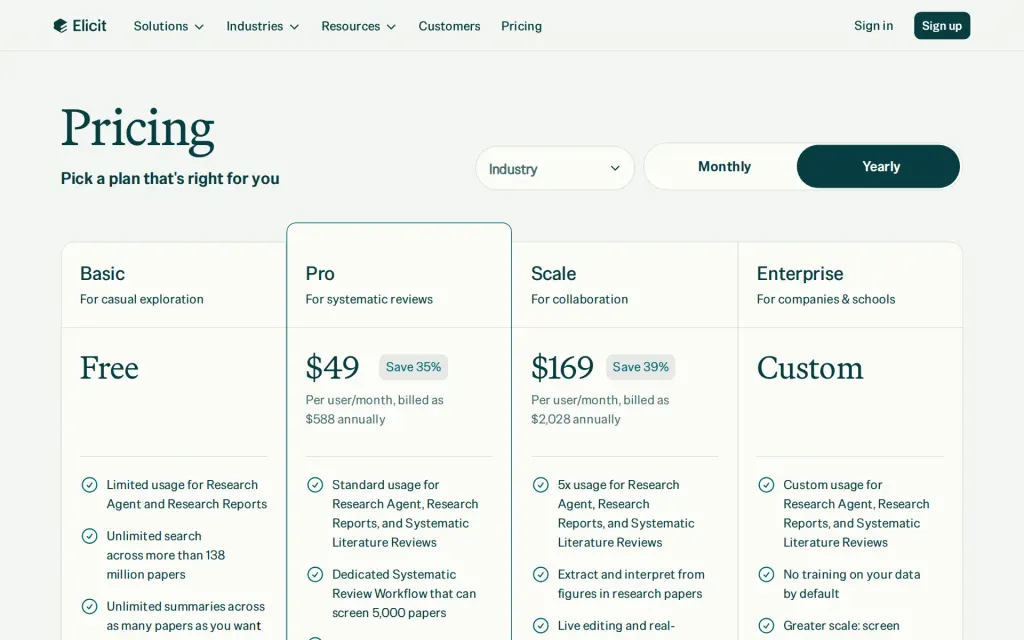
Pricing page, elicit.com, captured 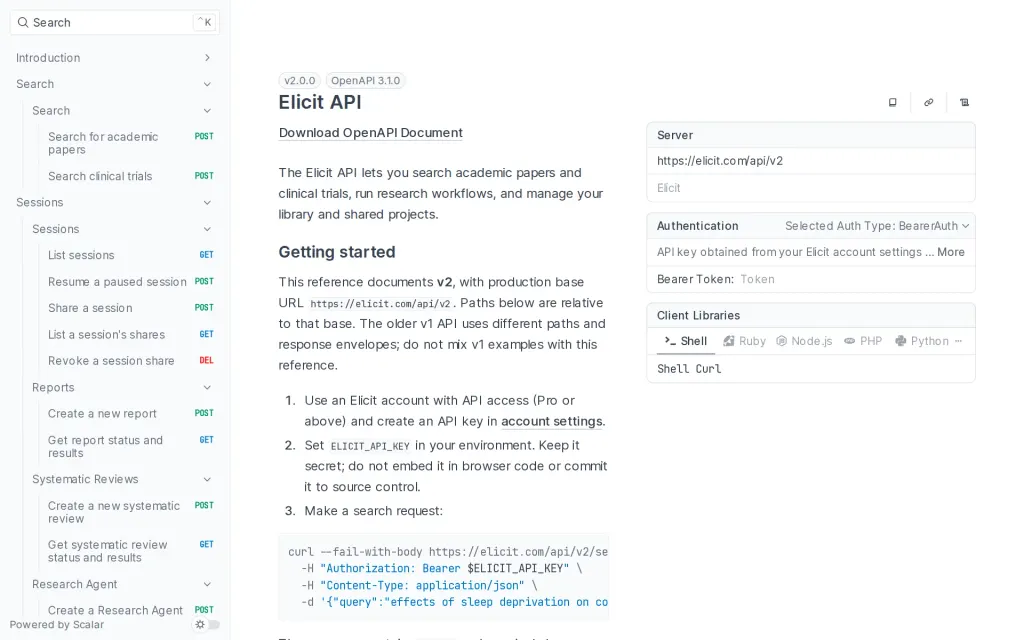
Docs, elicit.com, captured
Filed under
Sources and updates
Last changed
Sources22
- elicit.com/pricing
- support.elicit.com/en/articles/14759330-elicit-s-scale-plan-for-teams
- elicit.com/industries/pharma
- docs.elicit.com/
- elicit.com/blog/introducing-elicit-research-agent
- trust.elicit.com/subprocessors
- support.elicit.com/en/articles/14756886-elicit-s-research-agent
- support.elicit.com/en/articles/14757400-elicit-s-api
- support.elicit.com/en/articles/15646622-usage-limits-in-elicit
- elicit.com/
- trust.elicit.com/
- elicit.com/blog/elicit-achieves-soc-2
- elicit.com/blog/evaluating-claude-opus-4-5
- support.elicit.com/en/articles/14757404-use-elicit-via-mcp-server
- support.elicit.com/en/articles/14757543-getting-started-with-elicit-which-workflow-or-tool-should-i-use
- support.elicit.com/en/articles/14757979-elicit-s-reliability-does-elicit-run-the-same-risk-of-hallucination-as-other-ai-tools
- support.elicit.com/en/articles/14758189-export-your-data-from-elicit
- support.elicit.com/en/articles/16647708-skills-in-elicit
- support.elicit.com/en/articles/16649941-collaborate-in-a-shared-research-agent-session
- elicit.com/operations/privacy
- elicit.com/operations/terms
- elicit.com/solutions/research-agent
The Agents Index in AI answers0 of 1
- PerplexityDoes not cite The Agents IndexAsked
Elicit alternatives
on Other sources: otio.ai, itechguides.com, alternativeto.net, toolradar.com, g2.com, paperguide.ai
Updates4
- Capabilities · Free tier · Terms
- Capabilities · Free tier · Price · Terms
- Capabilities · Free tier · Price · Terms
- Alternatives · Crunchbase link · LinkedIn link · Summary · Tagline
Is this yours? Claim it free and edit it in your dashboard, or feature it in Research & data agents.