
Not for Non-technical users who want a polished, hosted ask-and-get-a-report product with no setup.
Changed since our last check
- Done-for-you service: now No. It was Partly when we checked on .
- In your editor: now Yes. It was Partly when we checked on .
- In a browser: now Yes. It was Partly when we checked on .
- Data residency: now Yes. It was Partly when we checked on .
The facts, with their sources
What it does
- Done-for-you service
- NoYou run the software yourself; no team builds or operates it for you, and managed VPC deployment or an SLA exists only as an invitation to email or Discord.Was Partly before our last check.
No first-party hosted SaaS today.
gptr.dev/pricing
How much it does unattended
- Runs autonomously
- YesA run plans subtopics, searches, validates sources and writes the report with no human step, and the human-feedback gate is opt-in.
include_human_feedback - If true, the user can provide feedback to the agents. If false, the agents will work autonomously.
docs.gptr.dev/docs/gpt-researcher/multi… - Multi-agent
- YesA LangGraph flow coordinates a chief editor, researcher, reviewer, revisor, writer and publisher, and an AG2 integration is documented too.
By using Langgraph, the research process can be significantly improved in depth and quality by leveraging multiple agents with specialized skills.
docs.gptr.dev/docs/gpt-researcher/multi… - Agent permissions
- PartlyThere are no approval prompts mid-run; you constrain it beforehand through configuration such as domain allow-lists, report source and depth, and its actions stay read-only research.
You can filter web search results by specific domains when using either the Tavily or Google Search retrievers.
docs.gptr.dev/docs/gpt-researcher/conte…
Which models it runs on
- Claude
- YesClaude is named as a supported model and anthropic appears in the docs list of LLM providers, with your own Anthropic key.
Thanks to the massive community contributions, GPT Researcher supports over 100 different LLMs such as Gemini, Claude, Llama, etc.
gptr.dev - GPT
- YesOpenAI is the default provider for the fast, smart and strategic model slots, so GPT models work out of the box.
GPT Researcher defaults to our recommended suite of integrations: OpenAI for LLM calls and Tavily API for retrieving real-time web information.
docs.gptr.dev/docs/gpt-researcher/gptr/… - Open models
- YesLocal open-weight models run through Ollama, and the supported-provider list also includes huggingface, vllm, together and deepseek.
If you deploy ollama locally, a .env like so, should enable powering GPT-Researcher with Ollama:
docs.gptr.dev/docs/gpt-researcher/llms/… - Model choice
- YesYou choose the provider and model per role through FAST_LLM, SMART_LLM and STRATEGIC_LLM config keys rather than accepting a vendor default.
Easily connect any LLM of your choice from OpenAI, Anthropic, Groq to Llama 3 and HF.
gptr.dev
Where you use it
- In your editor
- YesThe MCP server registers over stdio in Cursor and Claude Desktop, and a Claude Skill extends the agent into Claude Code.Was Partly before our last check.
It is self-hosted (MIT, Python 3.11+) and supports stdio (Claude Desktop, Cursor), SSE (Docker / n8n / web), and Streamable HTTP.
gptr.dev/agent - On the command line
- YesA documented cli.py takes the query, report type and tone as arguments and writes the finished report to an outputs directory.
This command-line interface (CLI) tool allows you to generate research reports using the GPTResearcher class.
docs.gptr.dev/docs/gpt-researcher/getti… - In a browser
- YesThe project ships its own browser frontends (static, NextJS, embed script) that you host, and a vendor-run instance answers at app.gptr.dev.Was Partly before our last check.
Includes an easy-to-use web interface (HTML/CSS/JS)
docs.gptr.dev/docs/gpt-researcher/getti…
Whose machine it runs on
- Self-hosted
- YesSelf-hosting is the only supported deployment: pip package, FastAPI server, docker-compose or Linux host, all on infrastructure you own.
You self-host the agent and pay only your underlying LLM and search-API providers.
gptr.dev/pricing - Open source
- YesThe core agent and the MCP server are MIT-licensed public repositories, published to PyPI and npm with community contributions.
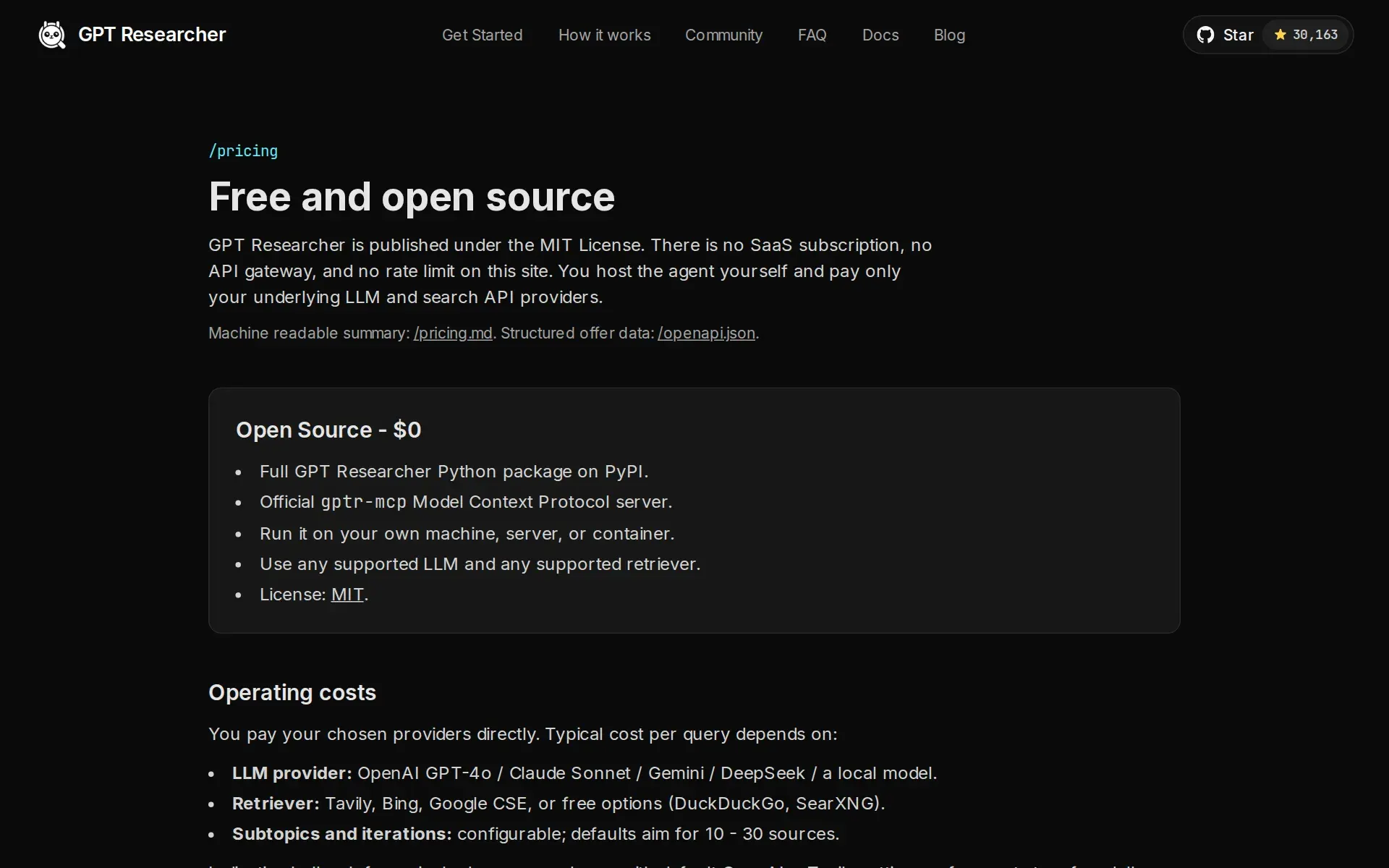
GPT Researcher is published under the MIT License.
gptr.dev/pricing
What it costs to run
- How it meters
- YesThe vendor charges nothing at all; cost is pass-through usage billing from the LLM and retriever providers you configure, which the page says runs a few cents to a few dollars per deep-research run with OpenAI plus Tavily on default settings.
Indicative ballpark for a single deep-research run with default settings on OpenAI + Tavily: a few cents to a few dollars of provider spend.
gptr.dev/pricing - Free tier
- YesNo call, no card and no account: clone or pip install the MIT package and supply your own provider keys to start.
There is no SaaS subscription, no API gateway, and no rate limit on this site.
gptr.dev/pricing - API access
- YesYour own stack drives it through the self-hosted FastAPI REST endpoints, an OpenAPI 3.1 spec, SSE streaming and signed outbound webhooks.
The self-hosted GPT Researcher FastAPI server exposes a small, agent-friendly REST API.
gptr.dev/api-reference - MCP server
- YesThe official gptr-mcp server exposes deep_research, quick_search, write_report and source tools over stdio, SSE and Streamable HTTP.
The GPT Researcher MCP Server provides Model Context Protocol (MCP) integration for GPT Researcher, allowing AI assistants to perform autonomous,…
docs.gptr.dev/docs/gpt-researcher/mcp-s… - Bring your own key
- YesBring-your-own-key is the only model: your LLM and retriever credentials go in environment variables on infrastructure you run.
Provide your own LLM (e.g. OPENAI_API_KEY) and retriever (e.g. TAVILY_API_KEY) credentials via environment variables when you run the server or MCP…
gptr.dev/agent
Buying it for a team
- A company can buy it
- PartlyAn organisation can adopt the MIT software freely but cannot buy anything: there is no published contract, seat or subscription path, only an enterprise enquiry.
Both! GPT Researcher is ideal for anyone who needs to conduct research to make unbiased and informed decisions. We work closely with individuals,…
gptr.dev - Seat model
- NoOne MIT-licensed tier priced at $0 for the whole product; no seats, user counts or subscription anywhere on the pricing page.gptr.dev/pricing
- Pooled budget
- NoThere is no vendor-side balance; spend sits entirely with the LLM and retriever accounts you own.
None imposed by GPT Researcher. Limits come from your underlying LLM / retriever providers' rate limits.
gptr.dev/pricing.md - Admin controls
- PartlyWhoever runs the deployment constrains the agent through config and environment variables, but there is no admin console, role separation or policy enforced above the operator.
MAX_SEARCH_RESULTS_PER_QUERY: Maximum number of search results to retrieve per query. Defaults to 5.
docs.gptr.dev/docs/gpt-researcher/gptr/… - Audit log
- NoEach run writes a downloadable JSON event log of research steps, but no administrative trail of users, permissions or policy changes exists.
There is no GPT Researcher account system.
gptr.dev/llms-full.txt - Single sign-on
- NoNo SAML or OIDC is offered and there is no vendor login to federate; identity is whatever your own hosting puts in front of the server.
GPT Researcher is self-hosted; there is no gptr.dev account.
gptr.dev/agent
What happens to your code
- Opt out of training
- YesNothing reaches a GPT Researcher service to train on; only the providers you pick see your queries, and a local model plus SearXNG removes even that.
Only via the LLM and retriever providers you configure. Self-host with a local model and SearXNG to keep everything on-prem.
gptr.dev/pricing - Data residency
- YesResidency is wherever you deploy, since the vendor stores nothing; the jurisdictions that matter are your host's and your chosen providers'.Was Partly before our last check.
Self-host on your own machine, server, or container.
gptr.dev/pricing - Getting out
- YesReports export to PDF, Word, Markdown, JSON and CSV, run logs download as JSON, and no credits exist that could expire.
Export your research to any format from PDF, Word, Markdown to JSON and CSV.
gptr.dev
Plans and pricing
Price and terms
- Free plan
- YesYes
The terms in full
The whole product is the free Open Source plan at $0: deep research agent, quick search, report writing, the gptr-mcp server, all LLM providers and retrievers, Docker image and multi-agent orchestration are all marked Included, and the pricing FAQ states GPT Researcher imposes no usage limits of its own - you pay your own LLM and retriever providers.
Checked .
The Agents Index digest
Price changes and new agents like GPT Researcher, at most once a week.
Last issue: Devin vs Claude Code: Which Should You Pick? · 13 October 2026
Works with
 Claude
 GPT
GPT- YesOpen models
For AI agents
- MCP server
- Yes
- API
- Yes
Screenshots
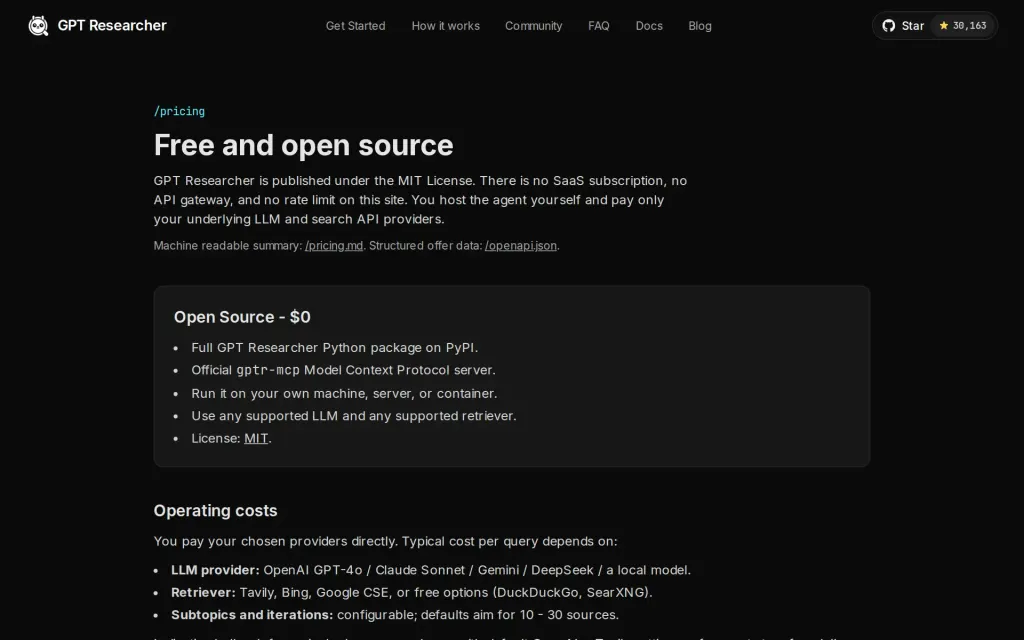
Pricing page, gptr.dev, captured 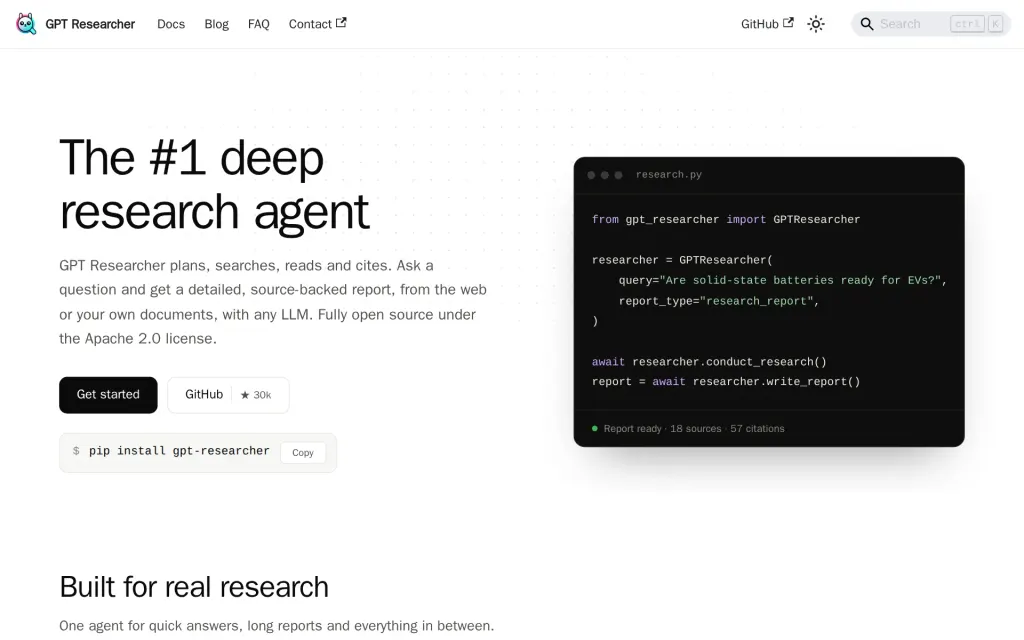
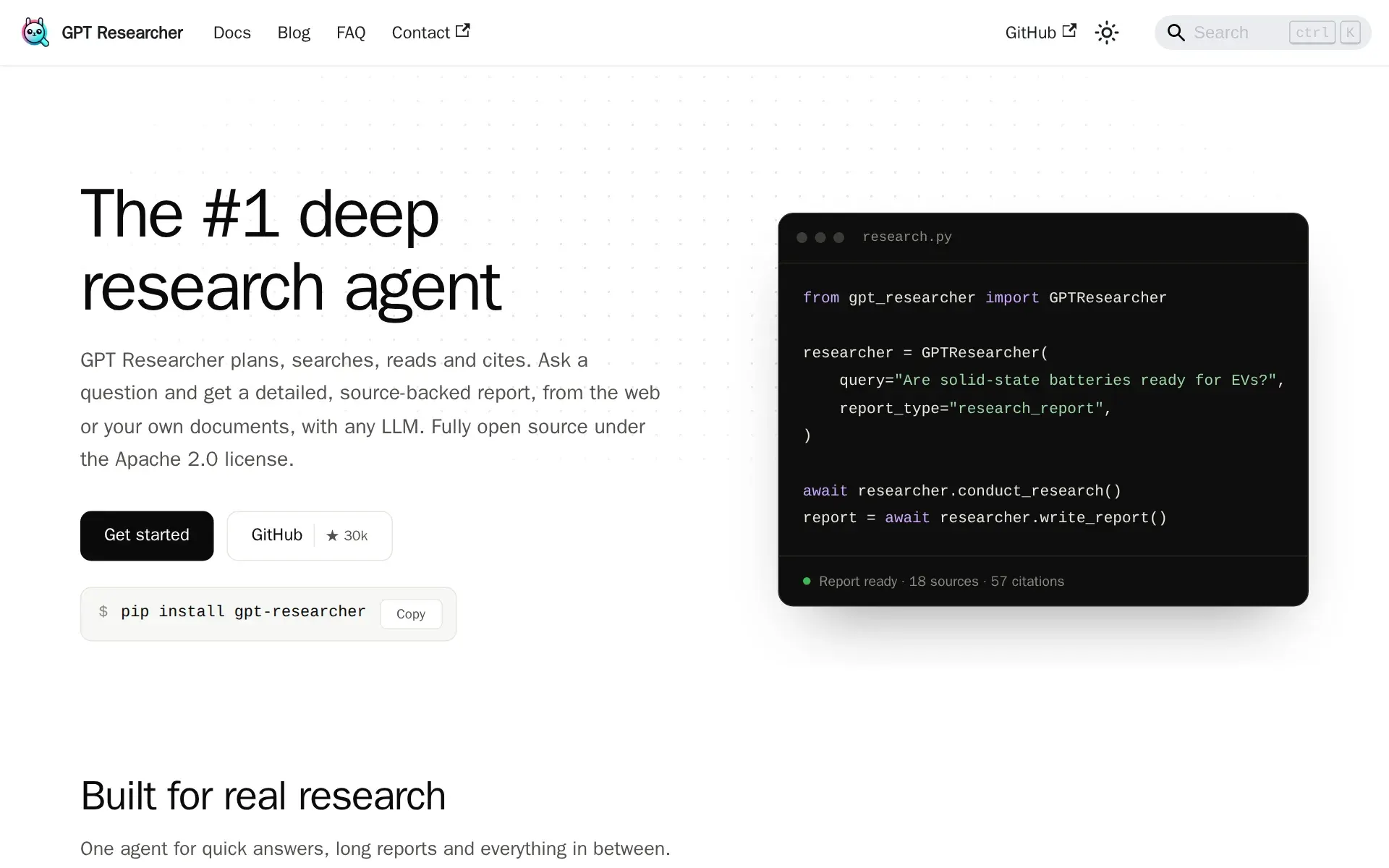
Docs, gptr.dev, captured
Filed under
Sources and updates
Last changed
Sources18
- gptr.dev/llms-full.txt
- gptr.dev/pricing
- gptr.dev/pricing.md
- gptr.dev/
- gptr.dev/llms.txt
- gptr.dev/agent
- docs.gptr.dev/docs/gpt-researcher/multi_agents/langgraph
- docs.gptr.dev/docs/gpt-researcher/gptr/config
- docs.gptr.dev/docs/gpt-researcher/mcp-server/getting-started
- gptr.dev/api-reference
- docs.gptr.dev/docs/gpt-researcher/context/filtering-by-domain
- docs.gptr.dev/docs/gpt-researcher/getting-started/cli
- docs.gptr.dev/docs/gpt-researcher/getting-started/getting-started-with-docker
- docs.gptr.dev/docs/gpt-researcher/getting-started/introduction
- docs.gptr.dev/docs/gpt-researcher/gptr/deep_research
- docs.gptr.dev/docs/gpt-researcher/llms/running-with-ollama
- docs.gptr.dev/docs/gpt-researcher/llms/supported-llms
- api.github.com/repos/assafelovic/gpt-researcherRepository
Repository30 August 2026
- Licence
- Apache-2.0
- Stars
- 29,205
- Forks
- 3,964
- Last push
- 27 August 2026
Coverage elsewhere2
The Agents Index in AI answers0 of 1
- PerplexityDoes not cite The Agents IndexAsked
GPT Researcher alternatives
on Other sources: store.hypergpt.ai, aiagentsdirectory.com, itechguides.com, listenlabs.ai, clickup.com, repocloud.io
Updates6
- Capabilities · Free tier · Plan limits · Price
- Capabilities · Free tier · Price · Terms
- Capabilities · Free tier · Terms
- Capabilities · Free tier · Terms
- Alternatives · Documentation link · Summary · Tagline
- Summary
Is this yours? Claim it free and edit it in your dashboard, or feature it in Research & data agents.