
Summary
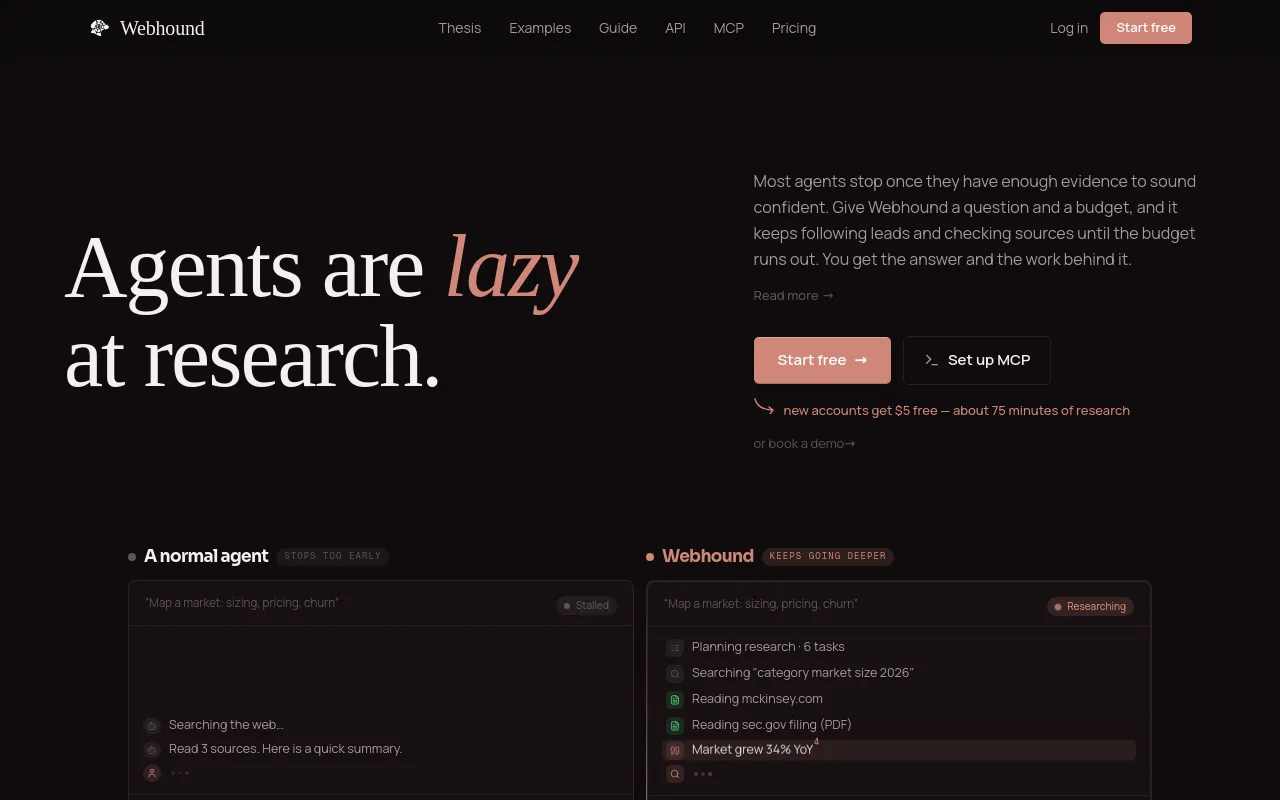
Webhound is an autonomous web-research engine that takes a question and a dollar budget and returns cited reports, sourced datasets, and JSON claims carrying their evidence. It is driven from an agent over MCP or a REST API, or from its own hosted workspace UI.
- Best for
- Developers and technical researchers who want an agent-triggered research tool, callable via MCP from inside Claude, Codex or Cursor, that returns either a cited Report or a structured, sourced Dataset, priced transparently by the dollar rather than an opaque credit system.
- Not for
- Buyers who need a specialized corpus such as academic literature (Elicit, Undermind) or US case law (GC AI), or who want an established, multi-year track record rather than a two-person team still iterating on its own pricing and interface.
- From
- $1/per research run (minimum $1 budget)metered on usage
- Free trial
- PartlyNew accounts receive a one-off $5 grant — 'New accounts include one $5 Report or Dataset' (pricing page); the homepage states '$5 free on signup — about 75 minutes of research'. No standing $0 plan; after the grant all use is prepaid credit.
What it does
- Writes code
- PartlyIt writes and runs Python against your own research data for analysis and charts, but it is a research engine, not a tool that authors application code from a spec.
Run code. The agent writes and executes Python for data analysis, charts, transformations, and file generation—using your actual datasets, not…
webhound.ai/news/webhound-agent - Done-for-you service
- NoSelf-serve software you run yourself from an agent or the web app; nothing on the site offers people who run research engagements for you.
Webhound is your agent’s research engine — made to be called by an agent and left to run. When you want to get hands-on, the same engine runs behind…
webhound.ai
How much it does unattended
- Runs autonomously
- YesThe stated default is an unattended run: an agent starts research by tool call, the engine keeps working to the budget, and results return as JSON.
An agent starts research on its own · Wire it into a pipeline or a tool call · Results come back as structured JSON · No human has to sit in the loop
webhound.ai - Multi-agent
- PartlyChains run several research and extraction steps in sequence, each consuming the previous step's output, which is orchestration of stages rather than several agents coordinating concurrently on one task.
Describe a sequence of steps — "research the best CRMs, then extract 30 of them with pricing, then write a buying recommendation" — and the system…
webhound.ai/news/webhound-agent - Agent permissions
- PartlyThe dollar budget is a hard ceiling set before the run and pipelines need plan approval, but the vendor documents no per-capability permission controls over what the agent may touch.
You approve the full plan before anything starts, and you can stop the pipeline at any point.
webhound.ai/news/webhound-agent
Which models it runs on
- Claude
- NoThe Hound harness is stated as built with DeepSeek V4 Pro and GPT-5.4 and is not a selectable model; Claude appears only as an MCP client that calls Webhound, not as an inference option.
Hound 1.0 is Webhound’s research harness, built with DeepSeek V4 Pro and GPT-5.4. Set a dollar budget and it spends that effort on the investigation.…
webhound.ai - GPT
- YesGPT-5.4 is named by the vendor as one of the two models the Hound 1.0 research harness is built with, though buyers cannot select it themselves.
Hound 1.0 is Webhound’s research harness, built with DeepSeek V4 Pro and GPT-5.4.
webhound.ai - Open models
- NoA DeepSeek model sits inside the harness, but the vendor states Hound is not a selectable model or mode, so a buyer cannot choose or supply open-weight models.
Webhound now exposes Hound, a research harness built with DeepSeek V4 Pro and GPT-5.4 across planning, execution, verification, and assembly. Hound…
webhound.ai/news/session-minimums - Model choice
- NoThe vendor chooses the models: Hound is explicitly not a selectable model or mode, and the older Flash/Pro model picker was retired, leaving only the dollar budget as a dial.
Hound is not a selectable model or mode and does not resolve to a single provider backend. You choose the question and dollar budget; the budget…
webhound.ai/news/session-minimums
Where you use it
- In your editor
- PartlyIt reaches editors only as an MCP tool inside a client such as Cursor or Claude Code; the vendor documents no native IDE extension of its own.
Webhound runs as a tool call inside Claude Code, Codex, Manus, and any MCP client. Kick off a research job, keep working, and read structured results…
webhound.ai - On the command line
- PartlyThere is no Webhound CLI; the terminal surface is borrowed from CLI agents such as Claude Code and Codex that call it over MCP.
Webhound runs as a tool call inside Claude Code, Codex, Manus, and any MCP client.
webhound.ai - In a browser
- YesA hosted web workspace is a first-class surface, with a chat agent home page, nested folders, session steering and published results alongside the API.
Read and verify in a rich UI · Steer a run mid-flight · Publish and share results · Explore claim traces by hand
webhound.ai
Not established: In your pipeline
Whose machine it runs on
- Self-hosted
- NoEverything runs in the vendor's cloud: the documented integration is a hosted REST endpoint with a Webhound API key, and no self-hosted or bring-your-own-infrastructure option appears anywhere on the site.
Full programmatic access to research, extraction, publications, and workspace management — https://api.webhound.ai/api/v2 · 58 endpoints · Bearer…
webhound.ai/docs/api
Not established: Open source
What it costs to run
- How it meters
- YesPurely consumption-priced: you prepay credits and spend a per-run dollar budget, with per-operation and per-token rates published rather than a seat or subscription fee.
Prepaid Credits: Add credits to your account before using Webhound · Real-time Deduction: Costs are deducted as operations are performed · No…
webhound.ai/news/pay-as-you-go - Free tier
- PartlyYou can start without talking to sales, but the free path is a one-off $5 grant on signup rather than a standing free tier you can keep using.
New accounts include one $5 Report or Dataset.
webhound.ai/pricing - API access
- YesA documented public REST API with bearer keys covers research, extraction, pipelines, files, publications and account credits, and it is presented as the default way to drive the product.
All requests require an API key in the Authorization header: Authorization: Bearer wh_your_api_key_here. Get your API key from the Account page. Keys…
webhound.ai/docs/api - MCP server
- YesMCP is the vendor's stated default interface, letting any MCP client start a run and read back structured results without a person in the loop.
MCP & API — the default … An agent starts research on its own … Results come back as structured JSON
webhound.ai - Bring your own key
- PartlyYou save your own third-party API keys and the agent calls them mid-run; inference keys are not a thing here because the models are not selectable.
Yes. Save an API key once and the agent generates and runs the calls at session time — your keys stay private to your workspace.
webhound.ai
Buying it for a team
- Seat model
- NoThere are no seats to buy at all: the vendor sells prepaid research budget per run, so cost scales with work done rather than with headcount.
Set a dollar budget and it spends that effort on the investigation. No subscription, no seats.
webhound.ai - Audit log
- PartlyThe API exposes a per-session work log and account spending history, which records what the agent and your credits did, but nothing described covers administrative actions by an organisation's users.
GET /sessions/:sessionId/tasks Work log … GET /account/usage Spending history
webhound.ai/docs/api
Not established: A company can buy it, Pooled budget, Admin controls, Single sign-on
What happens to your code
- Getting out
- PartlyOutputs leave cleanly in ordinary formats and via an export endpoint, but the vendor states nothing about whether unused prepaid credits expire or can be refunded.
Cited long-form analysis. Every claim links to the page and the tool call behind it. Export to Word or HTML. … You define the columns; rows come back…
webhound.ai - Certifications
- PartlyGDPR and UK GDPR legal bases and data-subject rights are set out in the privacy notice, but no SOC 2, ISO 27001 or other certification is claimed anywhere on the site.
The General Data Protection Regulation (GDPR) and UK GDPR require us to explain the valid legal bases we rely on in order to process your personal…
webhound.ai/privacy
Not established: Opt out of training, Data residency
22 sourced claims on this page. Checked 2026-09-27. How we check.
Alternatives
Where we would send a reader instead, in that listing's own words.
AI answer engine with an agentic Computer, the Comet browser, and a developer API for web-grounded search.
Open-source autonomous research agent that writes cited long-form reports from web and local sources.
General-purpose AI agent that plans and executes multi-step tasks on its own cloud computer.
Filed under
Sources and updates
Pages we read on webhound.ai15
Every fact below comes from the vendor. Nothing here is independently corroborated yet.
Updates4
- Capabilities · Commercial terms · Free tier · Price
- Capabilities · Commercial terms · Free tier
- Capabilities · Commercial terms · Free tier · Price
- Alternatives · Crunchbase link · Documentation link · LinkedIn link · One-liner · Summary