
Not for Mission-critical or highly conditional workflows where a mistake is costly, or anyone needing predictable, fixed pricing.
Changed since our last check
- Whole-codebase work: now Partly. It was No when we checked on .
- Model choice: now Partly. It was No when we checked on .
- In your editor: now Partly. It was No when we checked on .
- On the command line: now Partly. It was No when we checked on .
- In your pipeline: now Partly. It was No when we checked on .
- Bring your own key: now Partly. It was No when we checked on .
The facts, with their sources
What it does
- Writes code
- YesGenerates full-stack applications from a plain-language description, including backend, database and authentication, with no code written by the buyer.
Manus generates the code, sets up the database, configures authentication, and designs your interface—automatically.
manus.im/features/webapp - Debugs and fixes
- YesRuns what it builds in its own browser, finds the failure and fixes it without being asked.
With its integrated browser, Manus can actively test what it builds — launching the application, interacting with it like a real user, detecting…
manus.im/blog/manus-1.5-release - Writes tests
- PartlyClaims it tests the app it just generated; no claim that it authors test code or a test suite.
Generate a full-stack web app with user login, database, and backend, then build, launch, and test it automatically.
manus.im/download - Whole-codebase work
- PartlyWorks across the whole project it builds and keeps a two-way sync with a private GitHub repo, pulling main before each change; carrying a migration across a pre-existing repository is not described anywhere I read.Was No before our last check.
Automatic Pull: Before making any new code changes, Manus first pulls the latest version from the main branch to reduce the risk of conflicts.
manus.im/docs/website-builder/github-in… - Ships it
- YesDeploys what it builds on managed infrastructure with a custom domain, so it goes past the diff; the API exposes the same publish step and deploys require a confirmation.
With Manus, deploying your application is as simple as giving a command. There are no servers to provision, no deployment scripts to write, and no…
manus.im/docs/website-builder/cloud-inf… - Done-for-you service
- NoThis is self-serve software on published per-month and per-seat plans, not an engagement where the vendor's staff build and run the work for you; only Team buyers get a sales contact.
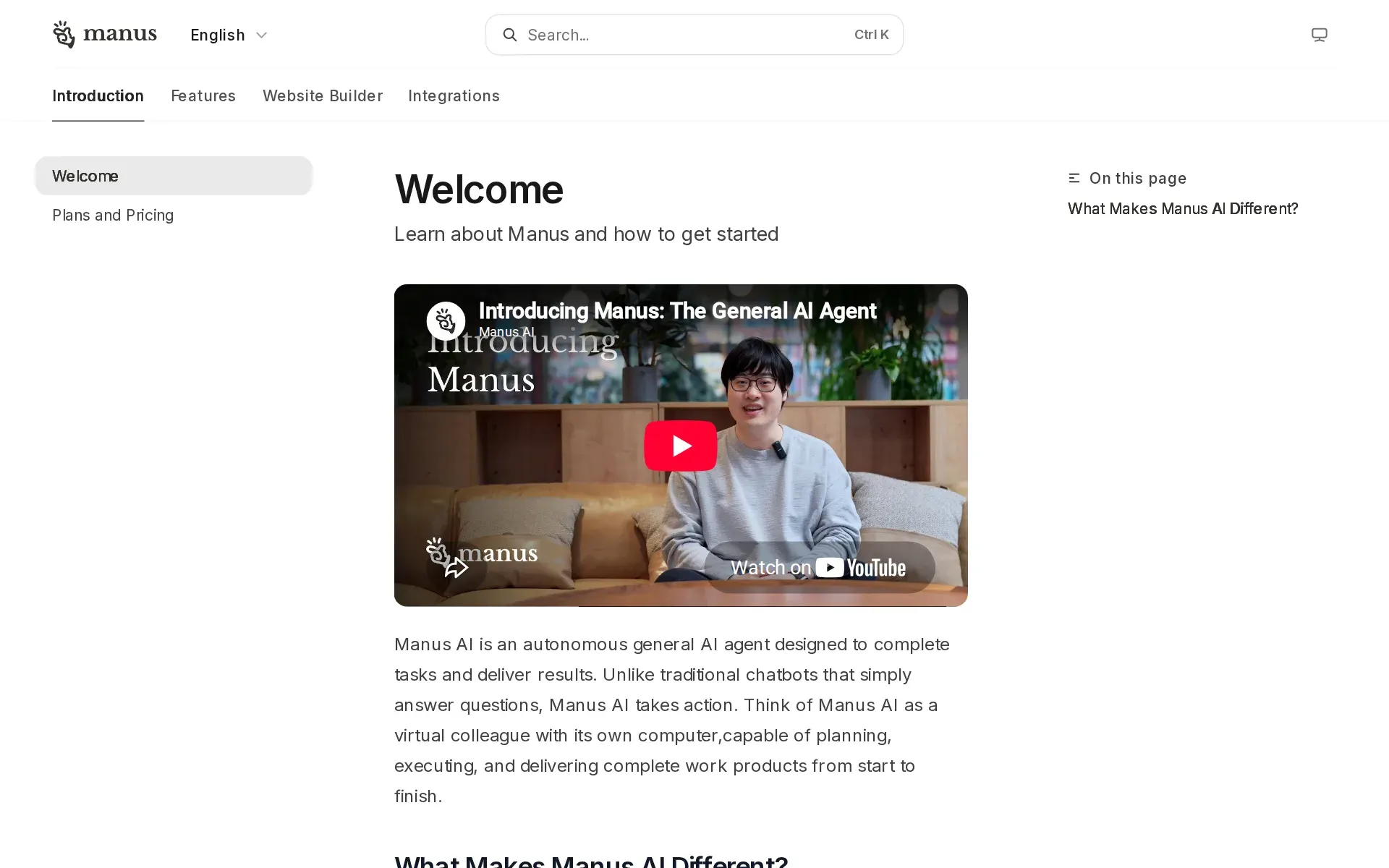
Manus AI is an autonomous general AI agent designed to complete tasks and deliver results.
manus.im/docs/introduction/welcome
How much it does unattended
- Runs autonomously
- YesRuns a task through to a finished deliverable without step-by-step supervision, and paid plans allow 20 concurrent and 20 scheduled tasks running unattended.
This means Manus AI can work independently, remember context across long tasks, and deliver production-ready results without you managing every…
manus.im/docs/introduction/welcome - Multi-agent
- YesWide Research decomposes one request into independent sub-tasks and runs many agents in parallel, each with its own context, then a main agent synthesises the results.
Instead of using a single AI agent that processes items sequentially, Wide Research deploys hundreds of independent agents that work in parallel.
manus.im/docs/features/wide-research - Agent permissions
- PartlyIt pauses for approval on sensitive actions (local commands, deploys, sending Gmail or Outlook mail, calendar writes), but each prompt offers Always Allow or global_allow, which switches that class off for good.
Every command that Manus attempts to execute on your local machine requires your explicit approval.
manus.im/docs/features/desktop
Which models it runs on
- Claude
- PartlyClaude is selectable only for LLM features inside apps Manus builds for you; you cannot choose it for the Manus agent itself, and Anthropic is not among the disclosed foundational-model subprocessors.
LLM-powered features can run on any of ten models across three providers: OpenAI (GPT-5), Anthropic (Claude), and Google (Gemini).
manus.im/docs/website-builder/ai-capabi… - GPT
- PartlyOpenAI is a disclosed foundational-model subprocessor for Manus itself, and GPT is nameable for LLM features in generated apps, but the agent's model is never user-selectable.
OpenAI United States Foundational models
trust.manus.im/subprocessors - Open models
- NoThe disclosed subprocessor list names only Google Cloud Platform and OpenAI as foundational-model providers; no open-weight model is named anywhere as running Manus.
Google Cloud Platform United States Cloud infrastructure and foundational models
trust.manus.im/subprocessors - Model choice
- PartlyThe platform is deliberately model-agnostic but the vendor does the choosing; users only pick between Manus's own tiers, and the Lite tier is all a free account gets.Was No before our last check.
Being LLM-agnostic, Manus selects the right model for each use case so users don't have to.
trust.manus.im
Where you use it
- In your editor
- PartlyThere is a VS Code instance inside Manus's own cloud computer that you can take over mid-task, and GitHub sync lets you work in your own editor, but the pages read document no plug-in for your IDE.Was No before our last check.
the user can take control of Manus's computer, operating the browser or VS Code to help Manus overcome certain challenges in the tasks
help.manus.im/en/articles/11711218-how-… - On the command line
- PartlyThrough the desktop app the agent drives your machine's command line and the API exposes terminalExecute confirmations, but no Manus CLI client you type commands into is documented.Was No before our last check.
Manus can use any tool that is accessible from your computer's command line (CLI).
manus.im/docs/features/desktop - In your pipeline
- PartlyThe GitHub connector lets it open and close pull requests and issues and keeps main in two-way sync, but no CI runner, GitHub Action or pipeline trigger is documented on the pages read.Was No before our last check.
Work with Pull Requests: Create, view, edit, and close pull requests.
manus.im/docs/website-builder/github-in… - In a browser
- YesThe hosted web app is the primary surface and the place connectors are authorised; the same account also has macOS and Windows desktop apps and a mobile app.
Before using a connector via the API, authorize it in the Manus web app
open.manus.ai/docs/v2/connectors
Whose machine it runs on
- Self-hosted
- NoThe agent runs on Manus-operated cloud machines (the Trust Center lists Google Cloud, AWS and Azure as its infrastructure), and no published plan offers a customer-hosted deployment; only the desktop app touches your own hardware.
It operates in a complete sandbox environment—a virtual computer with internet access, a persistent file system, and the ability to install software…
manus.im/docs/introduction/welcome
What it costs to run
- How it meters
- YesBilling is per credit, burned by LLM tokens, cloud VM time and third-party API calls, on top of a per-month plan or a per-seat Team price; hosting a built site is metered separately.
The specific credits consumption for a task is determined by its complexity and duration.
help.manus.im/en/articles/11711097-what… - Free tier
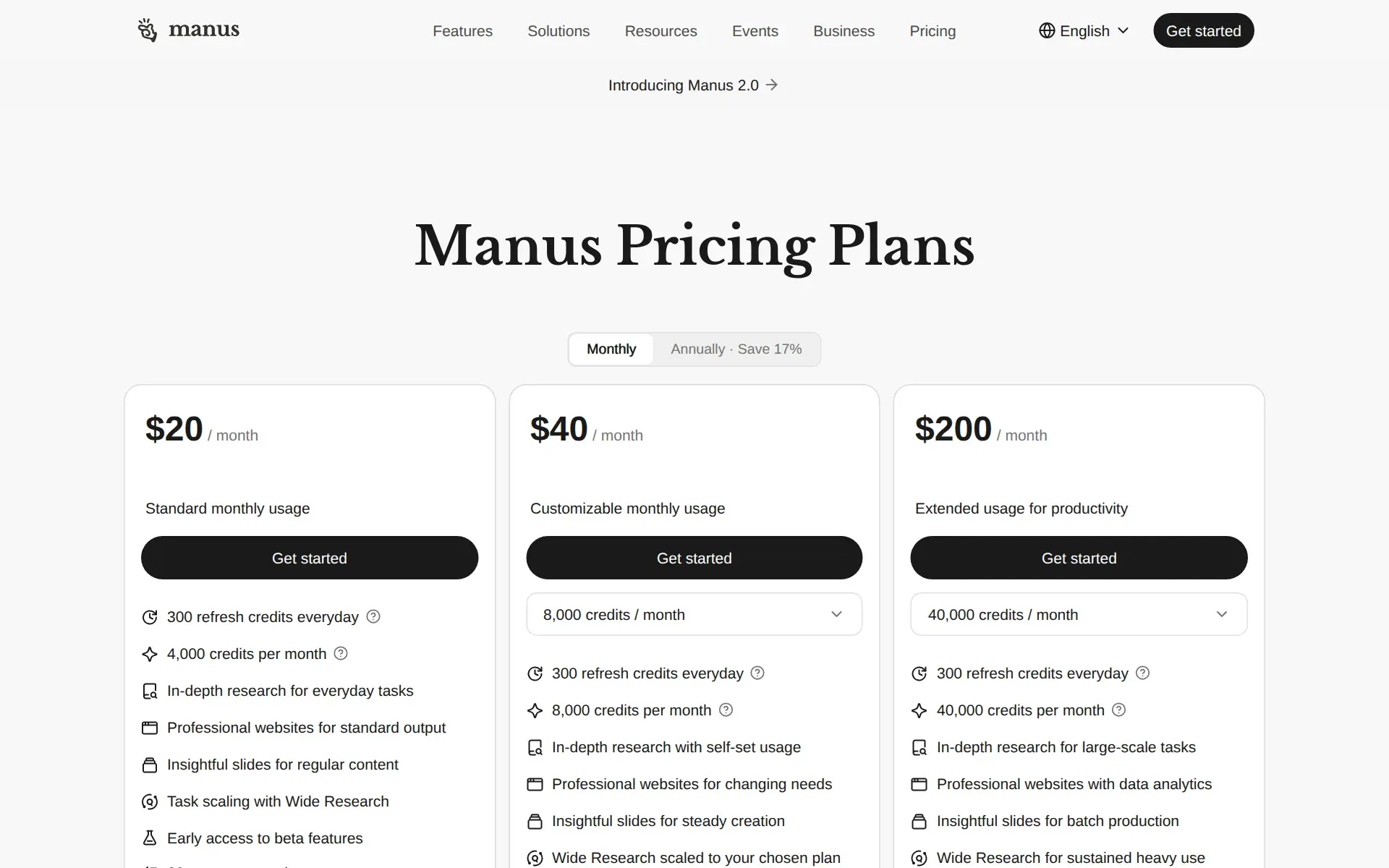
- YesA standing $0 plan exists with 300 daily refresh credits, one concurrent task and two scheduled tasks, limited to the Lite model; it is not shown on the pricing page itself.
Free Plan Price: $0/month
help.manus.im/en/articles/11711111-what… - API access
- YesA documented REST API with API keys or OAuth2 creates and polls tasks, uploads files, manages projects, skills, agents and webhooks; per-user rate limits apply and v1 is deprecated.
The Manus API allows you to programmatically create and manage AI agent tasks.
open.manus.ai/docs/v2/introduction - MCP server
- PartlyManus is an MCP client (prebuilt MCP connectors on every plan plus your own custom MCP servers), but no Manus-hosted MCP server another agent could query is documented; the REST API is the way in.
Manus includes several prebuilt MCP servers on all plans.
manus.im/docs/integrations/mcp-connecto… - Bring your own key
- PartlyYou supply your own third-party keys for connectors and for apps Manus builds, and it stores them server-side, but there is no documented way to point the agent's own inference at your keys or cloud.Was No before our last check.
Manus will store the API key as an environment variable on the server and will not expose it in the client-side code.
manus.im/docs/website-builder/third-par…
Buying it for a team
- A company can buy it
- YesA Team plan sells to an organisation with unified billing that tracks headcount, seats can be added or removed at any time, and enterprise buyers get a sales contact.
You can invite members to your team anytime. Your bill adjusts at the next billing cycle to match your team size.
manus.im/team - Seat model
- YesTeam is priced per seat (US$20 a month or US$200 per seat a year), with each seat adding 4,000 credits to the pool; no seat floor or ceiling is published on the pages read.
Team Plan Price: Starting from $20 per seat/month (Enjoy a 17% discount with annual billing)
help.manus.im/en/articles/11711111-what… - Pooled budget
- YesTeam seats share one credit balance rather than each holding its own, so heavy users draw on what lighter colleagues leave unspent before add-on credits are needed.
Each billed user adds credits to your team's shared pool. This eliminates waste and maximizes your subscription value.
manus.im/team - Admin controls
- PartlyTeam owners and super admins get an admin dashboard with access control and, once SSO is on, a security policy choosing how members may join; no published control constrains what the agent itself may do.
Admin dashboard with usage tracking and access control
manus.im/team - Audit log
- PartlyAudit logs are listed as a Team plan feature alongside the compliance claims; nothing on the pages read says individual and Pro accounts get them, or what events are recorded.
Audit logs and enterprise-grade compliance (SOC 2 Type II, ISO 27001)
manus.im/team - Single sign-on
- PartlySSO is a Team-plan subscription that only owners and super admins can enable, with a verified domain and the identity provider configured through WorkOS; the pages read never name SAML or OIDC.
click on the “Manage in WorkOS” button to configure your SSO with your chosen third-party Identity Provider
help.manus.im/en/articles/12807937-wher…
What happens to your code
- Opt out of training
- PartlyThe Trust Center states contracts bar every third-party model provider from training on your data, but the Team FAQ frames that prohibition around Team and Enterprise customers and the help centre lists Data Training Opt-Out as a Team feature.
We maintain formal agreements with all third-party model providers to ensure they do not use your data for training their models.
trust.manus.im - Data residency
- PartlyStorage locations are disclosed as the US and Singapore with SCCs covering transfers, and the company is headquartered in Singapore, but no page read offers a customer-selectable region.
For international transfers, we use EU Standard Contractual Clauses (SCCs) and other appropriate safeguards to ensure adequate protection.
trust.manus.im - Getting out
- PartlyCode for anything it builds can be downloaded whole or exported to your own GitHub repo, but credits are the opposite: unused plan credits are wiped each cycle and reset to zero when a subscription ends.
Manus does not allow unused credits to roll over to the next cycle. At the start of each new cycle, all unused credits are cleared and replaced with…
help.manus.im/en/articles/11711097-what… - Certifications
- YesThe Trust Center publishes SOC 2 Type I and Type II attestations plus ISO 27001 and ISO 27701 certificates for download, and the privacy policy addresses EU and UK GDPR roles.
We are SOC 2 compliant. We do not train models on your data.
manus.im/team
Plans and pricing
Price and terms
- Free trial
- Yes7 days
Checked .
The Agents Index digest
Price changes and new agents like Manus, at most once a week.
Last issue: Devin vs Claude Code: Which Should You Pick? · 13 October 2026
Works with
 Claude
Website builder — LLM features in generated apps
 GPT
GPTPartly
For AI agents
- MCP server
- Partly
- API
- Yes
Screenshots
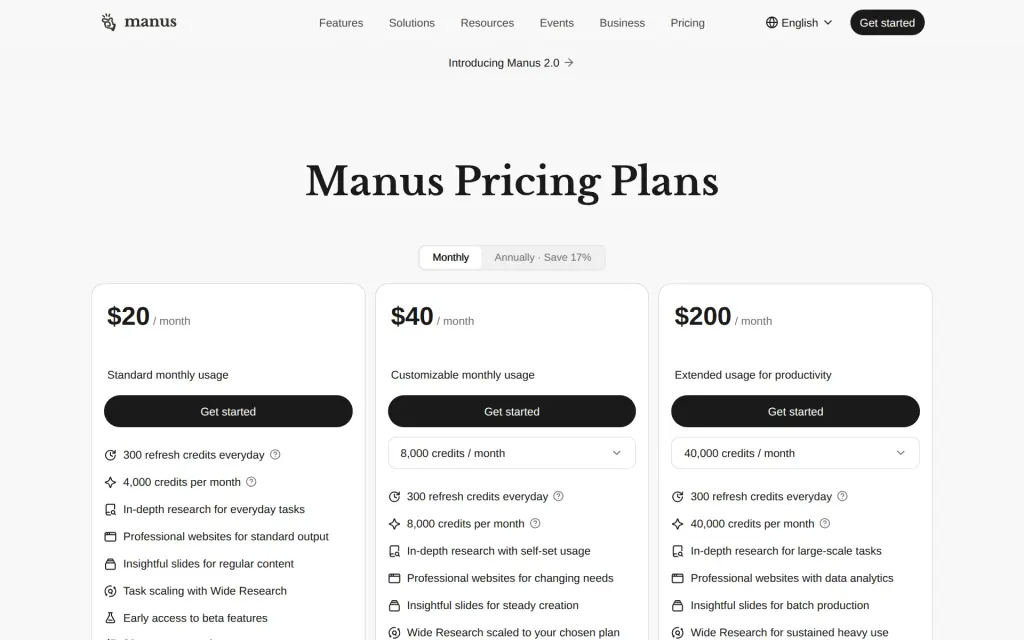
Pricing page, manus.im, captured 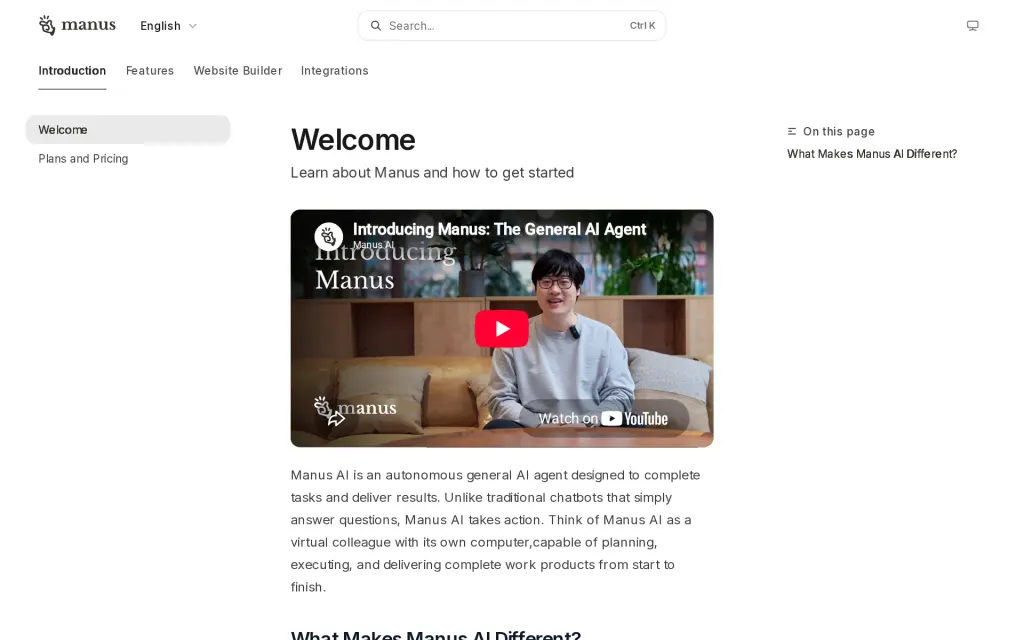
Docs, manus.im, captured
Filed under
Sources and updates
Last changed
Sources36
- manus.im/team
- trust.manus.im/faq
- help.manus.im/en/articles/11711111-what-is-the-current-membership-pricing-for-manus
- trust.manus.im/
- manus.im/docs/introduction/welcome
- manus.im/docs/website-builder/ai-capabilities
- manus.im/download
- help.manus.im/en/articles/11711097-what-are-the-rules-for-credits-consumption-and-how-can-i-obtain-them
- manus.im/compare/manus-vs-replit
- manus.im/docs/features/desktop
- manus.im/docs/website-builder/github-integration
- help.manus.im/en/articles/12807937-where-can-i-enable-subscribe-to-a-single-sign-on-sso-subscription-for-manus-team
- manus.im/privacy
- trust.manus.im/subprocessors
- manus.im/blog/manus-1.5-release
- manus.im/docs/features/wide-research
- manus.im/docs/integrations/custom-mcp
- manus.im/docs/integrations/data-sources
- manus.im/docs/integrations/manus-api
- manus.im/docs/integrations/mcp-connectors
- open.manus.ai/docs/v2/authentication
- open.manus.ai/docs/v2/connectors
- open.manus.ai/docs/v2/introduction
- open.manus.ai/docs/v2/rate-limits
- open.manus.ai/docs/v2/task-lifecycle
- manus.im/docs/website-builder/cloud-infrastructure
- manus.im/docs/website-builder/code-control
- manus.im/docs/website-builder/third-party-integrations
- help.manus.im/en/articles/11711218-how-can-i-take-over-manus-browser-or-vs-code
- help.manus.im/en/articles/11711750-what-is-manus-team-plan
- help.manus.im/en/articles/12697595-what-is-the-current-single-sign-on-sso-subscription-pricing-for-manus-team
- help.manus.im/en/articles/13644620-manus-compliance-apis
- manus.im/features/webapp
- manus.im/features/wide-research
- manus.im/help/credits
- manus.im/pricing
Coverage elsewhere4
The Agents Index in AI answers0 of 1
- PerplexityDoes not cite The Agents IndexAsked
Manus alternatives
on Other sources: alternativeto.net, g2.com, hostinger.com, moda.app, openalternative.co, vellum.ai
Updates6
- Free tier · Plan limits
- Capabilities · Free tier · Terms
- Capabilities · Free tier · Terms
- Capabilities · Free tier · Price · Terms
- Alternatives · Summary
- Summary
Is this yours? Claim it free and edit it in your dashboard, or feature it in Research & data agents.