
Summary
Genspark is a hosted AI workspace where agents research, write, build slides, docs, sheets, images, video and code from one prompt. Its Super Agent, GenTeam and Claw products add multi-agent channels, scheduled tasks and a dedicated cloud computer that keeps working unattended.
- Best for
- A consultant, marketer, founder or operations lead who wants research, files, code, slides and media handled in one web workspace.
- Not for
- Buyers who need a conventional REST API, predictable usage billing, or a narrow research workflow without persistent memory.
- From
- Freethen $30/month
- Free tier
- YesFree plan receives 100 credits per day automatically on a rolling one-month window, with Super Agent file uploads up to 500 MB; the zero-credit unlimited chat and image models, 50 GB+ drive storage and commercial-use rights belong to the paid Plus, Pro and Team plans.
What it does
- Writes code
- YesGenspark Code is pitched as a full autonomous coding agent that turns a plain-language brief into a working application, aimed at people who do not code themselves.
Genspark Code (formerly AI Developer) is a L4 autonomous AI coding agent that enables everyone to build complete applications without coding skills.
genspark.ai/helpcenter/ai-developer - Debugs and fixes
- PartlyThe vendor claims the agent iterates through its own plan-code-test loop and can start a project from existing code, but no page documents diagnosing and fixing a defect in a repository you bring.
it marks the leap to L4 full autonomy, where AI independently plans, codes, tests, and deploys.
genspark.ai/helpcenter/ai-developer - Writes tests
- PartlyTesting is named as a step the agent performs on what it builds; nothing on the site says it authors a test suite or runs your project's existing tests.
it marks the leap to L4 full autonomy, where AI independently plans, codes, tests, and deploys.
genspark.ai/helpcenter/ai-developer - Reviews code
- PartlyReviewing pull requests appears only as one capability of Claw's GitHub session once you connect the account; there is no dedicated diff-review surface, inline comment flow or review report documented.
Once connected, Claw keeps the session active and can read and send emails, manage calendar events, review PRs, and more — without you opening the…
genspark.ai/helpcenter/genspark-claw - Whole-codebase work
- PartlyGenspark Code lists 'Existing code' as one of five project categories, and GenTeam local agents can be pointed at a repository directory, but repo-wide migration scale is never described.
Genspark Code builds in the five categories Web, Mobile Apps, Game, E-commerce, and Existing code.
genspark.ai/helpcenter/ai-developer - Ships it
- YesDeployment is claimed as the last step of the agent's own loop, so it goes past producing a diff; Claw can additionally host a site on its cloud computer.
it marks the leap to L4 full autonomy, where AI independently plans, codes, tests, and deploys.
genspark.ai/helpcenter/ai-developer - Done-for-you service
- NoGenspark sells software a buyer runs: Team is bought and provisioned self-serve, and Enterprise adds a CSM and implementation team for onboarding rather than building or operating agents for you.
Team is self-serve and built for groups of 2–150 people that want to start collaborating right away.
genspark.ai/helpcenter/team-enterprise-…
How much it does unattended
- Runs autonomously
- YesSuper Agent is described as running multi-step work to completion unattended, and Claw adds scheduled tasks plus a Heartbeat that acts without you starting a conversation.
Sharper on long-running tasks. It reasons through every step without losing the thread. Start it, close your laptop, and come back to finished work.
genspark.ai/helpcenter/super-agent - Multi-agent
- YesGenTeam puts several named agents in shared channels with humans, agents claim tasks and hand results to each other, and Custom Agents can be combined inside one Super Agent conversation.
GenTeam is Genspark's multi-agent workspace where you chat with your team and their AI agents side by side.
genspark.ai/helpcenter/genteam - Agent permissions
- PartlyControls exist but the vendor states their limits plainly: the local workspace folder is guidance rather than a boundary, while Claw DMs default to approved contacts and AgentBase advises draft-only sending.
Note that this is a soft guidance, not a hard boundary: Claw may still access files outside the folder if the task requires it.
genspark.ai/helpcenter/genspark-claw
Which models it runs on
- Claude
- YesAnthropic models are offered as the frontier option in AI Slides Ultra mode, and the Team plan card lists a Claude model in its zero-credit chat lineup.
Ultra mode — keeps offering frontier models (top-tier models from other labs) such as Claude Opus 5
genspark.ai/helpcenter/gen-one-model - GPT
- YesOpenAI models are named in the vendor's own model-partner claim on the business page, and GPT image and Sora video models appear in plan and troubleshooting material.
70+ AI models including ChatGPT, Claude, and Gemini.
genspark.ai/business - Open models
- YesThe vendor confirms it serves open-weight models itself on US inference platforms, and its own Gen-1 slide model is post-trained from an open-weight base.
Several of the models Genspark offers are open-source, including DeepSeek, Kimi, GLM, MiniMax, and Qwen.
genspark.ai/helpcenter/troubleshooting-… - Model choice
- PartlyOnly a named subset of products exposes a by-name model picker; everywhere else you choose a Standard or Ultra quality tier and Genspark decides which model actually runs.
A smaller set of products expose the full model list so you can choose exactly what you want — including lower-cost, standard, and high-end options…
genspark.ai/helpcenter/credits-guide
Where you use it
- On the command line
- PartlyClaw exposes a browser terminal on its cloud machine and GenTeam is joined by pasting a connect command into a terminal, but Genspark ships no command-line client that drives its agents.
The Terminal tab gives you direct command-line access to your cloud computer in the browser.
genspark.ai/helpcenter/genspark-claw - In your pipeline
- PartlyClaw connects GitHub under Developer Tools and can act on pull requests via a saved session; no CI runner, webhook or PR-triggered automation is documented.
Once connected, Claw keeps the session active and can read and send emails, manage calendar events, review PRs, and more — without you opening the…
genspark.ai/helpcenter/genspark-claw - In a browser
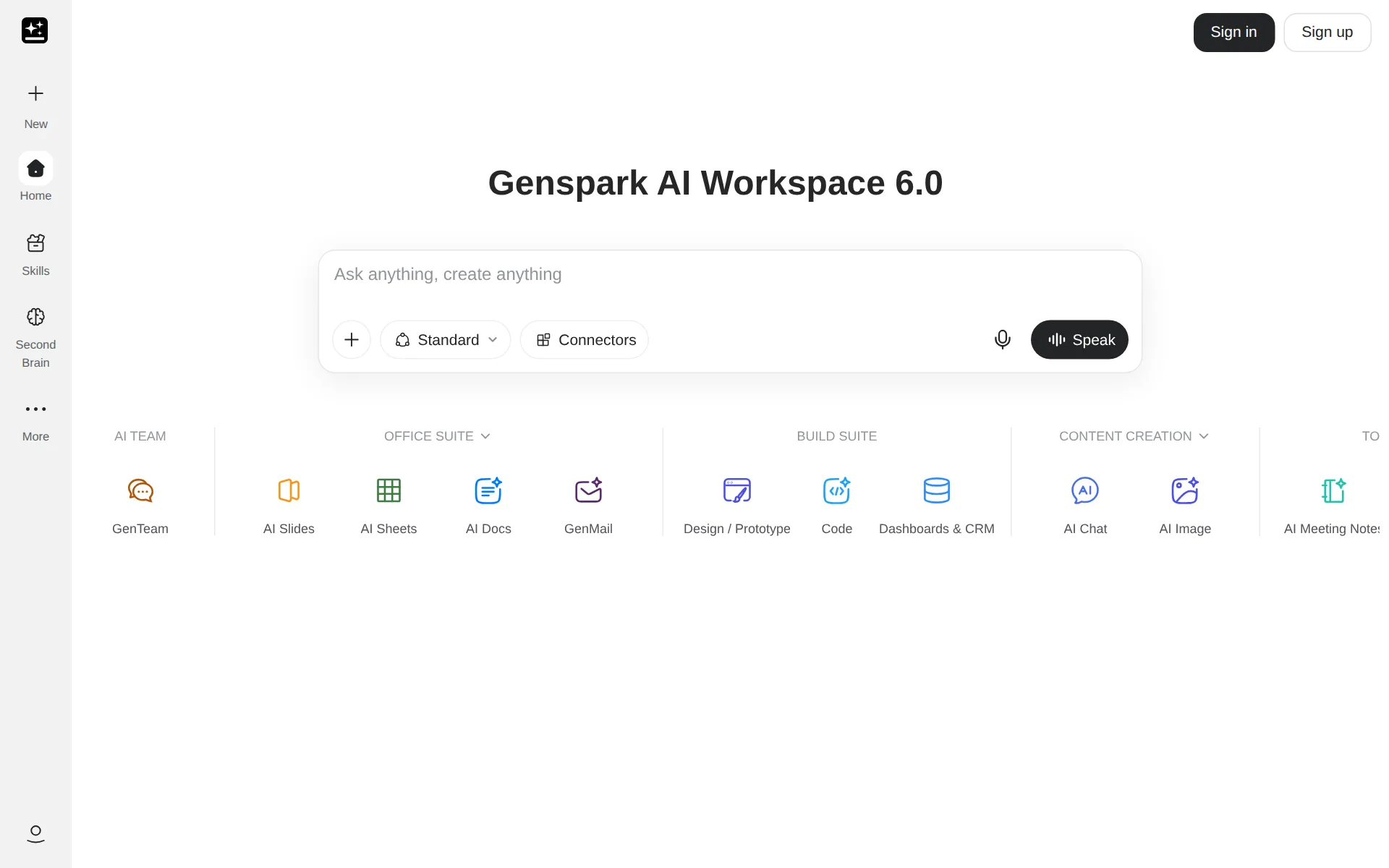
- YesThe product is a hosted web workspace entered from the homepage chat box, with a project sidebar, canvases and drives all running in the browser.
Navigate to the Genspark homepage and enter your prompt in the central chat box, or select Super Agent from the "New" menu in the sidebar.
genspark.ai/helpcenter/super-agent
Not established: In your editor
Whose machine it runs on
- Self-hosted
- PartlyClaw can run on your own Mac or Windows machine and GenTeam agents can run on a computer you connect, but the workspace, accounts and everything else stay on Genspark's cloud.
Flexible deployment — Run Claw on a cloud computer (always on, 24/7) or locally via the desktop app (no subscription required, uses your own machine)
genspark.ai/helpcenter/genspark-claw - Open source
- PartlyGenOffice, the companion desktop office suite, is open source on GitHub; the Genspark platform is proprietary, and the Team/Enterprise terms state Genspark retains all service and software IP.
Open-sourcing GenOffice, the world's first full-featured open-source AI Office for PC and Mac. GenOffice is free for everyone, ad-free.
genspark.ai/blog/genoffice-open-source-…
What it costs to run
- How it meters
- YesConsumption is metered in credits that scale with model tier, output length and task complexity, layered on a $30 per-seat monthly charge on Team and a separate flat Cloud Computer fee for Claw.
Credits measure computational effort. Every time you generate something — text, an image, a video, or audio — you use credits based on the processing…
genspark.ai/helpcenter/credits-guide - Free tier
- YesA standing free plan grants a daily credit allowance with no card or sales call, and free users can still upload large files to Super Agent.
100 credits/day, automatically. Free users see a rolling one-month window, not a fixed refresh date.
genspark.ai/helpcenter/credits-guide - API access
- PartlyTeam members can create API keys that admins see and revoke, but Genspark publishes no API reference, and API access to its own model is arranged by emailing a partner address.
API Keys — View and revoke API keys created by team members
genspark.ai/helpcenter/team-enterprise-… - Bring your own key
- PartlyAgents you host on your own computer run on your hardware with your own model access and spend no Genspark credits, but cloud agents give no option to supply your own provider keys.
Agents running on your own computer (and any Genspark Claw / OpenClaw agents connected earlier) use your own hardware and your own model access…
genspark.ai/helpcenter/genteam
Not established: MCP server
Buying it for a team
- A company can buy it
- YesTwo group tiers exist above personal plans, both bought by the organisation with one subscription, centralised billing, seat management and admin controls.
Team and Enterprise are Genspark's two group subscription tiers — they let an entire organization use Genspark together under a single subscription,…
genspark.ai/helpcenter/team-enterprise-… - Seat model
- YesTeam is charged per seat at $30 a month with a floor of two seats and a ceiling of 150; above that the vendor requires the contracted Enterprise tier.
Pick the number of seats you need (minimum 2, up to 150) — the displayed monthly cost updates automatically
genspark.ai/helpcenter/team-enterprise-… - Pooled budget
- NoEach seat gets its own monthly credit balance that cannot be transferred between members; the workaround is admin-purchased credit packs, and only Enterprise can negotiate a shared pool.
By default, no — each seat receives its own monthly credit allocation (12,000 on Team, 25,000 on Enterprise) for that individual member. Credits…
genspark.ai/helpcenter/team-enterprise-… - Admin controls
- PartlyTeam admins can only govern connectors and roles org-wide, while restricting which agents and models a member may use is an Enterprise capability negotiated in the Order Form.
Agent-level permissions — Admins can restrict members from using specific features
genspark.ai/helpcenter/team-enterprise-… - Audit log
- PartlyTeam admins see only per-seat credit usage and seat changes; exportable usage logs and login history for security investigation are unlocked on Enterprise.
Login History — Under User analytics → Login History, review when and from where members signed in, for security audit and incident investigation
genspark.ai/helpcenter/team-enterprise-… - Single sign-on
- YesSAML 2.0 single sign-on is configurable on both group plans with the major identity providers, and admins may force SSO as the only login method for their domain.
In Identity & provisioning, configure SAML 2.0 single sign-on so members can log in through your company's identity provider.
genspark.ai/helpcenter/team-enterprise-…
What happens to your code
- Opt out of training
- PartlyGroup plans are opted out of model training automatically with no-training terms bound onto subprocessors, but no equivalent blanket statement covers Free, Plus or Pro accounts.
No training on your data — Accounts are automatically opted out of model training.
genspark.ai/helpcenter/team-enterprise-… - Data residency
- PartlyEveryone on the self-serve path is hosted in the United States; choosing EU or APAC residency, or a dedicated VPC, requires an Enterprise Order Form.
Team Plan data is hosted in the US (US-West) by default. Enterprise offers configurable data residency in the US, EU, or APAC, defined in your Order…
genspark.ai/helpcenter/team-enterprise-… - Getting out
- PartlyFiles can be downloaded or exported from AI Drive without spending credits and personal data is portable on request, yet credits expire every cycle and unused ones are forfeited on downgrade or cancellation.
Credits reset each billing period. Separately purchased top-up credits are valid for 3 months and carry across cycles.
genspark.ai/helpcenter/credits-guide - Certifications
- PartlySOC 2 Type II and ISO 27001 certifications are claimed with a public trust portal, but GDPR is listed as a programme in progress and a DPA is not offered on the Team plan.
Compliance — SOC 2 Type II certified and ISO 27001:2022 certified.
genspark.ai/helpcenter/team-enterprise-…
33 sourced claims on this page. Checked 2026-09-15. How we check.
Alternatives
Where we would send a reader instead, in that listing's own words.
General-purpose AI agent that plans and executes tasks in its own cloud computer.
AI answer engine with an agentic Computer, the Comet browser, and a developer API for web-grounded search.
Research agent that searches 138M+ papers and runs systematic reviews with sentence-level citations.
AI literature research agent that searches, reads and cites the scientific record.
Pay-as-you-go web research agent: set a dollar budget, get cited reports, datasets and claim traces.
Filed under
Sources and updates
Pages we read on genspark.ai16
Every fact below comes from the vendor. Nothing here is independently corroborated yet.
- /helpcenter/team-enterprise-plans12 fields
- /helpcenter/ai-developer5 fields
- /helpcenter/genspark-claw5 fields
- /helpcenter/credits-guide4 fields
- /team_pricing4 fields
- /helpcenter/super-agent3 fields
- /business2 fields
- /helpcenter/genteam2 fields
- /tools/ai-website-builder2 fields
- /blog/genoffice-open-source-ai-office1 field
- /blog/genspark-ai-developer1 field
- /blog/genspark-multiagent-orchestration1 field
- /code1 field
- /helpcenter/gen-one-model1 field
- /helpcenter/genterminal1 field
- /helpcenter/troubleshooting-guide1 field
Coverage elsewhere3
Updates5
- Capabilities · Commercial terms · Free tier
- Capabilities · Commercial terms · Free tier
- Capabilities · Commercial terms · Free tier · Price
- Alternatives · Documentation link · One-liner · Summary
- Summary