
Dust in our research
What we checked on Dust
Writes code
Agents author React components (Frames) and run code in a sandbox to produce files, but Dust documents no repository-level code authoring or commits.
A Frame is an interactive file (a React component generated by an agent) that can be stored in the Pod's Files tab.
Debugs and fixes
The engineering page claims debugging support by surfacing code context, docs and recent issues in the IDE, which stops short of diagnosing and landing a fix itself.
Streamline debugging within your IDE by surfacing relevant code context, documentation, and recent issues.
Reviews code
GitHub tools let agents review pull requests against internal coding rules, and the engineering page presents automated code review as a supported use case.
GitHub tools let your agents work with GitHub issues and pull requests. Use them to build agents that file issues when needed, or that review PRs…
Whole-codebase work
It can ingest a repository's default-branch code for search, refreshed every eight hours, but no documented ability to carry a change across that repository.
Code Synchronization: Repository code from the default branch
Done-for-you service
Dust sells software a buyer configures, self-serve for Business or sales-assisted for Enterprise; Enterprise adds a dedicated CSM and onboarding, not a team that builds agents for you.
Choose self-serve plan for your team, or talk to us about enterprise-ready deployment, governance, and support
dust.tt/home/pricingChecked
Runs autonomously
Agents run unattended on schedules and event triggers, but a root task started from the web app or extension pauses for human confirmation once it reaches 600 credits of AI spend.
Dust pauses a root task started from the web app or browser extension when its cumulative AI spend reaches 600 AWU credits.
Multi-agent
Multi-agent orchestration with scheduled and event-driven triggers is listed for both Business and Enterprise, and sub-agent credit costs accumulate across an agent chain.
Multi-agent orchestration & triggers (scheduled + event-driven)
dust.tt/home/pricingChecked
Agent permissions
Admins separate what agents may access from who may use them, can restrict tools to skills, and the credit checkpoint asks a human before a long task continues; granular per-action approval policy is not published.
Dust's dual-layer permission model separates what agents can access from who can use them. SCIM-synced groups, admin-gated overrides, zero privilege…
dust.ttChecked
Claude
Claude is named in the plan feature list of frontier models, and the admin model tier tables list several Claude models across Basic through Ultra tiers.
20+ frontier models — GPT, Claude, Gemini, Mistral, DeepSeek
dust.tt/home/pricingChecked
GPT
GPT is named in the Business plan model bullet, and the model access tier tables list GPT variants in every tier including Ultra.
On the page: Business plan card, first feature bullet
dust.tt/home/pricingChecked
Open models
The homepage states agents can be built with open-source models, and the model tier tables list Mistral, DeepSeek, GLM and Kimi options served through Fireworks.
Build agents with 20+ frontier and open-source models from OpenAI, Anthropic, Google, Mistral, and more.
dust.ttChecked
Model choice
The buyer picks the model per agent and nothing is gated behind a higher plan, though admins may cap which model tiers members can select and costlier models burn more credits.
All plans include access to 20+ models from OpenAI, Anthropic, Google, Mistral, and DeepSeek. You choose the model per agent. No model is locked…
dust.tt/home/pricingChecked
In your editor
There is no native IDE plugin documented; instead Dust exposes the workspace as a remote MCP server that IDEs and assistants can call, plus a browser and Raycast extension.
This lets tools such as IDEs and AI assistants call Dust to search workspace knowledge, work with conversations, and access files or Pods through the…
On the command line
A published npm CLI opens an interactive terminal chat with filesystem access, and takes single non-interactive messages that return JSON on stdout.
When no command is provided, the chat command runs by default, opening an interactive chat with @Dust with access to your local filesystem.
In your pipeline
Agents can be triggered by webhooks carrying GitHub, Jira or Slack events and can act on pull requests, but no first-party CI runner or pipeline step is documented.
Build webhook endpoints to trigger agents from any external system. Receive events from GitHub, Jira, Slack, or your own services with full company…
In a browser
Dust is a hosted web application with collaborative workspaces, conversations and Frames dashboards, and the pricing page sells it as self-serve from the browser.
Team collaboration workspaces
dust.tt/home/pricingChecked
Self-hosted
The isolation option Dust sells is a dedicated single-tenant deployment it runs on Enterprise; the MIT-licensed source exists but no self-hosting guide is published.
On the page: Compare plans table, Security & admin section, Single-tenant deployment row
dust.tt/home/pricingChecked
Open source
The product's own source repository is public under the MIT licence and is linked from the Developers column of every page footer.
MIT License
github.com/dust-tt/dustChecked
How it meters
Billing is per seat with a monthly credit allowance per seat type, and non-human usage is metered separately at a published per-credit rate on Business.
Programmatic usage rate
dust.tt/home/pricingChecked
Free credit
$5 of free usage (500 credits at $0.01 each), once, at signup.
Free: 0€, 500 credits lifetime. Best for occasional users or people trying Dust.
dust.tt/home/pricingChecked
Free tier
A Free seat type costs nothing and carries a one-time 500-credit lifetime allocation, so a buyer can start without a sales call but cannot run indefinitely.
Free seat | 500 credits (one-time lifetime allocation)
API access
Business plans get the Conversation API only; the Data Source API is added on Enterprise, and both sit on top of a documented REST platform with a JavaScript SDK.
On the page: Compare plans table, Developer tools group, "Developer API" row, Business column
dust.tt/home/pricingChecked
MCP server
Dust publishes a remote MCP server per region so another agent can query workspace knowledge, conversations and files over OAuth, with admins able to disable it.
Dust can expose your workspace as a remote MCP Server, so compatible MCP clients can use Dust where you already work.
A company can buy it
The self-serve Business plan is sold to teams of up to 100 people with workspace seat administration, and Enterprise is purchased through sales with custom MSA and DPA terms.
For teams up to 100 people
dust.tt/home/pricingChecked
Seat model
Three seat types are priced per seat per month and can be mixed and reassigned within one workspace; no seat minimum is published, though SSO on Business is noted at 5+ seats.
You can mix and match seat types across your workspace and reassign them anytime as usage changes.
dust.tt/home/pricingChecked
Pooled budget
Each paid seat has its own monthly credits first; a shared workspace pool exists but needs admin-purchased top-ups on Business and is contract-funded on Enterprise, and Free seats cannot touch it.
The workspace credit pool is a shared credit reserve that Pro and Max seat members can draw from once their individual credits are exhausted.
Admin controls
Admins cap which models and reasoning efforts members may select at workspace, group or member level, set personal and programmatic spend limits, and restrict tools to named skills.
As an administrator, you can cap how far up the model list each member can go.
Audit log
A tamper-evident log distinguishing human from agent actions exists with CSV export and SIEM streaming, but the docs restrict it to the Enterprise plan.
Enterprise feature. Audit Logs are only available to workspaces on the Enterprise plan.
Single sign-on
SAML single sign-on with Okta, Entra ID and Jumpcloud is supported and can be enforced workspace-wide, but on Business it is noted as 5+ seats on demand and OIDC is not mentioned.
SSO (Okta, Entra ID, Jumpcloud)
dust.tt/home/pricingChecked
Opt out of training
The security page states customer data is never used for model training and that third-party providers retain nothing, so there is no opt-out to find because training is excluded by default.
No Model Training Your data is never used to train models.
dust.tt/home/securityChecked
Data residency
Data can be hosted in either the United States or the European Union, and the comparison table shows US/EU residency on both Business and Enterprise with single-tenant reserved for Enterprise.
Regional Hosting Host in the EU or US to meet your regulatory needs.
dust.tt/home/securityChecked
Getting out
Analytics, audit logs and agent configurations can be exported via API or CSV, but credits are explicitly non-transferable, non-rolling and non-refundable, so unused balance is lost each period.
Credits are not transferable between users, do not roll over to the next billing period, and are not refundable.
Certifications
Dust states GDPR compliance and SOC 2 Type II certification, says it enables HIPAA compliance, and publishes a Trust Center; ISO 27001 is not claimed on the page read.
GDPR Compliant & SOC2 Type II Certified. Enables HIPAA compliance.
dust.tt/home/securityChecked
Dust price and terms
Terms
- Free plan
- YesYesA standing Free seat type at 0€ within the Business plan, carrying 500 credits on a lifetime (not monthly) basis
The terms in full
the pricing FAQ says free users who run out are "prompted to request an upgrade". Free seats are capped to the Business plan's own limits: up to 3 connectors, 5 Spaces, 5 remote MCP servers.
What needs a higher plan
- Enterprise
- Self-hosted, Audit log
For AI agents
- MCP server
- Yes
- API
- Partly
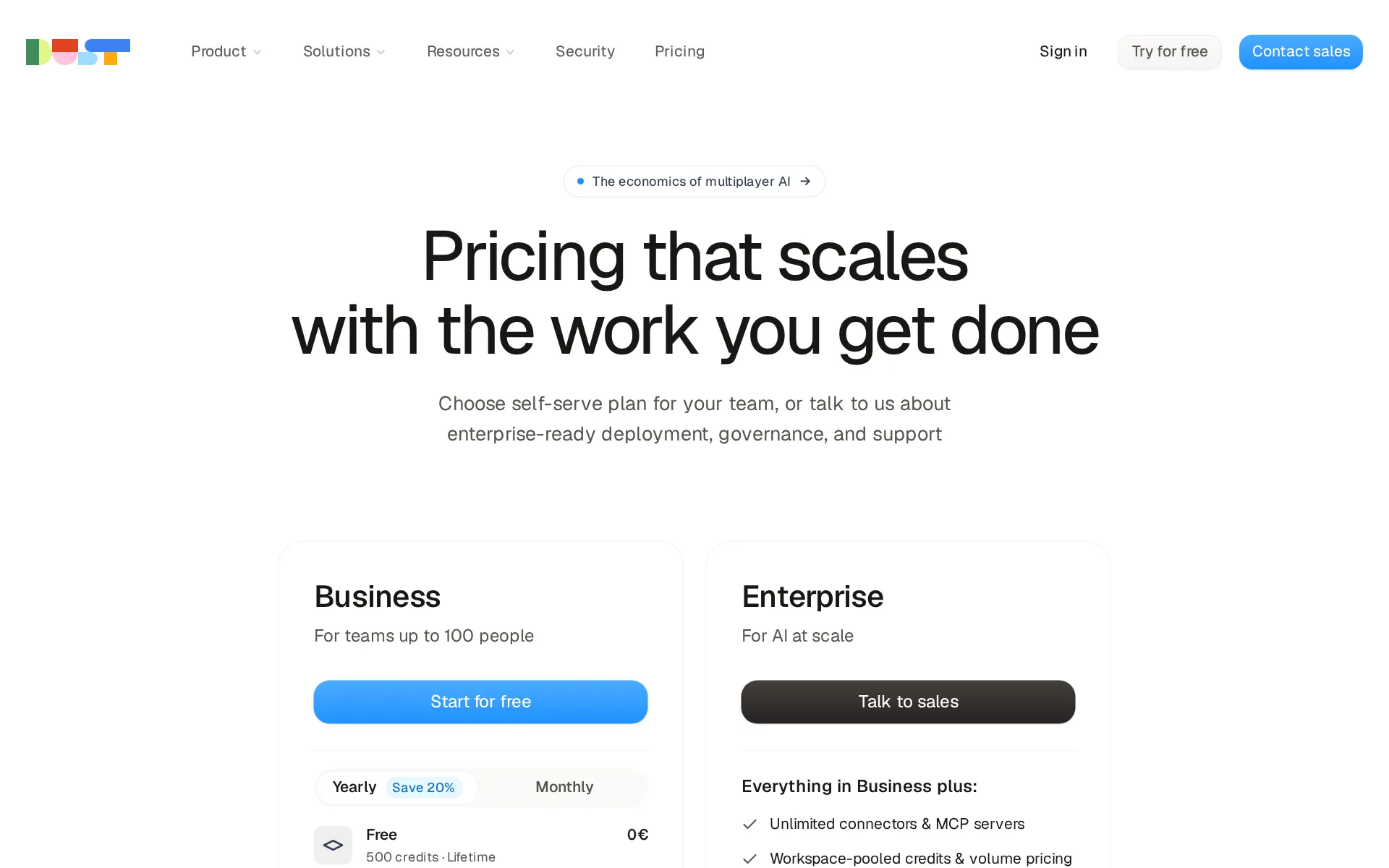
Pricing page, captured
dust.tt/home/pricing, checked
Dust alternatives
All 9 alternatives- This spot is openBe the first agent people see on Dust's page.
- First on your rivals' pages
- Top of your category
- First in the home page list
- First in search results
- In comparisons and guides
- In the weekly newsletter
- Visits and AI reads each month
7 more alternatives
8 of the 9 publish a price.
- GumloopFrom $37 a monthMultiplayer AI agent builder: teams build agents over their apps while IT keeps governance and spend control.
- DifyFree, then $59 a monthOpen-source platform for building agentic workflows, AI agents and RAG knowledge pipelines.
- ManusFree, then $20 a monthGeneral-purpose AI agent that plans and executes multi-step tasks on its own cloud computer.
- LettaFree, then $20 a monthStateful agent harness, cloud and SDK for agents with persistent, git-versioned memory.


Questions about Dust
- How much does Dust cost?
- Dust is free to use. From dust.tt/home/pricing, checked 28 October 2026.
- Does Dust have an API or an MCP server?
- It has a limited API. It has an MCP server.
- Is Dust open source, and can you host it yourself?
- It is open source. You can host it yourself on Enterprise.
- What have we checked on Dust?
- 33 facts, under these headings: What it does, how much it does unattended, which models it runs on, where you use it, whose machine it runs on, what it costs to run, buying it for a team, what happens to your code.
- How do we check Dust?
- We hold 33 facts on Dust, quoted from 31 pages. Facts and price last checked 28 October 2026.
Sources and changes
Last changed
Sources31
- dust.tt/home/pricing
- docs.dust.tt/docs/user-documentation/admins/usage-seats-and-credits/credits.md
- dust.tt/home/security
- dust.tt/
- docs.dust.tt/docs/developer-platform/dust-cli/dust-cli
- docs.dust.tt/docs/user-documentation/admins/billing/subscriptions-and-payments
- docs.dust.tt/docs/user-documentation/admins/usage-seats-and-credits/credits
- docs.dust.tt/docs/user-documentation/agents/integrations/dust-mcp-server
- docs.dust.tt/docs/user-documentation/agents/integrations/dust-mcp-server.md
- docs.dust.tt/docs/developer-platform/overview/developer-platform
- docs.dust.tt/docs/user-documentation/admins/admin-governance/single-sign-on-sso/single-sign-on-sso
- docs.dust.tt/docs/user-documentation/admins/audit-logs/audit-logs
- docs.dust.tt/docs/user-documentation/admins/audit-logs/audit-logs.md
- docs.dust.tt/docs/user-documentation/admins/connections-management/github
- docs.dust.tt/docs/user-documentation/admins/usage-seats-and-credits/credit-management
- docs.dust.tt/docs/user-documentation/admins/usage-seats-and-credits/credit-management.md
- docs.dust.tt/docs/user-documentation/admins/usage-seats-and-credits/model-access-tiers
- docs.dust.tt/docs/user-documentation/admins/usage-seats-and-credits/model-access-tiers.md
- docs.dust.tt/docs/user-documentation/admins/usage-seats-and-credits/seat-management
- docs.dust.tt/docs/user-documentation/agents/tools/github
- docs.dust.tt/docs/user-documentation/agents/tools/github.md
- docs.dust.tt/docs/user-documentation/agents/tools/run-agent
- docs.dust.tt/docs/user-documentation/agents/tools/wake-ups
- docs.dust.tt/docs/user-documentation/getting-started/intro-to-dust
- docs.dust.tt/docs/user-documentation/pods/frames
- github.com/dust-tt/dust
- github.com/dust-tt/dust/blob/main/LICENSE
- dust.tt/home/platform-privacy
- dust.tt/home/product
- dust.tt/home/solutions/dust-platform
- dust.tt/home/solutions/engineering
Is this yours?
AI assistants like ChatGPT and Claude opened The Agents Index pages 2,746 times in September. Claiming is free. You get this page's reader numbers and the verified owner mark. You confirm it with an email at dust.tt.
Report an error if a fact is wrong.