
Not for Non-technical operators who want a fully-managed, click-to-deploy "AI employee" with zero infrastructure.
The facts, with their sources
What it does
- Done-for-you service
- NoYou run the software: open-source Community edition, self-serve Cloud, or Enterprise where Dify hosts or you deploy in your own VPC.
Your AWS / GCP / Azure account. Fast deployment with Helm charts. Data never leaves your security perimeter. We monitor, you control.
dify.ai/dify-enterprise
How much it does unattended
- Runs autonomously
- YesAgents run in their own sandbox, executing commands and files to take on open-ended work; workflows also start unattended from schedule, webhook or integration triggers.
It works in a sandbox of its own: it runs commands, installs programs, and reads and writes files, so it takes on open-ended work rather than just…
docs.dify.ai/en/cloud/use-dify/build/ne… - Multi-agent
- YesAgents can be placed as nodes inside a workflow so several specialised agents hand work to each other.
Choose this when the work needs structure around it: several steps in a set order, branching on conditions, other kinds of nodes, or a few…
docs.dify.ai/en/cloud/use-dify/build/ne… - Agent permissions
- PartlyAutonomy is bounded by design, not by a permission prompt: a Human Input node pauses a run for review, approval or edits, with a timeout branch.
Recipients can use the form to review information, provide input, and choose from predefined decisions that determine how the workflow proceeds.
docs.dify.ai/en/cloud/use-dify/nodes/hu…
Which models it runs on
- Claude
- YesAnthropic models are among the providers covered by bundled message credits; you can also add your own Anthropic key.
Message credits are provided to help you easily try out different models from OpenAI, Anthropic, Gemini, xAI, Tongyi in Dify. Credits are consumed…
dify.ai/pricing - GPT
- YesOpenAI models are covered by bundled message credits, or via your own key.dify.ai/pricing
- Open models
- PartlyLocally deployed models are supported on air-gapped Enterprise deployments; on Cloud you install a provider from the Marketplace and supply its credentials.
Built for industries such as healthcare, finance, retail, and automotive. Run fully offline and connect locally deployed models based on your…
dify.ai/dify-enterprise - Model choice
- YesYou pick the model per app and per node, from bundled providers or any provider you install and key yourself; workspace defaults are configurable.
Add your own API key to a supported provider when you want higher rate limits or billing through your own provider account.
docs.dify.ai/en/cloud/use-dify/workspac…
Where you use it
- In your editor
- PartlyNo IDE extension; instead a published Dify app can be attached to Cursor or Claude Desktop as an MCP server.
Dify now supports exposing your applications as MCP (Model Context Protocol) servers, enabling seamless integration with AI assistants like Claude…
docs.dify.ai/en/cloud/use-dify/publish/… - On the command line
- YesOfficial difyctl CLI runs workspace apps from a terminal with OAuth sign-in and JSON output.
Dify CLI (difyctl) closes that gap: anything that can run a shell command can run your Dify apps.
docs.dify.ai/en/cli/overview - In your pipeline
- PartlyThe CLI is documented for CI pipelines, so apps can run as a build step; there is no pull-request review or repo-acting surface.
Run your Dify apps from terminals, scripts, CI pipelines, and AI agents with the official Dify command-line interface difyctl
docs.dify.ai/en/cli/overview - In a browser
- YesApps are built in a browser workspace and published as hosted web apps or embeds.
Turn your workflows into powerful web applications with batch processing, result management, and streamlined user experiences
docs.dify.ai/en/cloud/use-dify/publish/…
Whose machine it runs on
- Self-hosted
- YesCommunity Edition runs anywhere Docker runs; Enterprise adds Kubernetes/Helm, VPC and air-gapped deployment.
Dify runs anywhere Docker runs: a laptop, an on-premises server, or a cloud VM. Start with Docker Compose, or pick another path below.
docs.dify.ai/en/self-host/deploy/overvi… - Open source
- YesCore features are published in the public repository under Dify's own open-source licence; commercial licensing is an Enterprise item.
All Core Features Released Under the Public Repository
dify.ai/pricing
What it costs to run
- How it meters
- YesPer-workspace subscription with a seat ceiling, metered in message credits: one credit-consuming AI response per model call, priced by model.
An AI response is a single model call (one input and one output), and it counts as one response no matter how many tokens it uses.
docs.dify.ai/en/cloud/use-dify/workspac… - Price per 1,000 requests
- Yes$11.80 per 1,000 requests in Professional, its $59 plan fee over 5,000 requests, its cheapest mode.
Professional $59 per workspace / month
dify.ai/pricing - Free credit
- Yes200 free credits, with no period stated.
200 message credits
dify.ai/pricing - Free tier
- YesSandbox plan is free with 200 message credits, 1 member, 5 apps and 30-day log history; the Community edition is free to self-host.dify.ai/pricing.md
- API access
- YesEvery published app and every knowledge base is a REST API called with a Bearer key; Sandbox is capped at 5,000 calls/month, paid plans are uncapped.
Every app you publish in Dify doubles as a REST API, and so do your knowledge bases.
docs.dify.ai/en/api-reference/guides/ge… - MCP server
- YesAny app can be exposed as an MCP server from its Access Point tab; the URL carries credentials and can be regenerated.
On your app's Access Point tab, find the MCP Server card. The feature is disabled by default. When you toggle it on, Dify generates a unique MCP…
docs.dify.ai/en/cloud/use-dify/publish/… - Bring your own key
- YesBring your own provider keys, billed to your own provider account, and run them alongside or instead of bundled credits; own cloud via self-host or VPC.
Any key you add works across the whole workspace and bills to your own account with that provider.
docs.dify.ai/en/cloud/use-dify/workspac…
Buying it for a team
- A company can buy it
- YesSubscriptions are bought per workspace by its owner or admins, up to 50 members on Team; Enterprise is quoted by sales.
Billing in Dify is workspace-scoped. Your subscription sets the team member limit, feature access, and usage quotas for the entire workspace.
docs.dify.ai/en/cloud/use-dify/workspac… - Seat model
- YesSeats are a plan ceiling, not a per-seat price: 1 on Sandbox, 3 on Professional, 50 on Team.
The number of members your workspace can include depends on your subscription plan
docs.dify.ai/en/cloud/use-dify/workspac… - Pooled budget
- YesOne pooled balance: message credits, apps and storage quotas belong to the workspace, not to individual members.docs.dify.ai/en/cloud/use-dify/workspac…
- Admin controls
- YesFour built-in roles on Cloud gate who can build versus only use published apps; Enterprise adds workflow-level RBAC and SCIM.
Each member's access is determined by the role they hold.
docs.dify.ai/en/cloud/use-dify/workspac… - Audit log
- PartlyCloud gives per-app conversation and run logs; tamper-evident audit logs with SIEM streaming are an Enterprise capability.
Tamper-evident audit logs streamed to your SIEM. Per-call traces. PII-redacted prompt history.
dify.ai/dify-enterprise - Single sign-on
- PartlySAML/OIDC SSO is an Enterprise feature; Cloud sign-in uses GitHub/Google social login instead.
SSO via SAML/OIDC. Fine-grained RBAC down to workflow-level. SCIM provisioning. Session policies.
dify.ai/dify-enterprise
What happens to your code
- Opt out of training
- YesNothing to opt out of: the vendor states it does not train models and contractually bars its model sub-processors from training on your data.
LangGenius is a platform company. We do not train AI models ourselves, and we will not use your AI interaction data for model training.
dify.ai/legal/privacy-policy - Data residency
- PartlyCloud data may be processed in any country where the vendor or its providers operate; region confinement requires Enterprise VPC, dedicated or air-gapped deployment.
Specifically, our website servers are located in the United States, and our affiliates, partners, third parties, and service providers operate in the…
dify.ai/legal/privacy-policy - Getting out
- PartlyWorkflow run history exports as monthly CSV archives (Professional/Team, owner or admin only); no statement found on whether unused message credits expire or refund.
Each download is a ZIP containing CSV files that cover all workflow runs in the workspace for that month
docs.dify.ai/en/cloud/use-dify/monitor/… - Certifications
- PartlyGDPR handling is documented in the privacy policy (SCCs, EEA/UK/Swiss rights, DPA); SOC 2 Type II and ISO 27001 are asserted only in the Enterprise page metadata, with no trust page or report to verify.
The main safeguard relied upon by LangGenius is the Standard Contractual Clauses for Data Protection approved by the European Commission.
dify.ai/legal/privacy-policy
Plans and pricing
Price and terms
- Free plan
- YesYes
The terms in full
Sandbox plan, $0 with no time limit: 200 message credits, 1 Team Workspace, 1 Team Member, 5 Apps, 50 Knowledge Documents, 50MB Knowledge Data Storage, 3,000 Trigger Events, 30 Days Log History, 5,000 API Rate Limit/month. A free self-hosted Community edition is also listed.
From dify.ai/pricing, checked .
The Agents Index digest
Price changes and new agents like Dify, at most once a week.
Last issue: Devin vs Claude Code: Which Should You Pick? · 13 October 2026
Works with
 Claude
 GPT
GPT- PartlyOpen models
Dify Enterprise
For AI agents
- MCP server
- Yes
- API
- Yes
Screenshots
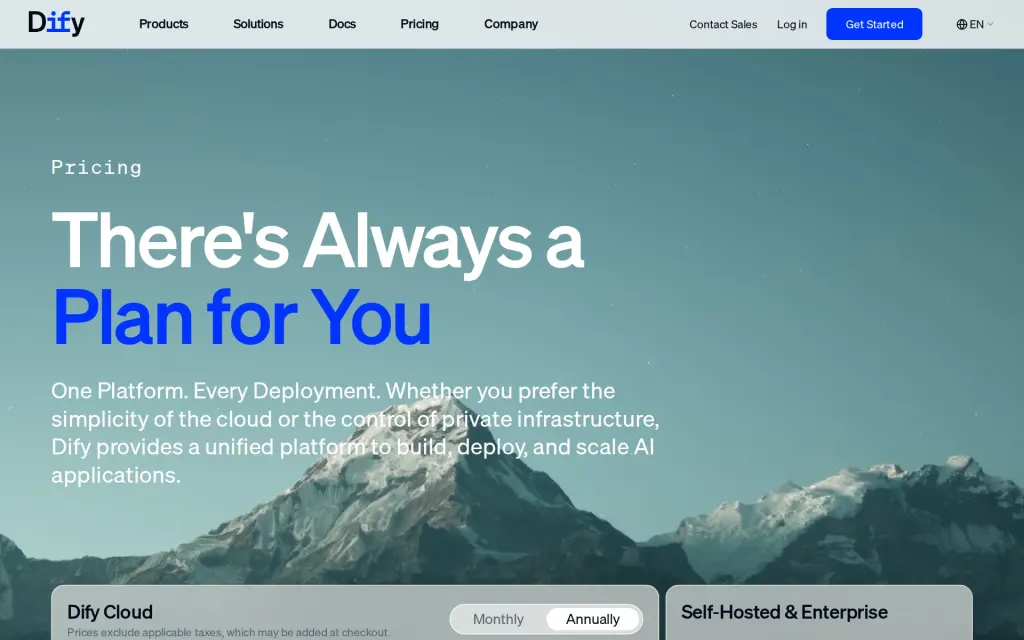
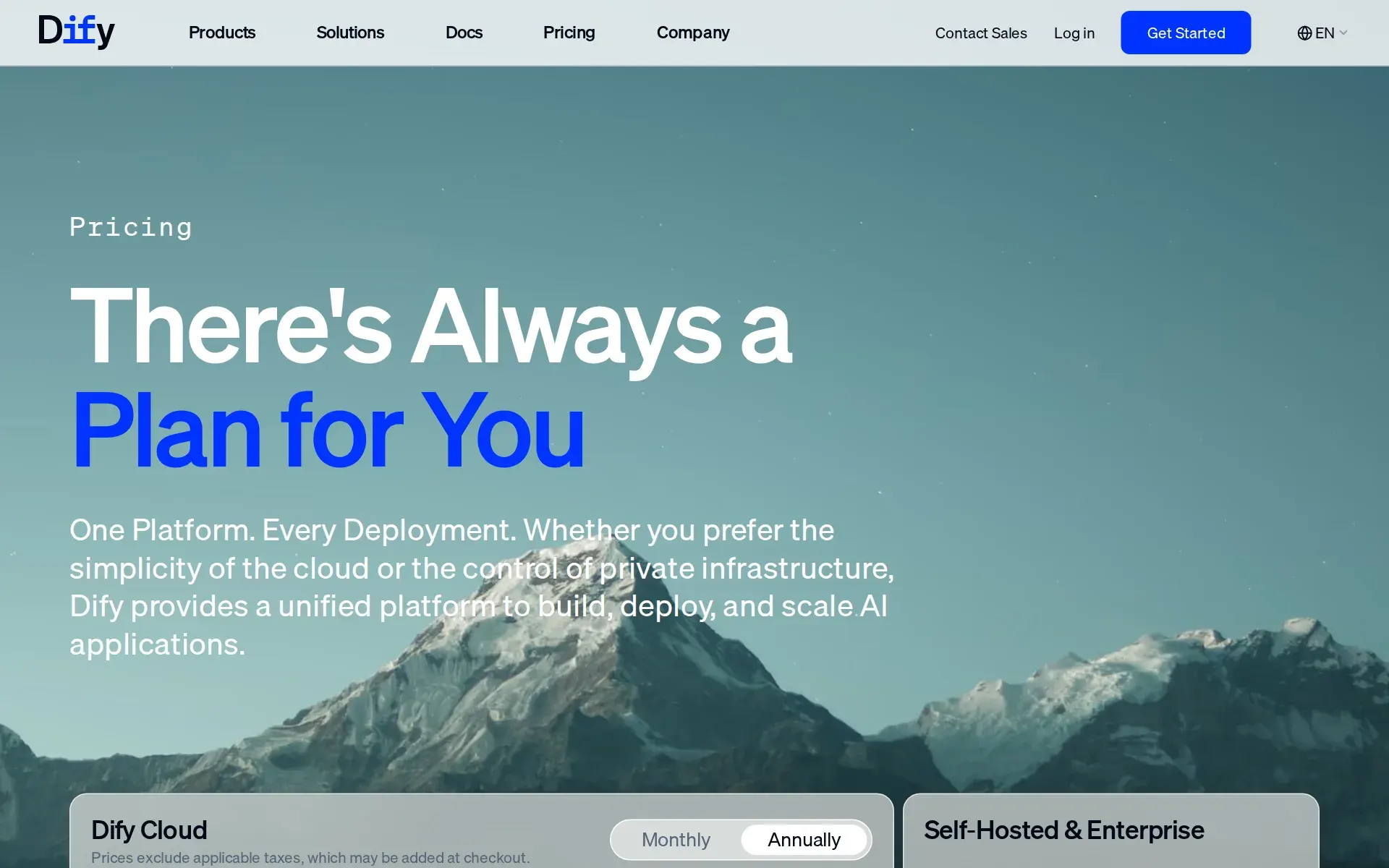
Pricing page, dify.ai, captured 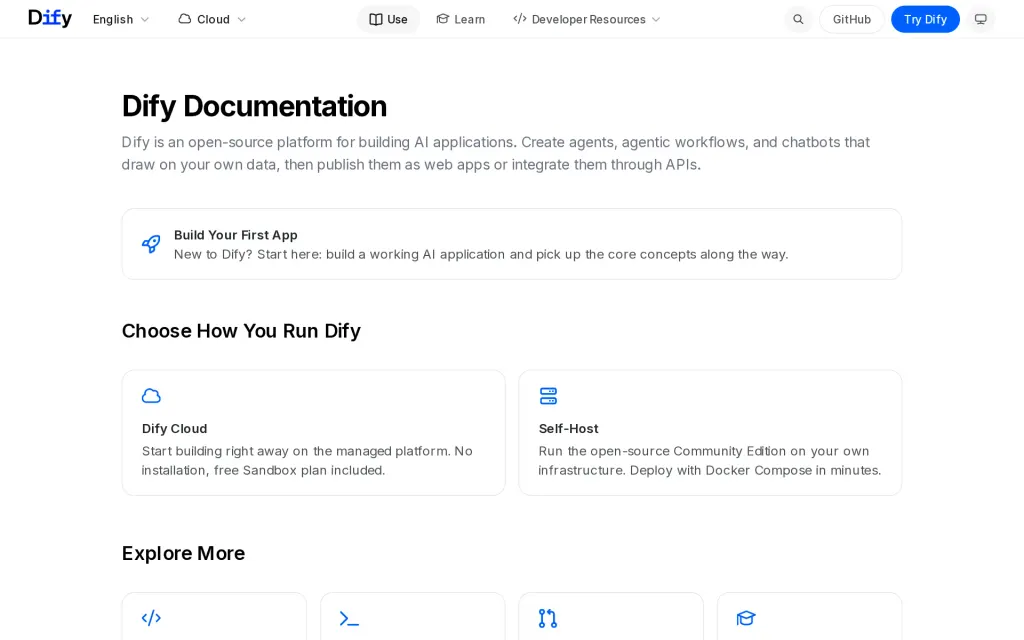
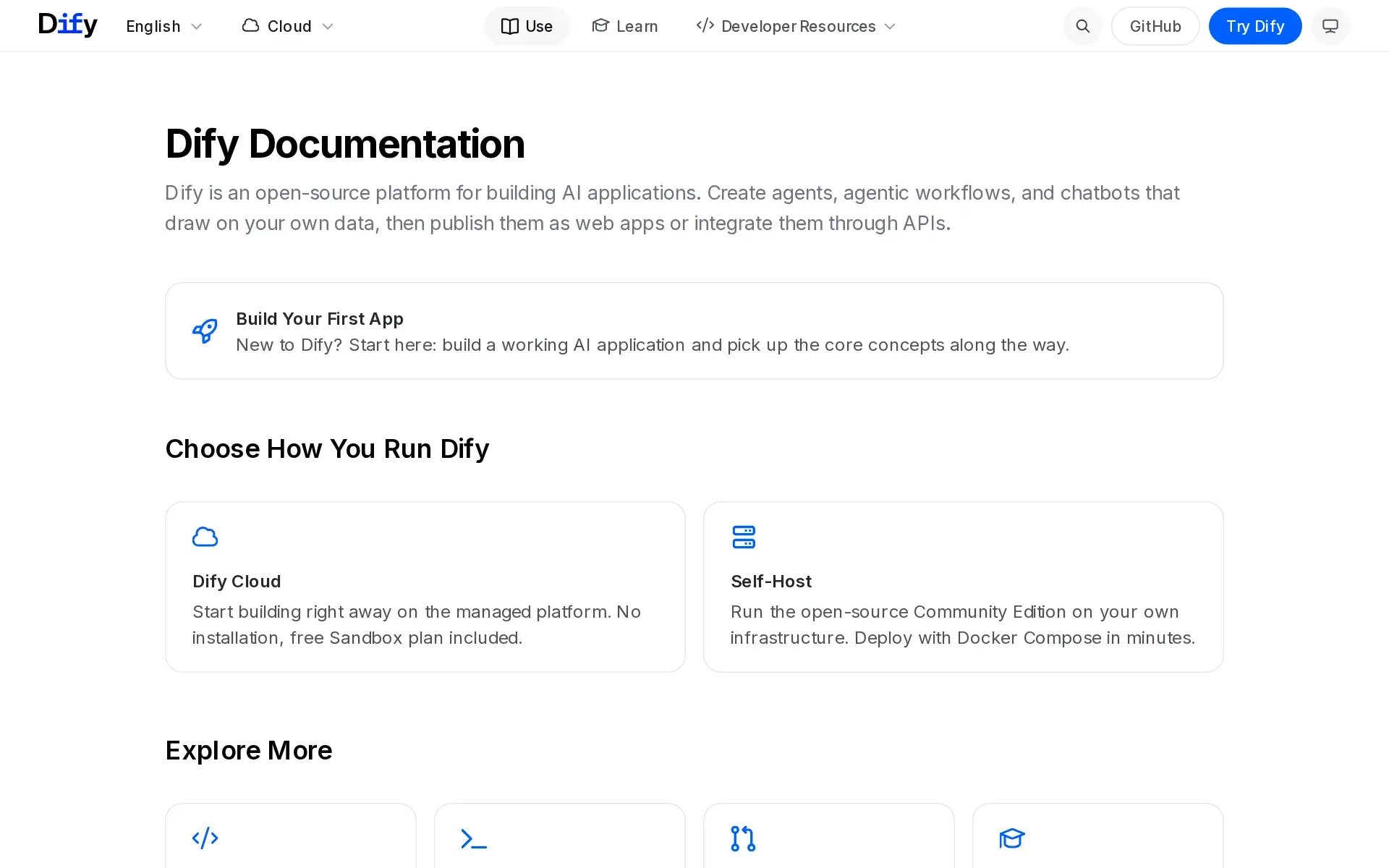
Docs, dify.ai, captured
Filed under
Sources and updates
Last changed
Sources22
- dify.ai/pricing
- dify.ai/dify-enterprise
- docs.dify.ai/en/cloud/use-dify/workspace/model-providers
- dify.ai/
- dify.ai/legal/privacy-policy
- docs.dify.ai/en/cli/overview
- docs.dify.ai/en/cloud/use-dify/build/new-agent/overview
- docs.dify.ai/en/cloud/use-dify/publish/publish-mcp
- docs.dify.ai/en/cloud/use-dify/workspace/subscription-management
- docs.dify.ai/en/cloud/use-dify/workspace/team-members-management
- dify.ai/pricing.md
- docs.dify.ai/en/api-reference/guides/get-started
- docs.dify.ai/en/cloud/use-dify/monitor/logs
- docs.dify.ai/en/cloud/use-dify/nodes/human-input
- docs.dify.ai/en/cloud/use-dify/publish/webapp/workflow-webapp
- docs.dify.ai/en/cloud/use-dify/workspace/app-management
- docs.dify.ai/en/self-host/deploy/overview
- marketplace.dify.ai/plugins/langgenius/anthropic
- marketplace.dify.ai/plugins/langgenius/ollama
- dify.ai/pricing/dify-cloud
- dify.ai/pricing/dify-enterprise
- api.github.com/repos/langgenius/difyRepository
Repository30 August 2026
- Stars
- 153,886
- Forks
- 24,317
- Last push
- 30 August 2026
The Agents Index in AI answers0 of 1
- PerplexityDoes not cite The Agents IndexAsked
Dify alternatives
on Other sources: alternativeto.net, toolradar.com, sim.ai, lleverage.ai, ones.com, gumloop.com
Updates4
- Capabilities · Free tier · Plan limits
- Capabilities · Free tier · Terms
- Capabilities · Free tier · Price · Terms
- Documentation link · LinkedIn link · Summary
Is this yours? Claim it free and edit it in your dashboard, or feature it in Agent platforms.