
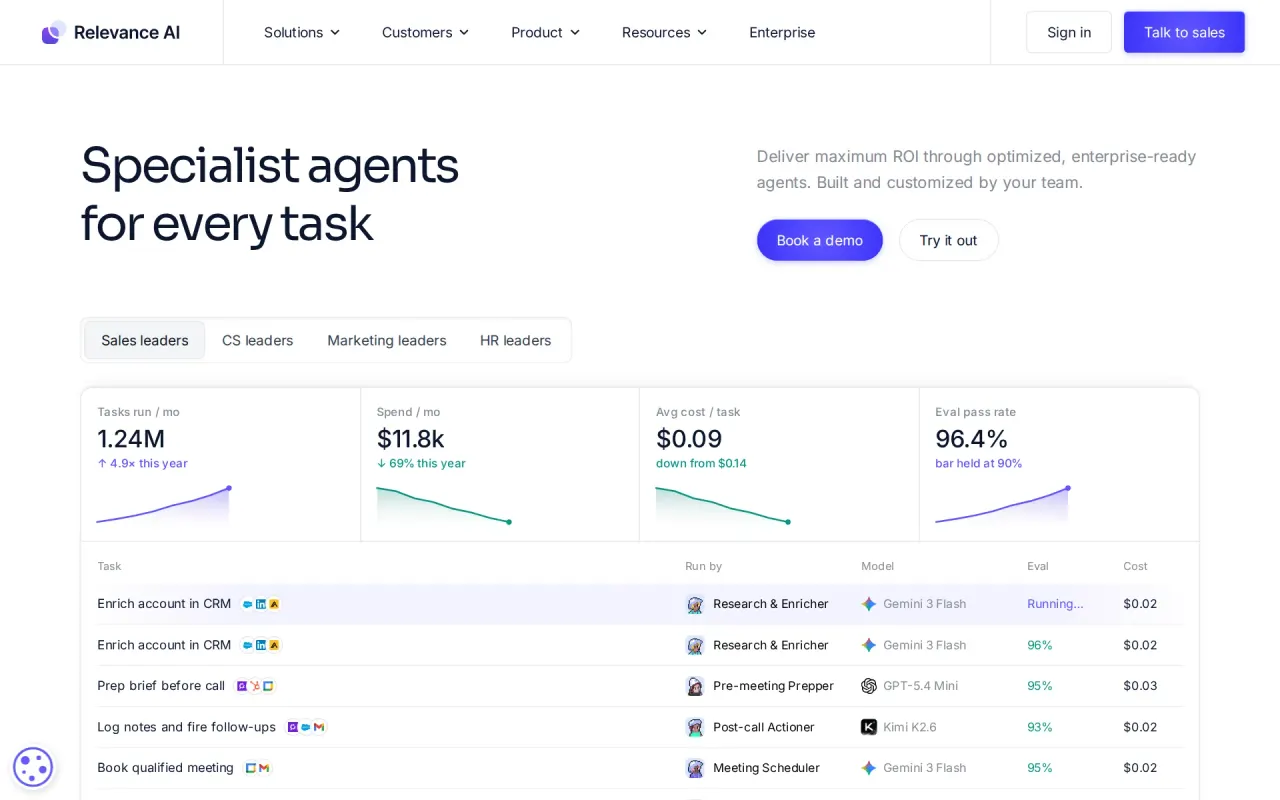
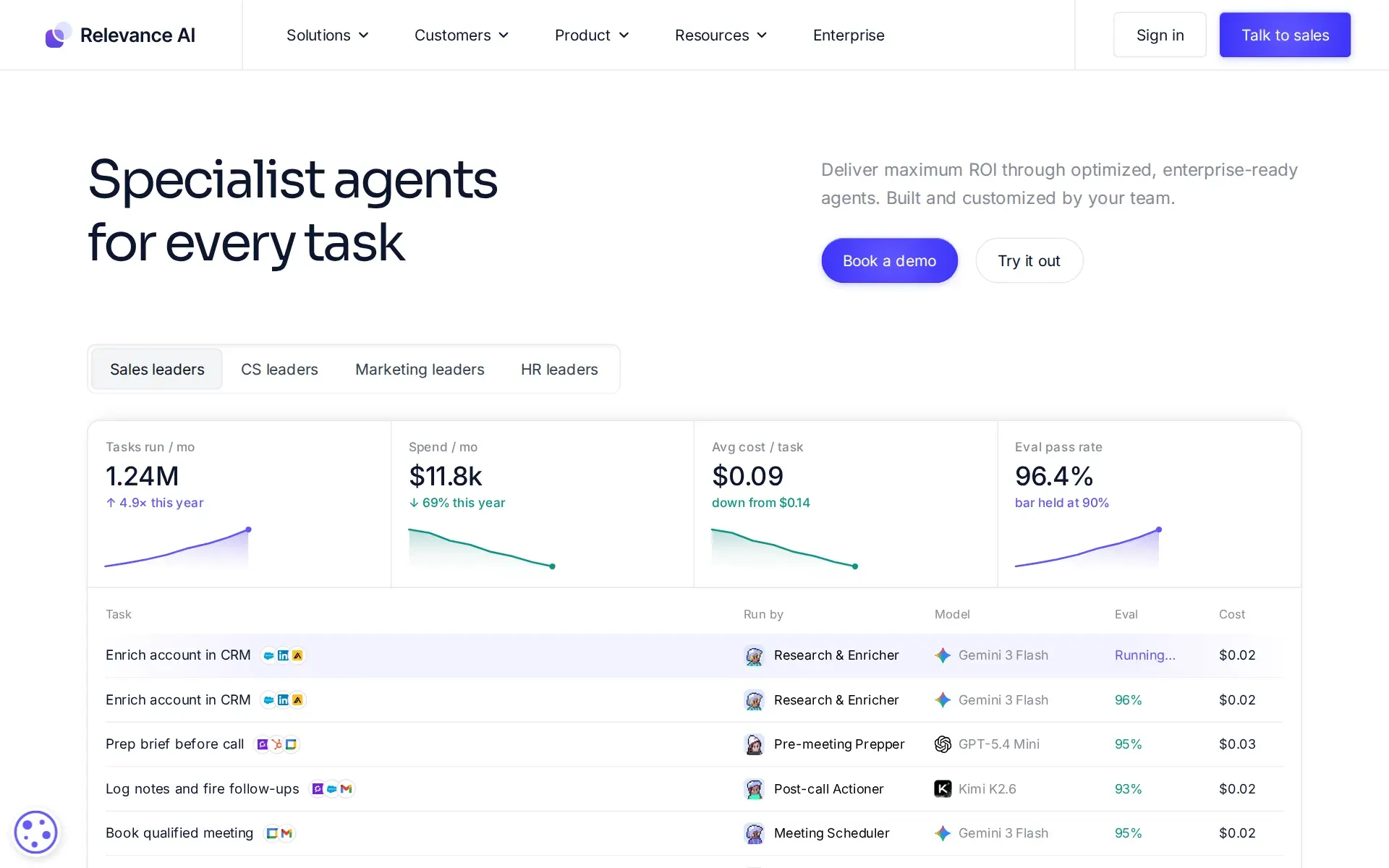
Not for Teams that only want a single Chat bot, since the multi-agent Workforce graph is the platform's reason to exist; open-source self-hosters, since Relevance is closed-source and cloud-only with no on-prem option.
Changed since our last check
- Free tier: now Partly. It was Yes when we checked on .
- Bring your own key: now Yes. It was Partly when we checked on .
The facts, with their sources
What it does
- Writes code
- PartlyNot a coding agent, but the built-in Website Builder agent in Chat generates a complete website from a text description; there is no general source-authoring product.
Website Builder is a built-in Agent in Chat that generates complete websites from a text prompt or description.
relevanceai.com/docs/get-started/chat/c… - Done-for-you service
- PartlyYou buy software, but the vendor also puts an embedded deployment team on the first build and then hands the work back to your own team.
An embedded deployment team gets you live, then trains your team to build without us.
relevanceai.com
How much it does unattended
- Runs autonomously
- YesAgent-to-tool and agent-to-agent connections can be set to Auto Run so actions execute with no human in the loop, with an optional cap on automatic executions.
In this mode, the agent will execute actions automatically without requiring approval.
relevanceai.com/docs/build/workforces/w… - Multi-agent
- YesWorkforce is a visual canvas for wiring several specialist agents together, and Workforces are unlimited on every published plan tier.
Workforce transforms how your agents collaborate by providing a visual canvas where you can design, connect, and monitor teams of specialised agents.
relevanceai.com/docs/llms.txt - Agent permissions
- YesEach connection carries one of three approval behaviours - Auto Run, Approval Required, or Let Agent Decide - so the autonomy boundary is set per tool, not per product.
This mode forces the agent to seek explicit approval before executing an action.
relevanceai.com/docs/build/workforces/w…
Which models it runs on
- Claude
- YesAnthropic Claude models run through Anthropic's API with no data logging, and agent settings expose Claude-specific thinking type and effort controls.
Anthropic models are offered through their API, and once again, no data is stored or trained on during this process.
relevanceai.com/docs/admin/security - GPT
- YesThe vendor's own model/vendor table lists GPT supplied by OpenAI with no logging and no training, available when you supply no API key of your own.relevanceai.com/docs/admin/security
- Open models
- YesOpen-weight models are reachable through the OpenRouter integration, and the vendor says it also hosts open-source models such as LLaMA in its own cloud accounts.
OpenRouter models are a unified access point to a wide variety of open models like Meta's LLaMA family, Google Gemini models, and others.
relevanceai.com/docs/integrations/llm-i… - Model choice
- YesYou pick the model per agent, set a fallback model from another provider, and the feature table marks "Bring your own LLM" available on every published tier.relevanceai.com/docs/get-started/pricing
Where you use it
- In your editor
- PartlyThere is no in-editor coding assistant; instead the MCP server can be added to Cursor, VS Code, Windsurf or Zed to build and run your Relevance agents from the editor.
The Relevance AI MCP server gives any MCP-compatible AI client direct access to your agents, tools, and knowledge.
relevanceai.com/docs/integrations/mcp/m… - On the command line
- PartlyNo first-party CLI of its own, but a published Claude Code plugin bundles the MCP server and skills so agents can be built and managed from a terminal.
Use the Relevance AI Claude Code plugin to build and manage your agents directly from your terminal.
relevanceai.com/docs/integrations/mcp/c… - In a browser
- YesThe product is a hosted web application, with a separate Chat interface documented for desktop, mobile and browser use.
Use AI Agents and Workforces in a chat interface on desktop, mobile, and browser
relevanceai.com/docs/llms.txt
Whose machine it runs on
- Self-hosted
- NoHosted multi-tenant service only; customer data is logically separated within the vendor's cloud and a single-tenant option is described as still unbuilt.
Relevance operates on a multi-tenanted architecture where customer data is logically separated ... Single-tenant options are currently in the works
relevanceai.com/docs/admin/security
What it costs to run
- How it meters
- YesTwo meters plus seats: an Action is one tool run, Vendor Credits are the pass-through model and tool cost, and each plan caps how many build users it carries.
An Action is a single run of a Tool. Each time a tool runs, it counts as an action — whether it's a simple task like sending one email or running a…
relevanceai.com/docs/admin/subscription… - Free tier
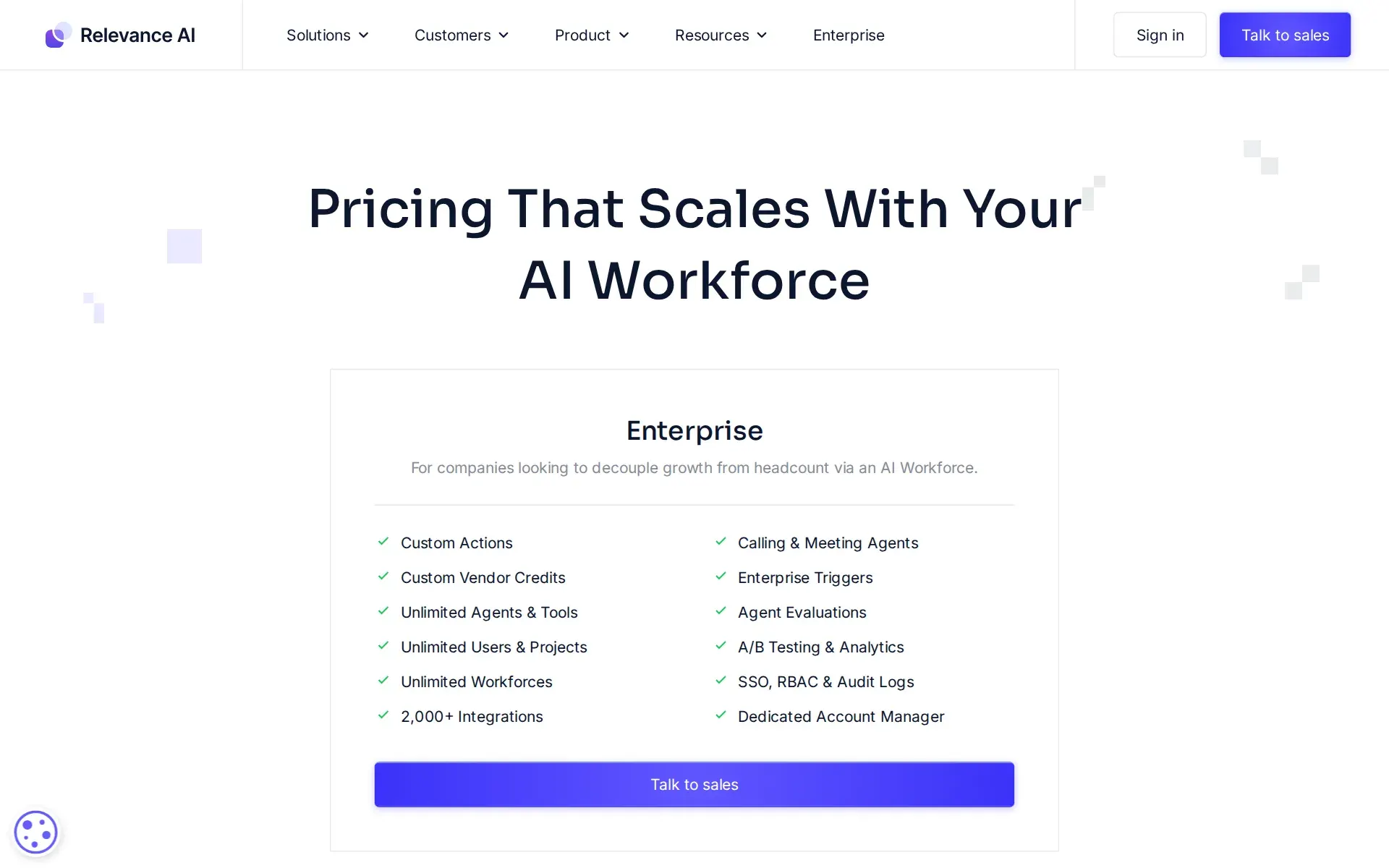
- PartlyThe pricing page publishes one quote-only Enterprise plan and its FAQ sends a new buyer to a sales call to find a plan, so there is no self-serve priced tier on this page; a 'Sign in' link to the app's signup route sits in the header, but the page states no free or trial allowance behind it.Was Yes before our last check.
Talk to our sales team to find the right plan for your team. Book a call at relevanceai.com/book-a-demo and we’ll help you get set up.
relevanceai.com/pricing - API access
- YesA documented SDK with sk- project API keys for server code plus scoped embed keys for browsers, and agents can additionally be triggered by direct HTTP requests.
API keys are available in the project settings on the dashboard. They follow the sk-... format and grant unrestricted access to every resource in the…
relevanceai.com/docs/sdk/authentication - MCP server
- YesA hosted MCP server at mcp.relevanceai.com lets another agent list and run your agents, with OAuth access bounded server-side by the caller's project role.relevanceai.com/docs/integrations/mcp/m…
- Bring your own key
- YesBringing your own model keys is optional on every plan and bypasses Vendor Credit metering entirely, with the vendor's credits left as a fallback.Was Partly before our last check.
To bypass Vendor Credits entirely, you can bring your own API keys. BYOK is optional on every plan — it lets you skip Vendor Credits while still…
relevanceai.com/docs/admin/subscription…
Buying it for a team
- A company can buy it
- YesPaid subscriptions attach to the Organization rather than a person, and Enterprise buyers can request further organisations under one contract.
Yes, for Pro and Team plans. Subscriptions are applied at the Organization level, not to individual users or projects.
relevanceai.com/docs/get-started/pricing - Seat model
- YesSeats are split into build users and end users with hard ceilings per tier - two builders on Pro, five builders plus 45 end users on Team, unlimited only on Enterprise.relevanceai.com/docs/get-started/pricing
- Pooled budget
- YesOne balance for the whole organisation: everybody shares the plan's Actions and Vendor Credits rather than holding a personal allowance.
Everyone in the Organization shares the plan's Actions, Vendor Credits, and feature access.
relevanceai.com/docs/get-started/pricing - Admin controls
- PartlyPer-connection approval gates and spend/usage limits are available broadly, but role-based and fine-grained access control are gated to Enterprise on the vendor's own tier table.relevanceai.com/docs/get-started/pricing
- Audit log
- PartlyAudit logging exists but only on Enterprise, where events and execution traces are streamed out over OpenTelemetry; Pro and Team are marked as not having it.relevanceai.com/docs/get-started/pricing
- Single sign-on
- PartlySAML 2.0 and OIDC single sign-on is documented but reserved for Enterprise; the two self-serve tiers are marked without it on the vendor's comparison table.relevanceai.com/docs/get-started/pricing
What happens to your code
- Opt out of training
- YesNothing to opt out of by default: the vendor states it does not train on customer data absent a specific partnership agreement, and metadata is excluded from training.
We do not use your data to train our models or improve our services unless you have a specific partnership agreement with us
relevanceai.com/docs/admin/security - Data residency
- YesThree regions are offered and chosen at signup - N. Virginia, London or Sydney - but the vendor warns the choice is fixed once the organisation exists.
Data is stored in Australia, the US, or the EU/UK, based on your selection at signup.
relevanceai.com/docs/admin/security - Getting out
- YesData exports in CSV, Excel or JSON are available at any time, and unused Vendor Credits roll over indefinitely while the subscription stays active rather than expiring.
You can export your data at any time in standard formats (CSV, Excel, JSON)
relevanceai.com/docs/admin/security - Certifications
- YesSOC 2 Type II and GDPR are claimed on every tier with third-party assessment reports offered to Enterprise under NDA; no ISO 27001 certification is claimed anywhere read.
Relevance AI is SOC2 Type II compliant, and we operate in a multi-region environment.
relevanceai.com/docs/admin/security
Plans and pricing
What needs a higher plan
- Enterprise
- Admin controls, Audit log, Single sign-on
From relevanceai.com/pricing, checked .
The Agents Index digest
Price changes and new agents like Relevance AI, at most once a week.
Last issue: Devin vs Claude Code: Which Should You Pick? · 13 October 2026
Works with
 Claude
 GPT
GPT- YesOpen models
For AI agents
- MCP server
- Yes
- API
- Yes
Screenshots
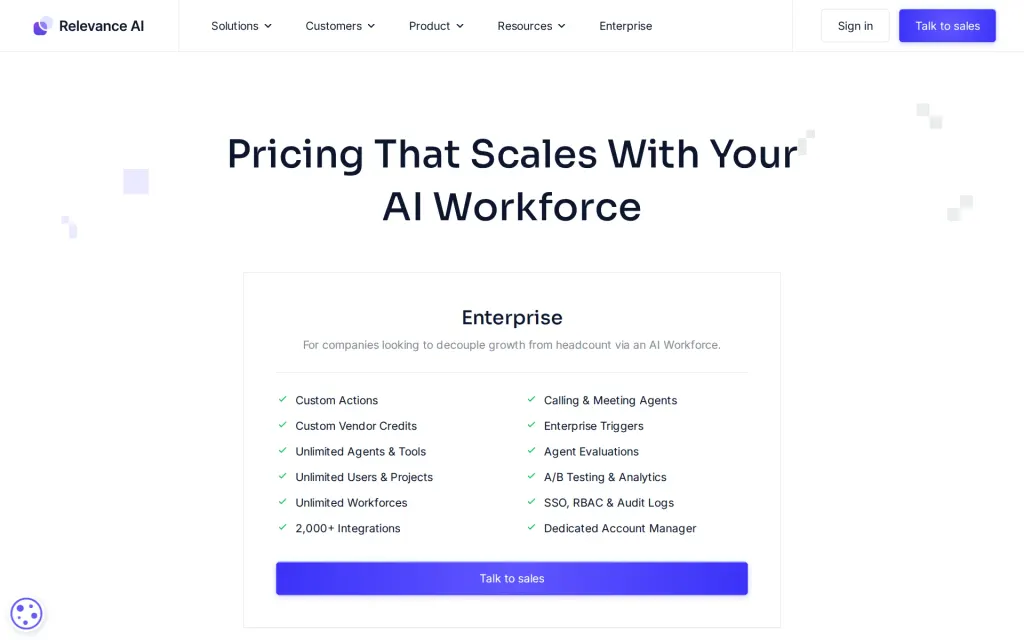
Pricing page, relevanceai.com, captured 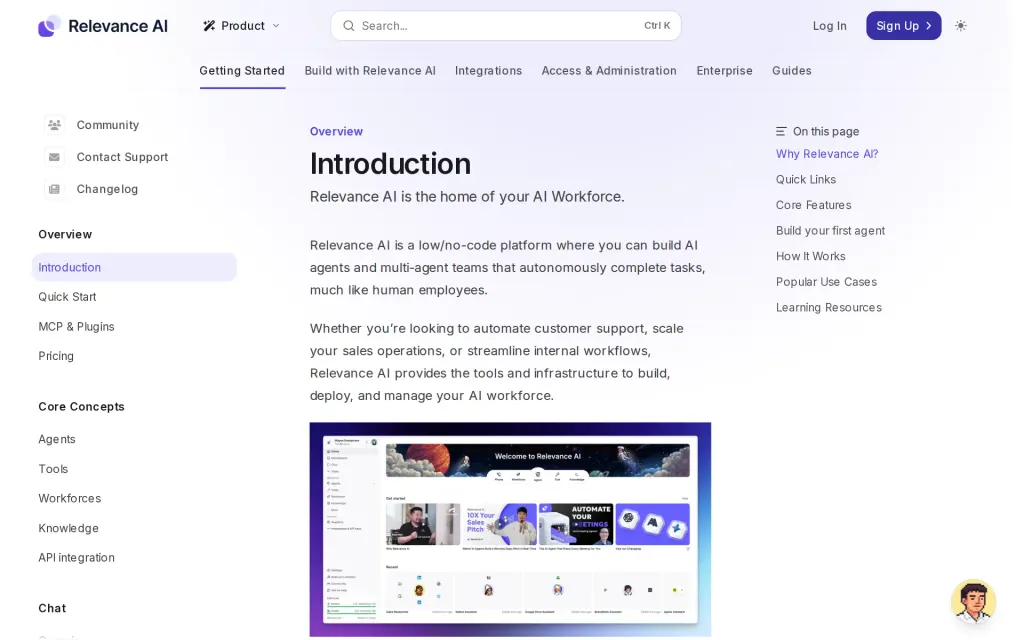
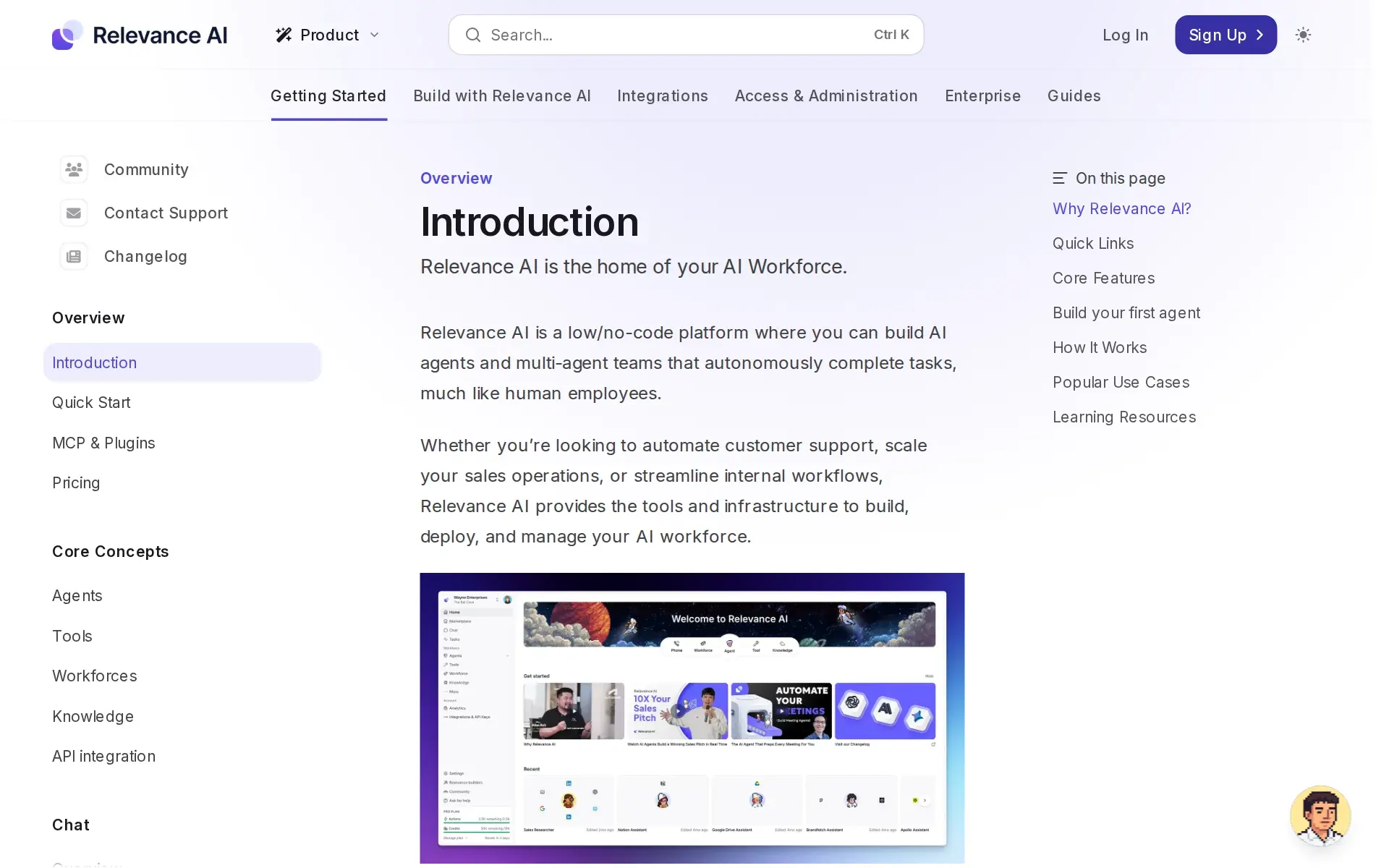
Docs, relevanceai.com, captured
Filed under
Sources and updates
Last changed
Sources on relevanceai.com22
- /docs/get-started/pricing
- /docs/admin/security
- /docs/get-started/core-concepts/mcp-plugins
- /docs/admin/subscriptions/plans
- /docs/build/workforces/workforce-features/approvals-and-escalations
- /docs/get-started/introduction
- /docs/integrations/mcp/mcp-server
- /docs/llms.txt
- /pricing
- /
- /docs/build/agents/build-your-agent/agent-triggers/api-trigger
- /docs/enterprise/sso-setup
- /docs/enterprise/streaming-events
- /docs/get-started/chat/chat-agents/website-builder
- /docs/get-started/chat/introduction
- /docs/get-started/core-concepts/api-integration
- /docs/get-started/core-concepts/workforces
- /docs/integrations/llm-integrations/anthropic
- /docs/integrations/llm-integrations/openai
- /docs/integrations/llm-integrations/openrouter
- /docs/integrations/mcp/claude-code
- /docs/sdk/authentication
Coverage elsewhere1
The Agents Index in AI answers0 of 1
- PerplexityDoes not cite The Agents IndexAsked
Relevance AI alternatives
on Other sources: getmacha.com, g2.com, openalternative.co, resources.rework.com, eesel.ai, artisan.co
Updates6
- Capabilities · Free tier · Price
- Capabilities · Free tier · Terms
- Capabilities · Free tier · Terms
- Capabilities · Free tier · Price · Terms
- Alternatives · Summary · Tagline
- Summary · Tagline
Is this yours? Claim it free and edit it in your dashboard, or feature it in Agent platforms.