
Not for Teams that need a self-hosted or fully programmable task agent. Perplexity is a hosted, closed product.
The facts, with their sources
What it does
- Writes code
- YesPerplexity Computer builds apps and sites from a natural-language prompt, and the Agent API sandbox has the model write the code itself.
Create production ready apps, websites, reports, and more.
perplexity.ai/products/computer - Debugs and fixes
- YesComputer is sold as fixing code from a plain-language instruction; the sandbox docs list reproducing an error as a use case.
Analyze data, create content, build sites, fix code, and more just by telling Computer what you need in plain language.
perplexity.ai/enterprise - Writes tests
- NoThe enumerated GitHub-connector actions cover cloning, changing, committing and opening a pull request; test generation appears nowhere in that list or in the sandbox use cases.
the agent can clone private repositories, inspect and change code, commit changes, push a branch, and create or update a pull request
docs.perplexity.ai/docs/agent-api/tools… - Reviews code
- PartlyReview happens through the managed GitHub connector, which the same note marks as preview; there is no dedicated diff-review product.
The GitHub connector lets the model run git and gh in the sandbox to review code, make changes, and open pull requests.
docs.perplexity.ai/docs/agent-api/tools… - Whole-codebase work
- PartlyThe agent clones a whole repository and works in it through git and gh, but Perplexity never claims a migration carried across a repo, and the connector is labelled preview.
With both tools enabled, the agent can clone private repositories, inspect and change code, commit changes, push a branch, and create or update a…
docs.perplexity.ai/docs/agent-api/tools… - Ships it
- PartlyThrough the API the agent pushes a branch and opens or updates a pull request; no deployment step or target is documented.docs.perplexity.ai/docs/agent-api/tools…
- Done-for-you service
- NoSelf-serve subscription software across web, desktop, mobile, Slack and Microsoft 365; Perplexity sells seats and support, not a build-and-run engagement.
Available to Pro and Max subscribers on desktop, mobile, Slack, and Microsoft 365.
perplexity.ai/products/computer
How much it does unattended
- Runs autonomously
- YesComputer takes recurring tasks and executes them unattended in the background; runs are described as lasting hours or months.
Set recurring tasks that Computer executes autonomously and persistently over time.
perplexity.ai/products/computer - Multi-agent
- YesComputer fans a prompt out to subagents; the API's wide-research preset runs the same wide-and-deep pattern in the background.
Prompt in natural language. Computer deploys subagents to handle the rest.
perplexity.ai/products/computer - Agent permissions
- PartlyAPI runs are bounded by the connected account's own permissions, an allowed_tools allowlist and a max_steps loop cap; no per-action human approval prompt is documented.
The agent can access only repositories and perform only actions that your connected GitHub account permits.
docs.perplexity.ai/docs/agent-api/tools…
Which models it runs on
- Claude
- YesClaude is one of the models the consumer product orchestrates, and the Agent API exposes Opus, Sonnet and Haiku by model id.
Perplexity orchestrates multiple top models and selects the best one per query, including ChatGPT, Google Gemini, Anthropic Claude, and NVIDIA…
perplexity.ai/hub/pricing - GPT
- YesThe Agent API lists the GPT-5 family with per-token rates; the consumer plans surface GPT as a selectable preferred model.
GPT-5 family — flagship, mini, and nano variants.
docs.perplexity.ai/docs/agent-api/models - Open models
- YesOpen-weight Nemotron, DeepSeek, GLM and Kimi models are callable by id and hosted by Perplexity; the Router API is a further open-weight catalogue in private preview.
Nemotron open-weight reasoning models.
docs.perplexity.ai/docs/agent-api/models - Model choice
- YesPaid consumer plans set a preferred model, and the API takes an explicit model id across multiple provider catalogues; otherwise Perplexity picks per query.
Pro and Max both allow selecting a preferred model.
perplexity.ai/hub/pricing
Where you use it
- In your editor
- PartlyThere is no Perplexity IDE extension; it enters the editor as an MCP tool that Claude Code, Cursor or VS Code calls.
This page is for adding Perplexity as an MCP tool inside clients such as Claude Code, Cursor, VS Code, and Claude Desktop.
docs.perplexity.ai/docs/getting-started… - On the command line
- YesA first-party pplx binary runs web search and page-snippet extraction from a terminal and returns JSON for pipelines.
The pplx CLI returns structured JSON from the Perplexity Search API, making it useful for shell pipelines, interactive terminal work, and coding…
docs.perplexity.ai/docs/cli/overview - In your pipeline
- PartlyThe Agent API can open and update pull requests through the GitHub connector, which is in preview; no CI runner or GitHub Action is documented.docs.perplexity.ai/docs/agent-api/tools…
- In a browser
- YesThe answer engine is a hosted web platform, with Comet as a downloadable browser and apps on desktop and mobile alongside it.
Yes, the API offers exactly the same internet data access as Perplexity's web platform.
docs.perplexity.ai/docs/resources/faq
Whose machine it runs on
- Self-hosted
- NoPerplexity runs the compute on its own AWS estate in North America; no self-hosted, on-prem or VPC deployment is documented.
Our compute is hosted via Amazon Web Services in North America.
docs.perplexity.ai/docs/resources/faq - Open source
- PartlyThe MCP server is open source and installable as a local stdio server; the answer engine, Computer and Comet are closed.
Local MCP server: run the open-source server on your machine over stdio.
docs.perplexity.ai/docs/getting-started…
What it costs to run
- How it meters
- YesConsumer and Enterprise plans bill per seat per month, Computer meters credits per seat, and the API bills per token plus a fee per tool invocation.
the Agent API charges per token at direct provider rates with no markup, plus a per-invocation fee for tools; the Search API charges per request; and…
docs.perplexity.ai/docs/resources/faq - Free tier
- YesA permanent $0 plan gives cited answers on the top models with limited weekly usage; the API instead requires purchased credits.
Free includes access to the top AI models with limited weekly usage.
perplexity.ai/hub/pricing - API access
- YesA separate API Platform exposes Agent, Search, Router and Embeddings APIs with Python and TypeScript SDKs, billed on prepaid credits rather than a consumer plan.
API keys are your credentials for accessing the Perplexity API.
docs.perplexity.ai/docs/getting-started… - MCP server
- YesPerplexity hosts a remote MCP server another agent can query with an API key, and publishes a local stdio server as an alternative.
Remote MCP server (recommended): hosted by Perplexity at https://api.perplexity.ai/mcp. No installation, nothing to update, works with any client…
docs.perplexity.ai/docs/getting-started… - Bring your own key
- NoPerplexity fronts the provider accounts and bills tokens against a Perplexity key; no bring-your-own-key, own-inference or own-cloud path is documented.
All models are accessed directly from first-party providers with transparent token-based pricing.
docs.perplexity.ai/docs/agent-api/models
Buying it for a team
- A company can buy it
- YesEnterprise Pro and Enterprise Max are sold to organisations, can be mixed within one org, and admins assign each member's tier.
Yes. An organization can include both Enterprise Pro and Enterprise Max users. Admins set each member's tier under Settings, then Members.
perplexity.ai/hub/pricing - Seat model
- YesEnterprise Pro is $34 and Enterprise Max $271 per seat per month billed annually; no seat floor or ceiling is published.
$34 / month per seat when billed annually
perplexity.ai/hub/pricing - Pooled budget
- NoComputer credits are allotted per seat, 500 a month on Enterprise Pro and 15,000 on Enterprise Max, not drawn from one shared org balance.
500 monthly Computer credits/seat
perplexity.ai/hub/pricing - Admin controls
- PartlyUser management arrives with Enterprise Pro; role-based access control and custom roles sit in the custom-priced governance tier and the comparison table marks that row 'Contract required'.
Manage user permissions and integrate with SSO
perplexity.ai/hub/pricing - Audit log
- PartlyAudit logs are named on the Enterprise Max card and in the custom governance tier; the comparison table marks the audit-log row 'Contract required'.
Premium security features including SCIM, audit logs, and data retention settings
perplexity.ai/hub/pricing - Single sign-on
- PartlySAML 2.0 and OIDC through your own IdP, but only for organisations with an active org subscription; the same page states it is not available on personal Pro or Max.
The portal supports SAML 2.0 and OIDC connections and walks you through your specific IdP.
docs.perplexity.ai/docs/admin/signing-in
What happens to your code
- Opt out of training
- PartlyGuaranteed on Enterprise Pro and Enterprise Max; the comparison row is blank for individual Pro, while the API is documented as zero-retention and never trained on.
Guaranteed no training on your data
perplexity.ai/hub/pricing - Data residency
- PartlyThe jurisdiction is stated as AWS in North America, but no region or residency choice is offered, and enterprise data-retention configurability is contract-gated.docs.perplexity.ai/docs/resources/faq
- Getting out
- PartlyPortability is a request under the privacy notice rather than a self-serve export, and nothing published states whether unused Computer credits expire.
In certain cases, you may ask to receive access to your data in a portable, machine-readable form.
perplexity.ai/hub/legal/privacy-notice - Certifications
- YesSOC 2 Type II, HIPAA, GDPR and PCI DSS are named on the Enterprise Pro card; the API docs add a 2025 HIPAA gap assessment and a CAIQlite assessment via the Trust Center.
SOC 2 Type II, HIPAA, GDPR, PCI DSS compliance
perplexity.ai/hub/pricing
Plans and pricing
What needs a higher plan
- Enterprise Pro
- Seat model, Admin controls, Single sign-on, Opt out of training
- Enterprise Max
- Audit log
From perplexity.ai/enterprise/pricing, checked .
The Agents Index digest
Price changes and new agents like Perplexity, at most once a week.
Last issue: Devin vs Claude Code: Which Should You Pick? · 13 October 2026
Works with
 Claude
 GPT
GPT- YesOpen models
Perplexity API Platform — Agent API
For AI agents
- MCP server
- Yes
- API
- Yes
Screenshots
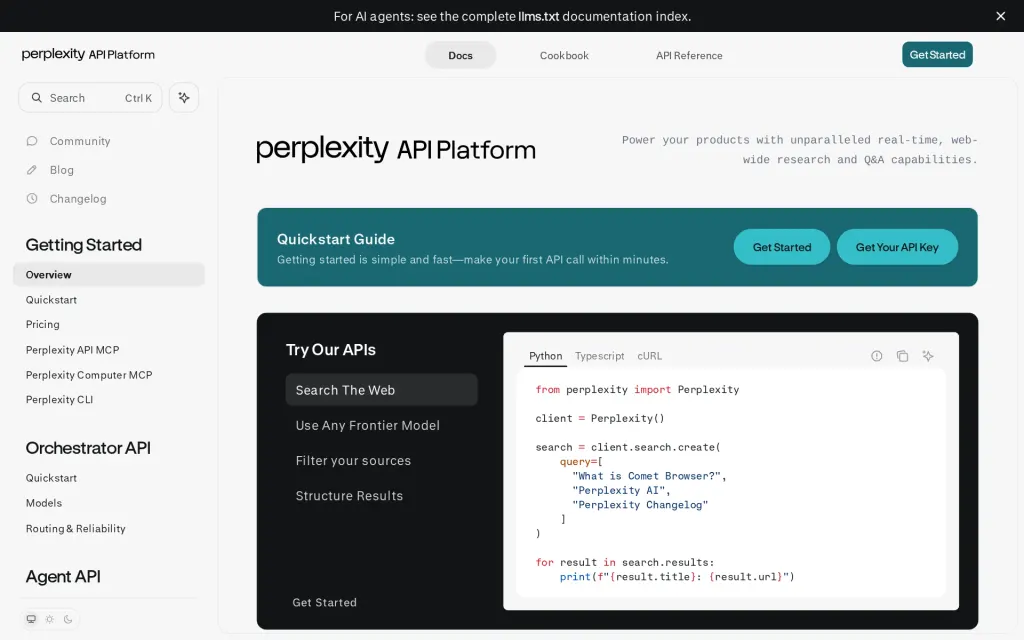
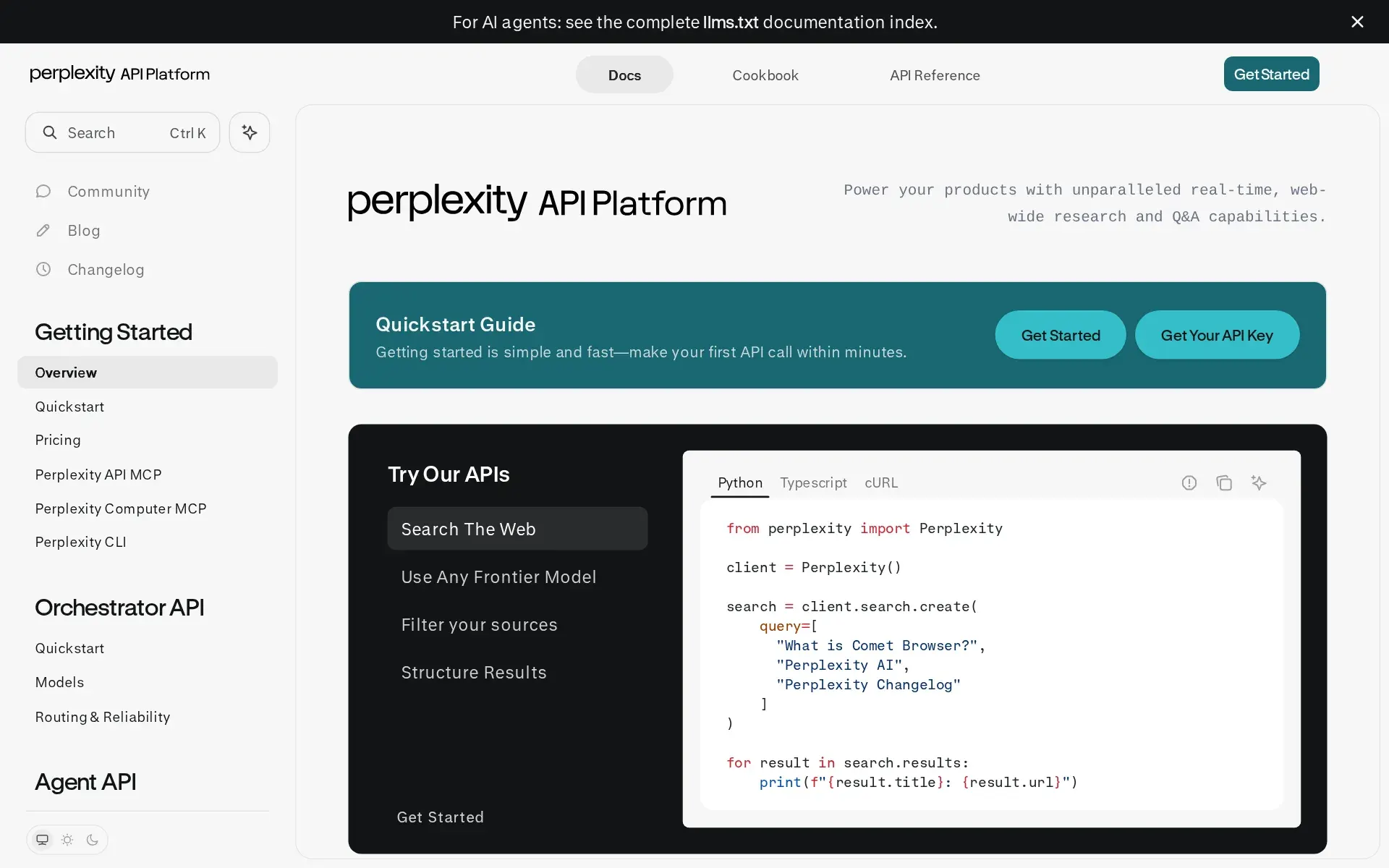
Docs, perplexity.ai, captured
Filed under
Sources and updates
Last changed
Sources27
- perplexity.ai/hub/pricing
- docs.perplexity.ai/docs/agent-api/tools/connectors
- docs.perplexity.ai/docs/resources/faq
- docs.perplexity.ai/docs/agent-api/models
- docs.perplexity.ai/docs/getting-started/integrations/computer-mcp-server
- docs.perplexity.ai/docs/getting-started/projects
- perplexity.ai/hub/pricing
- perplexity.ai/products/computer
- docs.perplexity.ai/docs/admin/computer-analytics-api
- docs.perplexity.ai/docs/agent-api/building-agents/define-the-run
- docs.perplexity.ai/docs/getting-started/integrations/mcp-server
- docs.perplexity.ai/docs/getting-started/pricing
- docs.perplexity.ai/docs/resources/aws-marketplace
- docs.perplexity.ai/docs/admin/signing-in
- docs.perplexity.ai/docs/agent-api/tools/mcp
- docs.perplexity.ai/docs/agent-api/tools/sandbox
- docs.perplexity.ai/docs/agent-api/background-mode
- docs.perplexity.ai/docs/agent-api/quickstart
- docs.perplexity.ai/docs/agent-api/wide-research
- docs.perplexity.ai/docs/agent-api/working-with-files
- docs.perplexity.ai/docs/cli/overview
- docs.perplexity.ai/docs/getting-started/integrations/opencode
- docs.perplexity.ai/docs/getting-started/quickstart
- docs.perplexity.ai/docs/resources/privacy-security
- docs.perplexity.ai/docs/router/quickstart
- perplexity.ai/enterprise
- perplexity.ai/hub/legal/privacy-notice
Coverage elsewhere6
The Agents Index in AI answers0 of 1
- PerplexityDoes not cite The Agents IndexAsked
Perplexity alternatives
on Other sources: itechguides.com, clickup.com, capterra.com, g2.com, layer3labs.io, saner.ai
Updates5
- Free tier
- Capabilities · Free tier · Price · Terms
- Capabilities · Price · Terms
- Capabilities · Free tier · Price · Terms
- Alternatives · Summary · Tagline
Is this yours? Claim it free and edit it in your dashboard, or feature it in Research & data agents.