
Not for Teams that want a single vendor's fully-managed, zero-setup hosted service with a traditional support contract, or anyone who needs to run OpenCode's local server on a shared or untrusted network without extra hardening given its disclosed 2026 security history.
Changed since our last check
- Runs autonomously: now Yes. It was Partly when we checked on .
- How it meters: now Yes. It was Partly when we checked on .
The facts, with their sources
What it does
- Writes code
- YesAuthors new code from a prompt across the terminal, desktop and IDE surfaces; the docs walk through describing a feature and letting it build it.
OpenCode is an open source agent that helps you write code in your terminal, IDE, or desktop.
opencode.ai - Debugs and fixes
- YesCan investigate a reported failure and land the fix: in GitHub it triages an issue, then works in a branch and opens a pull request.
Fix and implement: Ask OpenCode to fix an issue or implement a feature. And it will work in a new branch and submits a PR with all the changes.
opencode.ai/docs/github - Reviews code
- YesReviews diffs others wrote: a documented workflow runs it on pull_request events, and PR review comments hand it the file path, line numbers and diff context.
pull_request | PR opened or updated | Automatically trigger OpenCode when PRs are opened, synchronized, or reopened. Useful for automated reviews.
opencode.ai/docs/github - Whole-codebase work
- PartlyBuilt for multi-step work across a repository through subagents and LSP loading, but the docs describe no repository-wide index or migration guarantee, so scale rests on agent orchestration.
A general-purpose agent for researching complex questions and executing multi-step tasks. Has full tool access, so it can make file changes when…
opencode.ai/docs/agents - Ships it
- PartlyStops at a branch and a pull request in the documented GitHub flow; deployment is only possible because shell commands are permitted, not as a described feature.
OpenCode reads context and can create branches, open PRs, or reply.
opencode.ai/docs/github - Done-for-you service
- NoYou run the software yourself: it installs as a CLI, desktop app or IDE extension and the vendor sells model access, not delivery work on your behalf.
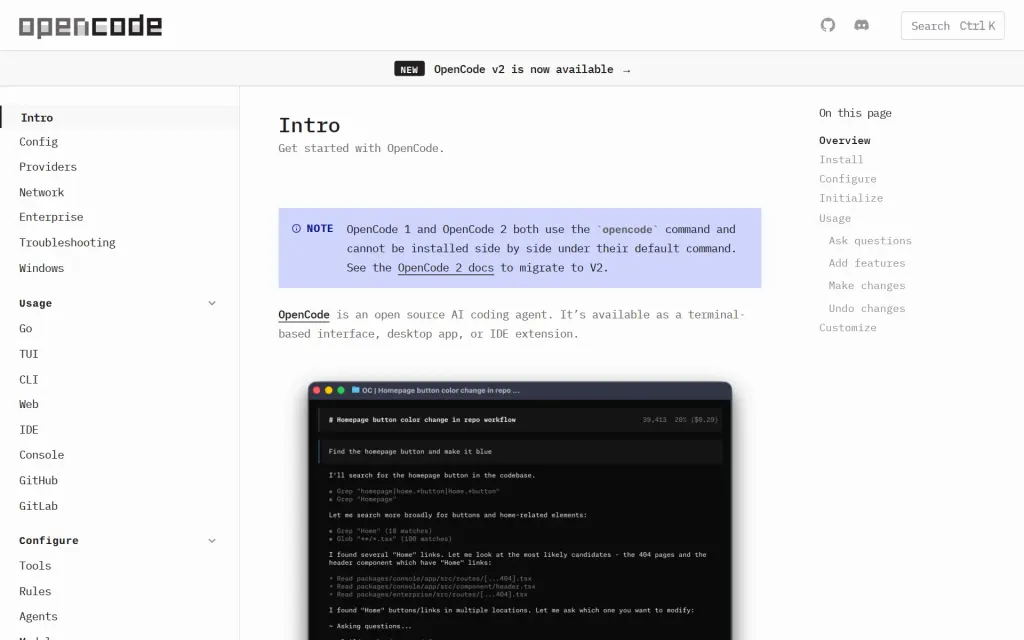
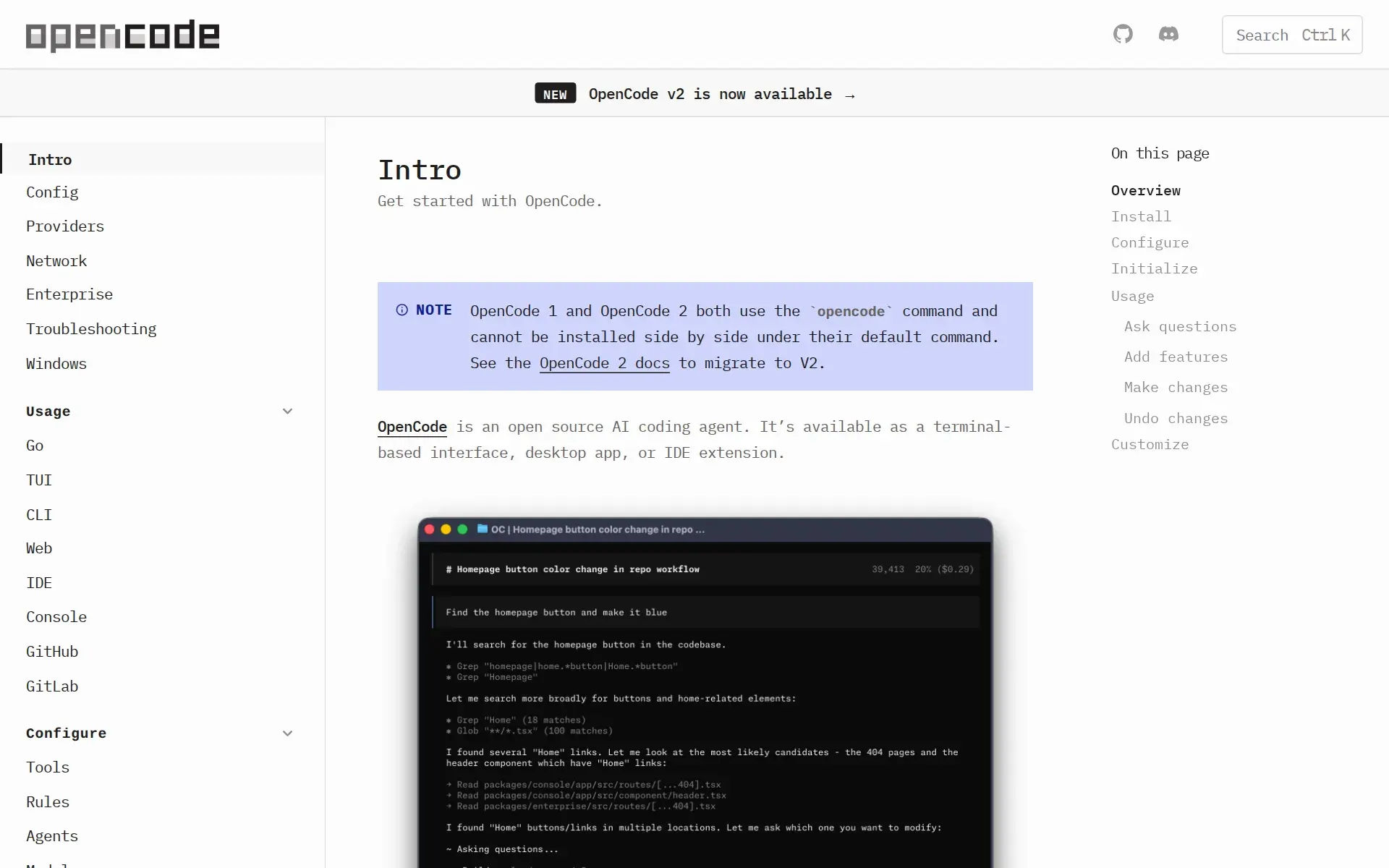
OpenCode is an open source AI coding agent. It's available as a terminal-based interface, desktop app, or web app.
opencode.ai/v2/docs
How much it does unattended
- Runs autonomously
- YesAn auto-approve mode clears every permission prompt that is not explicitly denied, and non-interactive runs plus scheduled GitHub workflows execute with no one watching.Was Partly before our last check.
Start OpenCode with --auto to automatically approve permission requests that are not explicitly denied.
opencode.ai/docs/permissions - Multi-agent
- YesPrimary agents invoke subagents that open child sessions, and several agents can be run in parallel on one project from separate sessions.
Subagents are specialized assistants that primary agents can invoke for specific tasks. You can also manually invoke them by @ mentioning them in…
opencode.ai/docs/agents - Agent permissions
- YesEach tool resolves to allow, ask or deny, with glob rules per shell command or file path and per-agent overrides; defaults are permissive apart from external directories.
Each permission rule resolves to one of: "allow" — run without approval; "ask" — prompt for approval; "deny" — block the action
opencode.ai/docs/permissions
Which models it runs on
- Claude
- YesClaude models are available both through an Anthropic API key and through the vendor's own gateway, and a Claude subscription can be connected directly.
Yes, OpenCode supports subscription plans from all major providers. You can use your Claude Pro/Max, ChatGPT Plus/Pro, or GitHub Copilot…
opencode.ai - GPT
- YesGPT models are listed on the vendor's own gateway with per-token prices, and a ChatGPT Plus or Pro login can be used instead of an API key.
ChatGPT Plus/Pro Log in with OpenAI to use your ChatGPT Plus or Pro account
opencode.ai - Open models
- YesOpen-weight families such as Qwen, DeepSeek, GLM and Kimi are offered on the gateway, and locally served models can be added as a custom provider.
OpenCode uses the AI SDK and Models.dev to support 75+ LLM providers and it supports running local models.
opencode.ai/docs/providers - Model choice
- YesYou pick the model per session or per agent in provider/model form; the vendor's own gateway is explicitly optional rather than a default lock-in.
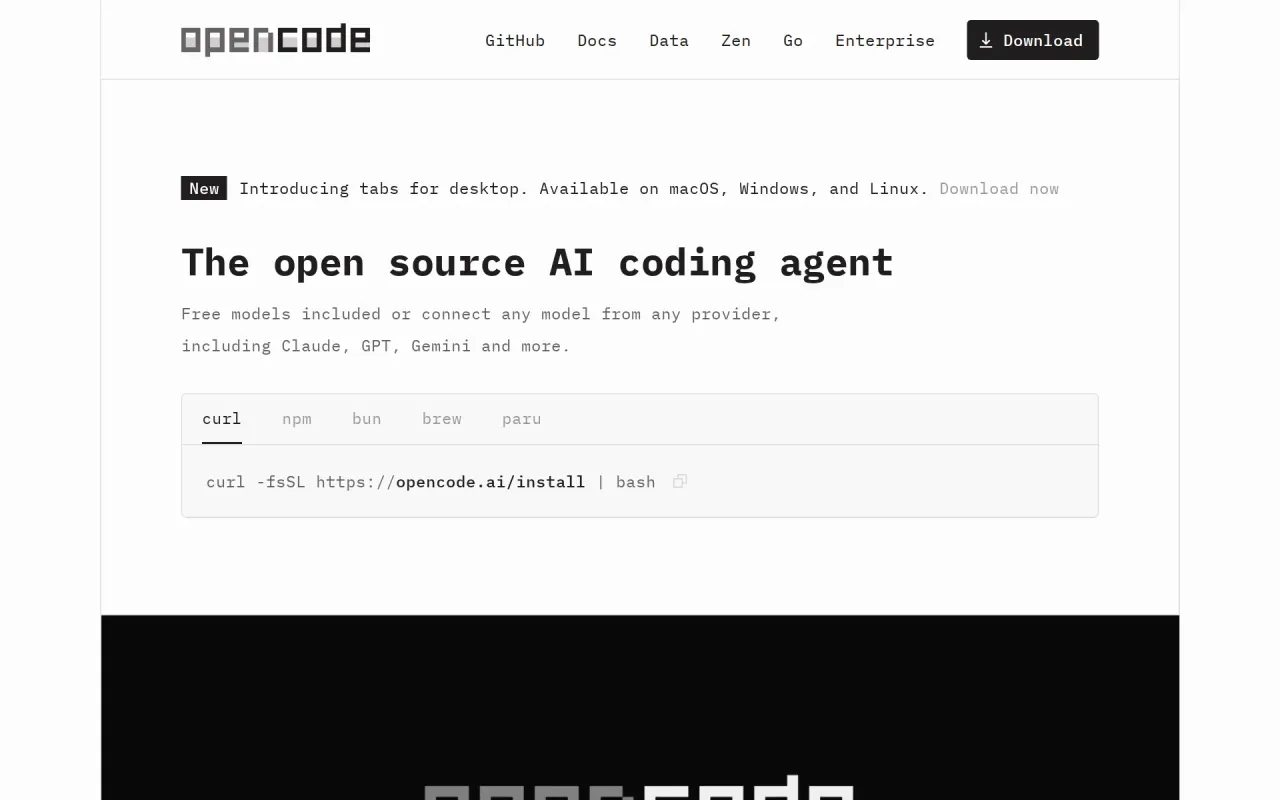
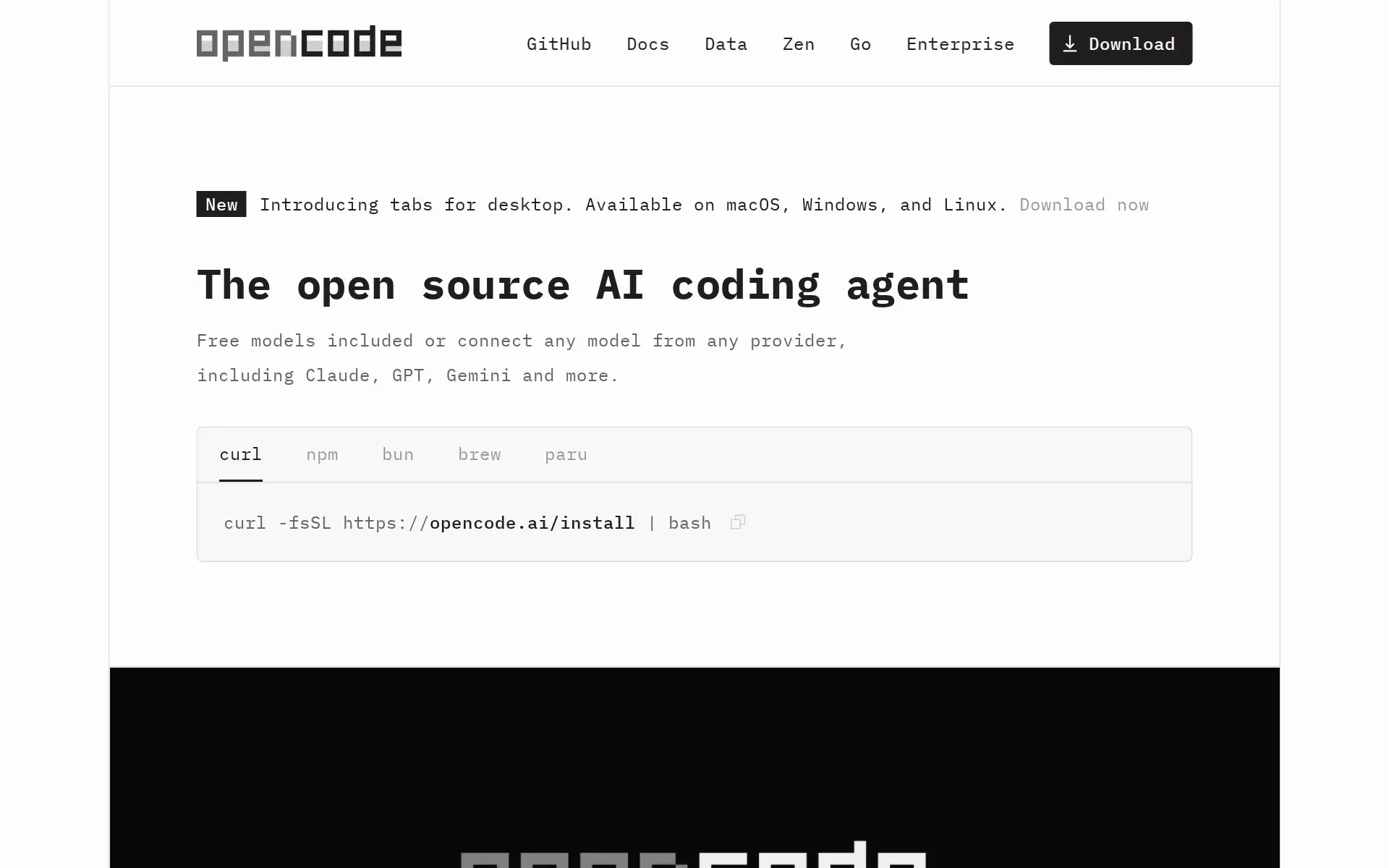
Free models included or connect any model from any provider, including Claude, GPT, Gemini and more.
opencode.ai
Where you use it
- In your editor
- YesAn extension covers VS Code and its forks with keyboard launch, selection sharing and file-reference shortcuts; it installs on first terminal run.
OpenCode integrates with VS Code, Cursor, or any IDE that supports a terminal. Just run opencode in the terminal to get started.
opencode.ai/docs/ide - On the command line
- YesThe terminal is the primary surface: a TUI by default, plus a non-interactive run command for scripting and automation.
Run opencode in non-interactive mode by passing a prompt directly.
opencode.ai/docs/cli - In your pipeline
- YesA GitHub Action runs it inside your own Actions runner, triggered by comments, PR events, a cron schedule or a manual dispatch.
OpenCode integrates with your GitHub workflow. Mention /opencode or /oc in your comment, and OpenCode will execute tasks within your GitHub Actions…
opencode.ai/docs/github - In a browser
- YesA browser interface is served by the local binary, bound to localhost by default and optionally exposed on the network with basic auth.
OpenCode can run as a web application in your browser, providing the same powerful AI coding experience without needing a terminal.
opencode.ai/docs/web
Whose machine it runs on
- Self-hosted
- YesThe agent runs on your own machine or server with no vendor backend in the path, and enterprises can point it at an internal AI gateway only.
OpenCode does not store your code or context data. All processing happens locally or through direct API calls to your AI provider.
opencode.ai/docs/enterprise - Open source
- YesSource is public under the MIT licence and the project takes outside issues and pull requests, so the agent itself can be forked and modified.
Yes, OpenCode is fully open source. The source code is public on GitHub under the MIT License, meaning anyone can use, modify, or contribute to its…
opencode.ai
What it costs to run
- How it meters
- YesThree meters coexist: the agent is free, the gateway bills per million tokens, a $10 or $40 monthly plan covers usage limits, and enterprise is per seat.Was Partly before our last check.
Console uses pay-as-you-go pricing. Below are the prices per 1M tokens.
opencode.ai/v2/docs/console/models - Free tier
- YesNo call and no account needed to start: the agent is free and ships with free models, with cost arriving only when you connect a paid provider.
OpenCode is 100% free to use. It also comes with a set of free models. There might be additional costs if you connect any other provider.
opencode.ai - API access
- YesA headless server publishes an OpenAPI 3.1 spec used to generate the SDK, covering sessions, messages, files and agents, with optional basic auth.
The opencode serve command runs a headless HTTP server that exposes an OpenAPI endpoint that an opencode client can use.
opencode.ai/docs/server - MCP server
- PartlyMCP runs one way here: OpenCode consumes local and remote MCP servers, and no MCP server of its own is documented, though its HTTP API lets other software drive it.
You can add external tools to OpenCode using the Model Context Protocol, or MCP. OpenCode supports both local and remote servers.
opencode.ai/docs/mcp-servers - Bring your own key
- YesYour own keys are the default path: credentials are stored locally per provider, base URLs are overridable, and enterprises can force an internal gateway.
With OpenCode you can use any LLM provider by configuring their API keys.
opencode.ai/docs
Buying it for a team
- A company can buy it
- YesOrganisations buy through a Console workspace with roles, invitations and shared credits, or through a quoted per-seat enterprise agreement.
A workspace holds everything in the Console: members, credits, budgets, providers, policies, and service accounts. Usage and billing are tracked per…
opencode.ai/v2/docs/console/workspaces - Seat model
- PartlyThe gateway charges no seat fee at any team size, so seats only appear in the unpriced enterprise agreement, which is quoted rather than published.
We use a per-seat model for OpenCode Enterprise. If you have your own LLM gateway, we do not charge for tokens used.
opencode.ai/docs/enterprise - Pooled budget
- YesOne prepaid balance covers the whole workspace, with an optional per-member limit layered on top; a request must fit both ceilings.
Console is free for any team size, with no seat fees. You pay only for usage, from prepaid credits that cover the whole workspace.
opencode.ai/v2/docs/console/billing - Admin controls
- YesAdmins constrain spend and model choice in the workspace, and an enterprise central config can restrict the agent to one approved gateway.
You can also disable all other AI providers, ensuring all requests go through your organization's approved infrastructure.
opencode.ai/docs/enterprise - Audit log
- PartlyUsage and request logs per member are recorded and exportable as CSV, but no log of administrative actions such as role or budget changes is documented.
Click a member to see their monthly budget, models and clients they use, usage charts, and request logs.
opencode.ai/v2/docs/console/members - Single sign-on
- YesBoth protocols are supported with named providers, one connection per workspace, and it is included rather than gated behind an enterprise tier.
Single sign-on (SSO) sends workspace members through your company's identity provider when they sign in. Owners and admins set it up in Settings ›…
opencode.ai/v2/docs/console/sso
What happens to your code
- Opt out of training
- PartlyPaid gateway models carry a zero-retention, no-training commitment, but several free and stealth models explicitly may use your data to improve the model.
Our providers follow a zero-retention policy and do not use your data for model training, with the following exceptions:
opencode.ai/v2/docs/console/models - Data residency
- PartlyThe gateway names US and EU hosting in the current docs while the Zen marketing page still says US only; running against your own provider puts residency in your hands.
All our models are hosted in the US and EU.
opencode.ai/v2/docs/console/models - Getting out
- PartlyUsage exports to CSV and refunds are possible within 14 days on unused credits, but any balance left when a workspace is deleted is lost outright.
Any remaining credit balance is forfeited.
opencode.ai/v2/docs/console/workspaces - Certifications
- PartlyA SOC 2 Type 2 report and security policies are offered through a trust centre under NDA; no ISO 27001 or GDPR certification is claimed on the site.
Our Trust Center has everything: SOC 2 Type 2 report, security policies, subprocessor list, and answers to common security questions. Visit…
opencode.ai/enterprise
Plans and pricing
Price and terms
- Free plan
- YesYesThe agent itself is free and open source with no account required, and ships with a set of free models
The terms in full
The free models are described as free "for a limited time" and several may use submitted data to improve the model; paid models are pay-as-you-go per 1M tokens, and a $10/month Go plan is the cheapest subscription.
Checked .
The Agents Index digest
Price changes and new agents like OpenCode, at most once a week.
Last issue: Devin vs Claude Code: Which Should You Pick? · 13 October 2026
Works with
 Claude
 GPT
GPT- YesOpen models
For AI agents
- MCP server
- Partly
- API
- Yes
Screenshots
Docs, opencode.ai, captured
Filed under
Sources and updates
Last changed
Sources39
- opencode.ai/
- opencode.ai/docs/zen
- opencode.ai/docs/enterprise
- opencode.ai/docs
- opencode.ai/docs/github
- opencode.ai/docs/github
- opencode.ai/docs/cli
- opencode.ai/docs/enterprise
- opencode.ai/docs/permissions
- opencode.ai/docs/zen
- opencode.ai/v2/docs/console/models
- opencode.ai/zen
- opencode.ai/docs/agents
- opencode.ai/docs/agents
- opencode.ai/docs/permissions
- opencode.ai/docs/providers
- opencode.ai/docs/providers
- opencode.ai/enterprise
- opencode.ai/v2/docs
- opencode.ai/v2/docs/console/workspaces
- opencode.ai/docs/cli
- opencode.ai/docs/go
- opencode.ai/docs/ide
- opencode.ai/docs/ide
- opencode.ai/docs/mcp-servers
- opencode.ai/docs/mcp-servers
- opencode.ai/docs/server
- opencode.ai/docs/server
- opencode.ai/docs/web
- opencode.ai/docs/web
- opencode.ai/go
- api.github.com/repos/anomalyco/opencodeRepository
- opencode.ai/v2/docs/console/api
- opencode.ai/v2/docs/console/billing
- opencode.ai/v2/docs/console/budgets
- opencode.ai/v2/docs/console/go
- opencode.ai/v2/docs/console/members
- opencode.ai/v2/docs/console/sso
- opencode.ai/v2/docs/policies
Repository30 August 2026
- Licence
- MIT
- Stars
- 202,501
- Forks
- 26,324
- Last push
- 30 August 2026
The Agents Index in AI answers0 of 1
- PerplexityDoes not cite The Agents IndexAsked
OpenCode alternatives
on Other sources: alternativeto.net, openalternative.co, theaiagentindex.com, replicas.dev, zbuild.io, respan.ai
Updates6
- Capabilities · Free tier · Terms
- Capabilities · Free tier · Terms
- Capabilities · Free tier · Price · Terms
- Capabilities · Free tier · Terms
- Capabilities · Free tier · Price · Terms
- Alternatives · Repository · Summary · Tagline
Is this yours? Claim it free and edit it in your dashboard, or feature it in Coding agents.