
Summary
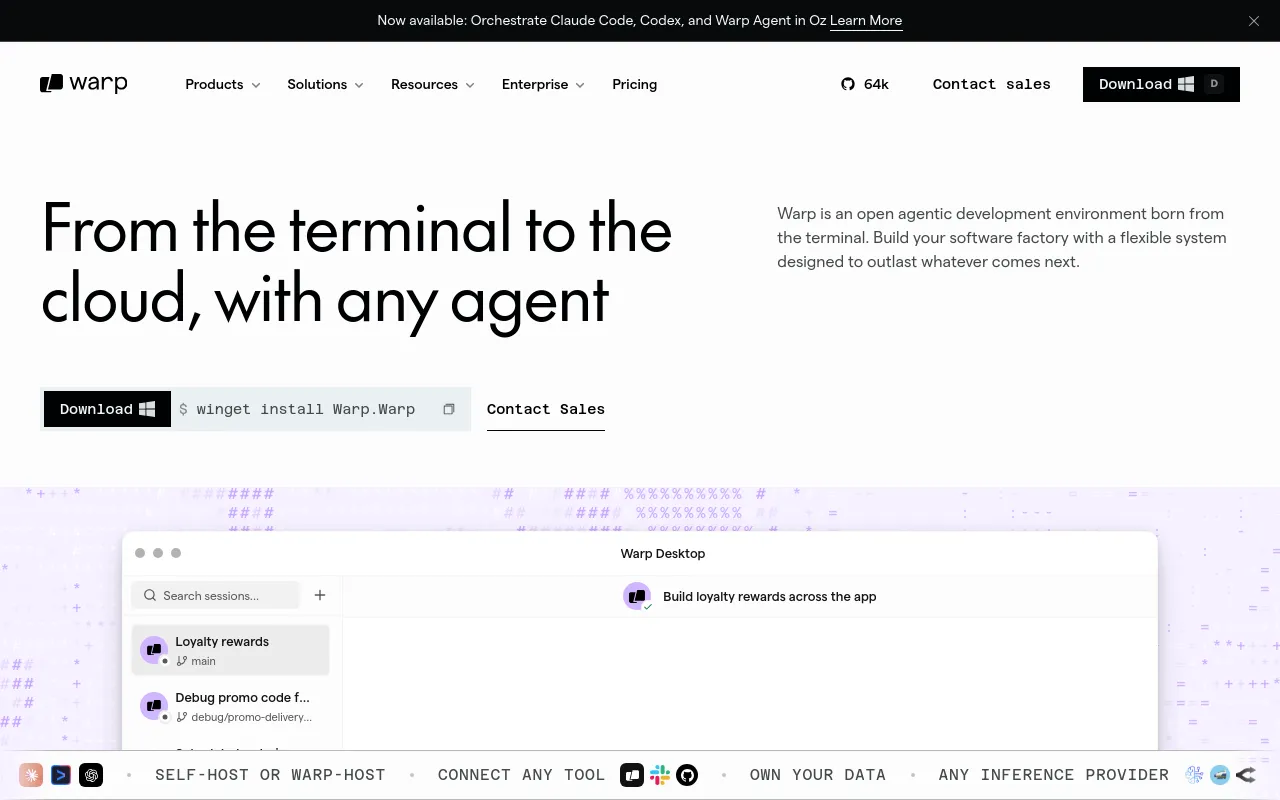
Warp is an agentic development environment: a modern terminal, a standalone agent CLI, and cloud agents that carry out coding tasks. Its automation platform runs and orchestrates those agents, locally or in Warp's cloud, at team scale.
- Best for
- Developers and teams who want one open platform that runs and coordinates multiple coding agents (Claude Code, Codex, Gemini CLI, Warp Agent) side by side across terminal, CLI and cloud, with shared team context and programmatic API access to cloud agent runs.
- Not for
- Developers who want to keep their current terminal and simply add one CLI agent to it. Claude Code, Codex CLI or Antigravity CLI are the lighter-weight fit for that.
- From
- Freethen $20 monthly · $18 billed annually
- Free tier
- YesFree is $0/month and self-serve: modern terminal, Warp Agent CLI access, limited cloud agents, limited Warp Drive, collaboration and cloud conversation storage, individually configured data controls. It bundles no agent usage - the docs state "The Free plan doesn't include bundled AI usage for the Warp Agent", so you must buy add-on credits (at a higher per-credit rate than paid plans) or bring your own inference before the agent runs on Warp models.
What it does
- Writes code
- YesThe coding agent generates and edits code from natural-language prompts and surfaces the result as inline diffs you accept or reject.
Warp's coding agent is designed to help you generate, edit, and manage code directly in the Agentic Development Environment.
docs.warp.dev/code/overview - Debugs and fixes
- YesLocal agents diagnose failures in a real terminal; in CI the agent pulls failure logs, attempts a root-cause fix and opens a PR with it.
The agent integrates seamlessly into your CI pipeline, automating tasks like code review, issue triage, bug fixing, and maintenance using your…
docs.warp.dev/platform/integrations/git… - Writes tests
- YesTest authoring is one of the vendor's enumerated coding capabilities, and the agent can run the test it wrote inside a REPL session.
“Identify functions without test coverage and create Jest test files for them.”
docs.warp.dev/code/overview - Reviews code
- YesCloud agents review other people's pull requests and comment inline, via GitHub Actions or the GitHub App; the in-app review panel is the inverse, a human reviewing the agent.
Agent inspects changed files, analyzes the diff, and comments inline
docs.warp.dev/platform/integrations/git… - Whole-codebase work
- YesCodebase Context indexes the Git-tracked repo (and other indexed repos) so agents can carry repo-wide changes; index size caps vary by plan, at least 5,000 files per codebase on every plan.
Codebase Context helps Agents understand your project by indexing your local codebase.
docs.warp.dev/agents/capabilities/codeb… - Ships it
- PartlyAgents commit, push branches and open pull requests through the GitHub integration, but no page describes the agent performing a deployment.
Posts progress updates and a final summary back into the thread, including any pull requests the agent opened and branches it pushed.
docs.warp.dev/platform/integrations/git… - Done-for-you service
- NoYou run the software. The only services Warp sells are Enterprise-tier onboarding, a named implementation engineer and an account manager; no build-and-run engagement is offered.
White-glove onboarding and implementation engineer support
warp.dev/pricing
How much it does unattended
- Runs autonomously
- YesCloud agents run unattended from schedules, integrations, CI or the API; locally, Run until completion auto-approves every command until the task ends.
Warp cloud agents can run unattended from schedules, team tools, CI, the Oz CLI, or the API.
docs.warp.dev/guides/agent-workflows/ho… - Multi-agent
- YesOne agent spawns and coordinates children, which may run a different harness than the parent; orchestrations are one level deep and require approval before launch.
Multi-agent orchestration lets one agent spawn and coordinate other agents to parallelize work, delegate specialized tasks, or verify another agent's…
docs.warp.dev/platform/orchestration - Agent permissions
- YesFour autonomy levels per action type, plus regex allowlist and denylist; the denylist wins, except that Run until completion bypasses your personal denylist while admin-enforced rules still hold.
The denylist takes precedence over both the allowlist and Agent decides: if a command matches the denylist, the Agent asks for permission even when…
docs.warp.dev/agents/capabilities/agent…
Which models it runs on
- Claude
- YesAnthropic models are a first-class option in the model picker, and Claude Code can also be used as the agent harness inside Warp.
Models from OpenAI, Anthropic, Google, and open source providers are available, with configurable reasoning levels and per-profile defaults.
docs.warp.dev/agents/inference/model-ch… - GPT
- YesOpenAI models are listed in the vendor's own model table alongside Anthropic and Google; Codex is also supported as an alternative harness.
Models from OpenAI, Anthropic, Google, and open source providers are available, with configurable reasoning levels and per-profile defaults.
docs.warp.dev/agents/inference/model-ch… - Open models
- YesOpen-weight models are hosted for you through Fireworks AI, and an Auto (Open-weights) router picks between them; Llama is absent from that enumerated table.
Warp also supports leading open source models hosted via Fireworks AI, so you can run them from inside Warp without setting up your own inference…
docs.warp.dev/agents/inference/model-ch… - Model choice
- YesYou pick from the model picker or write your own routing rules; an admin or your plan can grey out models, and Auto hands selection back to Warp if you want it.
Warp lets you choose from a curated set of large language models to power your agents, or let Warp auto-select the best model for each task.
docs.warp.dev/agents/inference/model-ch…
Where you use it
- In your editor
- NoThere is no first-party IDE or editor extension; Warp ships its own editor and diff review and positions itself as the thing that replaces the external IDE. It can only launch your editor.
It detects opportunities to apply code diffs and surfaces them inline, allowing you to review and apply changes without switching to an external IDE.
docs.warp.dev/code/overview - On the command line
- YesTwo terminal surfaces: the Warp Terminal app for macOS, Linux and Windows, and a standalone agent CLI that runs in any terminal without the app.
The Warp Agent CLI is a standalone terminal program that runs the same agent without the Warp app.
docs.warp.dev - In your pipeline
- YesTwo paths onto a pull request: the oz-agent-action GitHub Action inside your workflows, or mentioning the GitHub App on an issue, PR or review comment with no workflow file.
Run agents directly in your GitHub Actions workflows using oz-agent-action.
docs.warp.dev/platform/integrations/git… - In a browser
- YesA browser app manages cloud agents, runs, schedules and environments without installing Warp, and works on mobile; Warp Drive is also reachable on the web.
The Oz web app provides a visual interface for managing cloud agents. You can start runs, browse agents and skills, create schedules, configure…
docs.warp.dev/platform/oz-web-app
Whose machine it runs on
- Self-hosted
- PartlyEnterprise only, and execution plane only: agents run on your machines while orchestration, session management and inference still route through Warp's backend.
Self-hosted agents are available exclusively to teams on an Enterprise plan.
docs.warp.dev/platform/self-hosting - Open source
- PartlyThe client is AGPL v3 and auditable. Nothing Warp says makes the same claim for the Automation Platform, cloud agents or Factories, and no licence is named for them.
Warp's client is open source under AGPL v3, so the editor and terminal that host your agents are fully auditable.
docs.warp.dev/agents
What it costs to run
- How it meters
- YesPer-credit, on top of a per-seat subscription. A credit is token-proportional and non-deterministic, metered across inference, sandbox compute and platform, all drawing on one balance.
A credit in Warp is a unit of work representing the total processing required to complete an interaction with an Agent. It is not the same as “one…
docs.warp.dev/support-and-community/pla… - Free tier
- PartlyThe Free plan is a self-serve download with no call, but it bundles no agent usage: you must buy add-on credits or bring your own inference before the agent will run on Warp models.
The Free plan doesn't include bundled AI usage for the Warp Agent.
docs.warp.dev/support-and-community/pla… - API access
- YesA REST API with a published OpenAPI spec creates and inspects cloud agent runs, with official Python and TypeScript SDKs; a separate read-only analytics API is Enterprise-only.
The Oz API & SDK lets you create, monitor, and inspect cloud agent runs programmatically. Use the REST API from any HTTP client, or the official…
docs.warp.dev/reference/api-and-sdk - MCP server
- PartlyWarp is a mature MCP client for local and cloud agents. Being queried by another agent works only through the hosted Factory MCP server, which is inside Warp Factories Early Access.
Factory MCP is a hosted Model Context Protocol (MCP) server that connects coding agents to your team's factories, in both directions
docs.warp.dev/factories/factory-mcp - Bring your own key
- YesThree levels: your own provider key stored on your device, your own OpenAI-compatible endpoint, and Enterprise BYOLLM through your AWS or Google Cloud account. Device-local keys do not reach cloud agents, and orgs over ten employees need Business or Enterprise.
Use your own API key for OpenAI, Anthropic, or Google models. Keys are stored locally on your device.
docs.warp.dev/agents/inference/bring-yo…
Buying it for a team
- A company can buy it
- YesBusiness is self-serve per user up to 25 seats; Enterprise is sales-led and applied by Warp internally, billed by invoice through an account manager.
For teams scaling AI-powered development (up to 25 seats)
warp.dev/pricing - Seat model
- YesPriced per user with a 25-seat ceiling on Business and unlimited seats on Enterprise; no minimum seat count is published, and seats are prorated on add and remove.
On paid plans, adding new members automatically adds them as paid seats. New members are billed on a prorated basis for the remainder of the billing…
docs.warp.dev/enterprise/team-managemen… - Pooled budget
- PartlySplit model: each seat gets its own monthly credit allowance, while purchased top-up credits go into one team-wide pool. Only Enterprise gets a contracted shared pool by default.
On the multi-seat paid plans, plan-included credits are per-seat while add-on credits are shared across the team
docs.warp.dev/support-and-community/pla… - Admin controls
- PartlyAdmins set org-wide autonomy per action type plus regex command allowlists and denylists, and can lock users out of overriding them. On Free most settings are fixed; configurability starts at Business and is complete on Enterprise.
Configure how agents behave across your organization, including autonomy levels and command permissions. This is where you balance agent productivity…
docs.warp.dev/enterprise/team-managemen… - Audit log
- PartlyWarp logs agent actions, and an Enterprise analytics API returns message-level events for compliance review, but it needs an admin toggle and there is no audit trail of admin configuration changes.
Audit message-level activity - Filter the events endpoint by run_type, user_id, conversation_id, message_type, or tool_type for compliance reviews…
docs.warp.dev/enterprise/enterprise-fea… - Single sign-on
- PartlyBoth SAML 2.0 and OIDC, with Okta, Entra ID, Google Workspace and OneLogin named, plus SCIM and admin-enforced SSO. Gated: SAML SSO starts at Business, and Free through Max sign in with password, Google or GitHub instead.
Any SAML 2.0 or OpenID Connect (OIDC) compatible provider
docs.warp.dev/enterprise/security-and-c…
What happens to your code
- Opt out of training
- YesZero Data Retention agreements with the contracted providers apply on every plan, including Free; admins on Business and Enterprise can additionally switch off the optional interaction-data sharing, which is already off by default there.
Warp has Zero Data Retention (ZDR) agreements with its contracted LLM providers (Anthropic, OpenAI, Google), meaning they do not store or train on…
docs.warp.dev/enterprise/security-and-c… - Data residency
- YesUnited States only, on Google Cloud. No EU or other region is offered anywhere on the site; Enterprise BYOLLM is the one lever that moves inference into your own cloud account.
Any data supplied to Warp by users or companies is stored on Google Cloud Platform. Database locations are in the United States.
warp.dev/legal/security - Getting out
- PartlyAccount and data deletion is self-serve within 30 days, and Drive notebooks and workflows export as Markdown and YAML, but no bulk export tool is documented. Monthly plan credits expire each cycle; purchased credits last 12 months and are forfeited if you leave the team.
Unused credits do not rollover to the next cycle and can't be transferred to other accounts.
docs.warp.dev/support-and-community/pla… - Certifications
- YesSOC 2 Type II attested, report on request via the trust centre; GDPR handled contractually through a DPA with EU SCCs and the UK Addendum. ISO 27001 is claimed only of Google's datacentres, not of Warp.
Yes, Warp has obtained a SOC 2 Type 2 attestation from an accredited third party. Visit Warp's Trust Center to request the report.
warp.dev/legal/security
35 sourced claims on this page. Checked 2026-09-03. How we check.
Alternatives
Where we would send a reader instead, in that listing's own words.
Agentic coding tool from Anthropic that edits your codebase, runs commands, and opens pull requests.
OpenAI's terminal coding agent for inspecting, editing and running repository code from the shell.
Filed under
Sources and updates
The pages we read33
1 of 33 independent of the vendor.
- docs.warp.dev/agents/inference/model-choice5 fields
- warp.dev/pricing4 fields
- docs.warp.dev/code/overview3 fields
- docs.warp.dev/platform/faqs3 fields
- docs.warp.dev/platform/integrations/github-actions3 fields
- docs.warp.dev/2 fields
- docs.warp.dev/agents2 fields
- docs.warp.dev/enterprise2 fields
- docs.warp.dev/enterprise/security-and-compliance/security-overview2 fields
- warp.dev/legal/security2 fields
- docs.warp.dev/support-and-community/plans-and-billing/credits2 fields
- docs.warp.dev/support-and-community/plans-and-billing/pricing-faqs2 fields
- warp.dev/1 field
- docs.warp.dev/agents/capabilities/agent-profiles-permissions1 field
- docs.warp.dev/agents/capabilities/codebase-context1 field
- docs.warp.dev/agents/inference/bring-your-own-api-key1 field
- docs.warp.dev/code/code-editor1 field
- docs.warp.dev/enterprise/enterprise-features/analytics-api1 field
- docs.warp.dev/enterprise/security-and-compliance/sso1 field
- docs.warp.dev/enterprise/support-and-resources/billing1 field
- docs.warp.dev/enterprise/team-management/admin-panel1 field
- docs.warp.dev/enterprise/team-management/teams1 field
- docs.warp.dev/factories/factory-mcp1 field
- docs.warp.dev/guides/agent-workflows/how-to-run-unattended-agents1 field
- docs.warp.dev/platform/integrations/github1 field
- docs.warp.dev/platform/integrations/quickstart-github-actions1 field
- docs.warp.dev/platform/orchestration1 field
- docs.warp.dev/platform/orchestration/multi-agent-runs1 field
- docs.warp.dev/platform/oz-web-app1 field
- docs.warp.dev/platform/self-hosting1 field
- docs.warp.dev/reference/api-and-sdk1 field
- api.github.com/repos/warpdotdev/warpPlatform record1 field
- docs.warp.dev/support-and-community/plans-and-billing/plans-pricing-refunds1 field
Platform record2026-08-30
- Licence
- AGPL-3.0
- Stars
- 64,654
- Forks
- 5,489
- Last push
- 2026-08-30
Coverage elsewhere1
Updates4
- Capabilities · Commercial terms · Free tier
- Capabilities · Commercial terms · Free tier · Price
- Alternatives · One-liner · Repository · Summary
- Summary