
Summary
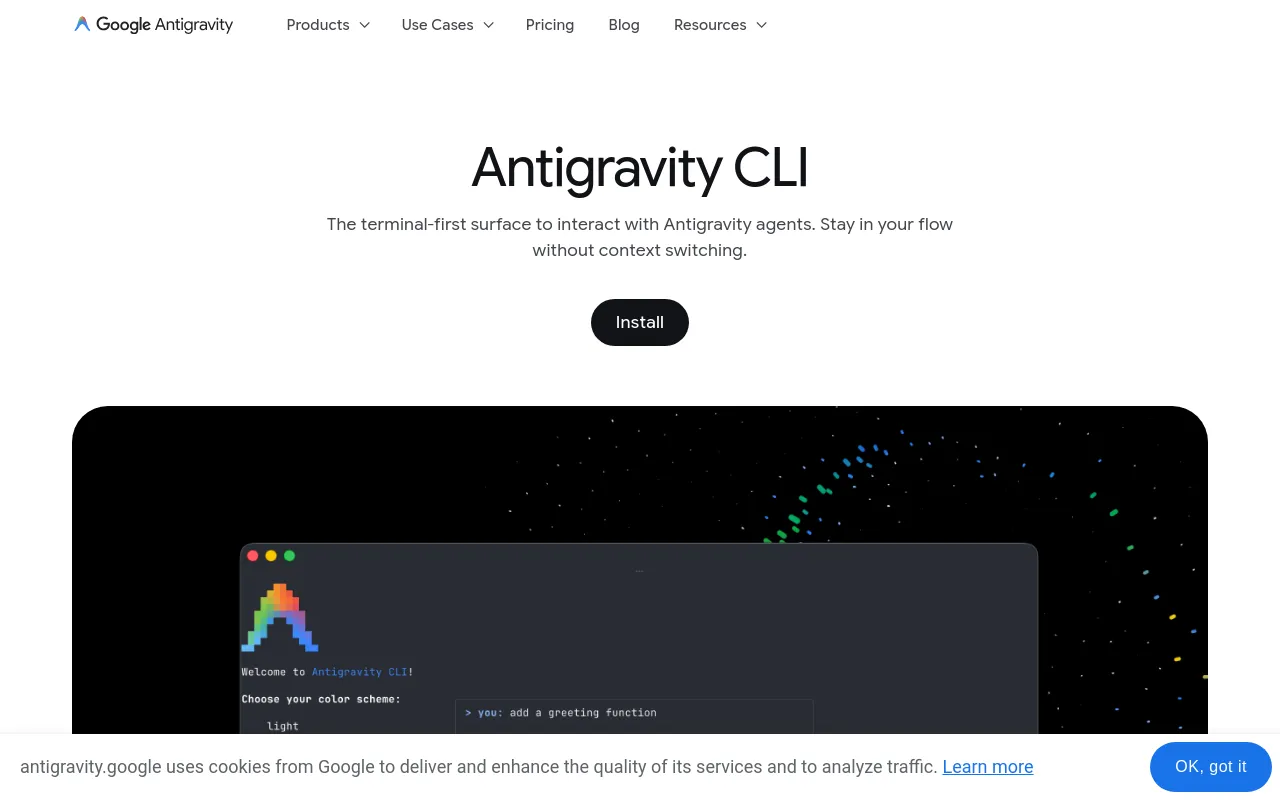
Antigravity CLI is Google's terminal user interface for the Antigravity agent harness, installed as the agy binary on macOS, Linux and Windows. It runs multi-file agent tasks in the shell, spawning parallel subagents and pausing at artifacts for review.
- Best for
- Developers already inside the Google ecosystem (Google AI subscription, GCP billing) who want a free terminal agent with Gemini, Claude and gpt-oss model access, especially anyone migrating off a now-sunset Gemini CLI workflow.
- Not for
- Developers who specifically valued Gemini CLI's open-source license, teams that need ACP compatibility to run their agent inside a third-party editor today, or anyone who needs published per-seat pricing before evaluating.
- From
- Freethen €21.99/month
- Free tier
- YesThe 'For Individuals' plan costs $0/month with no subscription: the full agent model list, unlimited Tab completions and Command requests, and 'Basic weekly rate limits' whose numeric ceiling the vendor does not publish.
What it does
- Writes code
- YesThe TUI's core loop is instructing agents in plain language to edit and build code across the workspace, with the same harness as the desktop app.
Edit, orchestrate, and build all in natural language. Tell your agents what you need, and they’ll work on getting it done.
antigravity.google/product/antigravity-… - Debugs and fixes
- YesA dedicated /boost command escalates hard defects to multi-agent reasoning, and the docs push you to give the agent a test command so it iterates on failures itself.
Multi-agent deep reasoning for complex bugs, race conditions, and algorithms.
antigravity.google/docs/cli/features - Writes tests
- YesThe vendor's own best-practice sequence is to have the agent author a test block before implementing, then run the suite to verify its change.
If tests do not exist, direct the agent to write a standard test block first.
antigravity.google/docs/cli/best-practi… - Reviews code
- PartlyThe diff viewer opens workspace changes, agent turns and any commit in the repository for line-level comments, but review is a human reading diffs to steer the agent; no pull-request or reviewer workflow is documented.
The /diff command opens the Interactive Diff Viewer, a full-screen panel that allows you to inspect changes in your workspace and conversation…
antigravity.google/docs/cli/commands/di… - Whole-codebase work
- YesIt indexes the trusted workspace and the docs direct large refactors and repository-wide sweeps to concurrent background subagents rather than one serial thread.
For large-scale sweeps or multi-file refactoring, direct the primary agent to spawn concurrent background subagents.
antigravity.google/docs/cli/best-practi… - Ships it
- PartlyThe agent executes local shell commands under your permission rules, so it can run deploy scripts you authorise, but no release, CD or environment-promotion feature is documented anywhere in the CLI docs.
The Terminal Sandbox is a lightweight security isolation mechanism that protects your host system from potentially destructive file manipulations or…
antigravity.google/docs/cli/features - Done-for-you service
- NoSelf-installed software: you run the agy binary on your own machine. Google sells no build-and-run service around it.
Antigravity CLI runs natively on macOS, Linux, and Windows.
antigravity.google/docs/cli/install
How much it does unattended
- Runs autonomously
- YesAutonomy is a setting: the default prompts before writes and commands, while always-proceed or a headless one-shot run finishes a task with nobody watching.
Select agent autonomy level (request-review, always-proceed, or strict).
antigravity.google/docs/cli/features - Multi-agent
- YesThe main agent spawns concurrent subagents with their own tool grants, monitored in an /agents panel; collaborative agent teams via /teamwork-preview are gated to paid plans.
Subagents are independent, concurrent agent sessions designed to tackle specific background tasks in parallel with the main conversation.
antigravity.google/docs/cli/features - Agent permissions
- YesEvery sensitive action is an action(target) resource sorted into deny, ask and allow lists with deny winning, and unconfigured commands, MCP tools and out-of-workspace files default to asking.
Every sensitive operation the agent performs is represented as a permission resource formatted as action(target).
antigravity.google/docs/cli/permissions
Which models it runs on
- Claude
- PartlyClaude Sonnet 4.6 and Opus 4.6 are selectable reasoning models on the free and consumer paid plans, but the model matrix marks both unavailable on Enterprise deployments.
| Claude Opus 4.6 (thinking) | ✅ | ✅ | ✅ | ❌ |
antigravity.google/docs/models - GPT
- PartlyThe only OpenAI-lineage option in the reasoning-model table is the open-weight GPT-OSS-120b, absent on Enterprise; no proprietary GPT model appears anywhere in that per-plan matrix.antigravity.google/docs/models
- Open models
- PartlyOne open-weight model, GPT-OSS-120b, is offered as a hosted choice on the consumer plans and is switched off for Enterprise; you cannot supply your own weights.
For the core reasoning model, Antigravity offers leading frontier models. Availability depends on your plan:
antigravity.google/docs/models - Model choice
- PartlyYou pick the reasoning model from the vendor's fixed per-plan list and it persists across sessions, but auxiliary models are fixed and there is no third-party provider selection.
Users can select which reasoning model they want to use within the model selector drop-down under the conversation prompt box:
antigravity.google/docs/models
Where you use it
- In your editor
- PartlyThe CLI itself is a keyboard TUI with no editor surface; the same agent harness runs in Antigravity 2.0 and IDE extensions, and conversations export between them.
| Primary interface | Keyboard-driven TUI | Visual desktop editor / IDE |
antigravity.google/docs/cli/overview - On the command line
- YesThe terminal is the whole product: a lightweight TUI installed as agy that carries the desktop agent's reasoning and multi-file editing into the shell.
The Antigravity CLI is the lightweight Terminal User Interface (TUI) surface of Antigravity.
antigravity.google/docs/cli/overview - In your pipeline
- YesHeadless print mode is built for pipelines, returning JSON or NDJSON events; an unauthenticated CI run fails fast rather than hanging, and a Gemini API key avoids the browser sign-in.
Run Antigravity CLI non-interactively to script agent tasks, integrate with CI pipelines, and capture machine-readable output.
antigravity.google/docs/cli/headless - In a browser
- YesThe CLI ships a Remote Control daemon you register as an OS service, after which the browser dashboard drives that machine's conversations, tasks and artifacts.
The headless daemon is built into the Antigravity CLI.
antigravity.google/docs/remote-control
Whose machine it runs on
- Self-hosted
- PartlyThe binary and its sandbox run on your own machine and requests can be pointed at a Gemini-compatible endpoint or your own Cloud project behind VPC-SC, but the models themselves stay Google-hosted.
To send model requests to a different Gemini-compatible endpoint, set the GOOGLE_GEMINI_BASE_URL environment variable:
antigravity.google/docs/cli/install - Open source
- NoShipped as a prebuilt executable fetched by an install script; no source repository for the CLI is published on the site.
Execute the native installer script to download and install the executable to ~/.local/bin/agy
antigravity.google/docs/cli/install
What it costs to run
- How it meters
- YesBilling is subscription quota first, then metered AI credits at Agent Platform consumption rates, or pure consumption billing for organisations; nothing is priced per seat in the CLI itself.
AI credits are consumed at standard Gemini Enterprise Agent Platform consumption pricing.
antigravity.google/docs/plans - Free tier
- YesA standing zero-cost individual plan needs no subscription and no sales call, giving the full agent model list with basic weekly rate limits rather than a time-boxed trial.
For Individuals $0/month
antigravity.google/pricing - API access
- YesHeadless runs return a JSON envelope or streaming NDJSON with token usage and tool calls, accept a JSON schema, and take prompts on stdin; note the terms forbid third-party clients using Antigravity OAuth.
Headless mode (also called print mode) sends a single prompt to the agent, streams or returns the response, and exits.
antigravity.google/docs/cli/headless - MCP server
- PartlyIt is an MCP client: local stdio and remote servers are configured globally or per workspace with per-tool approval, but no MCP server is documented that would let another agent query this CLI.
Antigravity CLI supports both local stdio processes and remote host MCP server configurations.
antigravity.google/docs/cli/mcp - Bring your own key
- YesYou can run the CLI on your own Gemini API key with no account session, or on your own Google Cloud project; the plans page still says bring-your-own-key is unsupported, which contradicts this.
Run Antigravity CLI with your own Gemini API key instead of a signed-in Google account. Model requests go directly to the Gemini API, and the CLI…
antigravity.google/docs/cli/install
Buying it for a team
- A company can buy it
- YesOrganisations buy through Google Cloud rather than this site, connecting the CLI to a billed Cloud project or a Gemini Enterprise licence under Cloud terms.
Google Cloud customers can now access Antigravity 2.0 and CLI.
antigravity.google/pricing - Seat model
- PartlyEnterprise access is a per-user licence a Cloud administrator assigns, with one licence per project and location, but no seat price, seat minimum or ceiling is published anywhere on the site.
Licenses are assigned by your organization’s Google Cloud administrator.
antigravity.google/docs/enterprise - Pooled budget
- PartlyConsumer plans meter into your own credit pool rather than a team balance; organisations get consumption billed centrally to the Cloud project behind the licence, with no documented per-seat budget cap.
Gemini Enterprise Agent Platform - Connect directly to Agent Platform API to use Antigravity with consumption-based billing.
antigravity.google/docs/enterprise - Admin controls
- PartlyCentral administrative control arrives with the Google Cloud path; on individual plans the allow/deny/ask rules live in a user-editable settings file, and the vendor says admin URL allowlists are not yet honored.
Operates under your existing Google Cloud Terms of Service with centralized administrative controls.
antigravity.google/docs/enterprise - Audit log
- PartlyEnterprise instances can log model requests and responses into the Cloud project for compliance records; nothing describes an administrative action trail, and consumer plans get no audit log at all.
Audit model interactions and maintain enterprise compliance records for your Gemini Enterprise Agent Platform instance.
antigravity.google/docs/enterprise - Single sign-on
- PartlyBusiness sign-in is a Google SSO flow that detects your licence, and external identity providers such as Okta work through Workforce Identity Federation; a documented defect logs some federated users out on restart.
Bring Your Own Identity (BYOID) uses Workforce Identity Federation (WIF) to let your organization authenticate through an external identity provider,…
antigravity.google/docs/enterprise
What happens to your code
- Opt out of training
- YesConsumer terms say your interactions feed Google's model development unless you change a setting, and the enterprise path states corporate data is never used for training.
If you don’t want your Interactions used in this way, navigate to settings to change your preference on how such data is used.
antigravity.google/terms - Data residency
- PartlyEnterprise deployments choose a global, US or EU endpoint to meet residency rules, with image generation only on global; consumer plans publish no jurisdiction choice at all.
Antigravity CLI, Antigravity 2.0, and IDE Extensions support multi-region deployment endpoints to satisfy regional data residency requirements:
antigravity.google/docs/enterprise - Getting out
- PartlyConversations live locally and export to the desktop app, but deleting your stored interactions means emailing support rather than a self-serve control, and nothing says whether purchased credits expire.
You will have the option to delete your Interactions. If you would like to request that your Interactions be deleted, you can email…
antigravity.google/terms
Not established: Certifications
33 sourced claims on this page. Checked 2026-09-10. How we check.
Alternatives
Where we would send a reader instead, in that listing's own words.
Agentic coding tool from Anthropic that edits your codebase, runs commands, and opens pull requests.
OpenAI's terminal coding agent for inspecting, editing and running repository code from the shell.
Open-source terminal AI pair programmer that edits and commits code in your local git repo.
Filed under
Sources and updates
The pages we read23
1 of 23 independent of the vendor.
- antigravity.google/docs/enterprise7 fields
- antigravity.google/docs/cli/features5 fields
- antigravity.google/docs/cli/install5 fields
- antigravity.google/pricing5 fields
- antigravity.google/docs/models4 fields
- antigravity.google/docs/cli/best-practices3 fields
- antigravity.google/docs/cli/overview3 fields
- antigravity.google/download3 fields
- antigravity.google/product/antigravity-cli3 fields
- antigravity.google/terms3 fields
- antigravity.google/docs/cli/headless2 fields
- antigravity.google/docs/plans2 fields
- antigravity.google/docs/teamwork2 fields
- one.google.com/about/google-ai-plansIndependent source1 field
- antigravity.google/blog/changes-to-antigravity-plans1 field
- antigravity.google/docs/cli/commands/diff1 field
- antigravity.google/docs/cli/mcp1 field
- antigravity.google/docs/cli/modes1 field
- antigravity.google/docs/cli/permissions1 field
- antigravity.google/docs/cli/sandbox1 field
- antigravity.google/docs/cli/subagents1 field
- antigravity.google/docs/cli/tutorial1 field
- antigravity.google/docs/remote-control1 field
Platform record2026-08-30
- Stars
- 2,081
- Forks
- 189
- Last push
- 2026-08-27
Coverage elsewhere3
Updates6
- Capabilities · Commercial terms · Free tier · Price
- Capabilities · Commercial terms · Free tier · Price
- Capabilities · Commercial terms · Free tier · Price
- Capabilities · Commercial terms · Free tier
- Alternatives · Documentation link · One-liner · Summary
- Summary