
Not for Non-technical users or teams wanting a fully managed, plug-and-play coding assistant with built-in model access and no setup overhead.
Changed since our last check
- Multi-agent: now Partly. It was Yes when we checked on .
- Open source: now Partly. It was Yes when we checked on .
- Seat model: now Partly. It was No when we checked on .
- Pooled budget: now Yes. It was Partly when we checked on .
- Admin controls: now Yes. It was Partly when we checked on .
The facts, with their sources
What it does
- Writes code
- YesCore purpose: the agent authors code from a natural-language task across GUI, CLI and SDK surfaces, including scripted headless runs.
Build AI agents that write software. A clean, modular SDK with production-ready tools.
docs.openhands.dev/llms.txt - Debugs and fixes
- YesDocumented for CI failure remediation and incident work: it investigates failures, finds likely causes and implements the fix.
Investigate failed builds and tests, identify likely causes, and propose or implement fixes.
openhands.dev/services - Writes tests
- YesTest generation and coverage maintenance is named as a supported workflow, not only code authoring, on the services page.
Generate tests, expand coverage, and keep test suites aligned as the codebase changes.
openhands.dev/services - Reviews code
- YesA dedicated PR review workflow reads someone else's diff and posts inline comments on the pull request within minutes.
The OpenHands PR Review workflow is a GitHub Actions workflow that: Triggers automatically when PRs are opened or when you request a review
docs.openhands.dev/openhands/usage/use-… - Whole-codebase work
- PartlyRepository-wide migrations are documented as prompts the agent handles, but the Large Codebase SDK that targets big repos is an Enterprise-only line on the pricing table.openhands.dev/pricing
- Ships it
- PartlyIt ends at a pull request rather than a deploy: the documented automation loop opens a PR and leaves the merge and release to you.
When the trigger fires, the agent runs in an isolated cloud container, does the work, and opens a pull request. You review the output.
openhands.dev/enterprise - Done-for-you service
- PartlySoftware you run yourself, but the vendor also sells advisory and implementation engagements that deploy agents alongside your team.
We work alongside your team to design and deploy production-ready agents that are integrated with your environment and workflows, on an OpenHands…
openhands.dev/services
How much it does unattended
- Runs autonomously
- YesEvent-triggered runs complete the task with nobody in the loop, and headless CLI mode forcibly approves every action.
Headless mode always runs in always-approve mode. The agent will execute all actions without any confirmation. This cannot be changed
docs.openhands.dev/openhands/usage/cli/… - Multi-agent
- PartlyA parent agent can delegate to sub-agents, but the documented TaskToolSet runs them sequentially and blocks, so it is delegation rather than parallel coordination.Was Yes before our last check.
The TaskToolSet lets a parent agent launch sub-agents that handle complex, multi-step tasks autonomously. Each sub-agent runs synchronously - the…
docs.openhands.dev/sdk/guides/task-tool… - Agent permissions
- YesThree confirmation policies ship in the SDK, from approving every action to only risky ones judged by a security analyzer.
AlwaysConfirm() - Require approval for all actions; NeverConfirm() - Execute all actions without approval; ConfirmRisky() - Only require approval for…
docs.openhands.dev/sdk/guides/security.…
Which models it runs on
- Claude
- YesThe pricing page lists use of third-party agents including Claude on every tier, free Agent Canvas included, and pairs it with a bring-your-own-LLM-key row, so you supply Anthropic credentials yourself.
Use 3rd-party agents (Claude, Codex, etc.)
openhands.dev/pricing - GPT
- YesThe same third-party agent row names Codex, OpenAI's coding agent, ticked on all three plans alongside bring-your-own-LLM-key; the pricing page names that agent rather than GPT model versions, so the model list itself is not enumerated here.
Use any agent (Codex, Claude, etc.)
openhands.dev/pricing - Open models
- YesOpen-weight models are supported first-class: a recommended local model plus documented LM Studio, Ollama, vLLM and SGLang serving paths.
We now recommend Qwen3.6-35B-A3B as the first local model to try with OpenHands. It is an open-weight MoE model built for agentic coding
docs.openhands.dev/openhands/usage/llms… - Model choice
- YesYou choose the model on every tier; the vendor lists model agnosticism as a feature of the free local plan itself.openhands.dev/pricing
Where you use it
- In your editor
- PartlyZed, JetBrains and a community VS Code extension connect over ACP, but the vendor itself labels the IDE integration experimental.
IDE integration via ACP is experimental and may have limitations.
docs.openhands.dev/openhands/usage/cli/… - On the command line
- YesA terminal CLI is included on every plan including the free local one, with headless and JSON output modes for scripting.
OpenHands CLI
openhands.dev/pricing - In your pipeline
- YesShips as GitHub Actions plugins for PR review and QA, and headless mode is documented specifically for CI/CD pipelines.
Headless mode runs OpenHands without the interactive terminal UI, making it ideal for: CI/CD pipelines
docs.openhands.dev/openhands/usage/cli/… - In a browser
- YesA web GUI is on every tier, hosted on OpenHands Cloud for the SaaS plans and run locally on the open-source one.
Hosted cloud access from desktop and mobile
openhands.dev/pricing
Whose machine it runs on
- Self-hosted
- YesTwo self-host routes: the free open-source stack on your own machine, and Enterprise deployed into your own Kubernetes VPC.
Deploy on your own Kubernetes infrastructure. Your code never leaves your environment. No shared tenancy.
openhands.dev/enterprise - Open source
- PartlyThe core is MIT-licensed open source, but the Enterprise control plane is described only as source-available under a commercial licence.Was Yes before our last check.
OpenHands Open Source is a full, MIT licensed version of OpenHands that is designed for a single user and can run locally on your machine with your…
openhands.dev/pricing
What it costs to run
- How it meters
- YesNot seats: you pay for model tokens, either with your own key or through the vendor's proxy billed per million tokens at provider rates.
Pricing follows official API provider rates. Below are the current pricing details for OpenHands models:
docs.openhands.dev/openhands/usage/llms… - Free tier
- YesTwo standing free plans with no sales call: the local open-source build, and a free hosted Individual tier on the cloud.
Bring your own key or use our providers at-cost
openhands.dev/pricing - API access
- YesA documented REST API starts and polls conversations with a bearer key, and the pricing table ticks Cloud APIs on all three plans.
OpenHands Cloud provides a REST API that allows you to programmatically interact with OpenHands.
docs.openhands.dev/openhands/usage/clou… - MCP server
- YesMCP is fully supported on CLI, SDK, local GUI and Cloud, letting the agent consume external tool servers over SSE, SHTTP or stdio.
Model Context Protocol (MCP) is an open standard that allows OpenHands to communicate with external tool servers, extending the agent's capabilities…
docs.openhands.dev/overview/model-conte… - Bring your own key
- YesBring-your-own-key works on every plan, and Enterprise additionally runs on your own infrastructure with your existing provider agreements.
Yes! OpenHands Open Source and OpenHands Cloud plans offer support to bring your own LLM keys.
openhands.dev/pricing
Buying it for a team
- A company can buy it
- YesOrganisations buy the Enterprise plan on a custom contract, with multi-user orgs, shared credits and centralised team billing.
Centralized team billing
openhands.dev/pricing - Seat model
- PartlyNo published per-seat rate at all: the two free plans are single-user, Enterprise is unlimited users and is explicitly sold without seat licensing.Was No before our last check.
Use your own compute resources and LLM API keys. No per-seat licensing.
docs.openhands.dev/enterprise.md - Pooled budget
- YesOrganisation members draw on one shared credit pool, with an org-wide monthly cap plus per-user budgets admins can override.Was Partly before our last check.
Create conversations - Start new conversations using the organization's shared credits.
docs.openhands.dev/openhands/usage/clou… - Admin controls
- YesAdmins constrain the agent's reach: which secrets, tools and domains it may touch, plus enforced default LLMs and spending caps.Was Partly before our last check.
Define exactly which secrets, tools, and domains each agent can reach. Detect prompt injection. Halt risky actions for human review.
openhands.dev/enterprise - Audit log
- PartlyFull per-action audit logging is claimed for the Enterprise control plane; the free and Individual tiers carry no such published logging.
Complete audit logs for every agent action
openhands.dev/enterprise - Single sign-on
- PartlySAML SSO exists only on self-hosted Enterprise; the comparison table shows it absent from Cloud and from both free tiers.
This guide explains how to let users sign in to an OpenHands Enterprise installation with your corporate identity provider (for example Okta,…
docs.openhands.dev/enterprise/integrati…
What happens to your code
- Opt out of training
- PartlyRunning it locally or self-hosted keeps code out of vendor hands entirely, but the cloud privacy policy reserves model training on your content with no opt-out published.
we may use content and feedback from your use of the Services to train and tune our AI models to improve the capabilities of our Services
openhands.dev/privacy - Data residency
- PartlyEnterprise puts code and conversations in your own infrastructure, but no region or jurisdiction is published for the hosted cloud tiers.
All code and conversations stay on your infrastructure. Nothing leaves your environment.
docs.openhands.dev/enterprise.md - Getting out
- PartlyYou can manage and delete stored content, and deletion is by email request; no bulk data export or credit-expiry terms are published.
If you require your data to be deleted, please email contact@all-hands.dev.
openhands.dev/privacy
Plans and pricing
Price and terms
- Free plan
- YesYes
The terms in full
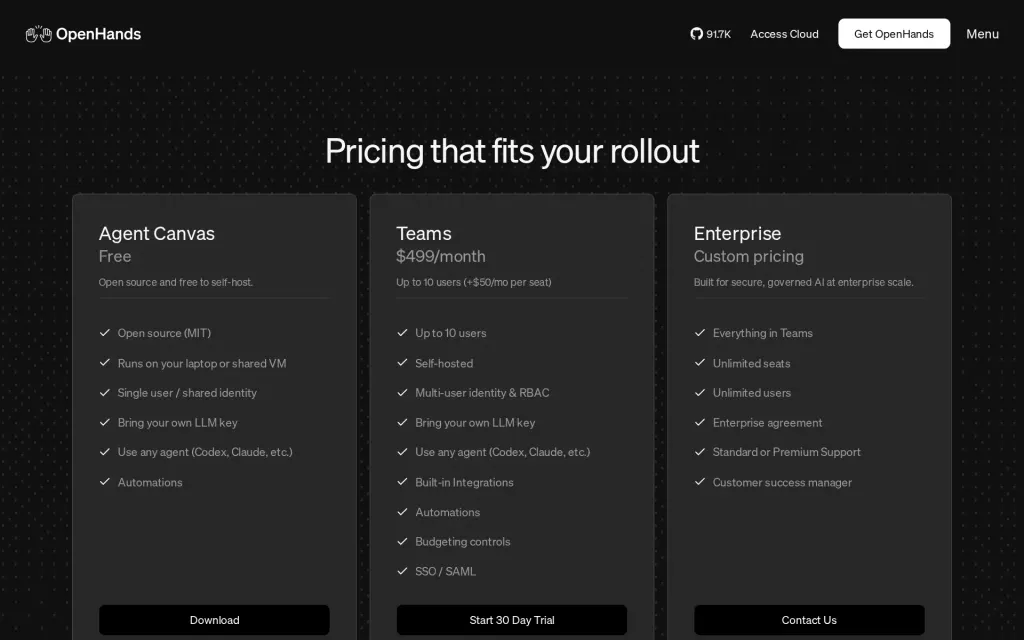
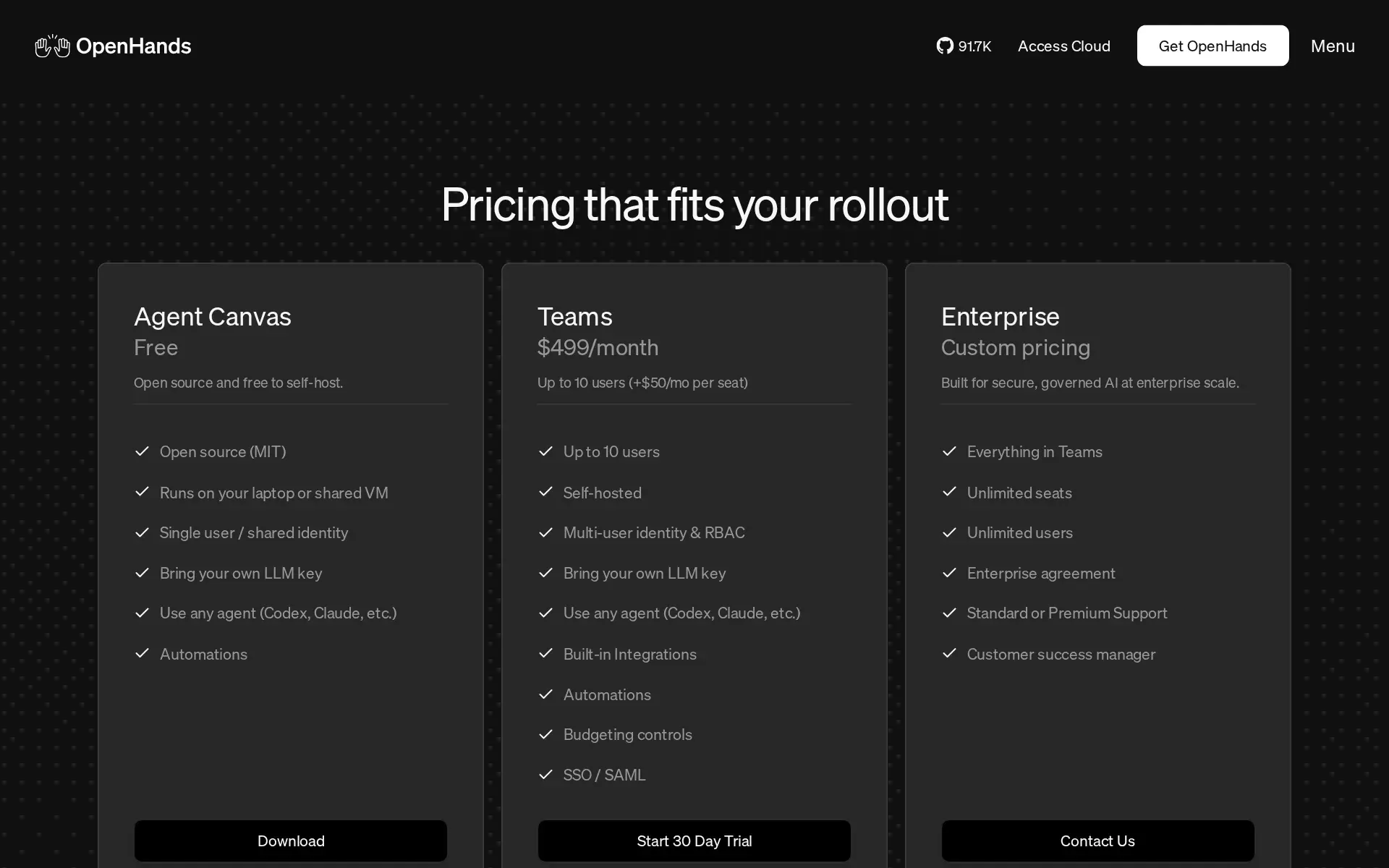
Agent Canvas is priced 'Free' and described as 'Open source and free to self-host', running on your own laptop or shared VM with a single shared identity and your own LLM key; the paid Teams plan separately offers a 30-day trial.
What needs a higher plan
- Enterprise
- Whole-codebase work, A company can buy it, Admin controls, Audit log, Data residency
- Organizations
- Pooled budget
- OpenHands Enterprise
- Single sign-on
From openhands.dev/pricing, checked .
The Agents Index digest
Price changes and new agents like OpenHands, at most once a week.
Last issue: Devin vs Claude Code: Which Should You Pick? · 13 October 2026
Works with
 Claude
 GPT
GPT- YesOpen models
For AI agents
- MCP server
- Yes
- API
- Yes
Screenshots
Pricing page, openhands.dev, captured 
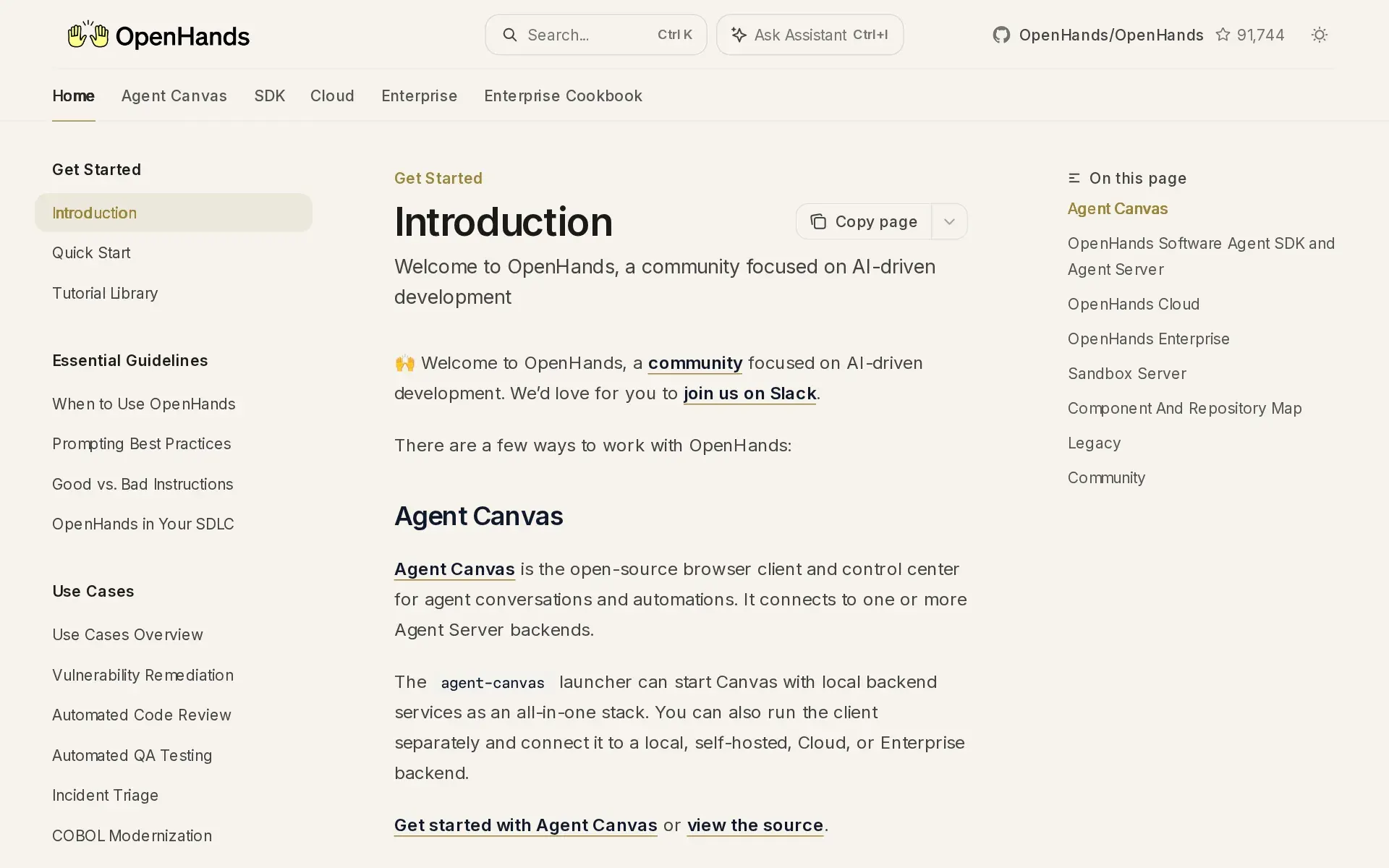
Docs, openhands.dev, captured
Filed under
Sources and updates
Last changed
Sources37
- openhands.dev/pricing
- openhands.dev/enterprise
- docs.openhands.dev/enterprise
- openhands.dev/services
- docs.openhands.dev/openhands/usage/llms/openhands-llms
- docs.openhands.dev/openhands/usage/llms/openhands-llms.md
- docs.openhands.dev/enterprise.md
- docs.openhands.dev/openhands/usage/cli/headless.md
- docs.openhands.dev/openhands/usage/cloud/organizations/overview
- docs.openhands.dev/openhands/usage/essential-guidelines/when-to-use-openhands
- docs.openhands.dev/openhands/usage/llms/llms
- docs.openhands.dev/openhands/usage/use-cases/code-review
- openhands.dev/privacy
- openhands.dev/product
- openhands.dev/
- docs.openhands.dev/enterprise/integrations/saml-sso.md
- docs.openhands.dev/llms.txt
- docs.openhands.dev/openhands/usage/cli/headless
- docs.openhands.dev/openhands/usage/cli/ide/overview
- docs.openhands.dev/openhands/usage/cli/ide/overview.md
- docs.openhands.dev/openhands/usage/cloud/cloud-api
- docs.openhands.dev/openhands/usage/cloud/cloud-api.md
- docs.openhands.dev/openhands/usage/cloud/organizations/roles-permissions
- docs.openhands.dev/openhands/usage/cloud/organizations/roles-permissions.md
- docs.openhands.dev/openhands/usage/llms/local-llms.md
- docs.openhands.dev/openhands/usage/use-cases/cobol-modernization
- docs.openhands.dev/openhands/usage/use-cases/code-review.md
- docs.openhands.dev/openhands/usage/use-cases/qa-changes
- docs.openhands.dev/openhands/usage/use-cases/spark-migrations
- docs.openhands.dev/overview/model-context-protocol
- docs.openhands.dev/overview/model-context-protocol.md
- api.github.com/repos/OpenHands/OpenHandsRepository
- docs.openhands.dev/sdk/guides/agent-server/openai-gateway
- docs.openhands.dev/sdk/guides/security
- docs.openhands.dev/sdk/guides/security.md
- docs.openhands.dev/sdk/guides/task-tool-set
- docs.openhands.dev/sdk/guides/task-tool-set.md
Repository30 August 2026
- Licence
- MIT
- Stars
- 85,613
- Forks
- 11,214
- Last push
- 30 August 2026
Coverage elsewhere2
The Agents Index in AI answers0 of 1
- PerplexityDoes not cite The Agents IndexAsked
OpenHands alternatives
on Other sources: g2.com, openalternative.co, alternativeto.net, aicentralresources.com, vantaige.io, spotsaas.com
Updates6
- Free plan · Plan limits · What it can do
- Free plan · Usage terms · What it can do
- Free plan · Price · Usage terms · What it can do
- Free plan · Usage terms · What it can do
- Alternatives · Repository · Summary · Tagline
- Summary · Tagline
Is this yours? Claim it free and edit it in your dashboard, or feature it in Coding agents.