
Not for Teams that need fast, interactive pair-programming: with 12 to 15 minutes between responses and an independently reported ~15% real-world task success rate, Devin fits asynchronous delegation, not rapid back-and-forth coding sessions.
The facts, with their sources
What it does
- Writes code
- YesImplements entire features from a prompt or a Linear/Jira ticket, running and testing the code it writes.
Devin is an autonomous AI software engineer that can write, run and test code.
docs.devin.ai/get-started/devin-intro - Debugs and fixes
- YesReproducing and fixing bugs is named as a core task, including bugs arriving as tickets or bug reports.
Ask Devin to tackle Linear/Jira tickets, implement entirely new features, repro and fix bugs, build internal tools, and more!
docs.devin.ai/get-started/devin-intro - Writes tests
- YesAnalyses the repository's existing test style and writes additional tests to raise coverage.
Devin can bridge this gap by analyzing a codebase’s existing test suite style and increasing coverage of less critical but still important functions.
docs.devin.ai/use-cases/tutorials/code-… - Reviews code
- YesDevin Review reviews pull requests anyone authored, reorganising and explaining large diffs in the Devin webapp.
Devin Review is a full-service code review platform within the Devin webapp that turns large, complex PRs into intuitively organized diffs and…
docs.devin.ai/work-with-devin/devin-rev… - Whole-codebase work
- YesMigrations spanning many files, modules or whole repositories are the stated use for fanning work out to parallel sessions.
This is the most powerful way to tackle work that spans many files, modules, or repositories — migrations, bulk test coverage, parallel research, and…
docs.devin.ai/work-with-devin/advanced-… - Ships it
- PartlyStops at the pull request in your repository; your team merges and ships through its existing pipeline.
Most Devin work follows the normal software delivery path: Devin works in your repository, opens a pull request, and your team reviews, merges, and…
docs.devin.ai/product-guides/deployment…
How much it does unattended
- Runs autonomously
- YesAutomations and schedules start sessions from events, so Devin works the task with nobody tagging it.
Instead of manually tagging Devin every time a bug is reported or a CI check fails, you define the trigger once and Devin handles each event as it…
docs.devin.ai/product-guides/automations - Multi-agent
- YesA coordinator Devin delegates to child sessions running in parallel, each on its own isolated VM.
Devin can break down large tasks and delegate them to a team of managed Devins working in parallel, each running in its own isolated VM.
docs.devin.ai/work-with-devin/advanced-… - Agent permissions
- YesGraded modes from prompt-before-writing up to full bypass, plus an OS-sandboxed autonomous mode.
In Normal mode (the default), read-only operations are auto-approved while writes and shell commands require your explicit approval.
docs.devin.ai/cli/reference/permissions
Which models it runs on
- Claude
- YesAnthropic models are selectable in Devin CLI, where opus and sonnet resolve to the latest in each family.
We typically support the latest and greatest models from Anthropic, OpenAI, Google, and Cognition within minutes of their launch.
docs.devin.ai/cli/models - GPT
- YesOpenAI models are selectable in Devin CLI, with gpt among the three the vendor recommends trying first.
At minimum we recommend trying swe, gpt, and opus. We find that the vast majority of use-cases can be covered by these three.
docs.devin.ai/cli/models - Open models
- YesOpen-weight models including DeepSeek, Kimi and GLM are selectable in Devin CLI.
We also support a number of leading open source models like DeepSeek, Kimi, and GLM.
docs.devin.ai/cli/models - Model choice
- PartlyYou pick the model in Devin CLI, or leave it to the Adaptive router; cloud Devin sessions document no model selector.
Devin CLI supports multiple AI models. You can choose the best model for your task to optimize for maximum capability, speed, or cost efficiency.
docs.devin.ai/cli/models
Where you use it
- In your editor
- YesRuns inside JetBrains IDEs from the AI Chat panel over the Agent Client Protocol, including Remote Development.
JetBrains IDEs can run Devin as an agent inside AI Chat using the Agent Client Protocol (ACP).
docs.devin.ai/cli/acp/jetbrains - On the command line
- YesDevin CLI is a local terminal agent working on your own files, installed by curl script, Homebrew cask or Windows installer.
Devin CLI is a local coding agent that runs directly in your terminal. It works with your local files and environment, giving you fast, interactive…
docs.devin.ai/cli - In your pipeline
- YesCreates pull requests and answers PR comments inside your repositories once the SCM integration is installed.
Integrating Devin with your GitHub organization enables Devin to create pull requests, respond to PR comments, and collaborate directly within your…
docs.devin.ai/integrations/gh - In a browser
- YesHosted web app at app.devin.ai; each session carries its own shell, embedded IDE and browser you can take over.
To access Devin, sign up at app.devin.ai. Individual and Teams plans are available.
docs.devin.ai/get-started/devin-intro
Whose machine it runs on
- Self-hosted
- PartlyOutposts runs session execution on machines you operate, but the agent loop stays in Cognition's cloud.
Outposts lets you run Devin sessions inside infrastructure you control — your own VMs, containers, Kubernetes clusters, or even a Mac Mini on your…
docs.devin.ai/cloud/outposts/overview - Open source
- PartlyOnly the Outposts Kubernetes orchestration operator is published as open source; no source distribution is documented for Devin itself.
deploy devin-outpost-k8s — our open-source operator that runs the loop on any Kubernetes cluster
docs.devin.ai/cloud/outposts/overview
What it costs to run
- How it meters
- YesMetered by the work performed: plan quota then prepaid on-demand credits self-serve, Agent Compute Units on Enterprise.
Self-serve customers consume their plan's included quota first, then draw from prepaid on-demand credits.
docs.devin.ai/admin/billing/usage - Free tier
- YesA Free plan you sign up for directly, with limited usage and an upgrade path to any paid plan.
The Free plan lets you try Devin with limited usage.
docs.devin.ai/admin/billing/self-serve - API access
- YesREST API creates and drives sessions under an organization scope, with a separate enterprise scope for analytics and audit logs.
The Devin API enables you to integrate Devin into your applications, automate workflows, and build powerful tools.
docs.devin.ai/api-reference/overview - MCP server
- YesAn authenticated MCP server at mcp.devin.ai lets any MCP client create sessions, query repositories and manage playbooks.
The Devin MCP server provides programmatic access to Devin's platform capabilities for both private and public repositories.
docs.devin.ai/work-with-devin/devin-mcp - Bring your own key
- PartlyYour own AWS KMS key encrypts data at rest, but only on the Enterprise Assured deployment; no bring-your-own-inference is documented.
With CMK, you provide your own AWS KMS key, and Cognition uses it to encrypt data stored in your dedicated tenant — including session data and VM…
docs.devin.ai/enterprise/security-acces…
Buying it for a team
- A company can buy it
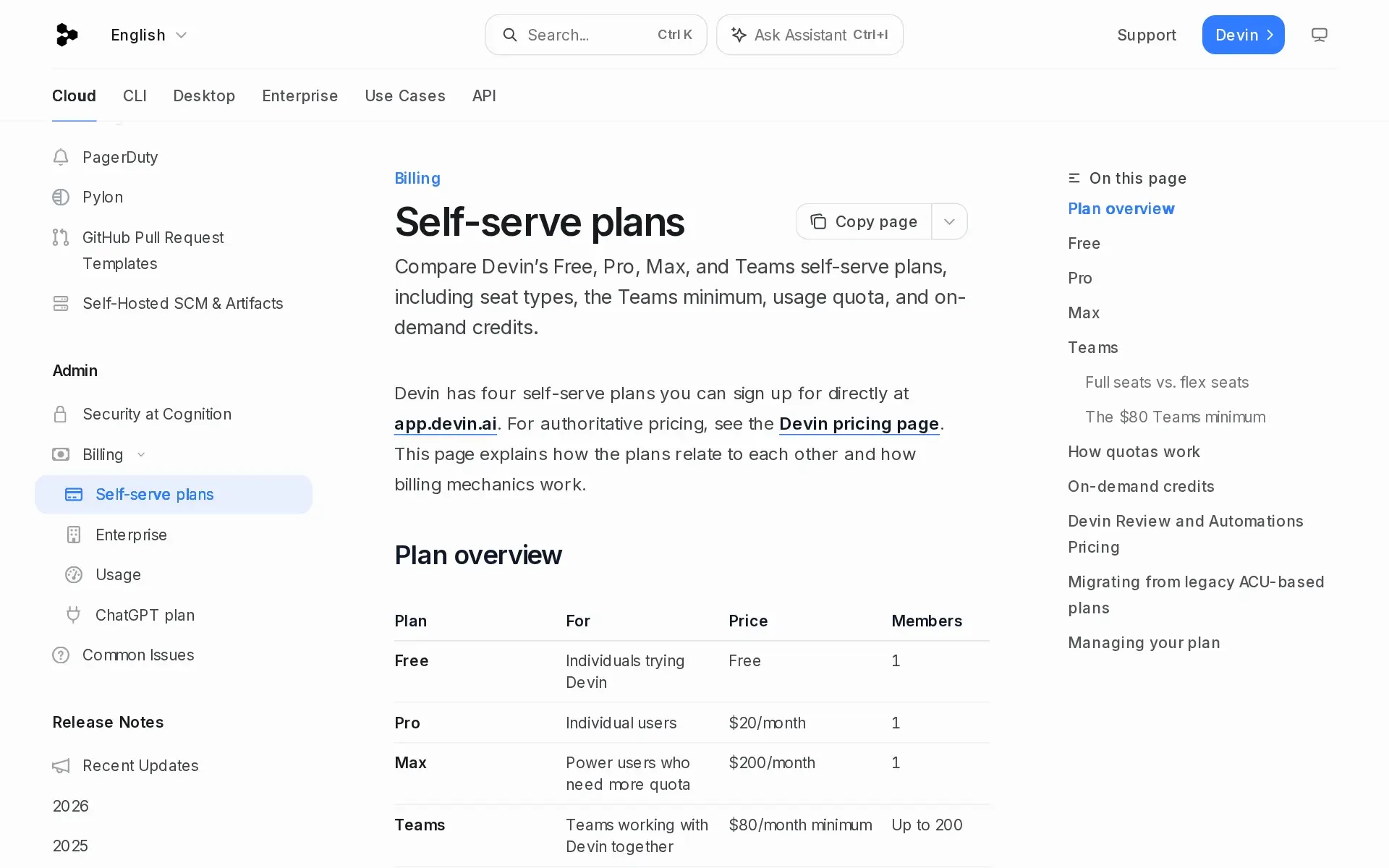
- YesThe self-serve Teams plan buys for a whole organisation with unlimited members; Pro and Max cannot be shared.
The Teams plan is Devin's self-serve plan for teams of any size.
docs.devin.ai/admin/billing/self-serve - Seat model
- YesIndividual Pro and Max plans cover a single member each; the Teams plan is a flat $80 a month platform fee plus $40 a month per full developer seat, capped at 200 users, with Enterprise quoted instead of priced.
$80/month for team plan + $40/mo per full dev seat
devin.ai/pricing - Pooled budget
- YesTeams draw from one shared credit pool with no per-member balance, while each full seat also carries its own quota.
On the Teams plan, credits are shared across all members, with no per-member balance. Any teammate can draw from the shared pool.
docs.devin.ai/admin/billing/self-serve - Admin controls
- YesAdmins bind network, MCP, git and GitHub-token restrictions to an org, an automation or a single session; enterprises can enforce them as a floor.
Security profiles let you define reusable bundles of security restrictions — network access, MCP access, git access, and GitHub CLI credentials
docs.devin.ai/product-guides/security-p… - Audit log
- PartlyLogins are recorded in an enterprise audit log; the docs describe audit logs only at the enterprise level.
Records the login in the enterprise audit log
docs.devin.ai/enterprise/security-acces… - Single sign-on
- PartlySAML 2.0 and OIDC (Okta, Microsoft Entra ID, generic) on Devin Enterprise, configured by the Cognition team, with IdP group to role mapping.
Create an application in your identity provider (Okta, Microsoft Entra ID, or any SAML/OIDC-compliant IdP) and share the following credentials with…
docs.devin.ai/enterprise/security-acces…
What happens to your code
- Opt out of training
- PartlyTraining is on by default and the opt-out is paid-plans-only; opting out also enables Zero Data Retention with the model providers.
By default, we may use your data for model training purposes to improve and enhance the Services. If you're on a paid plan, you can opt out at any…
docs.devin.ai/admin/security - Data residency
- PartlyThe AWS region holding a dedicated tenant is not published; the vendor confirms it on request.
Contact your Cognition account team to confirm the AWS region of your dedicated tenant.
docs.devin.ai/enterprise/security-acces… - Getting out
- PartlyPurchased on-demand credits roll over and never expire; no account-wide data export is documented beyond invoices and per-resource API reads.
Roll over month-to-month. Purchased credits never expire.
docs.devin.ai/admin/billing/self-serve - Certifications
- PartlySOC 2 Type II since September 2024; the Trust Center additionally lists ISO/IEC 27001:2022 and CCPA, behind an NDA request.
Cognition has been SOC 2 Type II certified since September 2024.
docs.devin.ai/enterprise/security-acces…
Plans and pricing
Price and terms
- Free plan
- YesYes
The terms in full
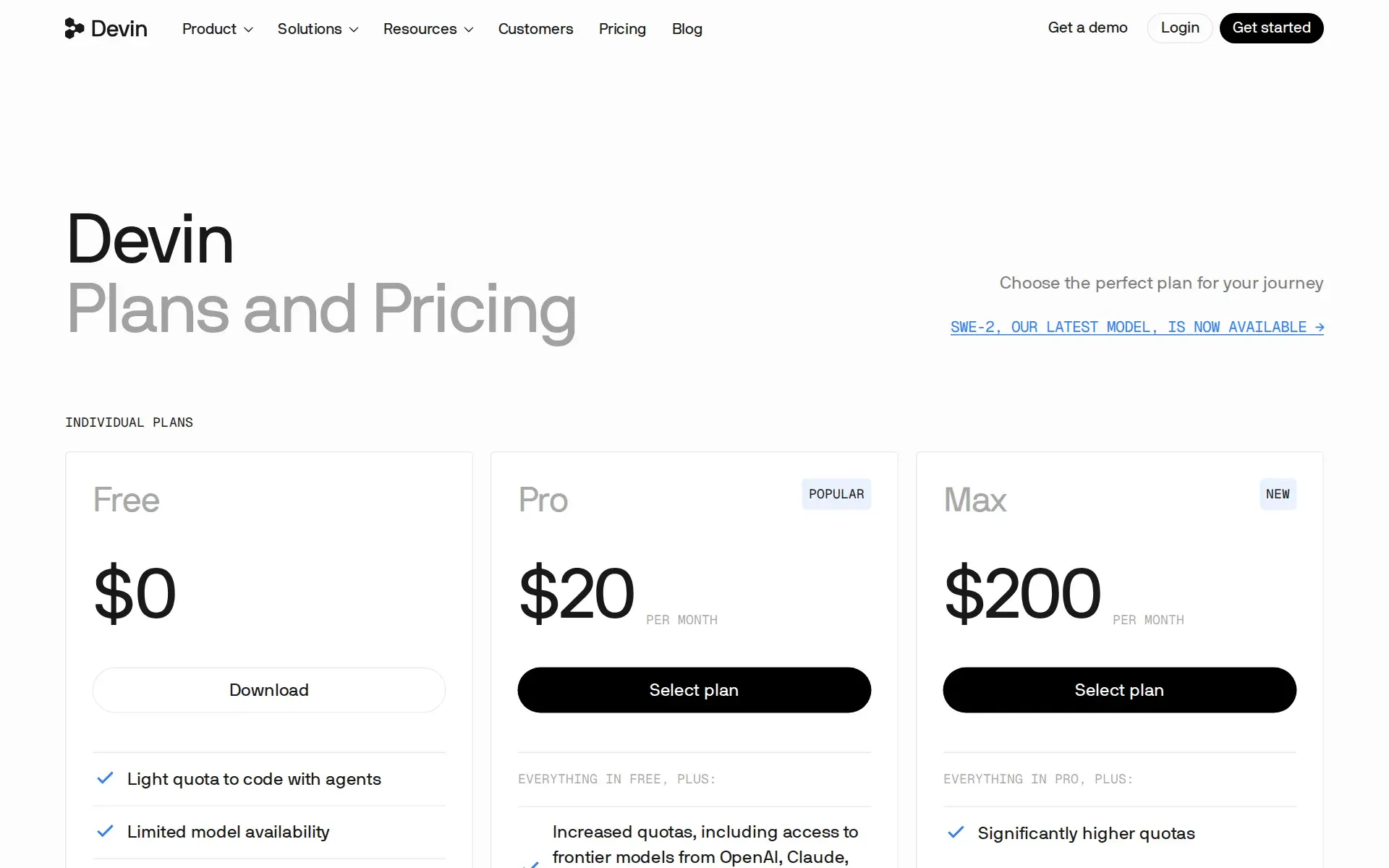
Free plan at $0 with a light quota to code with agents, limited model availability, unlimited inline edits and unlimited Tab completions; 1 member, up to 10 concurrent sessions.
What needs a higher plan
- Enterprise Assured
- Bring your own key
- Enterprise
- Audit log, Single sign-on
From devin.ai/pricing, checked .
The Agents Index digest
Price changes and new agents like Devin, at most once a week.
Last issue: Devin vs Claude Code: Which Should You Pick? · 13 October 2026
Works with
 Claude
Devin CLI
 GPT
GPTDevin CLI
- YesOpen models
Devin CLI
For AI agents
- MCP server
- Yes
- API
- Yes
Screenshots
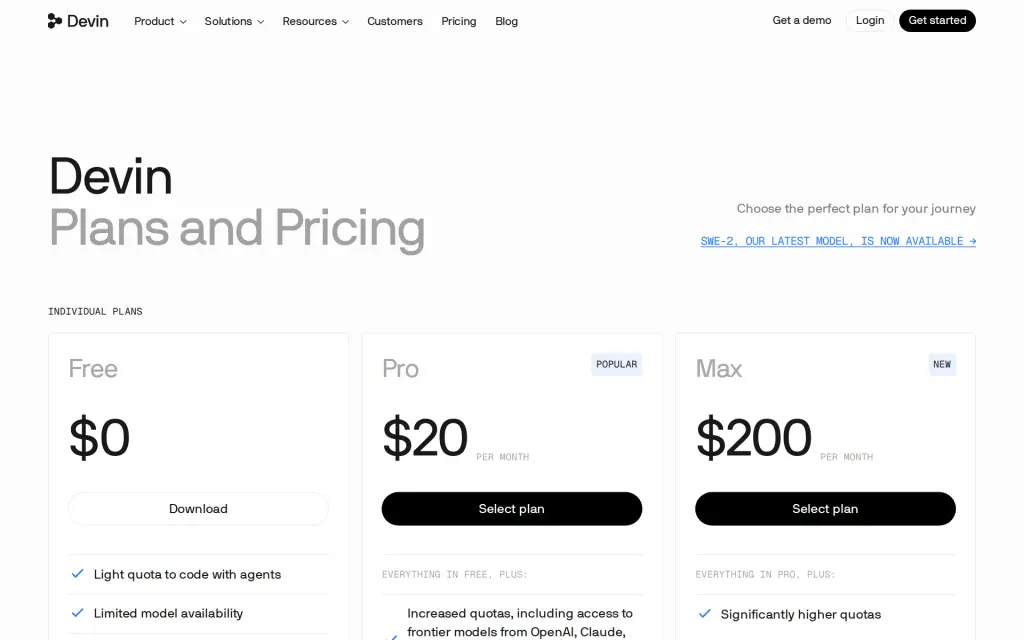
Pricing page, devin.ai, captured 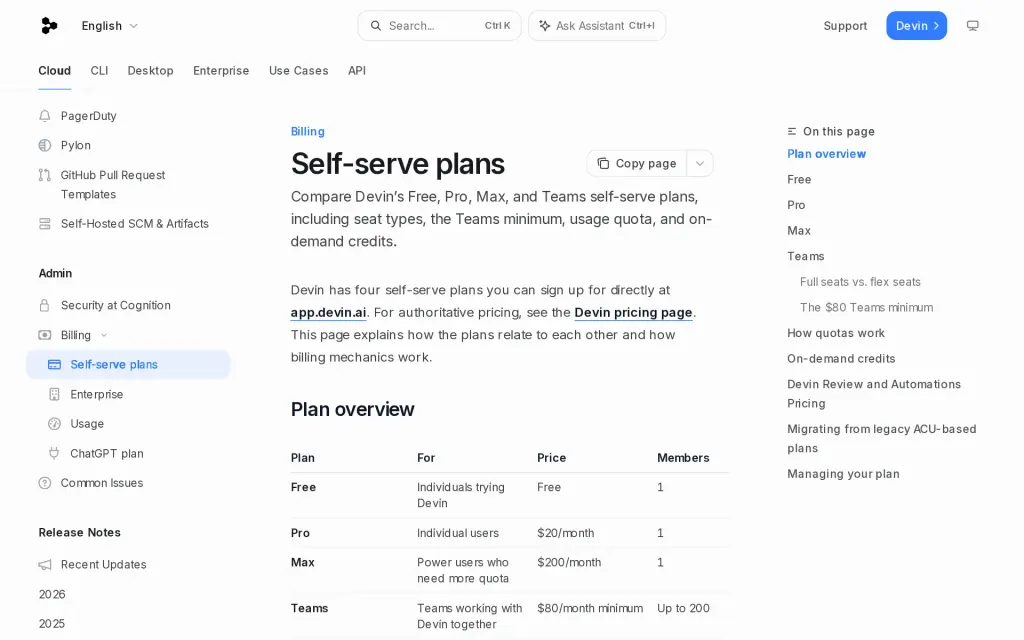
Docs, devin.ai, captured
Filed under
Sources and updates
Last changed
Sources26
- docs.devin.ai/admin/billing/self-serve
- docs.devin.ai/get-started/devin-intro
- devin.ai/pricing
- docs.devin.ai/cli/models
- docs.devin.ai/api-reference/overview
- docs.devin.ai/cloud/outposts/overview
- docs.devin.ai/enterprise/deployment/overview
- docs.devin.ai/enterprise/security-access/security/customer-managed-keys
- docs.devin.ai/enterprise/security-access/sso/guide
- cognition.com/legal/platform-terms-of-serviceIndependent source
- docs.devin.ai/work-with-devin/advanced-capabilities
- devin.ai/
- docs.devin.ai/admin/billing/usage
- docs.devin.ai/admin/security
- docs.devin.ai/cli
- docs.devin.ai/cli/acp/jetbrains
- docs.devin.ai/cli/reference/permissions
- docs.devin.ai/cli/subagents
- docs.devin.ai/enterprise/security-access/security/enterprise-security
- docs.devin.ai/integrations/gh
- docs.devin.ai/product-guides/automations
- docs.devin.ai/product-guides/deployment-capabilities
- docs.devin.ai/product-guides/security-profiles
- docs.devin.ai/use-cases/tutorials/code-coverage
- docs.devin.ai/work-with-devin/devin-mcp
- docs.devin.ai/work-with-devin/devin-review
Coverage elsewhere3
The Agents Index in AI answers0 of 1
- PerplexityDoes not cite The Agents IndexAsked
Devin alternatives
on Other sources: alternativeto.net, g2.com, usecarly.com, autogpt.net, pensero.ai, tembo.io
Updates5
- Capabilities · Free tier · Plan limits
- Capabilities · Free tier · Terms
- Capabilities · Free tier · Price · Terms
- Summary · Tagline
- Summary · Tagline
Is this yours? Claim it free and edit it in your dashboard, or feature it in Coding agents.