
Summary
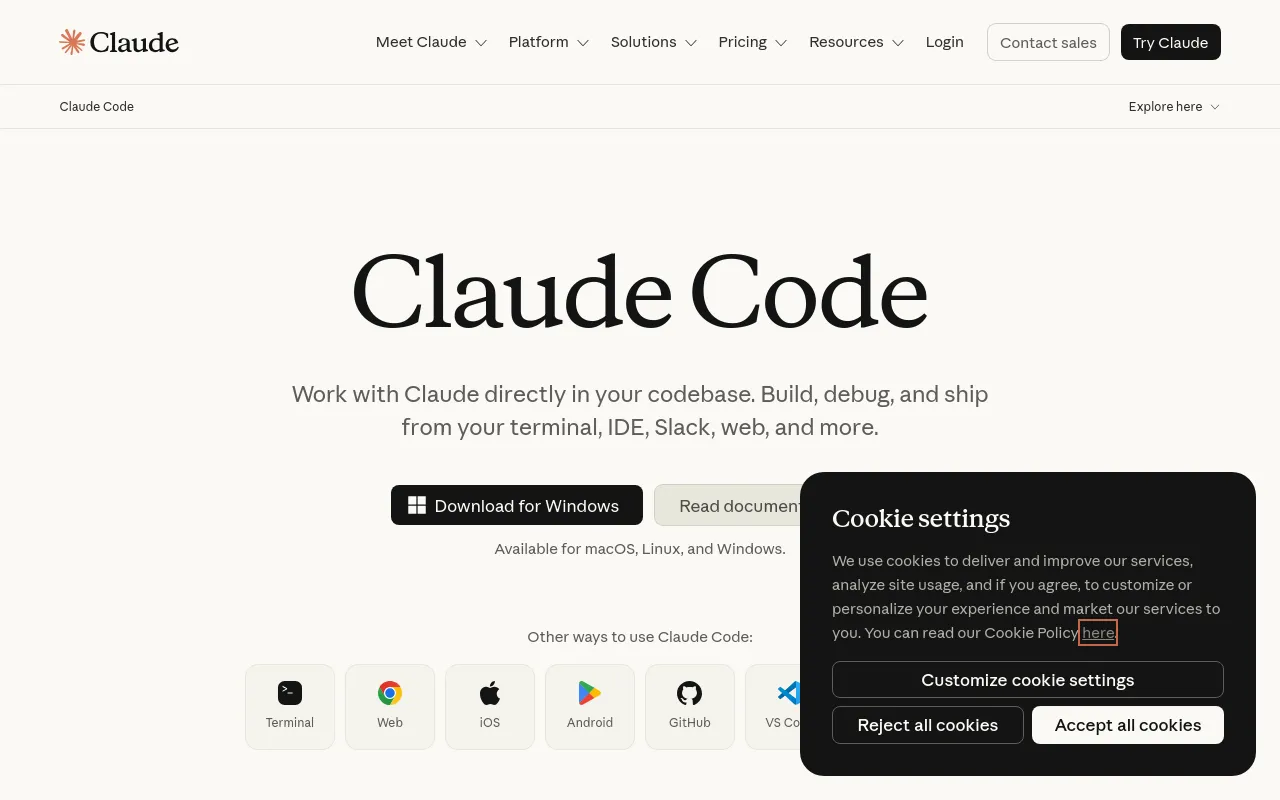
Claude Code is Anthropic's agentic coding tool for developers. It reads a codebase, plans a change, edits files across it, runs commands and tests, and takes the work through to a commit and pull request.
- Best for
- Developers and teams who want a terminal-native, scriptable agent that composes with CI and real engineering workflows.
- Not for
- Developers who want a GUI-first, click-to-edit experience over a command line, or teams that want the option to switch between model providers rather than being tied to Anthropic’s own Claude models.
- From
- $20/month$20 monthly · $17 billed annually
- Free tier
- NoAnthropic's $0 Claude plan does not include Claude Code: the pricing FAQ states 'Claude Code is included in all paid plans.' The cheapest way in is Pro at $17/month billed annually ($20 monthly), or pay-as-you-go API credits through a Console account.
What it does
- Writes code
- YesTakes a plain-language description and writes the change across multiple files, then verifies it.
Describe what you want in plain language. Claude Code plans the approach, writes the code across multiple files, and verifies it works.
code.claude.com/docs/en/overview - Debugs and fixes
- YesTakes an error message or symptom, traces it through the repository, and implements the fix.
Claude Code traces the issue through your codebase, identifies the root cause, and implements a fix.
code.claude.com/docs/en/overview - Writes tests
- YesWrites tests for untested code as a named use case, and runs them as part of the same task.
writing tests for untested code, fixing lint errors across a project, resolving merge conflicts, updating dependencies, and writing release notes
code.claude.com/docs/en/overview - Reviews code
- YesThe /code-review command reviews a local diff on any plan; the managed GitHub PR reviewer is a research preview on Team and Enterprise.
Code Review analyzes your GitHub pull requests and posts findings as inline comments on the lines of code where it found issues.
code.claude.com/docs/en/code-review - Whole-codebase work
- YesDynamic workflows run many subagents over a repository for audits and large migrations; the vendor's own example is a 500-file migration.
A job outgrows a handful of subagents, or you want findings verified against each other: a codebase-wide audit, a 500-file migration, cross-checked…
code.claude.com/docs/en/agents - Ships it
- PartlyThe claimed workflow ends at a commit, branch and pull request; deployment is only whatever shell command Claude is allowed to run.
integrates with GitHub, GitLab, and your command line tools to handle the entire workflow—reading issues, writing code, running tests, and submitting…
claude.com/product/claude-code
How much it does unattended
- Runs autonomously
- YesAuto mode has a classifier approve tool calls instead of a person; routines and background sessions run unattended, including in the cloud.
Auto-approves tool calls with background safety checks that verify actions align with your request
code.claude.com/docs/en/permissions - Multi-agent
- YesFour coordination styles: subagents, background agent view, agent teams with inter-agent messaging (experimental, off by default), and dynamic workflows.
Subagents, agent view, agent teams, and dynamic workflows each parallelize work in a different way.
code.claude.com/docs/en/agents - Agent permissions
- YesStarts read-only and asks per action in Manual mode; allow/ask/deny rules, six permission modes, and a bash sandbox set the boundary.
In Manual mode, Claude Code starts with read-only permissions. When Claude Code needs to edit files, run tests, or execute commands, it asks you first
code.claude.com/docs/en/security
Which models it runs on
- Claude
- YesClaude is the only model family: Fable, Opus, Sonnet and Haiku aliases, resolved per provider.
Uses the latest Opus model for complex reasoning tasks
code.claude.com/docs/en/model-config - GPT
- NoOn the first-party API the recognised model strings are aliases and names beginning claude-; the alias table lists only Claude families.
any name that starts with claude-
code.claude.com/docs/en/model-config - Open models
- NoNo open-weight option: every documented provider path (Anthropic API, Bedrock, Google Cloud, Microsoft Foundry) serves Claude models only.
any name that starts with claude-
code.claude.com/docs/en/model-config - Model choice
- PartlyYou choose the model and effort per session or per subagent, but only within Claude; admins can pin the allowlist.
Enterprise administrators can use availableModels in managed or policy settings to restrict which models users can select
code.claude.com/docs/en/model-config
Where you use it
- In your editor
- YesFirst-party extensions for VS Code (and Cursor) and JetBrains IDEs, with inline diffs and plan review.
Native extensions for VS Code (+ Cursor, Devin Desktop) and JetBrains IDEs.
claude.com/product/claude-code - On the command line
- YesThe terminal CLI is the primary surface, installed by shell script, Homebrew, WinGet or Linux package managers.
Super powerful terminal integration. Works with all your CLI tools alongside any IDE.
claude.com/product/claude-code - In your pipeline
- YesGitHub Actions and GitLab CI/CD run it in your own pipelines; a managed GitHub PR reviewer exists on Team and Enterprise.
In CI, you can automate code review and issue triage with GitHub Actions or GitLab CI/CD.
code.claude.com/docs/en/overview - In a browser
- YesCloud sessions run from claude.ai/code in a desktop browser or the iOS and Android app, with no local install.
Run Claude Code in your browser with no local setup.
code.claude.com/docs/en/overview
Whose machine it runs on
- Self-hosted
- PartlyThe CLI executes on your own machine, and cloud sessions can run on your runners in public beta on Team and Enterprise; inference always goes to Anthropic or a cloud provider.
Self-hosted environments are in public beta on Team and Enterprise plans and are off by default.
code.claude.com/docs/en/self-hosted-env… - Open source
- NoThe vendor's own repository carries an all-rights-reserved licence; the public repo holds plugins, docs and the issue tracker, not the CLI source.
© Anthropic PBC. All rights reserved. Use is subject to Anthropic's Commercial Terms of Service.
github.com/anthropics/claude-code/blob/…
What it costs to run
- How it meters
- YesTwo meters: a per-seat usage allowance on subscription plans, or per-token billing on the Console and cloud providers.
On Teams and Enterprise plans, usage draws from each member's seat allowance. On the Console and on cloud providers, usage is billed per token to…
code.claude.com/docs/en/costs - Free tier
- PartlySelf-serve with no sales call, but there is no free tier: the $0 Claude plan excludes Claude Code, so the entry point is a paid plan or API pay-as-you-go.
Claude Code is included in all paid plans.
claude.com/pricing - API access
- YesThe Agent SDK exposes the same agent loop as a Python or TypeScript library, and claude -p with JSON output drives it from any language.
the same tools, agent loop, and context management that power Claude Code, programmable in Python and TypeScript
code.claude.com/docs/en/agent-sdk/overv… - MCP server
- Yesclaude mcp serve exposes Claude Code as a stdio MCP server other clients connect to; it is also an MCP client for external servers.
You can use Claude Code itself as an MCP server that other applications can connect to
code.claude.com/docs/en/mcp - Bring your own key
- YesBring your own Anthropic API key, or your own cloud account via Amazon Bedrock, Google Cloud's Agent Platform or Microsoft Foundry; apiKeyHelper supports vault-issued tokens.
if your organization uses Amazon Bedrock, Google Cloud's Agent Platform, or Microsoft Foundry, set the required environment variables before running…
code.claude.com/docs/en/authentication
Buying it for a team
- A company can buy it
- YesTeam is self-serve for 2 to 150 seats; Enterprise is available self-serve or sales-assisted with central billing.
For teams of 2 to 150
claude.com/pricing - Seat model
- YesPer seat with a floor of 2 and a ceiling of 150 on Team; Standard $20/seat/mo annual ($25 monthly), Premium $100 ($125), Enterprise $20/seat plus usage.
Per seat / month if billed annually. $25 if billed monthly.
claude.com/pricing - Pooled budget
- NoEach member gets their own allowance on a rolling five-hour and weekly window; only usage-credit spend past it can be capped at org, group or member level.
each member's Claude Code usage draws from a per-seat allowance that resets on a rolling five-hour window and a weekly window
code.claude.com/docs/en/costs - Admin controls
- YesManaged and server-managed settings pin permission rules, model allowlists, telemetry and login method, and local settings cannot override them.
Security teams can configure managed permissions for what Claude Code is and is not allowed to do, which cannot be overwritten by local configuration.
code.claude.com/docs/en/third-party-int… - Audit log
- PartlyAudit logs are an Enterprise plan feature, alongside a compliance API; cloud sessions log every operation, and OpenTelemetry export works on any plan.claude.com/pricing
- Single sign-on
- PartlySSO ships on the business plans, not on individual Pro or Max; the vendor names no protocol, and SCIM is Enterprise-only.
Single sign-on (SSO)
claude.com/pricing
What happens to your code
- Opt out of training
- YesCommercial terms (Team, Enterprise, API, cloud providers) are no-training by default; Free, Pro and Max users toggle it in privacy settings.
Anthropic does not train generative models using code or prompts sent to Claude Code under commercial terms, unless the customer has chosen to…
code.claude.com/docs/en/data-usage - Data residency
- PartlyUS-only inference is selectable on the Claude API and Claude Platform on AWS at a 1.1x rate; workspace storage geo is US only, and Bedrock or Google Cloud regions follow the endpoint.
Inference runs only in US-based infrastructure.
platform.claude.com/docs/en/manage-clau… - Getting out
- Yes/export writes a readable transcript, transcripts sit locally as JSONL, and org analytics and spend reports export as CSV; prepaid usage credits mostly do not expire.
Run /export to open a menu that lets you copy the current conversation to your clipboard or save it as a plain-text file
code.claude.com/docs/en/sessions - Certifications
- YesSOC 2 Type 2 and ISO 27001 artefacts are published at the Trust Center; a HIPAA-ready offering and zero data retention are Enterprise options.
Learn more and access resources (SOC 2 Type 2 report, ISO 27001 certificate, etc.) at Anthropic Trust Center
code.claude.com/docs/en/security
Checked · How we check
Alternatives
OpenAI's terminal coding agent for inspecting, editing and running repository code from the shell.
Open-source terminal AI pair programmer that edits files in your local git repo and commits the changes.
AI IDE with a Kanban command center for running local and cloud coding agents; the renamed Windsurf.
Filed under
Sources and updates
Sources20
- code.claude.com/docs/en/overview
- claude.com/pricing
- claude.com/product/claude-code/enterprise
- code.claude.com/docs/en/model-config
- code.claude.com/docs/en/security
- claude.com/product/claude-code
- code.claude.com/docs/en/agents
- code.claude.com/docs/en/costs
- code.claude.com/docs/en/data-usage
- github.com/anthropics/claude-code/blob/main/LICENSE.md
- code.claude.com/docs/en/agent-sdk/overview
- code.claude.com/docs/en/authentication
- code.claude.com/docs/en/code-review
- platform.claude.com/docs/en/manage-claude/data-residency
- code.claude.com/docs/en/mcp
- code.claude.com/docs/en/permissions
- code.claude.com/docs/en/self-hosted-environments
- code.claude.com/docs/en/sessions
- code.claude.com/docs/en/third-party-integrations
- claude.com/regional-compliance
Repository2026-08-30
- Stars
- 143,445
- Forks
- 22,939
- Last push
- 2026-08-28
Coverage elsewhere3
Updates3
- Capabilities · Free tier · Price · Terms
- Capabilities · Free tier · Price · Terms
- Alternatives · Summary · Tagline