AI Support Agents: Decagon vs Sierra vs Intercom Fin
Every customer-support agent we index, compared: six genuinely different ways to buy one, and the right pick is whichever you actually want.
On this page
- The eight, at a glance
- The decision: how do you want to buy this?
- Decagon vs Sierra: the closest real head-to-head
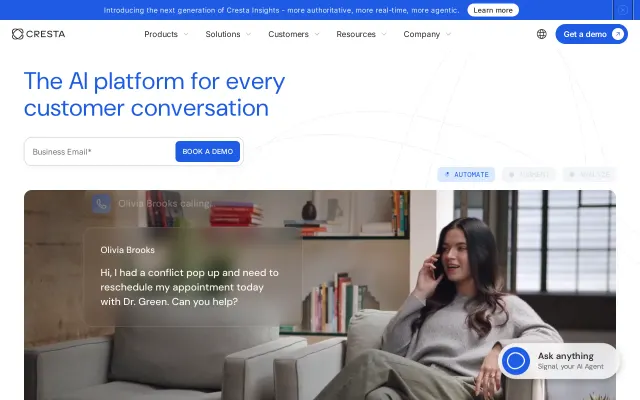
- Cresta: the one built to augment, not replace
- Ada: the pre-LLM incumbent, and the other real developer API
- Botsify: the only other public price, but a managed build, not self-serve
- Zendesk AI Agents: the one bundled into an existing helpdesk
- One thing five of the eight get right (and where Cresta, Ada and Botsify break the pattern)
- Frequently asked questions
Covers 10 topics
- Support agents
- Decision guide
- Decagon
- Sierra
- Intercom Fin
- Zendesk AI Agents
- Crescendo
- Cresta
- Ada
- Botsify
Eight names come up whenever a support or CX leader starts shopping for an AI agent to handle customer conversations: Decagon, Sierra, Intercom Fin, Zendesk AI Agents, Crescendo, Cresta, Ada and Botsify. All eight resolve real support conversations end to end. But read their own researched listings side by side and a much sharper split appears than "which agent is smartest." They are six genuinely different ways to buy the same outcome: software you configure yourself with a sales-led enterprise contract (Decagon, Sierra, Ada), software you can self-serve and trial today (Intercom Fin), an agent bundled directly into an existing helpdesk platform that is self-serve to sign up for but carries an undisclosed usage meter (Zendesk AI Agents), an outsourced team-plus-agents engagement you don't configure at all (Crescendo), a platform built to augment the human reps who stay in the loop rather than replace them outright (Cresta), or a publicly-priced managed build from a small, established vendor that assembles the agent for you rather than handing over a self-serve dashboard (Botsify). Which bucket you want usually decides the shortlist before a single feature comparison matters.
The eight, at a glance
Every figure below is pulled from each tool's own researched listing, last verified 19 July – 1 August 2026.
| Agent | How you buy it | Pricing | API / self-serve | Best known for |
|---|---|---|---|---|
| Intercom Fin | Self-serve software, layered on any helpdesk | $0.99/resolution (+$29/seat/mo if run on Intercom itself) | Documented API + MCP; 14-day free trial, no card | Most broadly deployed: 12,000+ customers, ~2M resolutions/week |
| Zendesk AI Agents | Bundled into Zendesk's own helpdesk Suite, not a standalone product | $55–$115/agent/mo (Suite plan) + an undisclosed per-Verified-Resolution rate, independently estimated at ~$1.20–$1.50 | Full public developer API (developer.zendesk.com); 14-day free trial, no card | The only agent here that ships inside a helpdesk platform millions of teams already run tickets on |
| Botsify | Publicly-priced managed build; Botsify's own team assembles it, not a self-serve dashboard | $149/month (Done-for-You plan); separate White Label/agency tier is custom, sales-led | Documented API (public Postman collection); no stated free trial | Decade-old (2016), bootstrapped small vendor; a genuine agency White Label/reseller program |
| Decagon | Enterprise software, sales-led | Custom, no public price list; third-party estimate ~$50K/yr platform fee + $0.99/conversation + $0.50/resolution | No self-serve signup or public API | $4.5B valuation (Jan 2026 Series D); published, named case studies with hard numbers |
| Sierra | Enterprise software, sales-led | Outcome-based, custom-negotiated; escalations to a human are not charged | Agent SDK exists but gated to contracted customers | Bret Taylor/Clay Bavor pedigree; $150M+ ARR by Feb 2026; $15B+ valuation (May 2026); reaches ChatGPT as a channel |
| Crescendo | Fully-managed outsourced CX, not software you run yourself | From $2.99/resolution, all-inclusive (setup, QA, knowledge-base upkeep bundled in) | No API, no self-serve trial; starts with a "proof of value" pilot | $500M valuation plus the PartnerHero acquisition (200+ customers, 3,000+ CX staff folded in) |
| Cresta | Enterprise software, augments human agents rather than replacing them | Custom, with one public data point: $150K/yr for Agent Assist alone (chat OR voice), via AWS Marketplace | API-based integrations + MCP; no self-serve signup | Unifies an AI Agent, real-time human Agent Assist and Conversation Intelligence on one record; $280M+ raised, 500+ employees |
| Ada | Enterprise software, sales-led | Custom, no public price list; third-party estimate (Vendr) puts the median contract at $73,500/yr | Documented Conversations/Email API + MCP server; no self-serve signup or free trial | The category's incumbent: founded 2016, $1.2B valuation (2021), one of the few sales-led rivals with a real developer API |
The decision: how do you want to buy this?
All eight carry a full researched verdict on their own listing, including who each one is explicitly not for. Read together, the honest decision tree runs on business model first, features second:
- You want to trial an agent today, without a sales call, on top of the helpdesk you already run → Intercom Fin. It's the only one of the eight with a public, fully disclosed price list, a 14-day no-card free trial, and a documented API/MCP you can start integrating against this week. Watch out for: it bills "assumed" resolutions when a customer simply stops replying, not just genuine fixes, and Intercom's own 76% headline resolution rate is a best case, since independent analyses of its published case studies land nearer 40–50% in practice.
- You're already running Zendesk as your helpdesk (or about to) and want the AI agent to come from the same vendor and billing relationship → Zendesk AI Agents. A 14-day no-card trial and a public per-seat Suite price make it self-serve to start, and a May 2026 billing change stopped charging for escalations and abandoned conversations. Watch out for: it isn't sold standalone (a $55–$115/agent/month Suite plan is required before any AI-agent usage), and Zendesk doesn't publish its per-resolution rate, and independent analysis puts it around $1.20–$1.50 per Verified Resolution, stacked on top of the seat fee.
- You want a public, no-sales-call price, but don't mind Botsify's own team building the agent rather than a self-serve dashboard, from a small and established vendor → Botsify. Its $149/month Done-for-You plan is the only other publicly-listed price in this group, and a decade of operating history (founded 2016) is real, if modest, credibility in a category full of newer entrants. Watch out for: neither pricing tier discloses which LLM powers the agent, the more distinctive White Label/agency tier publishes no price at all, and it carries its own G2/Capterra-vs-Trustpilot satisfaction split, the same pattern as Ada below.
- You're a large, well-resourced enterprise that wants a heavily-funded, actively-improving agent you configure yourselves in plain English, and you want published case-study numbers to justify the spend → Decagon. Its Agent Operating Procedures let a support team (not just engineers) write and adjust agent behaviour directly. The named case studies are concrete rather than vague marketing: Duolingo's 80% deflection, ClassPass's 95% cost reduction. Watch out for: no public pricing at all (only a third-party estimate exists), and reviewers describe real implementations spanning 4–12 weeks of engineering time despite the "plain English" pitch.
- You want the broadest possible reach, including inside ChatGPT itself, and pricing that only ever charges for a genuine resolution → Sierra. Its outcome-based model is one of the cleanest here (escalations to a human cost nothing), and its Agent Studio/Ghostwriter tooling turns existing SOPs into a working agent. Watch out for: it is the most opaque of the seven on price, with not even a third-party estimate available, and the Agent SDK is real but gated to signed customers, so there is no way to kick the tires before a contract.
- You don't want to run support software at all; you want an outsourced team that happens to be built on AI agents, especially for a regulated industry → Crescendo. Unlike the other five, you are not buying a platform to configure; you are buying a managed CX operation (agents, QA, staffing, compliance) billed per resolution with a "Total Outcome Guarantee." Watch out for: no API and no self-serve trial by design, because every engagement starts with a sales-adjacent "proof of value" pilot, and per-resolution billing needs real volume forecasting to avoid surge fees.
- You want AI automation and real-time support for your human reps unified on one platform, not a tool that only replaces conversations → Cresta. Its AI Agent resolves what it can end to end, then Agent Assist and the newer Knowledge Agent keep guiding the human rep in real time on everything else, all on one shared conversation record, with named results like Xanterra's 74% containment and $3.3M recovered revenue. Watch out for: pricing is among the most opaque here. The only public number anywhere is an AWS Marketplace listing for the narrower Agent Assist product alone ($150,000/year, one channel), and the full AI Agent/Conversation Intelligence suite is custom-quoted with no self-serve tier or free trial.
- You want an established, well-capitalized vendor with a real developer API, and a decade of production history over a newer LLM-native pitch → Ada. Founded in 2016, years before Decagon, Sierra, Crescendo and Cresta existed, and still backed by $190M+ raised and a $1.2B valuation, its documented Conversations/Email API and MCP server are a genuine developer surface Decagon, Sierra and Crescendo don't publish at all. Watch out for: no public pricing (Vendr's third-party data puts the median contract at $73,500/year) and no free trial, plus a wide admin-vs-end-user satisfaction gap, 4.6/5 on G2 from the teams who configure it, just 2.0/5 on Trustpilot from the customers actually chatting with it.
Decagon vs Sierra: the closest real head-to-head
Of the seven, Decagon and Sierra are the closest real rivals: both are enterprise, sales-led, agent-platform software with no self-serve tier, competing for the same large-account budget. The difference is configuration philosophy and pricing transparency, not capability. Decagon's Agent Operating Procedures convert a support team's own plain-English descriptions into agent logic, with Simulations and A/B experiments to test changes before a full rollout; Sierra's Agent Studio plus Ghostwriter does a similar job but leans more visual, and its channel reach goes further, since Sierra agents can operate inside ChatGPT itself, which none of the others offer. On price, Decagon is the more knowable of the two: a third-party cost breakdown (roughly $50K/year plus per-conversation and per-resolution fees) at least gives a buyer something to model against, while Sierra's outcome-based rate is negotiated case by case with nothing public to anchor an estimate. Neither is a fit for a team unwilling to run a multi-week sales and implementation cycle. That's the trade both make in exchange for depth.
Cresta: the one built to augment, not replace
Cresta is an outlier by design, not by feature gap. Decagon, Sierra, Intercom Fin, Crescendo and Ada all sell an AI agent that resolves a conversation end to end and treats the human as an exception path; Cresta instead unifies that same kind of autonomous AI Agent with real-time Agent Assist and a proactive Knowledge Agent that keep supporting the human rep through the rest of the conversation, plus Conversation Intelligence analyzing both the AI and human sides on one shared record. That's a genuinely different sale: a contact center trying to replace headcount reaches for Decagon, Sierra, Crescendo or Ada; one trying to make its existing human reps faster and more consistent, while still automating what it can, reaches for Cresta. The catch is pricing transparency: Cresta is among the most opaque here, with the only disclosed number anywhere being a narrow $150,000/year AWS Marketplace listing for Agent Assist alone (one channel, capped volume, non-cancellable), while Decagon and Ada at least have third-party cost estimates and Crescendo publishes its own starting per-resolution rate.
Ada: the pre-LLM incumbent, and the other real developer API
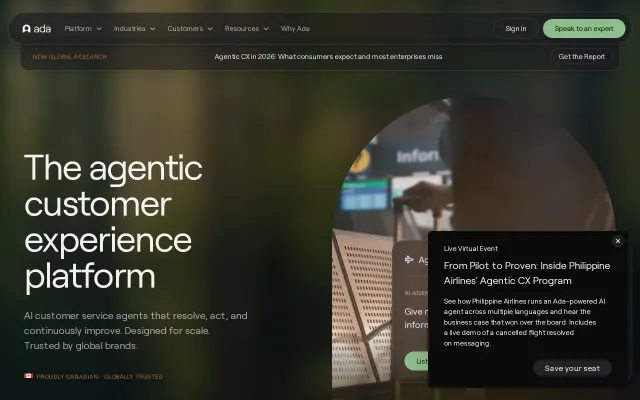
Ada predates every other name on this list by years. It was founded in 2016, when Decagon, Sierra, Crescendo and Cresta didn't yet exist. That history shows up as a real advantage: $190M+ raised, a $1.2B valuation from a 2021 Series C, and independently-confirmed enterprise customers (TechCrunch named Meta, Verizon and Shopify as live Ada customers in 2023). Alongside Intercom Fin, it's the only other agent here with a genuinely documented developer surface: a Conversations API, an Email Conversations API and an MCP server that most sales-led enterprise rivals in this category simply don't publish. The catch is that publishing docs isn't the same as self-serve access: getting an actual Ada account still runs through the same sales-led process as Decagon, Sierra and Crescendo, so if you want to start building against an API today without a sales call, Intercom Fin remains the only option. Ada's other honest catch is a real gap between how it looks from the admin seat and how it feels from the customer seat: a 4.6/5 rating on G2 (reviewed by the support teams who configure it) sits well above a 2.0/5 on Trustpilot (reflecting the people actually chatting with it), with recurring complaints about lost context and difficulty reaching a human.
Botsify: the only other public price, but a managed build, not self-serve
Botsify looks at first glance like a second Intercom Fin, being the only other listing here with a price you can find without a sales call, $149/month for its Done-for-You plan. But the resemblance stops there: Intercom Fin gives you a self-serve dashboard and a 14-day trial to configure yourself; Botsify's price buys a build its own team assembles for you, with a dedicated success manager and onboarding session, not a product you sign up for and start using in minutes. It's also the one listing in this group with a genuine second business: a White Label program that lets an agency resell Botsify-built agents under its own brand, a reseller angle none of the other six offer at all. And unlike Decagon, Sierra, Crescendo, Cresta and Ada, Botsify has a decade of operating history behind it (founded 2016, the same year as Ada), run as a small, self-funded team (22 employees per Tracxn) rather than a venture-backed platform. The catches are concrete: neither Botsify's Done-for-You nor White Label tier discloses which LLM powers the agent, the White Label tier itself publishes no price at all, and its review record splits the same way Ada's does, solid on G2 (4.3/5) and Capterra (4.6/5), weaker on Trustpilot (2.5/5), where reviewers cite slow support and advanced-feature bugs.
Zendesk AI Agents: the one bundled into an existing helpdesk
Zendesk AI Agents doesn't compete on being smarter than Fin or Decagon. Its pitch is that the agent ships inside the helpdesk platform millions of support teams already run tickets on, grown out of Zendesk's March 2024 acquisition of Ultimate. That means no second vendor contract or integration project, and a multi-model backbone (OpenAI, Anthropic, Google, Amazon Bedrock, with GPT-4o doing most live reasoning) instead of one proprietary model. A May 2026 billing restructuring was a genuine improvement: only a Verified Resolution, one that automated checking actually confirms was solved, draws from your paid allowance, while an escalation to a human or a reply the customer never followed up on is now free, closing exactly the "assumed resolution" complaint that dogs Intercom Fin. The trade-off is stacked, unpredictable cost: AI Agents require a Suite Team-or-higher plan ($55–$115/agent/month) before any AI-agent usage, and Zendesk doesn't publish its per-resolution rate on top of that. Independent analysis puts it around $1.20–$1.50 per Verified Resolution, and one modeled example put AI-agent overage costs at more than 5x the base human-seat cost for a mid-size team. Pick it if you're already on (or moving to) Zendesk and want one vendor for tickets and AI; pick Intercom Fin instead if you want the agent decoupled from your helpdesk choice, or a single number you can budget against.
One thing five of the eight get right (and where Cresta, Ada and Botsify break the pattern)
Intercom Fin, Decagon and Crescendo all charge per resolution; Sierra charges per successful resolution and explicitly waives the charge on human escalations; Zendesk AI Agents does the same since its May 2026 restructuring (free escalations, billed only on a Verified Resolution) but stacks that meter on top of a mandatory per-seat Suite fee none of the other four require. None of those five sells a flat per-agent-seat SaaS license on its own the way many support tools historically have. In a category built specifically to replace headcount, "pay for the work done" has become the default pricing logic, even where (as with Zendesk) it's layered on top of a seat fee rather than replacing one. Cresta, Ada and Botsify are the three exceptions, for different reasons: Cresta's one disclosed price (Agent Assist via AWS Marketplace) is a $150,000/year contract for a capped volume of chats or calls, with per-unit overage only once that cap is exceeded, which is closer to a committed-spend SaaS contract than pure outcome-based billing. Ada's third-party-estimated pricing also scales with monthly conversation volume, but as a platform fee rather than a disclosed per-resolution rate the way Crescendo's or Sierra's structure is at least described; there's simply no public per-unit number to point to either way. Botsify is the most conventional SaaS shape of the three: a flat $149/month regardless of resolution volume, the one genuinely simple, publicly-listed number in the whole group.
Every agent above carries its own full researched listing: pricing tiers, sourced pros and cons, and a committed verdict on who it's for and who it isn't. Start with the support agents category for the full set, including the other agent-platform vendors that compete on adjacent ground.
 Captured · theagentsindex.com
 Decagon
 Captured · theagentsindex.com
 Sierra
 Captured · theagentsindex.com
 Fin
Fin Captured · theagentsindex.com
 Zendesk AI agents
 Captured · theagentsindex.com
 Crescendo
 Captured · theagentsindex.com
 Cresta
 Captured · theagentsindex.com
 Ada
Ada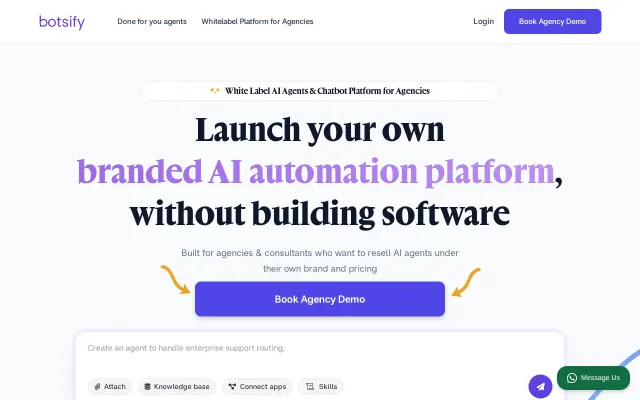 Captured · theagentsindex.com
 Botsify
 Captured · theagentsindex.com
 Auto-Respond
Frequently asked questions
Which of these eight has a public API?
Which is cheapest to start using?
What's the real difference between Decagon and Sierra?
How is Cresta different from the other seven?
Is Crescendo a software product I install or configure?
Do any of these eight offer a free tier?
How does Zendesk AI Agents compare to Intercom Fin?
How does Ada compare to the other sales-led enterprise agents?
How does Botsify compare to Ada?
The digestFree
Which agents actually ship.
New agents and articles, by email, at most once a week.
Last issue · No. 1 · 13 October 2026Devin vs Claude Code: Which Should You Pick?
One-click unsubscribe
The Agents Index digest
The agents we added and what we wrote about them, by email, no more than once a week.
Last issue: Devin vs Claude Code: Which Should You Pick? · 13 October 2026