
Not for Teams that want transparent public pricing, a self-serve trial to test before buying, or that have been burned before by a wide gap between polished admin tooling and the actual end-customer chat experience.
Changed since our last check
- Claude: now Yes. It was Partly when we checked on .
- GPT: now Yes. It was Partly when we checked on .
- Free tier: now No. It was Partly when we checked on .
- Opt out of training: now Yes. It was Partly when we checked on .
The facts, with their sources
What it does
- Writes code
- PartlyAda does not write application code, but code tools are small Python functions a buyer can have drafted from a plain-language description through Ada's MCP Server, staged and promoted by a person.
Through Ada’s MCP Server, where you describe the change in plain language and it lands on a change set that goes live only when a person promotes it.
ada.cx/platform/ada-computer - Debugs and fixes
- NoAda diagnoses its own agent's conversations, not software failures; its only code surface is a small data-shaping Python tool.
A code tool runs a small piece of Python to clean up, transform, or compute data before your AI Agent uses it.
docs.ada.cx/docs/automation/tools/code-… - Writes tests
- PartlyTests here are conversational test cases for the agent's own behaviour, created from production conversations and run for pass/fail, not unit tests for a codebase.
Create test cases from production conversations, trigger test runs, and review pass/fail results and evaluation rationale, all without leaving your…
docs.ada.cx/mcp/introduction/overview - Reviews code
- NoThe only review surface is the agent's own configuration; nothing reads a diff or a pull request.
Audit your setup. "Summarize our configuration" returns every playbook, API tool, coaching entry, and custom instruction in one view.
docs.ada.cx/mcp/introduction/overview - Whole-codebase work
- NoThere is no repository concept: code exists only as single sandboxed snippets in a restricted Python subset.
Language: Python only, a restricted subset, not full Python. A few standard-library modules can be imported; no classes.
docs.ada.cx/docs/automation/tools/code-… - Ships it
- PartlyWhat reaches production is agent configuration and code tools, not application code: MCP-authored changes land on a change set and go live only when a person promotes them.
Create, update, and delete Code tools through the same change-set flow — staged, tested, then promoted, and revertible.
docs.ada.cx/mcp/introduction/overview - Done-for-you service
- PartlySoftware you run yourself, but Ada sells a wrapped services layer: ACX Experts give hands-on guidance and ACX Practice supplies blueprints and training, so part of the operating model is delivered by Ada's people.
ACX Experts provide hands-on guidance to help customers build AI agents that consistently exceed human-level performance.
ada.cx/platform
How much it does unattended
- Runs autonomously
- YesThe vendor's own headline claim is end-to-end resolution without a human: the agent authenticates, checks status, runs the workflow and confirms the outcome, with a stated 84% autonomous resolution rate across voice, messaging and email.
It resolves 84% of customer inquiries autonomously across voice, messaging, and email channels.
ada.cx/platform - Multi-agent
- PartlyOne agent per conversation, with several models orchestrated behind a single Reasoning Engine; the vendor describes multi-LLM orchestration and human handoff, not several agents coordinating on one task.
Orchestrate multiple LLMs to understand, act, and resolve complex inquiries with accuracy, safety, and consistency
ada.cx - Agent permissions
- PartlyThe agent only runs tools an admin has activated, and Ada's own recommendation is to keep write tools behind a Playbook step so they execute inside a controlled flow rather than at the model's discretion; MCP tools are discovered but disabled until enabled.
It only calls tools you've made active, and Ada recommends keeping write tools behind a Playbook step so they run only inside a controlled flow.
ada.cx/platform/ada-computer
Which models it runs on
- Claude
- YesAnthropic is named as one of the model vendors in Ada's curated portfolio, and Claude is also a supported client for Ada's MCP server; the buyer does not choose the conversational model themselves.Was Partly before our last check.
Ada maintains a curated portfolio of models from leading vendors such as OpenAI, Anthropic, and Cohere.
ada.cx/platform/trust - GPT
- YesOpenAI is named in the same curated model portfolio, and ChatGPT is a documented MCP client for managing the agent; again Ada benchmarks and selects which model runs, not the customer.Was Partly before our last check.ada.cx/platform/trust
- Open models
- PartlyAda internally hosts open-source LLMs for contextual understanding only; reply generation runs on the commercial providers and the customer selects neither.
internally hosts other open source LLMs for additional contextual understanding
security.ada.cx - Model choice
- NoAda chooses the models: it benchmarks a curated portfolio on accuracy, safety, latency and cost and promotes versions through its own evaluation pipeline, so model selection is the vendor's decision rather than a customer setting.
New LLMs are benchmarked across accuracy, safety, latency, and cost before selection. Updated versions pass a rigorous evaluation pipeline:…
ada.cx/platform/trust
Where you use it
- In your editor
- PartlyNo coding-agent IDE surface, but Ada's MCP server can be connected from Cursor and VS Code, which lets a team manage and tune the agent from an editor rather than build software in one.
Other clients like Cursor and VS Code also work
docs.ada.cx/mcp/introduction/faq - On the command line
- PartlyThere is no Ada CLI binary; the terminal surface exists only through MCP clients such as Claude Code, Codex CLI and Gemini CLI, which manage the agent's configuration and metrics conversationally.
Claude Code and Codex CLI connect over HTTP.
docs.ada.cx/mcp/introduction/authentica… - In your pipeline
- PartlyThere is no pull-request or build integration, but API-key auth is documented specifically for non-interactive pipelines, so Ada configuration and test runs can be driven from CI jobs.
Running MCP clients in non-interactive environments (CI pipelines, scheduled jobs, backends).
docs.ada.cx/mcp/introduction/authentica… - In a browser
- YesThe Ada dashboard is the primary hosted surface, built around the Performance Center for building, launching, analysing and optimising the agent, with team access and audit log reached from the same sidebar.
The Performance Center gives your team full visibility and control to build, launch, analyze, and optimize your AI agent.
ada.cx/platform
Whose machine it runs on
- Self-hosted
- NoHosted-only: Ada states all of its infrastructure runs in its own AWS accounts, and the Trust Center risk profile records hosting as a major cloud provider with no on-premise option.
Ada is a remote company and does not maintain a physical location with trusted access to corporate or customer data; all infrastructure is hosted on…
security.ada.cx - Open source
- NoThe customer terms assign Ada all intellectual property in the services and its models, and forbid relicensing, which is incompatible with an available source distribution.
Ada Support owns all right, title, and interest, including Intellectual Property Rights, in and to: (i) the Services, including any Ada Models…
ada.cx/legal/customer-terms-of-use
What it costs to run
- How it meters
- YesBilling is metered per customer conversation rather than per seat, with a resolution-based alternative offered to some enterprises, so cost tracks conversation volume and channel expansion.
With our conversation-based pricing model, you pay for every conversation your AI agent has with end users
ada.cx/platform - Free tier
- NoThere is no self-serve entry at all: the pricing route resolves to the demo form and the only documented way in is a booked expert session leading to an enterprise agreement.Was Partly before our last check.
Meet with our team of experts to explore how agentic customer experience can lift CSAT, scale support, and drive new revenue.
ada.cx/demo - API access
- YesA documented REST API suite covers knowledge, end users, conversations and data export, with rotatable keys, versioning, cursor pagination, a downloadable OpenAPI spec and an in-docs playground.
Ada's APIs adhere to REST standards and utilize JSON formatting for data exchange.
docs.ada.cx/reference/introduction/over… - MCP server
- YesAda ships its own MCP server exposing most dashboard operations to any MCP-compatible assistant, with read tools for metrics and conversations plus two write tools whose behaviour changes stage on a change set until approved.
Ada's MCP Server connects your AI assistant directly to your Ada instance so it can analyze performance, update and create resources (knowledge…
docs.ada.cx/mcp/introduction/overview - Bring your own key
- PartlyYou bring your own system credentials, not your own inference: MCP and API tools run on company credentials or end-user sign-in you supply, while nothing documents bringing your own model keys or cloud.
Add your MCP server by URL and give Ada a credential to connect with, as a shared company account.
docs.ada.cx/docs/automation/tools/mcp-t…
Buying it for a team
- A company can buy it
- YesThis is sold only to organisations: the vendor cites 350+ global enterprises, scopes residency and deletion rights in an enterprise agreement, and routes every buyer through an expert review and business case.
For global deployments, data residency, retention schedules, and deletion rights are specified in your enterprise agreement
ada.cx/platform/trust - Seat model
- PartlyDashboard access is managed as named team members with roles, but the commercial meter is conversations rather than seats and no seat count, floor or ceiling is published anywhere on the site.
Manage who can access your Ada dashboard and what they can do. You can invite team members, assign permission levels, and remove access when needed.
docs.ada.cx/docs/other/team-access/my-t… - Pooled budget
- PartlyConsumption is metered per end-user conversation at the agent level rather than against per-user allowances, but no balance, pool or overage mechanics are published.
you pay for every conversation your AI agent has with end users
ada.cx/platform - Admin controls
- YesAdmins constrain the agent on two axes: role-based dashboard permissions across Owner, Admin, Agent and Read Only, and tool-level activation where discovered MCP tools stay off until explicitly enabled.
Connect an MCP server by URL and every tool it exposes is discovered. Each stays off until you turn it on.
ada.cx/platform - Audit log
- YesA searchable audit log records who changed what, when and through which interface, covering dashboard, API, MCP, import and export, and exports to CSV with a 10,000-row cap per view.
The Audit log records configuration changes made to your AI Agent, giving administrators a chronological, searchable history of who changed what,…
docs.ada.cx/docs/other/audit-log - Single sign-on
- YesSAML 2.0 single sign-on is supported with any compliant identity provider and email, firstName and lastName attribute mapping, though initial setup needs an Ada representative and IdP-initiated login is not supported.
Connect any SAML 2.0 compliant identity provider to Ada.
docs.ada.cx/docs/other/team-access/sso
What happens to your code
- Opt out of training
- YesOpting out is not a setting but the default posture: Ada enforces zero data retention with every LLM provider, processing prompts in volatile memory and discarding inputs and outputs after each response.Was Partly before our last check.
All large language model (LLM) providers operate under Zero Data Retention (ZDR) agreements, ensuring customer data is never stored or reused by…
ada.cx/platform/trust - Data residency
- PartlyResidency is contractual rather than a published region menu: it is written into the enterprise agreement by Ada's legal team, and instance domains show at least an EU region exists, but no list of jurisdictions is published.
For organizations with data residency requirements, particularly those operating in the EU under GDPR or in regulated industries with…
ada.cx/platform/trust - Getting out
- YesConversation and message records are exportable through a documented Data Export API, customers can delete personal data by identifier, and audit entries download as CSV; historical export reaches back twelve months.
The Data Export API allows authenticated access to conversation and message data, enabling you to integrate this data into your own systems.
docs.ada.cx/reference/data-export/overv… - Certifications
- YesAda holds SOC 2 Type II and HIPAA, operates in compliance with GDPR, states PCI DSS compliance on the same page, and was the first CX platform certified against AIUC-1, with annual third-party penetration tests covering the LLM layer.
Ada holds SOC 2 Type II and HIPAA certifications and operates in compliance with GDPR.
ada.cx/platform/trust
Plans and pricing
Price and terms
- Free plan or trial
- NoNo
Checked .
The Agents Index digest
Price changes and new agents like Ada, at most once a week.
Last issue: Devin vs Claude Code: Which Should You Pick? · 13 October 2026
Works with
 Claude
 GPT
GPT- PartlyOpen models
For AI agents
- MCP server
- Yes
- API
- Yes
Screenshots
Pricing page, ada.cx, captured 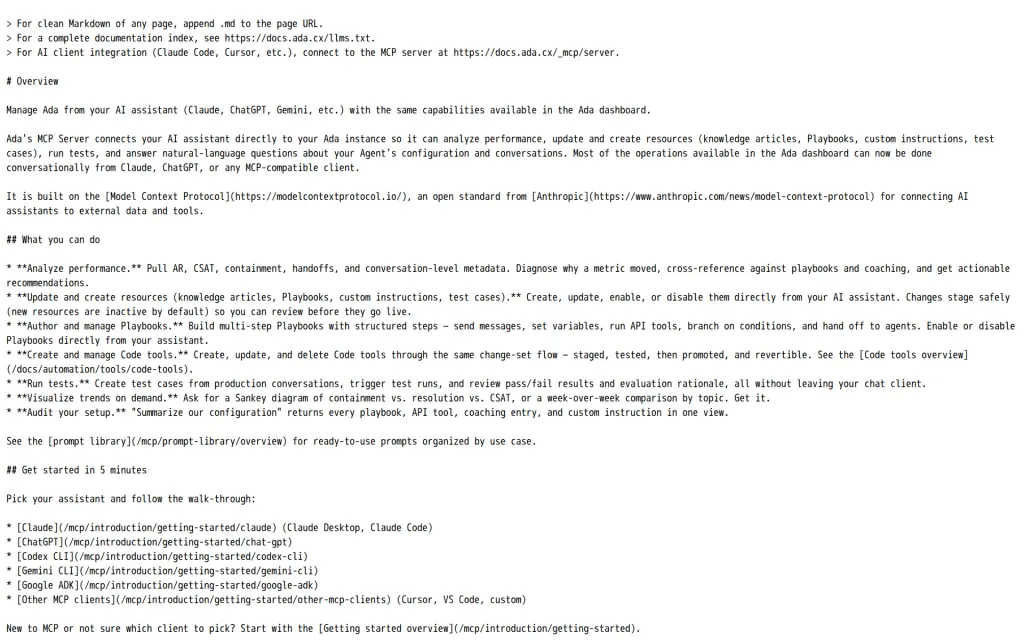
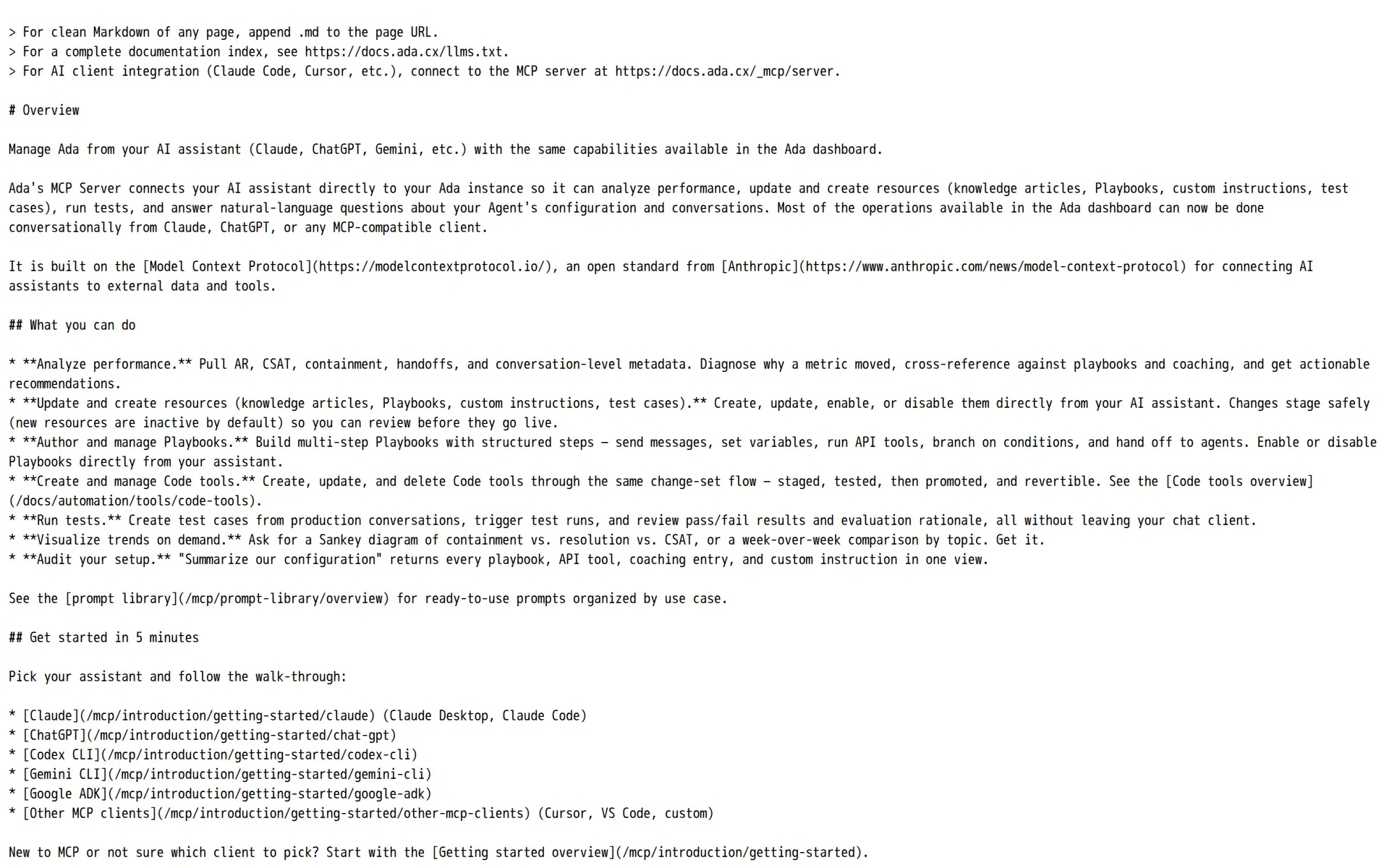
Docs, ada.cx, captured
Filed under
Sources and updates
Last changed
Sources55
- ada.cx/platform
- security.ada.cx/
- ada.cx/platform/trust
- docs.ada.cx/mcp/introduction/overview
- ada.cx/platform/trust
- ada.cx/legal/customer-terms-of-use
- docs.ada.cx/mcp/introduction/authentication
- ada.cx/platform/ada-computer
- docs.ada.cx/docs/automation/tools/code-tools
- docs.ada.cx/docs/other/team-access/my-team
- docs.ada.cx/docs/automation/tools/api-tools/api-tool-control.md
- docs.ada.cx/docs/automation/tools/code-tools/create-a-code-tool
- docs.ada.cx/docs/automation/tools/mcp-tools
- docs.ada.cx/docs/other/data-retention
- ada.cx/legal/subprocessors
- docs.ada.cx/mcp/introduction/faq
- docs.ada.cx/mcp/introduction/faq.md
- docs.ada.cx/mcp/introduction/getting-started
- docs.ada.cx/reference/introduction/overview
- ada.cx/demo
- docs.ada.cx/docs/automation/tools/api-tools/api-tool-control
- docs.ada.cx/docs/automation/tools/mcp-tools.md
- docs.ada.cx/docs/optimization/conversations/data-export
- docs.ada.cx/docs/other/team-access/my-team.md
- docs.ada.cx/docs/other/team-access/sso
- docs.ada.cx/docs/welcome
- docs.ada.cx/docs/welcome.md
- docs.ada.cx/mcp/introduction/getting-started/codex-cli
- docs.ada.cx/mcp/introduction/getting-started/other-mcp-clients
- docs.ada.cx/mcp/introduction/overview.md
- ada.cx/pricing
- docs.ada.cx/reference/data-export/overview
- ada.cx/
- github.com/ada-cx-public/messaging-ios
- docs.ada.cx/chat/web/getting-started
- docs.ada.cx/docs/automation/tools
- docs.ada.cx/docs/handoffs/amazon-connect/initial-configuration
- docs.ada.cx/docs/optimization/change-sets.md
- docs.ada.cx/docs/other/audit-log
- docs.ada.cx/docs/other/audit-log.md
- docs.ada.cx/docs/other/team-access/sso.md
- docs.ada.cx/docs/welcome/getting-started
- docs.ada.cx/docs/welcome/getting-started.md
- docs.ada.cx/docs/welcome/key-concepts
- docs.ada.cx/docs/welcome/key-concepts.md
- ada.cx/experts
- docs.ada.cx/home
- ada.cx/legal/privacy-policy
- docs.ada.cx/lovelace/overview
- docs.ada.cx/mcp/introduction/authentication.md
- docs.ada.cx/mcp/introduction/getting-started/gemini-cli
- docs.ada.cx/reference/data-export/overview.md
- docs.ada.cx/reference/introduction/availability-rules
- docs.ada.cx/reference/snapshot-api/overview
- docs.ada.cx/reference/snapshot-api/overview.md
Coverage elsewhere4
The Agents Index in AI answers0 of 1
- PerplexityDoes not cite The Agents IndexAsked
Ada alternatives
on Other sources: kayako.com, itechguides.com, alternativeto.net, g2.com, dragapp.com, chitika.com
Updates6
- Capabilities · Free tier · Terms
- Capabilities · Price · Terms
- Capabilities · Free tier · Price · Terms
- Capabilities · Free tier · Terms
- Capabilities · Free tier · Terms
- Capabilities · Free tier · Price · Terms
Is this yours? Claim it free and edit it in your dashboard, or feature it in Support agents.