
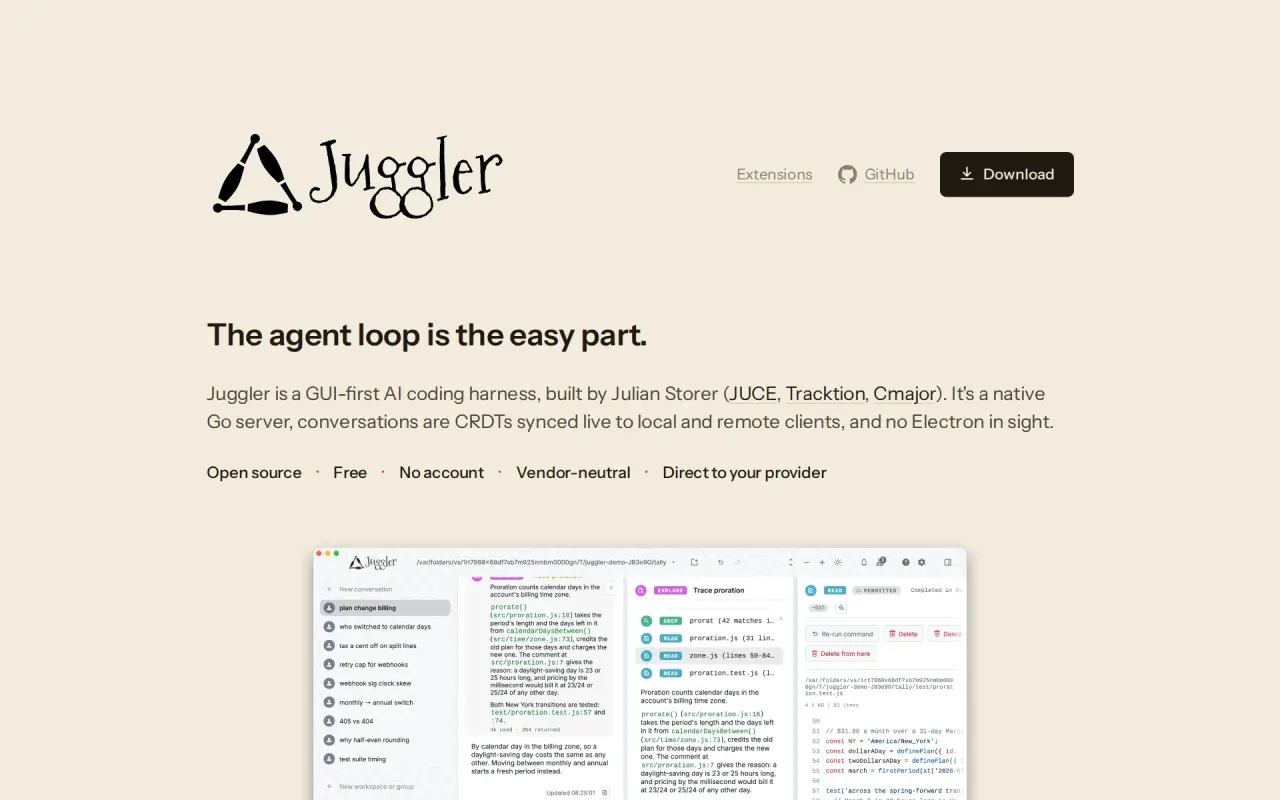
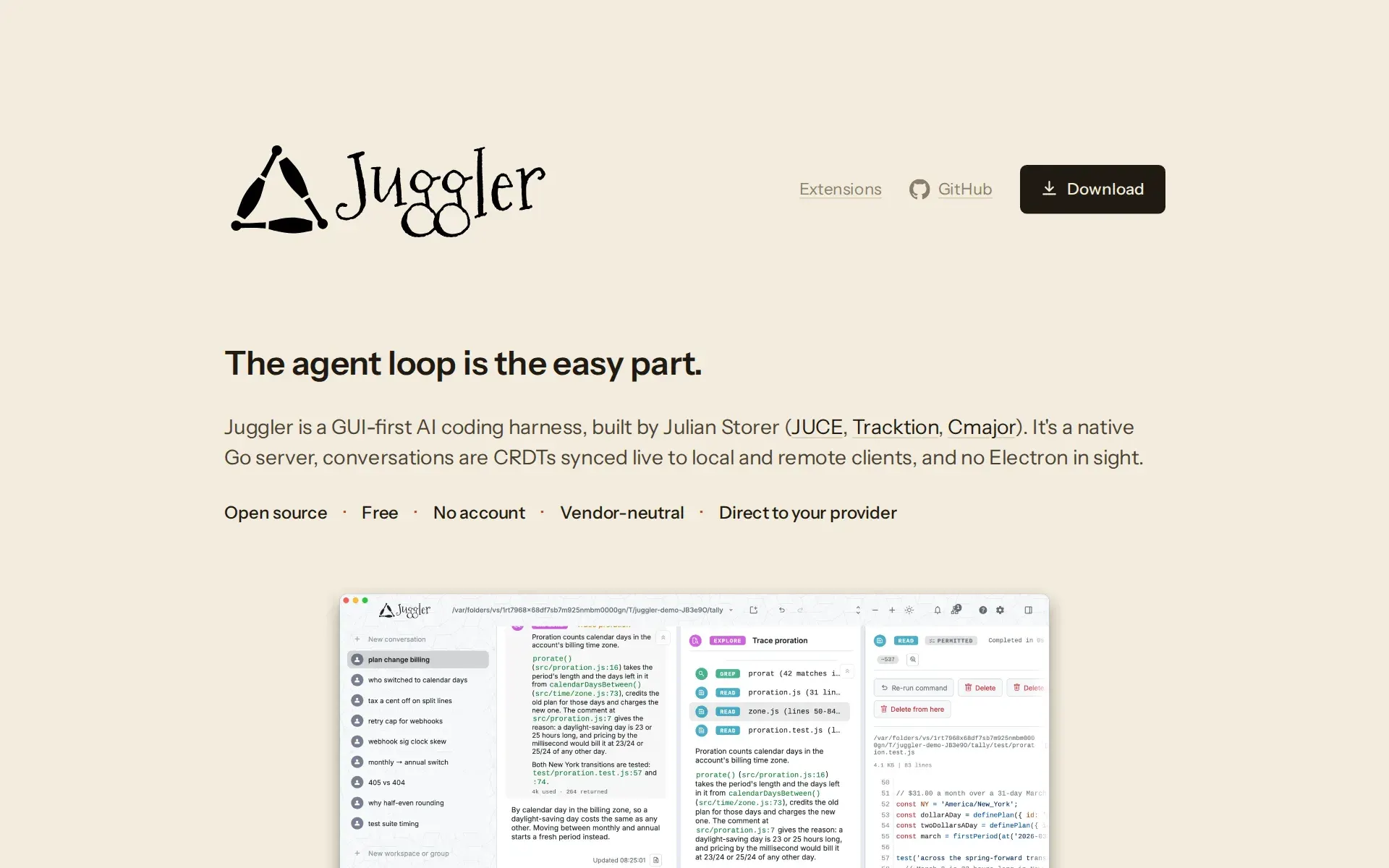
Not for Teams that want a mature, supported, terminal-first agent, or that depend on an existing ACP-based plugin ecosystem Juggler cannot yet import.
Changed since our last check
- Runs autonomously: now Partly. It was Yes when we checked on .
- In a browser: now Yes. It was Partly when we checked on .
- Open source: now Partly. It was Yes when we checked on .
- How it meters: now Partly. It was Yes when we checked on .
- API access: now No. It was Partly when we checked on .
- A company can buy it: now Partly. It was No when we checked on .
- Data residency: now Yes. It was Partly when we checked on .
The facts, with their sources
What it does
- Writes code
- YesThe model is handed file-write and shell tools inside the project you open, so it authors and edits code directly; Juggler supplies the loop and tooling while the model comes from whichever provider you connect.
Even tools such as read, write and bash use the public extension SDK.
juggler.studio - Debugs and fixes
- YesThe documented one-shot example is diagnosing and fixing a failing test.
juggler run "Fix the failing test in cmd/parser and explain what was wrong"
github.com/juggler-ai/juggler/blob/main… - Reviews code
- PartlyA Git review surface lets you read each changed file's diff and comment on individual lines before handing the lot to the model, so review is human-led inside the workbench; no pull-request or CI review integration is documented.
The Git pin is now a review: read each changed file's diff, comment on lines, paste the lot into the prompt
github.com/juggler-ai/juggler/blob/main… - Ships it
- PartlyThe agent edits files and executes shell commands, but no deployment or release capability is described.
The run approves its own tools, so it can edit files and execute commands without asking.
github.com/juggler-ai/juggler/blob/main… - Done-for-you service
- NoJuggler is software you download and run yourself on your own machine or server; the site sells no build, hosting or managed engagement and offers nothing but the app and its matching server.
Download and launch it. The app starts its matching local server and opens your project — no terminal required.
juggler.studio
How much it does unattended
- Runs autonomously
- PartlyThe agent runs a multi-step loop on its own and a strategy can auto-approve tools outright, but the shipped default is an approval gate on anything destructive, so a session can sit waiting for you rather than completing unattended.Was Yes before our last check.
Quit, relaunch or lose the connection and the conversation is still there, including an agent waiting for you to approve its next step.
juggler.studio - Multi-agent
- YesWork is delegated to nested sub-threads that run in isolation and return only the requested result to the parent, and read-only strategies drive Explore/Research sub-agents; coordination is parent-to-child, not peer agents on a shared bus.
Delegated threads keep their intermediate work out of the parent context and return only the result requested.
juggler.studio - Agent permissions
- YesTool calls pass through approval gates whose width you choose per tool, per read-only set or per server, and strategies decide which tools exist at all in a given turn; nothing destructive runs unasked by default.
The approval offers three widths: this tool, all read-only tools on this server, or every tool on that server (trust the server).
github.com/juggler-ai/juggler/blob/main…
Which models it runs on
- Claude
- YesAnthropic's API and the Claude Code CLI are both first-class providers; with the Claude Code provider Juggler spawns the CLI with strict MCP config and serves it Juggler's own toolset.
Juggler supports Anthropic and Claude Code, OpenAI and Codex, GitHub Copilot, Google Gemini, Mistral, Z.AI, Ollama, OpenRouter, DeepSeek and other…
github.com/juggler-ai/juggler - GPT
- YesOpenAI and the Codex CLI are named providers alongside GitHub Copilot, and any OpenAI-compatible endpoint can be pointed at, so GPT models run on your own key or an existing subscription.github.com/juggler-ai/juggler
- Open models
- YesOllama is supported for models running on your own hardware, and DeepSeek, Mistral, Z.AI and OpenRouter cover open-weight models hosted elsewhere; the provider list is explicitly extended by any OpenAI-compatible endpoint.github.com/juggler-ai/juggler
- Model choice
- YesYou choose the provider and the model, and can switch model and thinking level mid-workflow; Juggler sells no inference of its own, so the choice is yours in every case.
Switch models and thinking levels without changing the rest of your workflow.
github.com/juggler-ai/juggler
Where you use it
- In your editor
- NoJuggler is its own desktop workbench: the download inventory is the app and its server and nothing else, so there is no editor or IDE plugin — you work beside your IDE rather than inside it.
Each download contains two parts that always ship together:
github.com/juggler-ai/juggler - On the command line
- YesA headless command-line server is half of every download and runs on the machine holding the code; the same binary carries CLI subcommands for scaffolding, validating and linking extensions.
Run the headless juggler binary on the machine where your code lives, then attach from a browser or the desktop app — locally or across the network.
juggler.studio - In your pipeline
- Partly`juggler run` is built for CI jobs, git hooks and batch work with typed exit codes, but there is no PR-review or CI integration of its own.
juggler run does one prompt with nobody watching, then exits with a status - for CI jobs, git hooks, and batch work over many repositories.
github.com/juggler-ai/juggler/blob/main… - In a browser
- YesThe server serves its own web UI and prints the URL, so any browser on the desktop or a phone is a full client of the same live session alongside the native app.Was Partly before our last check.
The server serves the web UI and prints its URL and a QR code.
github.com/juggler-ai/juggler
Whose machine it runs on
- Self-hosted
- YesSelf-hosting is the only deployment there is: you run the server on your workstation, a dev box or your own server, and there is no vendor cloud in the path at all.
Run Juggler on your workstation, a dev box or a server, then use the same live session from the desktop app or a browser.
github.com/juggler-ai/juggler - Open source
- PartlyThe application is AGPL-3.0 and the extension SDK, bundled extensions and examples are Apache-2.0, but the official downloads are built from a private repository and may layer closed proprietary components on top of that open code.Was Yes before our last check.
Official Juggler binaries are built and distributed from a separate private repository. They may bundle additional proprietary components (paid…
github.com/juggler-ai/juggler/blob/main…
What it costs to run
- How it meters
- PartlyJuggler itself meters nothing and charges nothing: your spend is whatever your model provider bills against the subscription or API key you bring, so cost tracks token usage rather than seats or tasks, with no vendor-side calculator.Was Yes before our last check.
Bring a subscription you already pay for or your own API keys.
juggler.studio - Free tier
- YesThe full desktop app and server are a free download for macOS, Windows and Linux with no Juggler account, no trial clock and no sign-up; you supply only your own model access.
Free to download. Open-source core. No Juggler account. No Electron.
juggler.studio - API access
- NoThere is no documented public API for driving Juggler from your own stack: the app-server link is an explicitly private protocol with no stability promise, and automation is expected to happen inside the app as JavaScript extensions.Was Partly before our last check.
The app and server speak a private protocol over HTTP/WebSocket that is not promised to be stable across versions.
github.com/juggler-ai/juggler/blob/main… - MCP server
- PartlyJuggler is a full MCP client — local stdio or remote HTTP/SSE servers, header auth, per-tool allow and deny lists, and inspectable handoffs — but it publishes no MCP server of its own, so another agent cannot query Juggler this way.
Point Juggler at a local or remote MCP server and its tools join the built-in toolset.
github.com/juggler-ai/juggler - Bring your own key
- YesYou bring your own inference: either an existing provider subscription or your own API keys, stored locally in an owner-only credentials file, and local models via Ollama are equally supported.juggler.studio
Buying it for a team
- A company can buy it
- PartlyNo plans, seats or checkout exist to buy; an organisation's only published route is negotiating a commercial licence with the author for uses the AGPL does not permit, and official builds may include paid components with no stated terms.Was No before our last check.
If you want to use Juggler's AGPL code in a way the AGPL doesn't permit, contact the author about commercial licensing.
github.com/juggler-ai/juggler/blob/main… - Admin controls
- PartlyConstraints are real but local and per-user: a strategy fixes which tools exist and what is auto-approved in a turn, and each MCP server takes an allowlist or denylist, yet there is no organisation-level console enforcing policy across users.
A policy for the agentic loop: which tools exist this turn, what gets auto-approved, what guidance the model is given. Read-only and YOLO are just…
juggler.studio/extensions.html - Audit log
- PartlyActivity is logged in detail on your own disk — a structured server log plus one file per conversation — but these are operational logs the user can disable or redirect, swept by age after two weeks, not a tamper-evident administrative audit trail.
At startup Juggler removes any log file in the directory that hasn't been modified in 14 days
github.com/juggler-ai/juggler/blob/main… - Single sign-on
- NoThere is no identity layer to federate: Juggler requires no account of its own, and sharing a server across a LAN is documented as having no password at all, let alone SAML or OIDC.
LAN access has no password: enable it only on networks you trust.
github.com/juggler-ai/juggler
What happens to your code
- Opt out of training
- PartlyJuggler has no cloud and no account, so nothing reaches the vendor; whether your code trains a model is settled entirely by the provider whose key or subscription you connect, and Juggler publishes no policy of its own on it.
Open the app, choose a project and connect a model provider; no Juggler account is required.
github.com/juggler-ai/juggler - Data residency
- YesResidency is wherever you run the server: sessions and project state are written next to your code, credentials sit in an owner-only file in your home directory, and the server binds to localhost unless you open it.Was Partly before our last check.
It listens on localhost by default, so nothing off your machine can reach it.
github.com/juggler-ai/juggler - Getting out
- YesNothing is locked in a vendor account: sessions are files on your disk, per-user state in the config directory is documented as copyable to another machine, and there are no credits that could expire.
A session lives on disk, not just in memory.
juggler.studio
Plans and pricing
Price and terms
- Free plan
- YesYes
The terms in full
The complete desktop app and headless server for macOS, Windows and Linux, free to download with no Juggler account and no time limit. You supply model access yourself (an existing provider subscription or your own API keys), so inference is billed to you by the provider. The public repository's builds support local and LAN access; the official binaries add WAN modes, and the licensing page says official binaries may bundle proprietary paid components whose price is not published.
Checked .
The Agents Index digest
Price changes and new agents like Juggler, at most once a week.
Last issue: Devin vs Claude Code: Which Should You Pick? · 13 October 2026
Works with
 Claude
 GPT
GPT- YesOpen models
For AI agents
- MCP server
- Partly
- API
- No
Filed under
Sources and updates
Last changed
Sources14
- github.com/juggler-ai/juggler
- juggler.studio/
- github.com/juggler-ai/juggler/blob/main/docs/headless-linux.md
- github.com/juggler-ai/juggler/blob/main/SECURITY.md
- github.com/juggler-ai/juggler/blob/main/docs/mcp.md
- github.com/juggler-ai/juggler/blob/main/docs/extension_guide.md
- github.com/juggler-ai/juggler/blob/main/LICENSING.md
- juggler.studio/extensions.html
- github.com/juggler-ai/juggler/blob/main/CHANGELOG.md
- github.com/juggler-ai/juggler/blob/main/docs/context-window.md
- github.com/juggler-ai/juggler/blob/main/docs/distribution.md
- github.com/juggler-ai/juggler/blob/main/docs/logging.md
- github.com/juggler-ai/juggler/blob/main/docs/memory.md
- api.github.com/repos/juggler-ai/jugglerRepository
Repository30 August 2026
- Licence
- AGPL-3.0
- Stars
- 575
- Forks
- 43
- Last push
- 30 August 2026
The Agents Index in AI answers1 of 1
- PerplexityCites The Agents IndexAsked
Juggler alternatives
on Other sources: roasty.tech, producthunt.com, mudry.tech, openaltfinder.com, filearbor.com, alternativeto.net
Updates4
- Capabilities · Free tier · Price · Terms
- Capabilities · Free tier · Terms
- Capabilities · Free tier · Terms
- Alternatives · Summary · Tagline · Wikidata id