
Summary
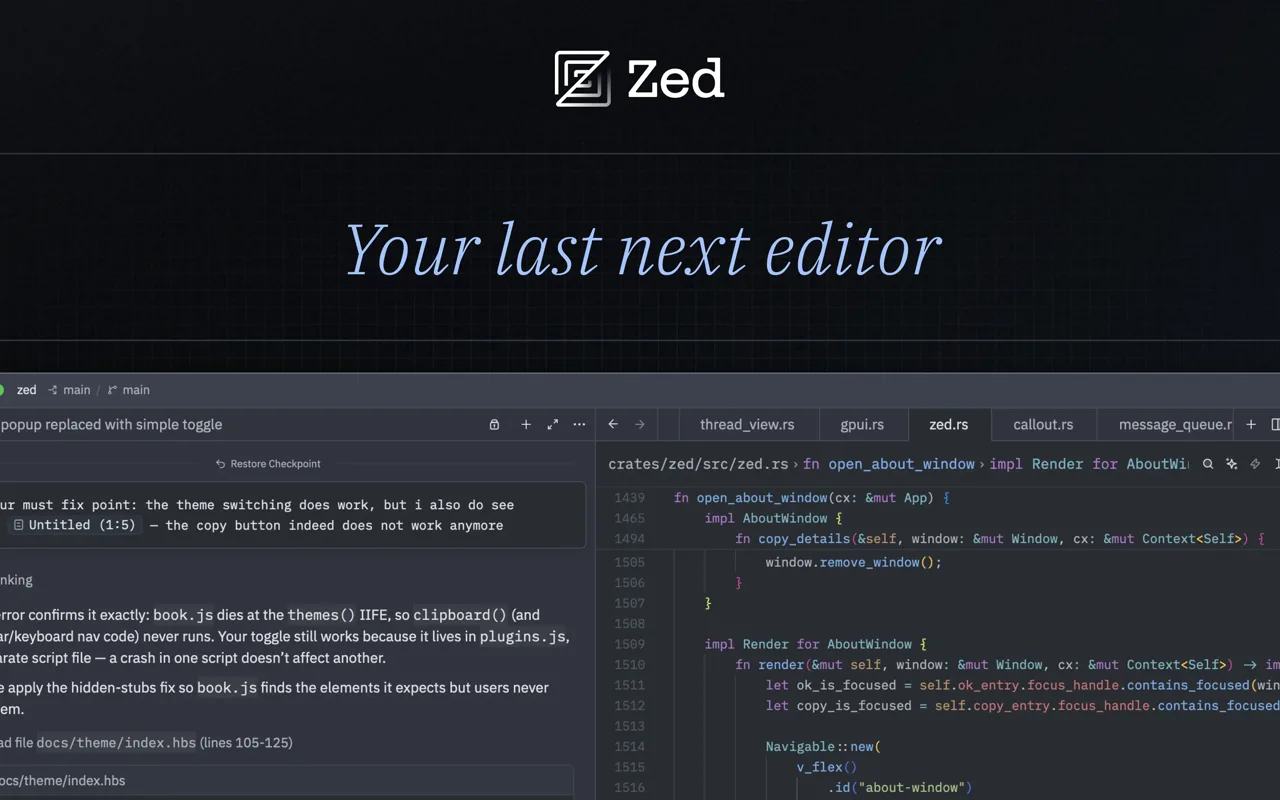
Zed is a code editor written from scratch in Rust, with an Agent Panel where its own agent, ACP-integrated external agents, or terminal CLIs read, edit and run code in your project. It ships as a desktop app with real-time multiplayer collaboration.
- Best for
- Developers who want a fast, open-source editor and the freedom to run Claude Code, Codex, Gemini CLI or other vendors' own agents natively via the Agent Client Protocol Zed created, instead of being locked into one editor's built-in agent.
- Not for
- Teams that need VS Code's much larger extension ecosystem or a managed, Codespaces-style cloud development environment, or who want the single most mature, batteries-included proprietary agent (Cursor, GitHub Copilot) without assembling their own editor-plus-agent combination.
- From
- Freethen $10/month
- Free tier
- YesPersonal plan, $0 forever: full editor, 2,000 accepted edit predictions, and unlimited use with your own API keys or external agents. Zed-hosted models require Pro. Separately, Pro has a two-week trial with $20 of token credits, excluding Claude Fable, Claude Opus and GPT Pro models.
What it does
- Writes code
- YesThe Agent Panel's stated job is agents that read, write and run code in the open project.
The Agent Panel is where you interact with AI agents that can read, write, and run code in your project.
zed.dev/docs/ai/agent-panel - Debugs and fixes
- YesDebugging is one of the uses Zed lists for the Agent Panel, alongside generation and refactoring.
It's the core of Zed's AI code editing experience — use it for code generation, refactoring, debugging, documentation, and general questions.
zed.dev/docs/ai/agent-panel - Reviews code
- PartlyA branch diff can be @-mentioned into a thread as context, but Zed documents no pull-request or third-party-diff review surface; its review UI covers the agent's own edits.
You can mention files, directories, symbols, previous threads, skills, diagnostics, branch diffs, and URLs to fetch.
zed.dev/docs/ai/agent-panel - Whole-codebase work
- YesAgents read and write across every folder of a multi-root project in one thread, with project-wide grep and multibuffer edits.
Agents can then read and write across all of those folders in a single thread.
zed.dev/docs/ai/parallel-agents - Ships it
- PartlyThe documented flow stops at the diff: you review and merge through your own Git workflow. The agent's terminal tool can run any shell command, subject to tool permissions and sandboxing.
After the agent finishes, review the diff and merge the changes through your normal Git workflow.
zed.dev/docs/ai/parallel-agents
Not established: Writes tests
How much it does unattended
- Runs autonomously
- PartlyEvery tool action prompts by default; unattended multi-step runs require setting tool permissions to allow, and Zed warns that longer tasks need monitoring.
"confirm" (default) — Prompts for approval before running any tool action, including MCP tool calls
zed.dev/docs/ai/mcp - Multi-agent
- YesA spawn_agent tool delegates work to subagents with their own context windows, and multiple threads run in parallel, optionally isolated in Git worktrees.
Spawns a subagent with its own context window to perform a delegated task.
zed.dev/docs/ai/tools - Agent permissions
- YesPer-tool allow/deny/confirm rules with Rust regex patterns, un-overridable built-in rm -rf rules, plus an OS-level sandbox for the terminal and fetch tools.
Configure which Agent Panel tools run automatically and which require your approval.
zed.dev/docs/ai/tool-permissions
Which models it runs on
- Claude
- YesClaude models are Zed-hosted on Pro and Business, and also reachable with your own Anthropic key, OpenRouter, or the Claude external agent.
The same model can be offered via multiple providers - for example, Claude Sonnet 4.5 is available via Zed Pro, OpenRouter, Anthropic directly, and…
zed.dev/docs/ai/agent-panel - GPT
- YesOpenAI GPT models are in Zed's hosted catalogue; the pro variants are restricted to Pro and Business, and any GPT model can be used with your own OpenAI key.
Claude Fable 5, Claude Opus models, GPT-5.5 pro, and GPT-5.4 pro are only available on Zed Pro and Zed Business.
zed.dev/docs/account/zed-hosted-models - Open models
- YesOpen-weight models run through llama.cpp, Ollama, LM Studio or any local OpenAI-compatible server, feeding the Zed Agent and Inline Assistant.
Use llama.cpp and its built-in server for local models with Zed Agent, Inline Assistant, and similar model-backed Zed AI features.
zed.dev/docs/ai/use-a-local-model - Model choice
- YesYou choose provider and model from a selector in the message editor; Zed hosts models but never forces its own.
After you've configured your LLM providers—either via API access or through Zed-hosted models—you can switch between their models by clicking on the…
zed.dev/docs/ai/agent-panel
Where you use it
- In your editor
- YesZed is itself the editor; the agent runs in its Agent Panel and Threads Sidebar and hooks into the project, editor, terminal and review surfaces.
It runs in the Agent Panel and Threads Sidebar, uses models configured through LLM Providers, and integrates with Zed's project, editor, terminal,…
zed.dev/docs/ai/zed-agent - On the command line
- PartlyTerminal Threads host third-party agent CLIs and TUIs inside Zed, and a zed CLI opens files from scripts; the terminal surface belongs to the CLI, which owns its own auth and config.
Terminal Threads are terminal-backed threads in the Threads Sidebar. Use them when you want to run an agent CLI or TUI directly in Zed.
zed.dev/docs/ai/terminal-threads - In your pipeline
- NoAll three documented agent paths run in Zed's Agent Panel, Threads Sidebar or terminal; no pull-request bot or CI runner is offered.
Zed supports three agent paths. Choose the path based on how you want agentic work to run.
zed.dev/docs/ai/agents - In a browser
- NoZed is a desktop app for macOS, Linux and Windows; the web platform is explicitly unsupported. dashboard.zed.dev is billing and org admin, not an agent surface.
Not supported at this time.
zed.dev/docs/installation
Whose machine it runs on
- Self-hosted
- PartlyThe editor runs on your machine and inference can run on hardware you control; Zed-hosted models, collaboration and the org dashboard stay on Zed's infrastructure.
Use local models when you run the model on your machine or on infrastructure you control.
zed.dev/docs/ai/use-a-local-model - Open source
- YesZed states the editor is open source, and its docs carry build-from-source instructions for macOS, Linux and Windows.
Since Zed is open source, these controls govern Zed's hosted services specifically.
zed.dev/pricing
What it costs to run
- How it meters
- YesTwo meters at once: a monthly seat price (Pro $10, Business $30/seat) plus per-token hosted usage billed at provider list price plus 10%.
With token-based billing, you’re only charged for the text your prompts and responses actually consume. Costs vary by model, but Zed Pro bills at API…
zed.dev/pricing - Free tier
- YesThe Personal plan is $0 forever with no call: full editor, 2,000 accepted edit predictions, and unlimited use of your own API keys or external agents.
The next-generation code editor. Free forever.
zed.dev/pricing - API access
- NoThe three documented agent paths all run inside the editor; Zed publishes no API for driving its agent from your own stack. Provider API keys feed models into Zed, not the other way round.
Agent paths decide how agentic work runs in Zed.
zed.dev/docs/ai/overview - MCP server
- PartlyZed is an MCP client: it installs local and remote MCP servers and forwards them to external agents over ACP. Only client-side Tools and Prompts support is documented; Zed does not expose itself as an MCP server.
Zed uses the Model Context Protocol to interact with context servers.
zed.dev/docs/ai/mcp - Bring your own key
- YesBring your own provider keys on any plan, including the free one; keys are stored in the system keychain and spend goes to your provider.
Yes you can! We currently support Amazon Bedrock, Anthropic, GitHub Copilot, Deepseek, Google AI, LM Studio, Mistral, Ollama, OpenAI, OpenRouter,…
zed.dev/pricing
Buying it for a team
- A company can buy it
- YesBusiness is self-serve month-to-month for organisations of any size, with order-form contracts offered from 25 seats.
No minimum. Business is self-serve and available to organizations of any size. Month-to-month plans are available to everyone.
zed.dev/pricing - Seat model
- Yes$30 per seat per month with no seat floor or ceiling; Billing Managers do not consume a paid seat.zed.dev/pricing
- Pooled budget
- PartlyBusiness seats share one org-wide spend limit and a single invoice, and hosted usage stops for everyone when it is hit; Pro spend limits are per individual.
On Zed Business, administrators set a pre-tax org-wide spend limit from the Data & Privacy page in the organization dashboard.
zed.dev/docs/account/plans-and-pricing - Admin controls
- PartlyBusiness admins can disable Zed-hosted models, Edit Predictions, feedback sharing and collaboration org-wide; the controls do not reach BYOK, gateways, local models, External Agents or Terminal Threads.
Owners and admins can configure settings that apply to every member of the organization.
zed.dev/docs/business/admin-controls - Audit log
- NoZed's own account of Business admin capability covers AI feature availability, data egress and spend tracking; no administrative audit or activity log is documented anywhere in the Business docs.
Administrators control which AI features are available, what data leaves your environment, and how AI spend is tracked.
zed.dev/docs/business/overview - Single sign-on
- NoNot shipped: members authenticate with GitHub after accepting an org invite. SSO, SAML and SCIM are stated as planned.
SSO, SAML, and SCIM are planned but not currently available.
zed.dev/pricing
What happens to your code
- Opt out of training
- YesNo training by default: retention needs an explicit rating or opt-in, and Business orgs have member opt-in disabled entirely by default.
Zed only retains AI data when you explicitly share feedback or opt in to training data collection.
zed.dev/docs/ai/privacy-and-security - Data residency
- YesZed's websites, software and service are hosted in the United States, with EEA/UK transfers under Standard Contractual Clauses.
Our websites, products, and services are hosted in the United States
zed.dev/privacy-policy - Getting out
- PartlyIncluded token credit resets on each billing date rather than rolling over, so unused credit does not carry forward.
Monthly included credit resets on your monthly billing date.
zed.dev/docs/account/plans-and-pricing - Certifications
- PartlyGDPR and UK rights are honoured and a Data Processing Agreement governs Business processing; see notes for the SOC 2 status.
If you are located in the European Economic Area (EEA) or the United Kingdom (UK), you may exercise any of the rights described above under GDPR or…
zed.dev/privacy-policy
32 sourced claims on this page. Checked 2026-09-03. How we check.
Alternatives
Where we would send a reader instead, in that listing's own words.
Coding agent in a desktop editor, terminal CLI, cloud VMs and CI, priced per seat plus token usage.
Open-source coding agent for VS Code, JetBrains, the terminal and CI, running on whichever model you bring.
JetBrains' coding agent: runs in JetBrains IDEs, the terminal and CI, on JetBrains models or your own keys.
Filed under
Sources and updates
The pages we read35
1 of 35 independent of the vendor.
- zed.dev/pricing11 fields
- zed.dev/ai6 fields
- zed.dev/docs/ai/agent-panel6 fields
- zed.dev/docs/ai/tools3 fields
- zed.dev/docs/account/plans-and-pricing2 fields
- zed.dev/docs/account/zed-hosted-models2 fields
- zed.dev/docs/account/zed-hosted-models.md2 fields
- zed.dev/docs/ai/agent-panel.md2 fields
- zed.dev/docs/ai/mcp2 fields
- zed.dev/docs/ai/mcp.md2 fields
- zed.dev/docs/ai/parallel-agents2 fields
- zed.dev/docs/ai/tools.md2 fields
- zed.dev/docs/ai/use-a-local-model2 fields
- zed.dev/privacy-policy2 fields
- zed.dev/docs/account/plans-and-pricing.md1 field
- zed.dev/docs/ai/agents1 field
- zed.dev/docs/ai/agents.md1 field
- zed.dev/docs/ai/overview1 field
- zed.dev/docs/ai/parallel-agents.md1 field
- zed.dev/docs/ai/privacy-and-security1 field
- zed.dev/docs/ai/privacy-and-security.md1 field
- zed.dev/docs/ai/terminal-threads1 field
- zed.dev/docs/ai/tool-permissions1 field
- zed.dev/docs/ai/tool-permissions.md1 field
- zed.dev/docs/ai/use-a-local-model.md1 field
- zed.dev/docs/ai/zed-agent1 field
- zed.dev/docs/business/admin-controls1 field
- zed.dev/docs/business/admin-controls.md1 field
- zed.dev/docs/business/overview1 field
- zed.dev/docs/installation1 field
- zed.dev/docs/installation.md1 field
- zed.dev/docs/reference/cli.md1 field
- zed.dev/docs/soc21 field
- zed.dev/docs/soc2.md1 field
- api.github.com/repos/zed-industries/zedPlatform record1 field
Platform record2026-08-30
- Stars
- 89,447
- Forks
- 10,332
- Last push
- 2026-08-30
Coverage elsewhere1
Updates3
- Capabilities · Commercial terms · Free tier
- Capabilities · Commercial terms · Free tier · Price
- Summary