
Not for Buyers who need a GUI (see Juggler), an enterprise support contract, or who are unwilling to accept the disclosed ToS risk of subscription-billing OAuth reuse and would rather stick to the API-key flow or a first-party vendor tool.
Changed since our last check
- Agent permissions: now Partly. It was Yes when we checked on .
- How it meters: now Partly. It was Yes when we checked on .
The facts, with their sources
What it does
- Writes code
- YesThe agent authors and modifies files directly through built-in write and edit tools, driven from a prompt in the terminal rather than a chat window that returns snippets.
read, write, edit, glob, bash. The minimum viable toolbox for an agent that actually ships code.
zot.sh - Debugs and fixes
- PartlyNo dedicated debugging feature; the vendor names failure investigation only as an example of a task you can hand a background sub-agent, which then edits the same working directory.
Spawn one for a side task (“draft the migration”, “investigate this stack trace”, “write the test harness for module X”), keep going in the main…
github.com/patriceckhart/zot - Writes tests
- PartlyTest authoring appears only as an example task for a swarm sub-agent; there is no test-generation feature in the tool set or the docs.github.com/patriceckhart/zot
- Reviews code
- PartlyStructured review is not in the binary; it arrives as the vendor's own opt-in zot-review extension, which maps the repository and records findings rather than commenting on a pull-request diff.
This starts a structured review of the current project. The agent maps the repository into feature slices, reads relevant files, records concrete…
zot.sh/extensions/patriceckhart/zot-rev… - Whole-codebase work
- PartlyIt works across a whole working directory with recursive glob search and a canned whole-project reading pass, but there is no repository index; large work depends on the model window and automatic compaction.
Run the canned prompt "Read and understand everything in the current directory." so the agent has full project context before you start asking…
github.com/patriceckhart/zot/blob/main/… - Ships it
- PartlyThere is no deployment feature; the agent stops at edits on disk and whatever your own shell commands do, since git and deploy scripts run through the generic bash tool.
bash: run a command in the session cwd with merged stdout/stderr and a timeout.
github.com/patriceckhart/zot/blob/main/…
How much it does unattended
- Runs autonomously
- YesConfirmation is opt-in rather than default, and the headless modes deliberately run tools without asking so pipelines complete unattended, bounded only by a step cap.
The flag is interactive-TUI only. In -p, --json, and rpc modes it is ignored with a stderr warning and tools still run freely, so scripts and…
zot.sh/docs/tool-gate - Multi-agent
- YesSwarm runs several agents at once as separate processes, each with its own model loop and session, and they share one working directory with no per-agent branch isolation.
Each agent is a separate zot subprocess with its own model loop, its own persistent session file, and its own chat in the dashboard — but they all…
zot.sh/docs/swarm - Agent permissions
- PartlyBy default the agent acts without asking; per-call confirmation is a flag you must pass, it only exists in the interactive TUI, and the jail sandbox is described as a guardrail rather than a boundary.Was Yes before our last check.
Run with --no-yolo to confirm every tool call before it runs. The active transcript and tool preview remain visible while a dialog offers four…
zot.sh/docs/tool-gate
Which models it runs on
- Claude
- YesAnthropic is a first-class provider reachable either with an API key or by logging in with an existing Claude Pro or Max subscription through the OAuth flow.
Anthropic Claude Pro/Max (anthropic), OpenAI Codex / ChatGPT Plus/Pro (openai-codex), Kimi Code (kimi), xAI SuperGrok / X Premium (xai), and GitHub…
zot.sh/docs/providers - GPT
- YesOpenAI is supported through both the Chat Completions and Responses APIs with a key, and through a ChatGPT Plus or Pro subscription via the Codex login flow.
Simple API-key providers can be configured through /login or environment variables. Examples include Anthropic, OpenAI, OpenAI Responses, DeepSeek,…
zot.sh/docs/providers - Open models
- YesOpen-weight models run locally through Ollama, LM Studio or a llama.cpp router, with in-app GGUF download and load management for the router path and no API key needed.
Managed GGUF models: connect the distinct llama.cpp provider to a recent llama.cpp router, then use /llama for download, load, unload, and removal.
zot.sh/docs/providers - Model choice
- YesYou choose the provider and model per run or per swarm agent, and you can register entirely new providers and endpoints yourself in a models file.
Named custom providers: define a new provider key with its own baseUrl and api format in $ZOT_HOME/models.json.
zot.sh/docs/providers
Where you use it
- In your editor
- NoThe vendor's complete inventory of run modes is terminal and headless only, with no editor plugin; an IDE surface would have to be built by someone else on the embedding interfaces.
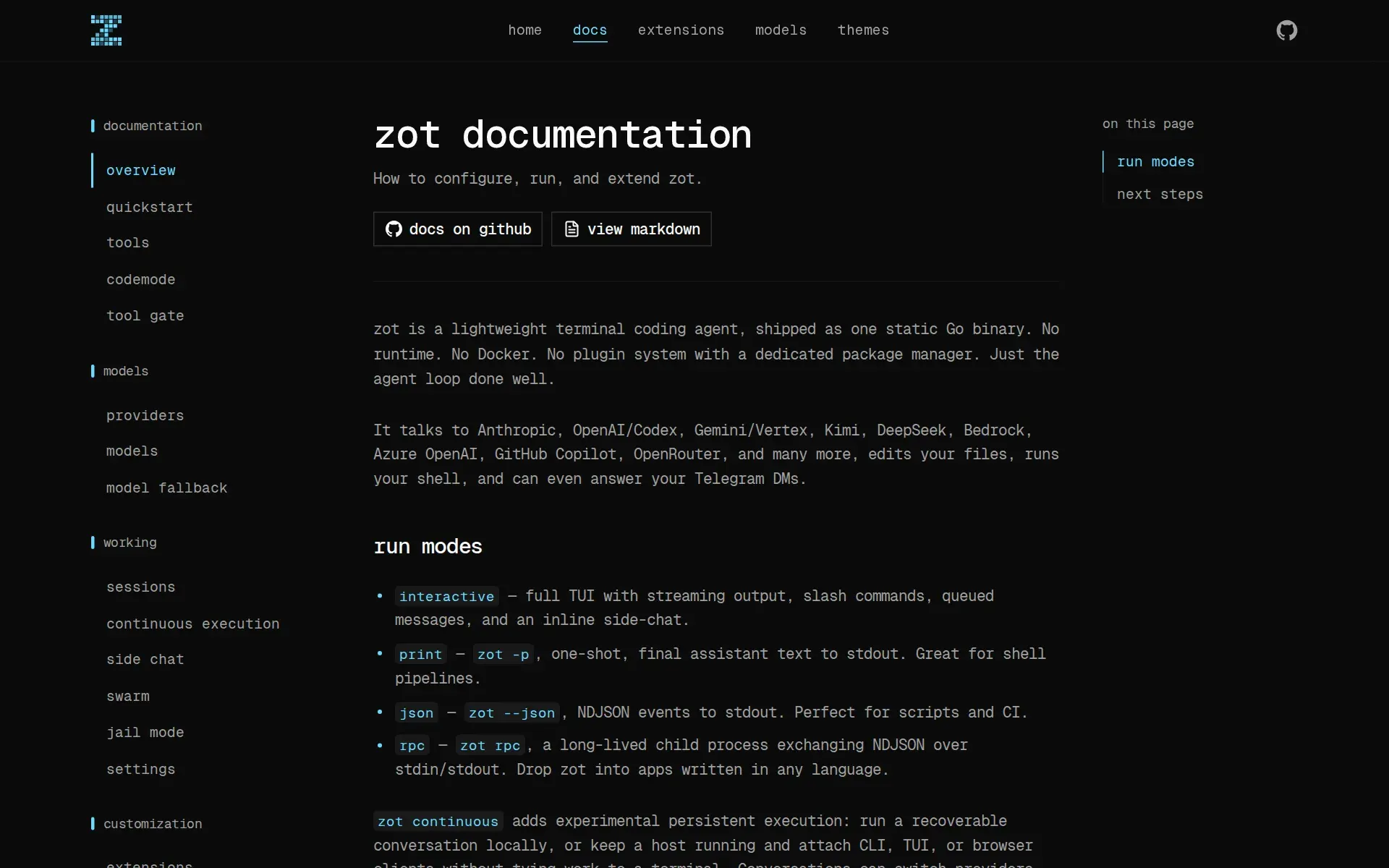
interactive — full TUI with streaming output, slash commands, queued messages, and an inline side-chat. print — zot -p, one-shot, final assistant…
zot.sh/docs - On the command line
- YesThe terminal is the product: a single static binary dropped on your PATH gives an interactive TUI plus one-shot print and streaming invocations.
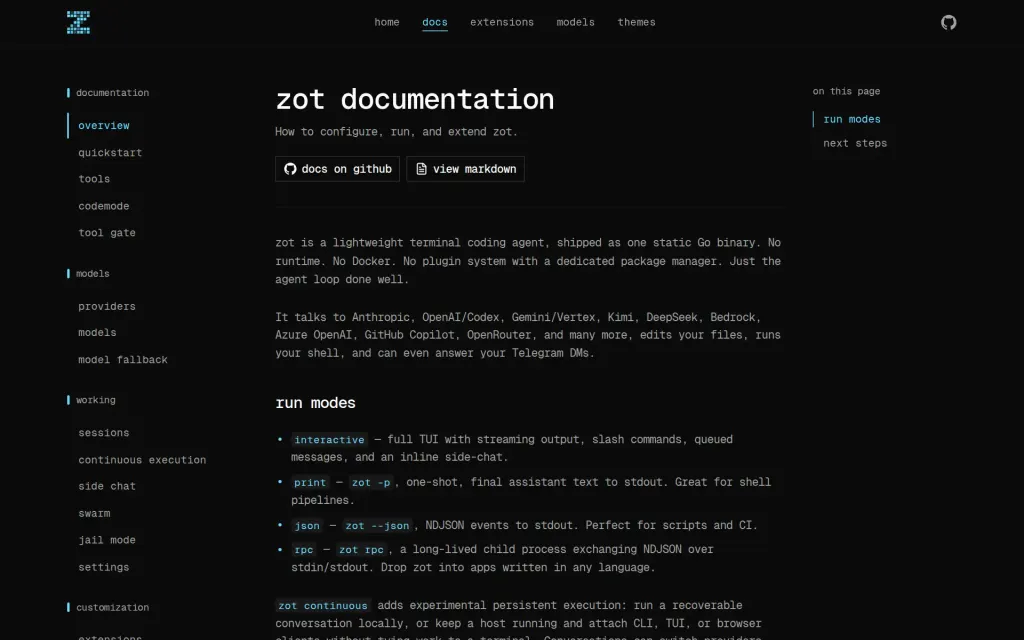
zot is a lightweight terminal coding agent, shipped as one static Go binary. No runtime. No Docker. No plugin system with a dedicated package manager.
zot.sh/docs - In your pipeline
- PartlyJSON event output is offered for scripts and CI, but nothing ties into a pull request or a hosted runner; you invoke the binary yourself inside your own pipeline.
json — zot --json, NDJSON events to stdout. Perfect for scripts and CI.
zot.sh/docs - In a browser
- NoThere is no hosted web application at all; the remote surface the vendor provides instead is a Telegram bridge that relays direct messages into a running local session.
Telegram Bridge Pair zot with a bot token and DM it from anywhere. It reads, writes, edits, and runs, same as the TUI.
zot.sh
Whose machine it runs on
- Self-hosted
- YesEverything runs on your own machine: one binary, no vendor service in the path, with all configuration, credentials and transcripts stored in a local state directory.
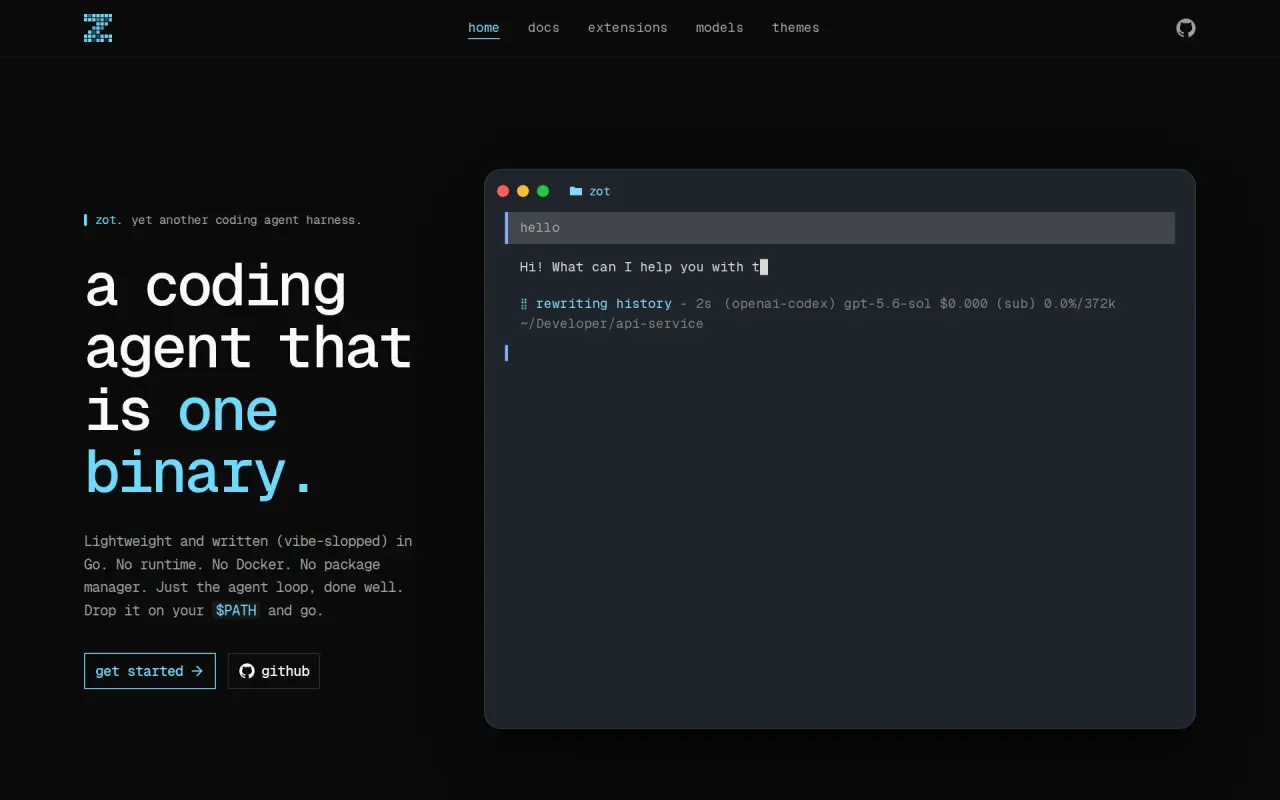
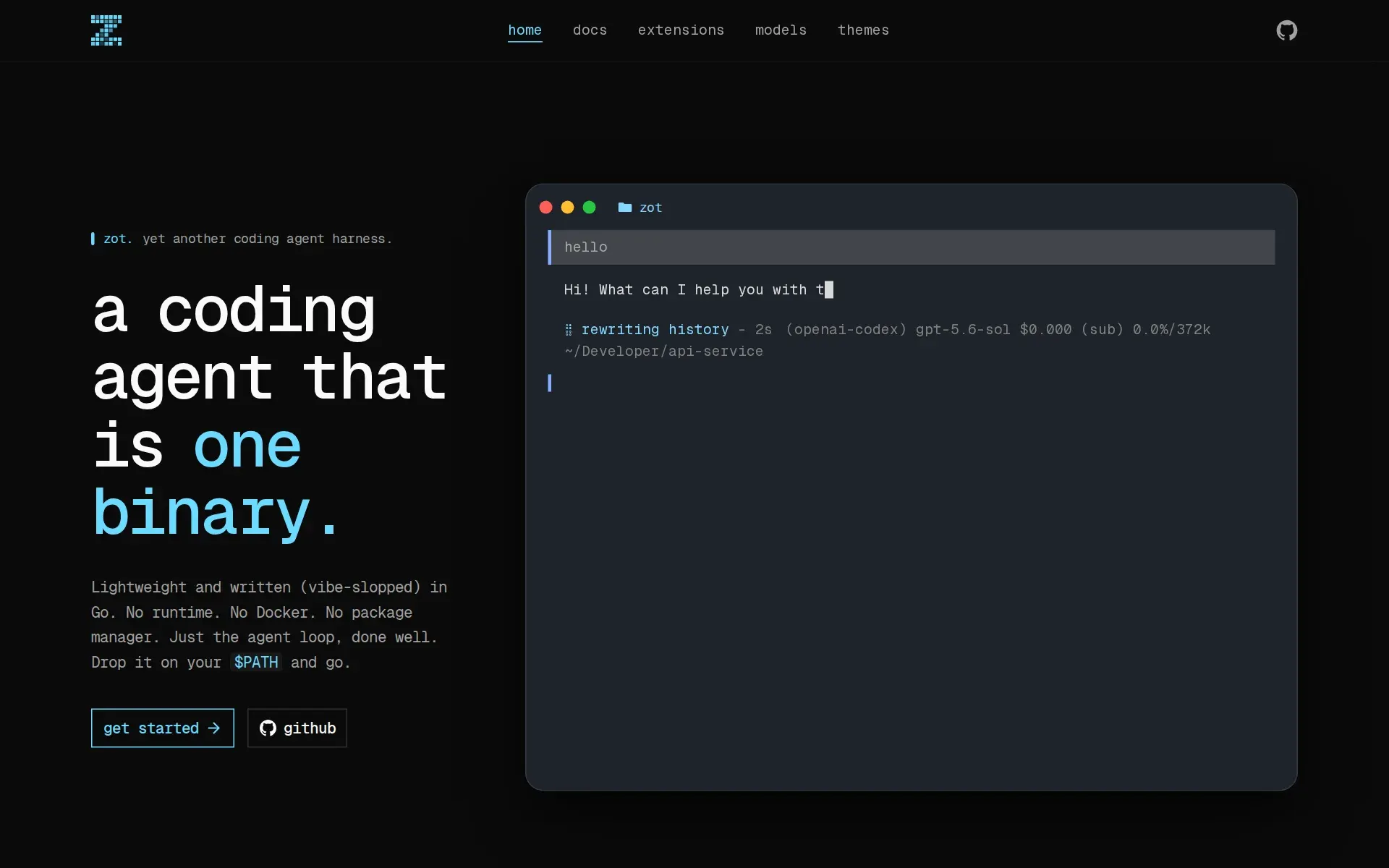
Lightweight and written (vibe-slopped) in Go. No runtime. No Docker. No package manager. Just the agent loop, done well. Drop it on your $PATH and go.
zot.sh - Open source
- YesThe full source is published on GitHub under the MIT licence, which permits commercial use, modification and redistribution without a separate agreement.
Permission is hereby granted, free of charge, to any person obtaining a copy of this software and associated documentation files (the “Software”), to…
github.com/patriceckhart/zot/blob/main/…
What it costs to run
- How it meters
- PartlyThe harness itself costs nothing and meters nothing; you pay your model provider per token or through an existing subscription, and zot only surfaces the running cost in its status line.Was Yes before our last check.
Use /login to store an API key or a subscription credential. zot supports Claude Pro/Max, ChatGPT/Codex, Kimi Code, SuperGrok/X Premium, and GitHub…
zot.sh/docs/quickstart - Free tier
- YesThere is no account, no sales contact and no paid tier: a one-line installer fetches the binary, and a local Ollama model gets you running without any credential at all.
No API key, config.json, or models.json is required for this command. zot defaults to http://localhost:11434.
zot.sh/docs/quickstart - API access
- YesA long-lived RPC child process exchanges newline-delimited JSON over stdin and stdout, and the vendor publishes a TypeScript SDK that wraps it for Node server runtimes.
It starts a long-lived zot rpc child process and talks newline-delimited JSON over stdin/stdout, so you get streaming output without hand-rolling the…
zot.sh/docs/node-sdk - MCP server
- PartlyMCP is deliberately absent from the binary and is framed as something to skip; reaching MCP servers requires installing a third-party bridge extension you must review and trust yourself.
No Mandatory MCP Build CLI tools with skills, or add an extension that speaks MCP if you actually need it.
zot.sh - Bring your own key
- YesYour own keys are the only way it works, resolved from a flag, provider environment variables or a local auth file, with an option to shell out to a password manager instead.
To keep an API key in a password manager instead of storing it directly in auth.json, configure an api_key_command for the provider:
zot.sh/docs/providers
Buying it for a team
- Admin controls
- PartlyConstraints exist but are machine-local, not centrally administered: a packaged agent can enforce tool permissions, and flags or settings restrict the tool list and confine paths to one directory.
A zotfile packages an agent's instructions, skills, requirements, and enforced tool permissions as a shareable agent.
github.com/patriceckhart/zot/blob/main/… - Audit log
- PartlyEvery session is written locally as a JSONL transcript with tool calls and results, but the vendor explicitly disclaims the extension event stream as an audit log and there is no central record.
Notifications are not a durable or exactly-once audit log. There is no acknowledgement, replay, or crash recovery.
zot.sh/docs/extensions - Single sign-on
- NoAuthentication is per-developer provider credentials only; the documented lookup order is an exhaustive three-step chain with no identity provider, SAML or OIDC anywhere in it.
1. --api-key flag 2. provider-specific env var (ANTHROPIC_API_KEY, OPENAI_API_KEY, ... ) 3. $ZOT_HOME/auth.json (API key or OAuth token; mode 0600)
github.com/patriceckhart/zot/blob/main/…
What happens to your code
- Opt out of training
- PartlyThe vendor operates no service that could train on your code and keeps all state on your disk, but whether prompts train a model is decided by the provider you log in to, not by zot.
Anthropic retains Fable prompts and outputs by default for safety classifiers. Eligible enterprises can request a time-limited zero-data-retention…
zot.sh/docs/providers - Data residency
- PartlyYour code, sessions and credentials never leave the machine, so residency for stored data is yours; in-flight prompts land wherever the chosen provider and region sit, such as a configured AWS region.
Bedrock API keys are bearer tokens. Set AWS_BEARER_TOKEN_BEDROCK and AWS_REGION, or use the standard AWS credential chain
zot.sh/docs/providers - Getting out
- YesTranscripts are plain local JSONL and can be exported to a portable session file or a JSON timeline dump; nothing is held server-side and no credits exist to expire.
/session export writes the transcript to a portable .zotsession file. /session import pulls one back in as a first-class resumable session.
zot.sh/docs/sessions
Plans and pricing
Price and terms
- Free plan
- YesYesThe whole product is free and MIT-licensed with no paid tier, no account and no usage ceiling imposed by the vendor
The terms in full
Model inference is not included: you supply an API key or an existing subscription for Anthropic, OpenAI, Kimi, xAI or GitHub Copilot, or run a local Ollama or llama.cpp model at no cost.
Checked .
The Agents Index digest
Price changes and new agents like zot, at most once a week.
Last issue: Devin vs Claude Code: Which Should You Pick? · 13 October 2026
Works with
 Claude
 GPT
GPT- YesOpen models
For AI agents
- MCP server
- Partly
- API
- Yes
Screenshots
Docs, zot.sh, captured
Filed under
Sources and updates
Last changed
Sources22
- zot.sh/docs/providers
- zot.sh/
- zot.sh/docs
- github.com/patriceckhart/zot
- github.com/patriceckhart/zot/blob/main/README.md
- zot.sh/
- zot.sh/docs/models
- zot.sh/docs/quickstart
- zot.sh/docs/sessions
- zot.sh/docs/tools
- github.com/patriceckhart/zot/blob/main/LICENSE
- zot.sh/docs/tool-gate
- zot.sh/docs/zotfiles
- zot.sh/disclaimer
- zot.sh/docs/embedding
- zot.sh/docs/extensions
- zot.sh/docs/instructions
- zot.sh/docs/node-sdk
- zot.sh/docs/swarm
- zot.sh/extensions
- zot.sh/extensions/patriceckhart/zot-review
- api.github.com/repos/patriceckhart/zotRepository
Repository30 August 2026
- Licence
- MIT
- Stars
- 328
- Forks
- 34
- Last push
- 27 August 2026
The Agents Index in AI answers1 of 1
- PerplexityCites The Agents IndexAsked
zot alternatives
on Other sources: utilo.io, selfhostindex.com, opensourceprojects.cc, aisotools.com, alternativeto.net, vioscale.ai
Updates4
- Capabilities · Free tier · Price · Terms
- Capabilities · Free tier · Terms
- Capabilities · Free tier · Terms
- Alternatives · Summary · Tagline
Is this yours? Claim it free and edit it in your dashboard, or feature it in Coding agents.