
What we checked on Arcade
Agent permissions
Every call is evaluated at the moment of action against the intersection of the user's own permissions and the agent's scope, rather than a standing service account, and crossing either boundary stops the action.
Every agent action runs at the intersection of what the user can do and what the agent is allowed to do. Not a service account. Not a shared token.…
arcade.dev/productChecked
Open models
The vendor says any LLM works behind the runtime because it is model agnostic; it does not name specific open-weight models or a self-hosted inference endpoint anywhere read.
any agent client, including Claude, Cursor, ChatGPT, Copilot, or your own, and any LLM
arcade.devChecked
Model choice
The buyer chooses: the vendor describes itself as framework agnostic across LangChain, CrewAI, Mastra, Google ADK and OpenAI Agents, with any client and any LLM behind it.
Yes. Arcade is framework agnostic. Build with LangChain, LlamaIndex, Mastra, CrewAI, Pydantic, Google ADK, or OpenAI Agents. The same flexibility…
arcade.devChecked
Self-hosted
The runtime can be deployed in the buyer's own cloud, a VPC, on-premises or fully air-gapped, and the docs publish a Helm chart for running the platform on your own Kubernetes cluster.
Yes. You can deploy the Arcade MCP runtime in your own cloud environment, a virtual private cloud, on-premises, or in a fully air-gapped environment.
arcade.devChecked
Open source
The tool-building framework arcade-mcp is MIT-licensed on GitHub, but the vendor says only much of what it builds is open source, and the runtime platform itself is distributed as licensed images.
Much of what we build is open source, including the arcade-mcp framework for building and running MCP servers.
arcade.dev/aboutChecked
SDK languages
Python and JavaScript/TypeScript are the languages named: the runtime connects to an existing Python or JavaScript codebase, and the open-source tool framework is Python with a CLI.
Connect the Arcade runtime to your existing Python or JavaScript codebase and your agents start taking authorized actions right away.
arcade.devChecked
Tracing and evals
Tool executions and audit logs are visible in one control plane and exportable over OpenTelemetry, and the open-source framework ships arcade evals for scoring tool-call accuracy against real LLMs.
Evals run against real LLMs, so you test tool-call accuracy before you ship.
arcade.dev/productChecked
How it meters
Billing is a flat monthly platform fee plus two metered units, auth events and tool calls, each priced per event rather than per seat or per token.
Auth events at $0.10 each Tool calls at $0.01 each
arcade.dev/pricingChecked
Cost of one job
On the cheapest paid plan a job is priced per action: 1,000 tool calls cost $10 and 1,000 user authorisations cost $100, on top of the $25 monthly platform fee.
$25 / month platform fee Auth events at $0.10 each Tool calls at $0.01 each
arcade.dev/pricingChecked
Free tier
A standing Free plan can be self-served with no sales call and no card, carrying a monthly allowance of auth events and tool calls on the managed cloud.
$0 platform fee, no credit card required
arcade.dev/pricingChecked
MCP server
Arcade federates its own, custom and third-party MCP servers into one endpoint that any MCP client can point at, and documents setup for ChatGPT, Claude, Cursor and Copilot clients.
Arcade federates your MCP servers, Arcade-hosted, custom, or third-party, into a single endpoint. Pick which tools each gateway exposes, then point…
arcade.dev/productChecked
Bring your own key
You can run the runtime in your own AWS, Azure or GCP account so data stays in your environment, and the open-source framework lets you supply your own access tokens when running standalone.
BYO Cloud Your AWS, Azure, or GCP. Data never leaves your environment.
arcade.dev/productChecked
A company can buy it
An organisation can buy the Team plan self-serve or an Enterprise contract through sales, the latter bundling annual allowances, SLA support and a dedicated account team.
Platform pricing includes annual bundles of auth events and tool calls
arcade.dev/pricingChecked
Seat model
There is no seat price or seat minimum: the vendor bills a flat platform fee plus usage and says explicitly that it does not charge per seat.
Pay for what your agents actually do, not per seat.
arcade.dev/pricingChecked
Pooled budget
Allowances are account-level pools of auth events and tool calls rather than per-person balances, and the vendor states plainly that it does not charge per seat.
On the page: Pricing page subheading under "Simple, scalable pricing"
arcade.dev/pricingChecked
Admin controls
Policies are enforced outside the model through pre- and post-tool-call hooks an admin configures once, plus group-based tool access and rate limiting, so a team can block or redact actions per call.
Arcade supports pre- and post-tool-call hooks that let your team add custom policies without forking the runtime. Inspect every request before it…
arcade.devChecked
Audit log
Each tool call records the agent, the user it acted for, the scope and the policy decision, and logs can be streamed to a customer's own SIEM over OpenTelemetry; the vendor says this is out of the box.
Every tool call records the agent, the user it acted on behalf of, the scope, and the policy decision applied. Logs stream to your SIEM via…
arcade.dev/productChecked
Single sign-on
SSO is listed as an Enterprise entitlement on the pricing page, while the homepage claims it out of the box; neither page names SAML or OIDC, and the Free and Team cards do not mention it.
SSO, RBAC, audit logs, and private registry access
arcade.dev/pricingChecked
Opt out of training
Content pulled from connected third-party accounts is never used for model training, but the same policy says other collected information may be used to train the vendor's models with no opt-out described.
We do not use content retrieved from your connected third-party accounts, including Google Workspace, to develop, improve, or train any AI or machine…
arcade.dev/privacy-policyChecked
Data residency
Residency follows the deployment model a buyer picks: Arcade Cloud, the buyer's own AWS, Azure or GCP account, on-premises or air-gapped, with the vendor saying data never leaves the chosen environment.
Data residency tied to your deployment model
arcade.dev/productChecked
Certifications
The vendor states SOC 2 compliance and links a trust centre; it names no ISO 27001 certificate, and GDPR is addressed only as data-subject rights in its privacy policy rather than as an attestation.
SOC 2 compliant. SSO, RBAC, and full audit logs out of the box.
arcade.devChecked
Arcade price and terms
Terms
- Free plan
- YesYes
The terms in full
Free plan: $0 platform fee, no credit card, 2,000 auth events and 2,000 tool calls per month, Arcade Cloud only, community support on Discord and GitHub.
What needs a higher plan
- Enterprise
- Single sign-on
For AI agents
- MCP server
- Yes
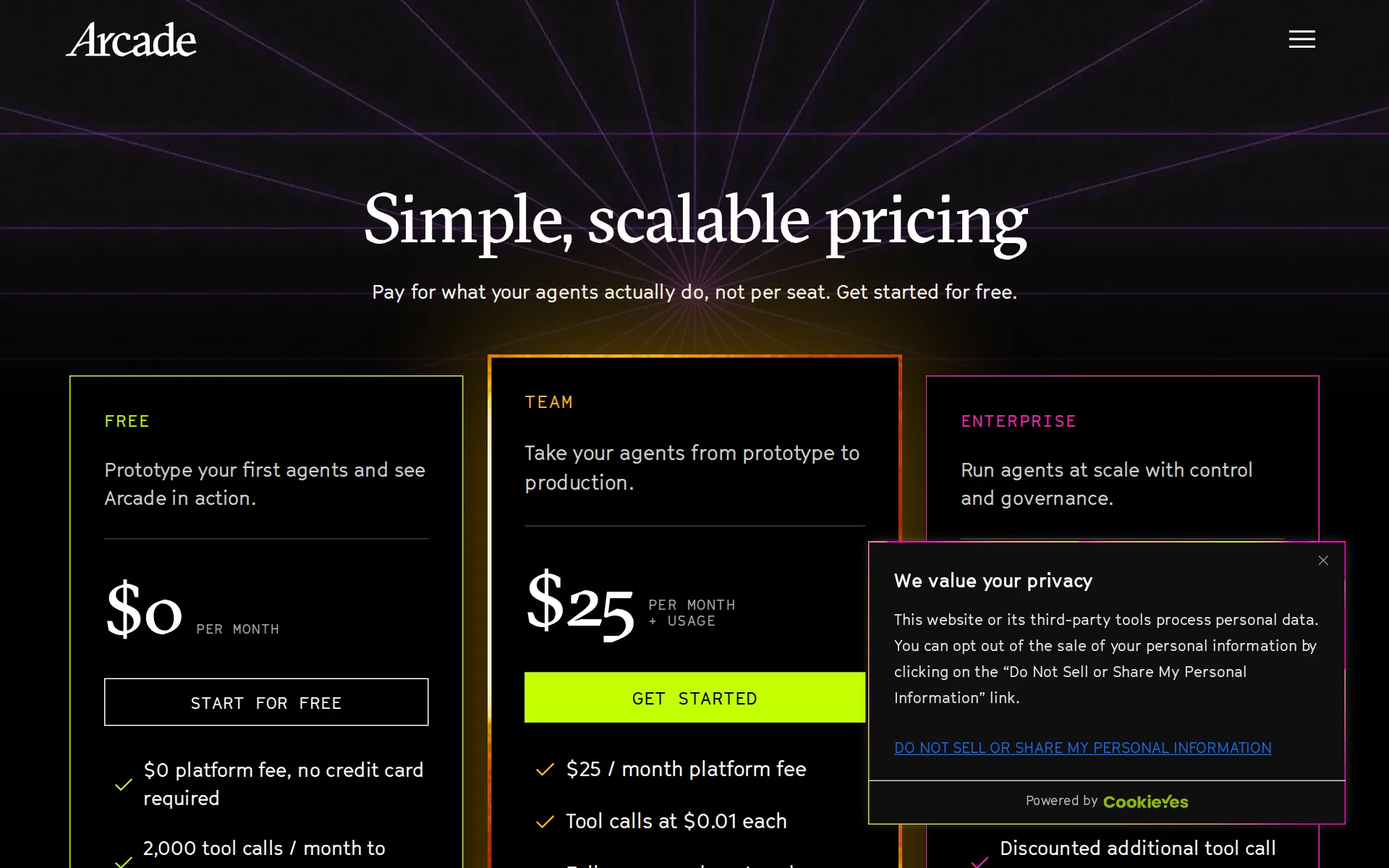
Pricing page, captured
arcade.dev/pricing, checked
Arcade alternatives
All 3 alternatives

Questions about Arcade
- How much does Arcade cost?
- Arcade is free to use. From arcade.dev/pricing, checked 28 October 2026.
- Does Arcade have an API or an MCP server?
- It has an MCP server.
- Is Arcade open source, and can you host it yourself?
- Part of it is open source. You can host it yourself.
- What have we checked on Arcade?
- 21 facts, under these headings: How much it does unattended, which models it runs on, whose machine it runs on, building with it, what it costs to run, buying it for a team, what happens to your code.
- How do we check Arcade?
- We hold 21 facts on Arcade, quoted from 5 pages. Facts and price last checked 28 October 2026.
Is this yours?
AI assistants like ChatGPT and Claude opened The Agents Index pages 2,746 times in September. Claiming is free. You get this page's reader numbers and the verified owner mark. You confirm it with an email at arcade.dev.
Report an error if a fact is wrong.