
What we checked on Nango
Agent permissions
Sessions are immutable and least-privilege by construction: toolsets can be narrowed to named tools per integration, the raw proxy meta tool is off unless you turn it on, and sessions expire (minimum 60s, default and maximum 15 days) or can be killed early.
"meta_tools": { // Optional. nango_proxy is off unless you turn it on
Model choice
Nango hosts no model and takes no view on yours: the session MCP endpoint is plain Streamable HTTP, so whichever client or provider you already use connects to it, and the docs show OpenAI, Anthropic, Vercel AI SDK, LangChain and Mastra wiring.
so any MCP-capable agent or client can connect to it
Self-hosted
Three ways off the vendor's cloud: a free Docker Compose build limited to Auth and Proxy, BYOC where Nango operates the instance in your AWS, GCP or Azure account, and Self-Managed via a Helm chart on your own Kubernetes — the latter two Enterprise-only.
Nango offers two ways to run outside of Nango Cloud, both on the Enterprise plan:
Open source
The platform's source is public on GitHub and the vendor calls it open source, but the licence is the Elastic License rather than an OSI-approved one, and the freely self-hostable build is deliberately feature-limited against Cloud.
Nango is available under the Elastic License.
github.com/NangoHQ/nangoChecked
SDK languages
TypeScript is the only shipped SDK: integration logic is written as TypeScript functions and the backend SDK is published as @nangohq/node. The Python, Go, Java, Ruby, Rust and PHP reference pages each say coming soon and point you at the REST API instead.
Coming soon. Use the REST API in the meantime.
Tracing and evals
Every operation in the account produces a log entry with its integration, connection and function, filterable in the dashboard, and traces for syncs, actions, webhooks and proxied requests export over OpenTelemetry; logs are deleted after 15 days and the free self-hosted build covers auth and proxy only.
Comprehensive: Everything that happens in Nango for your integrations produces an "operation" in the logs
How it meters
Three usage meters, no seats: connections billed per authorised end-user account per month and prorated, function compute billed per hour of execution rounded up to the nearest second, and egress data transfer billed per GB with ingress free.
Each connection represents one authorized user account (for example, one user’s Salesforce account). Billed per connection per month, prorated for…
nango.dev/pricingChecked
Cost of one job
On the cheapest paid plan a job is priced in three meters rather than one: $0.29 per connection per month, $0.72 per hour of function compute rounded up to the second, and $0.50 per GB of egress, on top of the $50 monthly fee which itself buys $50 of credits.
Pay-as-you-go $0.29 / connection $0.72 / hour $0.5 / GB
nango.dev/pricingChecked
Free tier
A standing Free plan at $0/mo covers API and MCP auth, tools and syncs with hard-capped monthly limits, and you can sign up and build without talking to anyone; only Enterprise terms need a call.
Free $0 /mo API & MCP auth, tools & syncs Hard-capped limits, reset monthly
nango.dev/pricingChecked
MCP server
Two MCP surfaces: every agent session serves its own Streamable HTTP MCP endpoint authenticated by the session token, and a separate Management MCP server lets a client administer the account and query logs. The free self-hosted build excludes MCP.
Every session exposes its own MCP server at its mcp_url. It speaks Streamable HTTP and authenticates with the session_token as a bearer token, so any…
Bring your own key
You can bring your own OAuth apps instead of Nango's pre-approved ones on any plan, and bring your own cloud account for the whole instance, though that second route (BYOC or Self-Managed) is Enterprise-only. No model keys are involved: Nango runs no inference of its own.
Use pre-approved OAuth apps or bring your own for a fully white-label experience.
nango.dev/pricingChecked
A company can buy it
There is a real organisation path: an Enterprise plan with commitment discounts, a master services agreement and an SLA, plus team roles, SAML SSO, SCIM and an audit trail for the buying side, and self-serve plans for teams that do not need paper.
Enterprise Custom pricing Discounts with commitments Self-hosting, MSA, SLA
nango.dev/pricingChecked
Seat model
There is no seat price and no seat floor: the vendor states its billing metrics exhaustively as connections, compute time and data transfer, so adding team members does not change the bill, though dashboard roles still govern who may do what.
Start free. Pay only for connections, compute time and data transfer as you grow.
nango.dev/pricingChecked
Pooled budget
Billing is one account-level pool rather than per-person balances: the Pay-as-you-go fee grants $50 of credits a month spent across whatever connections, compute and data transfer the account uses, with a single usage breakdown and spend alerts in the dashboard.
Pay-as-you-go $50 /mo Pay-as-you-go rates $50 in credits, each month
nango.dev/pricingChecked
Admin controls
An agent's reach is fixed when your backend mints the session: you pick the tenant connections, the allowed integrations and tools, and which meta tools are on, and the agent cannot widen that itself. Dashboard-side, RBAC limits what each human may change.
Your backend creates the session and exposes it to the agent as an MCP server. The agent never sees raw credentials, and cannot change the scope of…
Audit log
Control-plane changes are recorded account-wide with the actor, the outcome and the originating IP, entries are immutable, and you can export them as CSV; retention is one year by default and the free self-hosted build has no audit trail.
The audit trail records control-plane changes with actor, outcome, and originating IP: who created or deleted a connection, changed an integration,…
Single sign-on
SAML is gated: the Free and Pay-as-you-go plans get Google SSO only, SAML arrives with the $450/mo Growth add-on, SCIM only on Enterprise Cloud, and SAML is not yet available on self-hosted instances. Login must also be started from the identity provider.
Free / Pay-as-you-go Google SSO only
Data residency
Cloud data sits in a managed PostgreSQL database in AWS and there is no EU cloud today; residency elsewhere means BYOC, which puts the instance in your own AWS, GCP or Azure region but only on the Enterprise plan.
We currently don’t have an EU cloud, but are considering this for the future. Meanwhile we offer BYOC instances in any AWS, GCP or Azure region on…
nango.dev/pricingChecked
Getting out
Synced records come back through the records API, logs and traces export over OpenTelemetry to your own stack, and the audit trail exports as CSV; note the vendor's own retention clocks delete logs at 15 days and record payloads at 30 days whether you export or not.
Entries are immutable and account-wide, exportable as CSV.
Certifications
SOC 2 Type II with an annual audit and a report in the trust center, GDPR with a DPA that applies automatically to cloud accounts, and HIPAA with a BAA that the vendor ties to the Growth add-on rather than the entry plans.
Nango is SOC 2 Type II certified, GDPR compliant, and HIPAA compliant.
Nango price and terms
Terms
- Free plan
- YesYes
The terms in full
Free plan at $0/mo, hard-capped and reset monthly: 10 connections, 10 hours of compute time per month, 10GB of data transfer per month, and 200 API requests per minute.
What needs a higher plan
- Enterprise
- Data residency
For AI agents
- MCP server
- Yes
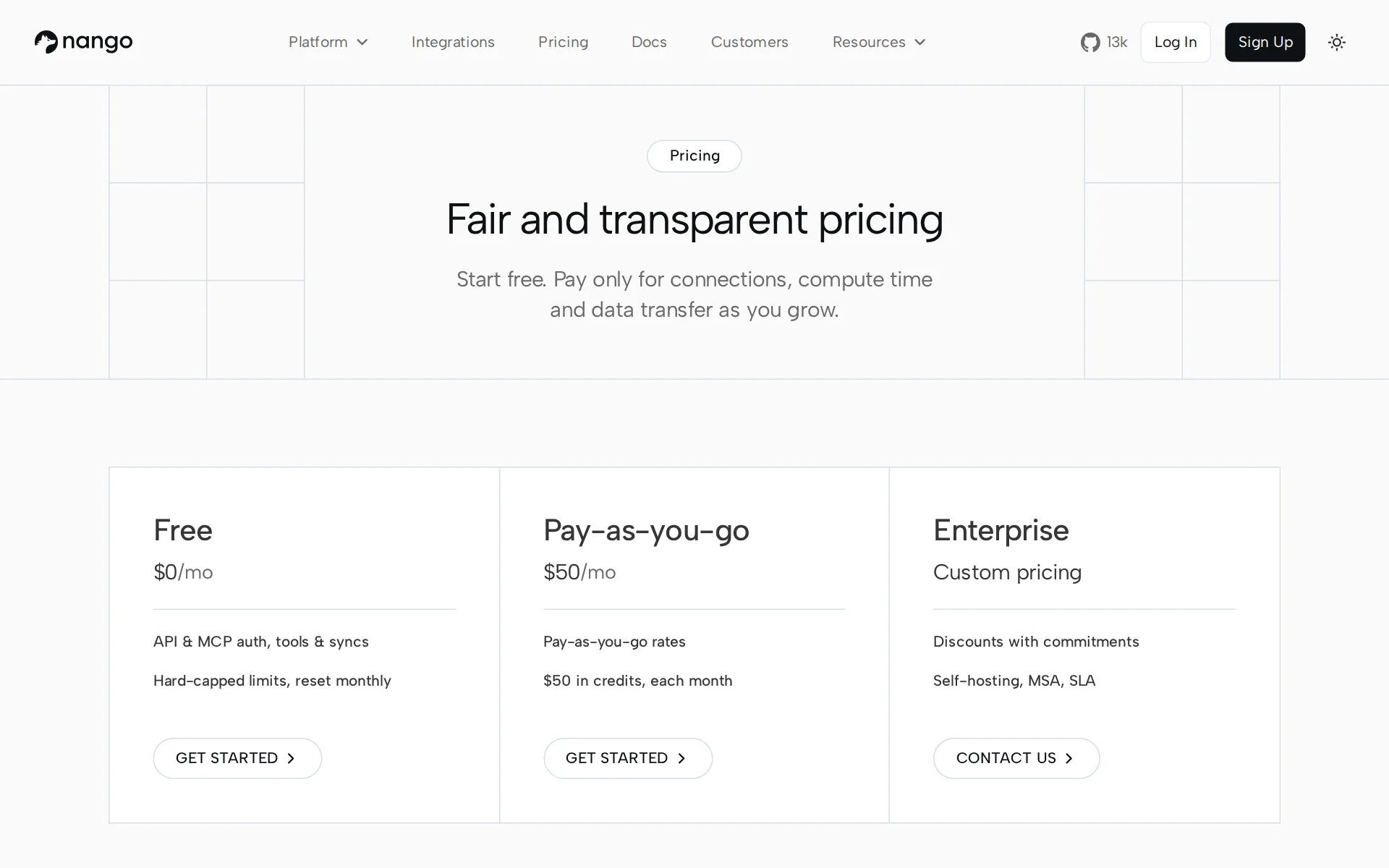
Pricing page, captured
nango.dev/pricing, checked
Nango alternatives
All 3 alternatives

Questions about Nango
- How much does Nango cost?
- Nango is free to use. From nango.dev/pricing, checked 28 October 2026.
- Does Nango have an API or an MCP server?
- It has an MCP server.
- Is Nango open source, and can you host it yourself?
- It is open source. You can host it yourself.
- What have we checked on Nango?
- 20 facts, under these headings: How much it does unattended, which models it runs on, whose machine it runs on, building with it, what it costs to run, buying it for a team, what happens to your code.
- How do we check Nango?
- We hold 20 facts on Nango, quoted from 7 pages. Facts and price last checked 28 October 2026.
Sources and changes
Last changed
Is this yours?
AI assistants like ChatGPT and Claude opened The Agents Index pages 2,746 times in September. Claiming is free. You get this page's reader numbers and the verified owner mark. You confirm it with an email at nango.dev.
Report an error if a fact is wrong.