
Summary
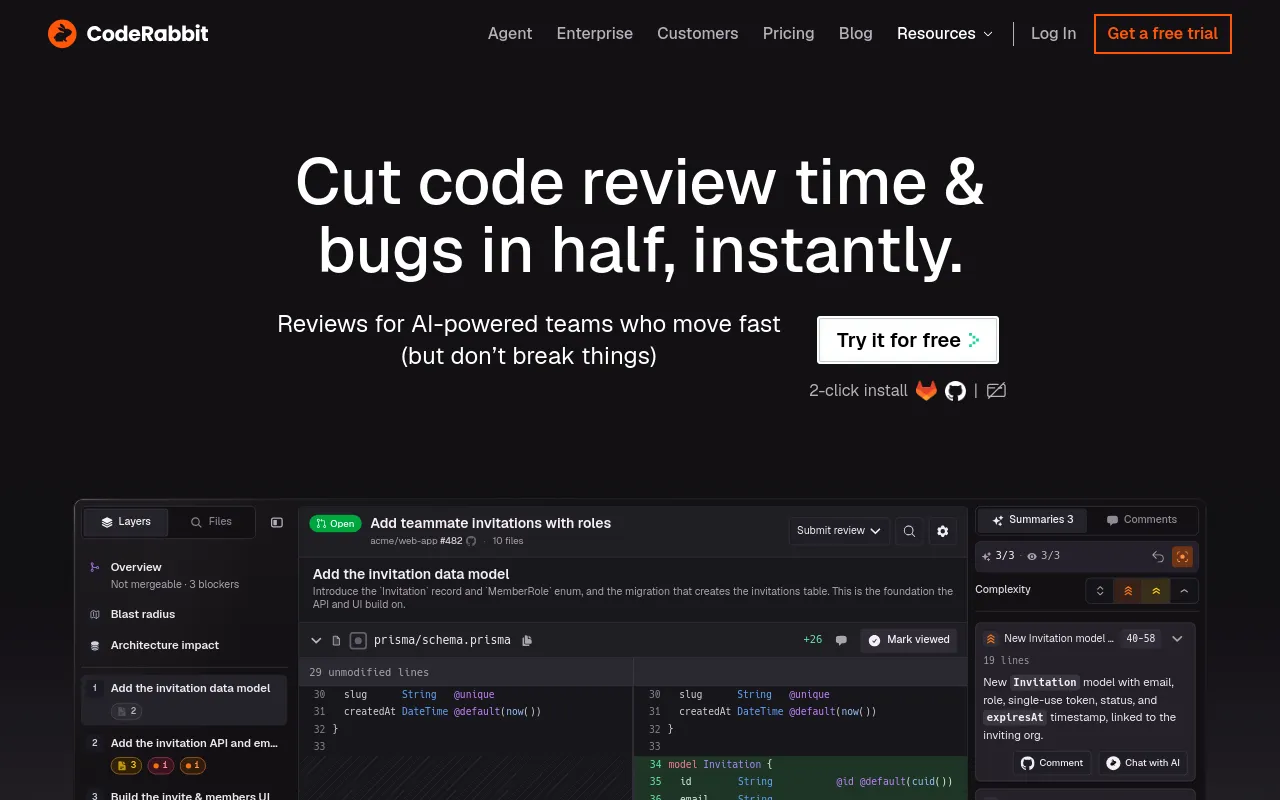
CodeRabbit is an AI code review platform that reviews pull requests on GitHub, GitLab, Bitbucket and Azure DevOps, adding line-level findings, walkthroughs and one-click fixes. It also runs in the IDE and CLI, and its cloud agent implements fixes as commits or stacked pull requests.
- Best for
- Engineering teams, using a coding agent or writing code by hand, that want automatic, consistent PR review plus triage, explanation and continuous security across GitHub, GitLab, Bitbucket or Azure DevOps before a human reviewer looks at it.
- Not for
- Teams looking for an agent that autonomously writes new features or fixes bugs end to end. CodeRabbit's core product reviews code that already exists rather than generating it from a prompt (its Slack Agent add-on and 1-click fixes do generate some code, but review, triage and security are the primary products).
- From
- Freethen $30 monthly · $24 billed annually
- Free tier
- YesFree plan: unlimited public and private repositories, no credit card, but PR summarisation only - code reviews come through the VS Code extension and CLI, at 1 PR, 3 IDE and 3 CLI reviews per developer per hour and 150 files per review. A separate open-source plan gives public repositories Team features free, with PR review limits of 1-10 per hour varying by star count and manual triggering below 10 stars. New organisations also start on a 14-day Advanced trial with no card required.
What it does
- Writes code
- YesA cloud Coding Agent clones the repo into a sandbox and implements a typed request, but it is in open beta and each starting point is enabled separately per organisation.
Coding Agent is the part of CodeRabbit that writes code. It takes a request — typed by you, or raised by a CodeRabbit review finding, a failing…
docs.coderabbit.ai/code - Debugs and fixes
- YesIt reads failing CI logs on the pull request and posts inline fixes on the offending lines, and a Fix CI finishing touch can land those fixes as a commit or stacked PR.
When a CI/CD pipeline fails on a pull request, CodeRabbit reads the failure output and posts inline comments with suggested fixes — directly on the…
docs.coderabbit.ai/pr-reviews/cicd-pipe… - Writes tests
- PartlyUnit test generation is a Team-and-above finishing touch, absent from the entry Essentials plan, and is itself labelled open beta on GitHub, GitLab and Azure DevOps.
Everything in Essentials, plus tasks and actions upstream and downstream of the review process: Triage, CodeRabbit Plan, issue planning, unit test…
docs.coderabbit.ai/management/plans - Reviews code
- YesReviewing diffs written by other people or agents is the core product: every pull request is reviewed automatically on open, with manual commands for older PRs.
Once installed, CodeRabbit automatically triggers a review when a pull request is opened against the main branch of any repository.
docs.coderabbit.ai/faq - Whole-codebase work
- PartlyReviews reach beyond one repo through linked-repository analysis, but the number of linked repos is capped per plan (1 on Essentials) and automatic linking needs Team or above.
The number of linked repositories you can configure depends on your plan. Automatic repository linking is available on Team, Advanced, and Enterprise.
docs.coderabbit.ai/knowledge-base/multi… - Ships it
- PartlyAccepted work lands in Git as a commit on the PR branch or a stacked pull request, pushed with your own credentials; nothing in the docs deploys or releases the change.
Delivery is always a separate, explicit step. A task that finishes successfully has changed nothing in your repository until you accept its patch and…
docs.coderabbit.ai/code/deliver-changes
How much it does unattended
- Runs autonomously
- PartlyReviews run unattended on every PR, but the coding agent stops at a proposed patch by default and a person must accept it before anything reaches the repository.
It proposes, you decide. By default a finished task produces a proposed patch: a diff you read, comment on, revise, reject, or accept. Delivery is a…
docs.coderabbit.ai/code - Multi-agent
- YesThe vendor describes several specialised agents running in parallel inside one review, rather than a single prompt, plus separate chat and finishing-touch agents.
Specialized AI agents working in parallel: Review, Verification, Chat, Pre-Merge Checks, and Finishing Touches
docs.coderabbit.ai/overview/architecture - Agent permissions
- PartlyThe agent inherits your Git permissions and branch protections and cannot push around them, and Plan mode adds an approval gate, but there is no per-action policy engine documented.
Delivery uses your Git provider authorization, so your branch protections and permissions apply exactly as they would to a push you made yourself.
docs.coderabbit.ai/code
Which models it runs on
- Claude
- YesAnthropic is named as a model provider that receives code for reviewing, though CodeRabbit selects the models and buyers cannot pick a specific Claude version on hosted plans.
Your code is shared with OpenAI and/or Anthropic for reviewing purposes only
docs.coderabbit.ai/faq - GPT
- YesOpenAI is named alongside Anthropic as a provider that processes code during reviews; the choice between them is CodeRabbit's, not the customer's, on hosted plans.
Your code is shared with OpenAI and/or Anthropic for reviewing purposes only
docs.coderabbit.ai/faq - Open models
- NoThe hosted service names only OpenAI and Anthropic as inference providers; no open-weight option is published for CodeRabbit Cloud.
Your code is shared with OpenAI and/or Anthropic for reviewing purposes only
docs.coderabbit.ai/faq - Model choice
- PartlyHosted plans give no model picker, but Enterprise self-hosted deployments may point CodeRabbit at their own LLM provider or account for inference.
Bring your own model — connect CodeRabbit to your own large language model provider or account.
docs.coderabbit.ai/self-hosted/overview
Where you use it
- In your editor
- YesA VS Code extension reviews uncommitted changes locally and works in Cursor, Windsurf and other VS Code-compatible editors, with chat, docstrings and test generation excluded.
Review code changes before you commit and create agent-ready Coding Plans, directly in your IDE with the CodeRabbit extension.
docs.coderabbit.ai/ide - On the command line
- YesA terminal tool reviews local Git changes before commit and emits structured JSON for coding agents, though the CLI carries an Open Beta badge.
The CodeRabbit CLI analyzes local Git changes using the same pattern recognition that powers our PR reviews.
docs.coderabbit.ai/cli - In your pipeline
- YesIt acts on pull requests automatically and reads pipeline output from five CI systems; an agentic API key also authenticates the CLI inside CI runners and bots.
This works across multiple CI/CD platforms: GitHub Actions, GitLab CI/CD, CircleCI, Jenkins, and Azure DevOps Pipelines.
docs.coderabbit.ai/pr-reviews/cicd-pipe… - In a browser
- YesA hosted dashboard at app.coderabbit.ai carries the coding agent, Triage queue, settings, reports and billing, separate from the Git platform surfaces.
Find it in the sidebar under Code, or go directly to app.coderabbit.ai/code.
docs.coderabbit.ai/code
Whose machine it runs on
- Self-hosted
- PartlyA container image runs the review agent inside your own network, but only for Enterprise customers at 500 seats or more, arranged through sales during onboarding.
The self-hosted option is available for CodeRabbit Enterprise customers with 500 or more user seats.
docs.coderabbit.ai/self-hosted/overview
Not established: Open source
What it costs to run
- How it meters
- YesBilling is a per-developer seat plus optional metering: over-limit reviews at a fixed price per reviewed file, and cloud agent work billed by the minute.
Continued reviews cost $0.25 per reviewed file and are added to the monthly invoice.
coderabbit.ai/pricing - Free tier
- YesA standing Free plan needs no card and covers public and private repos, and every paid plan opens with a 14-day trial that also requires no card.
Unlimited public and private repositories, no credit card required.
docs.coderabbit.ai/management/plans - API access
- PartlyThe REST API for metrics, users, roles, audit logs and security findings is Enterprise-only; lower tiers get an agentic API key for headless CLI review authentication.
The CodeRabbit API provides programmatic access to review data, AI Deep Scan findings, and administrative operations.
docs.coderabbit.ai/api - MCP server
- NoCodeRabbit consumes MCP servers for review context but publishes none of its own, so another agent cannot query it over MCP; plan tiers cap the connections at 5 to 20.
CodeRabbit as MCP client: CodeRabbit acts as the MCP client, not the server. It ingests data from your connected MCP servers.
docs.coderabbit.ai/connections/mcp-serv… - Bring your own key
- PartlyBring-your-own inference exists only in the Enterprise self-hosted deployment, where the agent sends prompts to your own LLM account; hosted plans use CodeRabbit's providers.
The agent sends review prompts, source code, and related data to your configured large language model provider for inference.
docs.coderabbit.ai/self-hosted/overview
Buying it for a team
- A company can buy it
- YesThe subscription is bought by an organisation against its Git provider org, with seats, admin and billing-admin roles, and AWS, GCP and Claude marketplace billing on Enterprise.
CodeRabbit ingests users from your git provider (GitHub, GitLab, Bitbucket, and Azure DevOps) and assigns seats based on your organization's active…
docs.coderabbit.ai/management/seat-assi… - Seat model
- YesSeats are per developer and only developers who open pull requests consume one; seats are reassignable, and auto-approval reclaims a seat unused for 30 days.
No, you will only be charged for developers who create pull requests. You can also manually assign purchased seats to specific developers.
coderabbit.ai/pricing - Pooled budget
- PartlyReview allowances are per developer per hour, not pooled, while pay-as-you-go overage spending runs through one organisation-wide path with a single monthly cap.
Your organization shares one pay-as-you-go billing path across all PR and CLI reviews.
docs.coderabbit.ai/management/usage-bas… - Admin controls
- YesAdmins choose what happens past the review limit, set spending caps and seat modes, and scope which repositories and connections CodeRabbit may touch; custom RBAC is Enterprise.
After the included review limit is reached, an admin chooses what happens next with the After included review limits setting in the Usage-based…
docs.coderabbit.ai/management/usage-bas… - Audit log
- PartlyA searchable, exportable administrative audit log covering seats, roles, API keys and config exists, but only for Enterprise organisations and only for admin-level roles.
The Audit Logs give Enterprise organizations a searchable record of administrative actions taken across workspace settings, billing controls, seat…
docs.coderabbit.ai/management/audit-logs - Single sign-on
- PartlySAML 2.0 single sign-on with Okta or Entra ID, plus SCIM provisioning, is an Enterprise-plan capability set up with the account team rather than self-serve.
CodeRabbit supports Okta, Microsoft Entra ID, and any SAML 2.0-compliant identity provider.
docs.coderabbit.ai/management/sso
What happens to your code
- Opt out of training
- YesNo opt-out is needed because customer code is never used for training by CodeRabbit or its providers; separately, retention of learnings and model-output logging can be switched off.
CodeRabbit never uses customer code for training. This remains true whether data retention is enabled or disabled.
docs.coderabbit.ai/faq - Data residency
- PartlyAn EU SaaS deployment is listed only under Enterprise; the trust centre lists US subprocessors and the CLI defaults to a US region, so ordinary plans are US-hosted.coderabbit.ai/pricing
- Getting out
- PartlyReview metrics export as CSV capped at 10,000 rows, with a larger Metrics API on Enterprise only; account deletion is irreversible and immediately cancels the subscription.
This page covers the Dashboard CSV export. For programmatic access, use the Metrics Data API (Enterprise plan required).
docs.coderabbit.ai/guides/data-export - Certifications
- YesThe trust centre publishes SOC 2 Type 2, ISO 27001:2022 and GDPR, with SOC 3, pentest and zero-data-retention amendments from OpenAI and Anthropic available on request.
Compliance SOC 2 TYPE 2 ISO 27001:2022 GDPR
trust.coderabbit.ai
32 sourced claims on this page. Checked 2026-09-15. How we check.
Alternatives
Where we would send a reader instead, in that listing's own words.
Cosmos platform running fleets of coding agents across the SDLC, plus Auggie CLI and IDE extensions.
Cloud AI software engineer that takes a ticket, works in its own VM, and opens a pull request.
Agentic coding tool from Anthropic that edits your codebase, runs commands, and opens pull requests.
Filed under
Sources and updates
The pages we read50
Every fact below comes from the vendor. Nothing here is independently corroborated yet.
- coderabbit.ai/pricing8 fields
- docs.coderabbit.ai/faq5 fields
- docs.coderabbit.ai/code4 fields
- docs.coderabbit.ai/faq.md4 fields
- docs.coderabbit.ai/management/plans4 fields
- coderabbit.ai/faq3 fields
- docs.coderabbit.ai/index.md3 fields
- docs.coderabbit.ai/self-hosted/overview3 fields
- docs.coderabbit.ai/self-hosted/overview.md3 fields
- docs.coderabbit.ai/management/usage-based-addon2 fields
- docs.coderabbit.ai/management/usage-based-addon.md2 fields
- docs.coderabbit.ai/overview/ide-cli-review2 fields
- docs.coderabbit.ai/pr-reviews/cicd-pipeline-analysis2 fields
- docs.coderabbit.ai/pr-reviews/post-merge-actions2 fields
- trust.coderabbit.ai/1 field
- docs.coderabbit.ai/agent1 field
- docs.coderabbit.ai/api1 field
- docs.coderabbit.ai/api/index.md1 field
- coderabbit.ai/cli1 field
- docs.coderabbit.ai/cli1 field
- docs.coderabbit.ai/cli/claude-code-integration.md1 field
- docs.coderabbit.ai/cli/headless-cli-integration1 field
- docs.coderabbit.ai/cli/skills1 field
- docs.coderabbit.ai/code/deliver-changes1 field
- docs.coderabbit.ai/configuration/auto-review1 field
- docs.coderabbit.ai/connections/mcp-servers1 field
- docs.coderabbit.ai/finishing-touches/autofix.md1 field
- docs.coderabbit.ai/finishing-touches/fix-ci1 field
- docs.coderabbit.ai/finishing-touches/fix-ci.md1 field
- docs.coderabbit.ai/finishing-touches/index.md1 field
- docs.coderabbit.ai/finishing-touches/unit-test-generation1 field
- docs.coderabbit.ai/guides/dashboard1 field
- docs.coderabbit.ai/guides/dashboard-metrics1 field
- docs.coderabbit.ai/guides/data-export1 field
- docs.coderabbit.ai/guides/data-export.md1 field
- docs.coderabbit.ai/guides/organization-settings1 field
- docs.coderabbit.ai/ide1 field
- docs.coderabbit.ai/knowledge-base/mcp-context.md1 field
- docs.coderabbit.ai/knowledge-base/multi-repo-analysis1 field
- docs.coderabbit.ai/knowledge-base/multi-repo-analysis.md1 field
- docs.coderabbit.ai/management/audit-logs1 field
- docs.coderabbit.ai/management/audit-logs.md1 field
- docs.coderabbit.ai/management/custom-roles.md1 field
- docs.coderabbit.ai/management/plans.md1 field
- docs.coderabbit.ai/management/seat-assignment1 field
- docs.coderabbit.ai/management/sso1 field
- docs.coderabbit.ai/overview/architecture1 field
- docs.coderabbit.ai/overview/architecture.md1 field
- docs.coderabbit.ai/overview/pull-request-review1 field
- docs.coderabbit.ai/pr-reviews/cicd-pipeline-analysis.md1 field
Coverage elsewhere7
Updates4
- Capabilities · Commercial terms · Free tier
- Capabilities · Commercial terms · Free tier · Price
- Capabilities · Commercial terms · Free tier · Price
- Alternatives · LinkedIn link · One-liner · Summary