
Not for Non-technical teams who want a turnkey, no-code voice agent live in an afternoon.
The facts, with their sources
What it does
- Done-for-you service
- PartlyYou build and run the agent yourself; the Scale contract adds an embedded Vapi engineer for the go-live, not a done-for-you build.
A dedicated engineer embedded in your team to get you live in a week.
vapi.ai
How much it does unattended
- Runs autonomously
- YesAgents take whole calls end to end and escalate to a human only when the configured path says so.
Automate inbound support calls with agents that can access your knowledge base and escalate to humans when needed.
docs.vapi.ai/quickstart/introduction - Multi-agent
- YesSquads route one conversation across several specialised assistants with context-preserving handoffs.
Squads orchestrate multiple assistants with context-preserving transfers.
docs.vapi.ai/quickstart/introduction - Agent permissions
- PartlyTools fire mid-call without human approval; a per-tool rejection plan is the mechanism that withholds an action.
A rejection plan lets you prevent a tool from executing when certain conditions are met.
docs.vapi.ai/tools/tool-rejection-plan
Which models it runs on
- Claude
- YesClaude is selectable as the assistant's LLM, on Vapi's integration or your own Anthropic account.
Anthropic builds the Claude family of large language models. On Vapi, you select a Claude model as the LLM for a voice agent.
docs.vapi.ai/providers/model/anthropic - GPT
- YesOpenAI GPT models are selectable as the assistant's LLM.
Set model.provider to openai and model.model to a GPT model.
docs.vapi.ai/providers/model/openai - Open models
- YesOpen-weight models reach the pipeline through Groq, Together AI, Mistral, DeepSeek and OpenRouter, or a self-hosted server.
Bring your own API keys for transcription, LLM, or TTS — or plug in your own self-hosted models.
vapi.ai/platform - Model choice
- YesYou choose transcriber, LLM and voice independently and can swap any of them.
Bring your own model, or choose from our managed list of 200+ models and integrations.
vapi.ai/platform
Where you use it
- In your editor
- PartlyNo agent runtime in the editor; `vapi mcp setup` teaches Cursor, Windsurf and VSCode the Vapi API so you can build from the IDE.
Your IDE's AI assistant (Cursor, Windsurf, VSCode) gains complete, accurate knowledge of Vapi's APIs and best practices.
docs.vapi.ai/cli - On the command line
- YesThe Vapi CLI covers assistants, numbers, calls, campaigns and logs from the terminal.
The Vapi CLI is the official command-line interface that brings world-class developer experience to your terminal and IDE.
docs.vapi.ai/cli - In your pipeline
- PartlyEvals run as pipeline quality gates via API and CLI; there is no pull-request surface because there is no code to review.
CI/CD integration - Automate quality gates in your deployment pipeline
docs.vapi.ai/observability/evals-quicks… - In a browser
- YesA hosted dashboard builds and observes agents, and calls embed in your own web app via the Web SDK and widget.
Web integration: Embed voice calls directly in your applications
docs.vapi.ai/quickstart/introduction
Whose machine it runs on
- Self-hosted
- PartlySelf-serve is hosted only; on-premise is offered to large enterprises, and the orchestration layer otherwise never leaves Vapi.
Yes, we support on-premise deployments for large Enterprises.
docs.vapi.ai/faq - Open source
- PartlyThe CLI and SDKs are MIT-licensed on Vapi's GitHub; the platform and its orchestration models are closed and hosted.
MIT License - see LICENSE file for details.
github.com/VapiAI/cli
What it costs to run
- How it meters
- YesPer call minute for Vapi hosting, plus model provider cost passed through at cost, plus $10 per concurrent line per month.
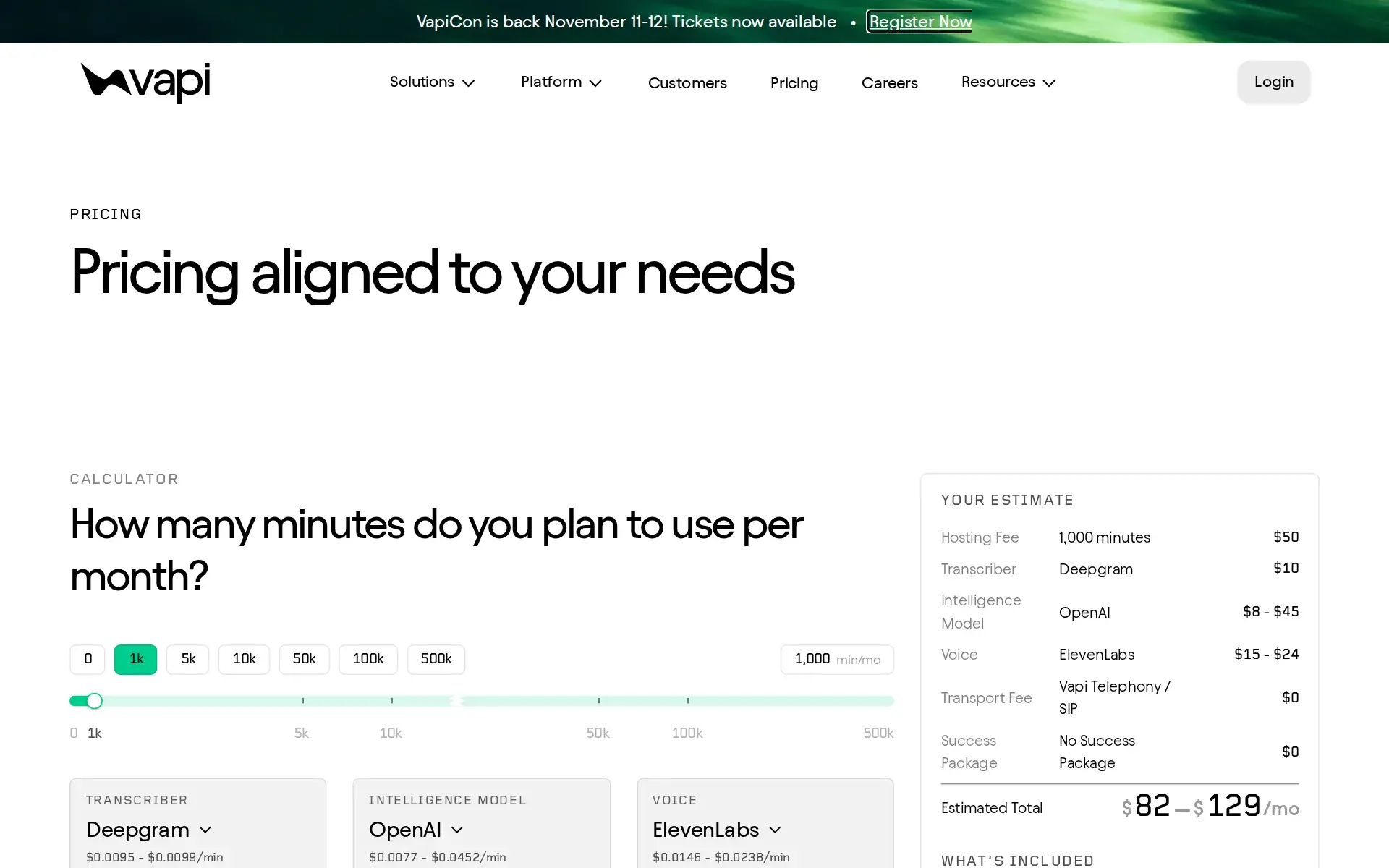
$0.05 / min
vapi.ai/pricing - Free tier
- YesSelf-serve signup with a $5 credit grant and no card; it is a grant against usage, not a standing free tier.
Yes, every new account gets $5 in free credits to start building without the need for credit card.
vapi.ai/pricing - API access
- YesREST API covers every capability; server and client SDKs wrap it.
Every capability is accessible via REST API. Your team owns the integration end to end.
vapi.ai/platform - MCP server
- YesA hosted MCP server exposes assistants, calls and numbers to another agent, and assistants can also call external MCP servers.
The Vapi MCP Server exposes Vapi APIs as tools via the Model Context Protocol (MCP), so you can manage assistants, phone numbers, and calls from any…
docs.vapi.ai/sdk/mcp-server - Bring your own key
- YesProvider keys for transcriber, LLM, voice and storage; with your key the model cost drops out of the Vapi bill entirely.
At cost ($0 if you bring your own API key)
vapi.ai/pricing
Buying it for a team
- A company can buy it
- YesBilling, credits, add-ons and concurrency all belong to an organization, purchased by a member with the Admin role.
Purchase call concurrency from Billing & Add-Ons to increase the number of simultaneous calls available to your Vapi organization.
docs.vapi.ai/billing/purchase-call-conc… - Seat model
- NoNothing is priced per seat: the plan table meters call minutes and concurrent lines only, and members are invited with RBAC roles.
10 included + $10 / line / mo
vapi.ai/pricing - Pooled budget
- YesOne organization credit balance and one concurrency pool; every inbound and outbound call draws on the same capacity.
All inbound and outbound calls share the organization's capacity.
docs.vapi.ai/billing/purchase-call-conc… - Admin controls
- YesPer-tool rejection conditions withhold an action, API keys are scoped to specific origins and assistants, and prompt guardrails override other instructions.
Every API key belongs to one Vapi organization. Choose the key type based on where your application runs, then limit the key to the origins and…
docs.vapi.ai/security-and-privacy/api-k… - Audit log
- PartlyThe dashboard keeps org-wide API, call and webhook logs and assistant version history; no member-action audit trail is documented.
Monitor all API requests and responses
docs.vapi.ai/debugging - Single sign-on
- PartlySAML 2.0 or OIDC with any IdP, but enterprise-only and without SCIM provisioning; the Build column shows a dash.
Vapi works with any IdP that supports SAML 2.0 or OpenID Connect (OIDC), including Google Workspace, Microsoft Entra ID (formerly Azure AD), and Okta.
docs.vapi.ai/security-and-privacy/sso
What happens to your code
- Opt out of training
- PartlyThe privacy policy reserves call content for model training and names no toggle; the $1,000/month ZDR add-on is the only documented way to stop it being kept at all.
Call recordings, transcripts and logs may be retained to help train and improve the AI models, in accordance with applicable laws.
vapi.ai/privacy - Data residency
- PartlyUS is the default region; the EU region is frozen to existing accounts and new EU residency is enterprise-only, so regional control comes from your own buckets and models.
Vapi's EU support and self-serve growth are frozen until 2027. Existing EU customers can continue using their accounts, but Vapi is not offering new…
docs.vapi.ai/security-and-privacy/data-… - Getting out
- YesCredits are bought upfront and spent over any time frame rather than lapsing at month end.
You can load credits upfront and use them over any time frame that suits your usage patterns - so you're not penalized for underuse in any given…
vapi.ai/pricing - Certifications
- PartlySOC 2 Type II and a HIPAA BAA sit in the Scale contract, and the plan table shows SOC2 only in that column; HIPAA mode is a $2,000/month add-on on either plan.
HIPAA BAA and SOC 2 (Type II) certified
docs.vapi.ai/enterprise/plans
Plans and pricing
Price and terms
- Free to start
- PartlyPartly$5 in free credits on signup with no credit card
The terms in full
there is no standing free plan, minimum credit top-up is $10, and 10 concurrent call lines are included on the Build plan.
What needs a higher plan
- Scale
- Done-for-you service, Single sign-on, Certifications
- Enterprise
- Self-hosted
From vapi.ai/pricing, checked .
The Agents Index digest
Price changes and new agents like Vapi, at most once a week.
Last issue: Devin vs Claude Code: Which Should You Pick? · 13 October 2026
Works with
 Claude
 GPT
GPT- YesOpen models
For AI agents
- MCP server
- Yes
- API
- Yes
Screenshots
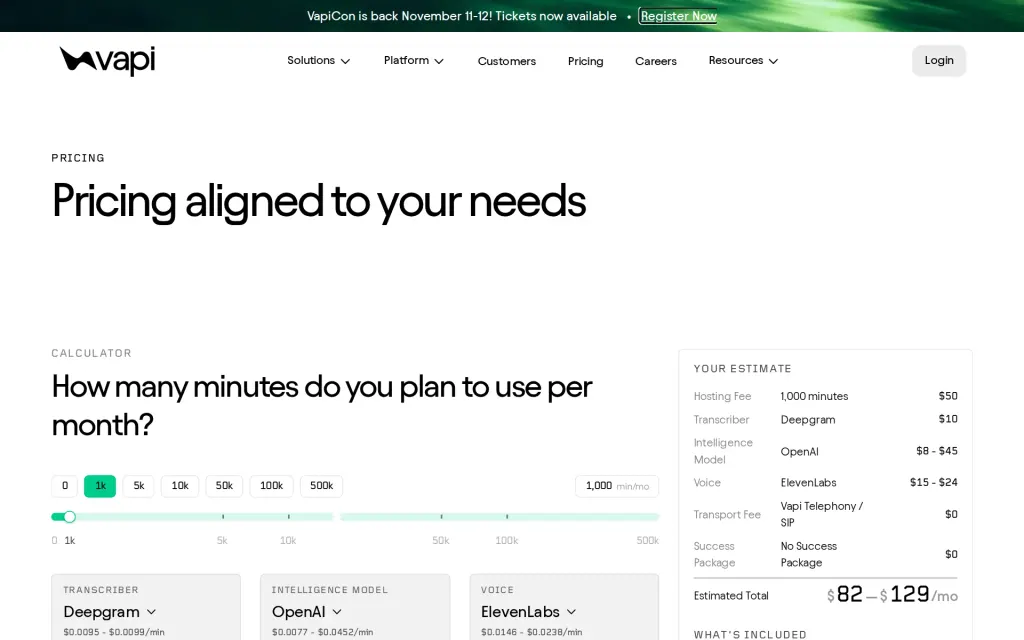
Pricing page, vapi.ai, captured 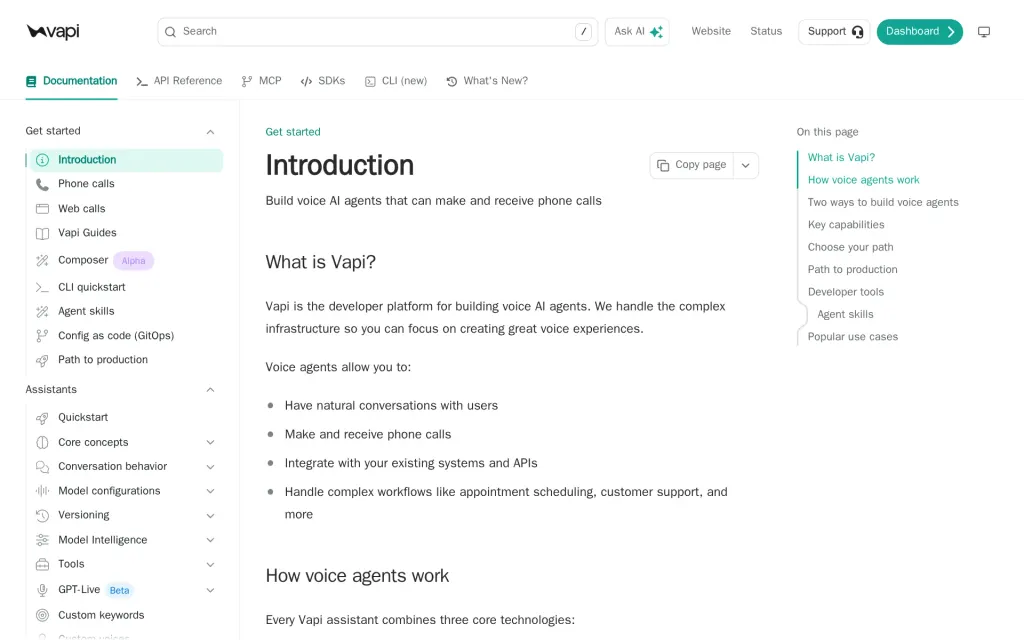
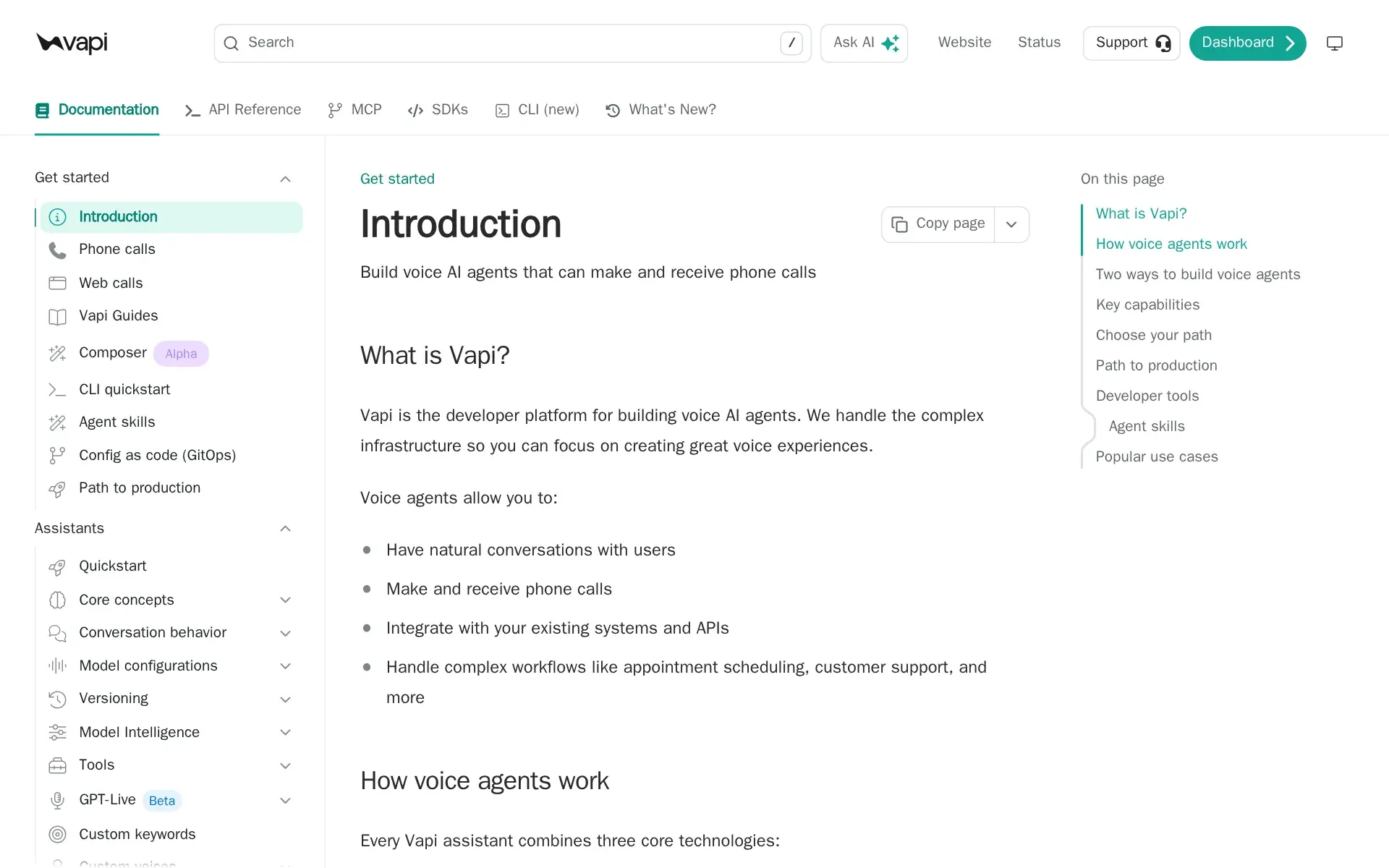
Docs, vapi.ai, captured
Filed under
Sources and updates
Last changed
Sources24
- vapi.ai/pricing
- vapi.ai/platform
- docs.vapi.ai/quickstart/introduction
- docs.vapi.ai/billing/purchase-call-concurrency
- docs.vapi.ai/cli
- docs.vapi.ai/faq
- docs.vapi.ai/security-and-privacy/data-flow
- docs.vapi.ai/security-and-privacy/sso
- vapi.ai/
- vapi.ai/
- docs.vapi.ai/assistants/examples/inbound-support
- docs.vapi.ai/billing/manage-billing-and-credits
- docs.vapi.ai/debugging
- docs.vapi.ai/enterprise/plans
- docs.vapi.ai/observability/evals-quickstart
- vapi.ai/privacy
- docs.vapi.ai/providers/model/anthropic
- docs.vapi.ai/providers/model/openai
- docs.vapi.ai/sdk/mcp-server
- docs.vapi.ai/security-and-privacy/api-keys
- docs.vapi.ai/security-and-privacy/GDPR
- docs.vapi.ai/tools/tool-rejection-plan
- github.com/VapiAI/cli
- github.com/VapiAI/cli/blob/main/LICENSE
Coverage elsewhere2
The Agents Index in AI answers0 of 1
- PerplexityDoes not cite The Agents IndexAsked
Vapi alternatives
on Other sources: ranktracker.com, g2.com, synthflow.ai, producthunt.com, elevenlabs.io, cloudtalk.io
Updates4
- Capabilities · Free tier · Terms
- Capabilities · Free tier · Price · Terms
- Alternatives · Crunchbase link · Documentation link · LinkedIn link · Repository · Summary
- Summary
Is this yours? Claim it free and edit it in your dashboard, or feature it in Voice agents.